




Abstract
Croes Council
Chairman
Jean de la Rosette, M.D.
Amsterdam (The Netherlands)
Adrian Joyce, M.S.
Leeds (UK)
Stavros Gravas, M.D.
Larissa (Greece)
Margaret Pearle, M.D.
Dallas, TX (USA)
Dean Assimos, M.D.
Wake Forest, NC (USA)
Ying-Hao Sun, M.D.
Shanghai (China)
Tadashi Matsuda, M.D.
Osaka (Japan)
Treasurer
John Denstedt, M.D.
London (Canada)
Executive Director
Sonja van Rees Vellinga
Amsterdam (The Netherlands)
Mission
Through worldwide collaboration, CROES seeks to assess, using evidence based scientific methodology, the various aspects of clinical endourology.
Vision
By applying rigorous scientific evaluation to the field of clinical endourology, CROES will enable all urologic surgeons to bring to their patients the most effective and efficient care possible.
Projects
• Global PCNL study
• Global URS study
• Global Greenlight Laser study
• Global Renal Mass study
• Global NBI study
Contact
For more information please contact Sonja van Rees Vellinga (
Global Ureteroscopy Study: An Inside Look at the Current Top Recruiters
Stavros Gravas and Jean de la Rosette
When the concept of the Clinical Research Office of the Endourological Society (CROES) was envisaged and introduced, we could only speculate and share with our colleagues our beliefs regarding the feasibility of global studies. At present, a global network of endocenters has been established and can serve as the basis for promotion of international clinical research and coordination of large-scale, multicenter clinical studies. This has been made possible only because of 350 centers and 720 investigators from all over the world. This is an exceptional number that demonstrates the acceptance of the CROES endeavor by the endourologic community.
Participating centers in the Global PCNL project were granted a certificate signed by the Chairman of CROES, the Secretary General, and the President of the Endourological Society for their valuable participation in the project and its altruistic contribution to clinical research in the field of endourology and emerging technologies. In addition, all the sites and the principal investigators have been acknowledged in a previous CROES Newsletter. 1 Into this frame, the CROES Council feels the need to further bring into light the centers that work hard and spearheaded the recruitment race in every ongoing study. For this reason, the top three centers from all projects were invited to present themselves and share with us their opinion and experience from CROES. This will give to the involved departments the exposure they deserve and to all of us the opportunity to know about the centers that represent the core of the CROES network.
Starting from the Global Ureteroscopy Study that was closed for initiating new sites in January 2011, Prof. P. Geavlete (“Saint John” Emergency Clinical Hospital, Bucharest, Romania), Prof. S.V. Kandasami (Vedanayagam Hospital and Postgraduate Institute, Tamilnadu, India), and Prof. M.H. Radfar (Hasheminejad Kidney Center, Tehran, Iran) will offer us an inside look at the current top recruiting centers.
Prof. P. Geavlete
“During the last decades, we witnessed an explosive development of endourologic techniques,with a large variety of pathologies benefiting today from these procedures. Ureteroscopy (URS) dramatically changed the surgical management of urolithiasis. Moreover, this method proved its great importance and applicability in the majority of cases in which modern treatment modalities are used.

Prof. P. Geavlete.
“The ‘Saint John’ Emergency Clinical Hospital, Department of Urology, Bucharest, chaired by Prof. Petrisor Geavlete, M.D., Ph.D., made great and continuous efforts to meet the modern standards of urologic treatment, materialized in a very complex variety of minimally invasive procedures, some of them performed as national premieres in Romania (photo 2). URS was first introduced more than 18 years ago, the indications and complexity of the procedures increasing ever since, together with our expertise. A result of these continuous efforts is represented by more than 7000 URS being performed, not only for urolithiasis but also for stenosis, benign and malignant (in selected cases) tumors, malformations, or pyelocaliceal diverticulum. This high volume of endourologic interventions translated into more than 1150 patients enrolled in the CROES URS Study during the last 6 months.

The staff of the Department of Urology at “Saint John” Emergency Clinical Hospital.
“With the accelerated technologic development, increasing expertise of many urologists and the spreading of this therapeutic modality, many characteristics of URS changed since the series published one or two decades ago. In our opinion, the CROES Study offers a unique opportunity to evaluate not only a huge number of cases, but also techniques performed in many centers, each of them with its own habits and procedural specifics. This perspective will provide a more accurate view of what URS actually represents today, which maneuvers are still mandatory and which are facultative, as well as what is the real associated morbidity in everyday practice. We strongly believe these data will prove priceless for all the urologists involved in the ureteroscopic approach to various pathologies.
“For our center, which is directly involved in the CROES Study, it is important to define our place in the international endourologic patterns, and, why not, to find ways to improve our daily practice. On the other hand, with a significant experience achieved during the last two decades, it is of the same importance to share our data with other urologists who may benefit from it while aiming to optimize their URS training. From all these points of view, we feel very proud to be among the three main contributors of such a prestigious project as the CROES URS Study.”
Prof. S.V. Kandasami
“Vedanayagam Hospital and Postgraduate Institute is a 30-year-old dedicated urology super specialty hospital in South India. From a modest 35-bed hospital in 1979, we have, over these years, doubled our capacity to 70 beds solely in the specialty of urology (photo 3). Very early on, the institution made endourology its forte, and it was credited as being one of the first institutions to develop these facilities in the country way back in 1986. The institution has also kept up pace with advances in the field of endourology. In 2001, we were accredited by the National Board of Examinations for the training of urology residents in a 3-year in-service program.

View of the Vedanayagam Hospital and Postgraduate Institute.
“We have four consultants and six residents (photo 4). The hospital has state-of-the-art equipment, including the video ureteroscope, 20- and 30-watt laser equipment, and a Dornier lithotripter. The hospital is also known for reconstructive urologic work. The institution regularly conducts workshops in percutaneous nephrolithotomy (PCNL), flexible URS, and reconstructive urology. It has a well-structured academic program headed by Dr. Ganesh Gopalakrishnan, former Professor and Head of the Department of Urology at the Christian Medical College in Vellore. The hospital has an annual outpatient caseload of approximately 12,000 and performs, on average, 10 URS and PCNL per day.
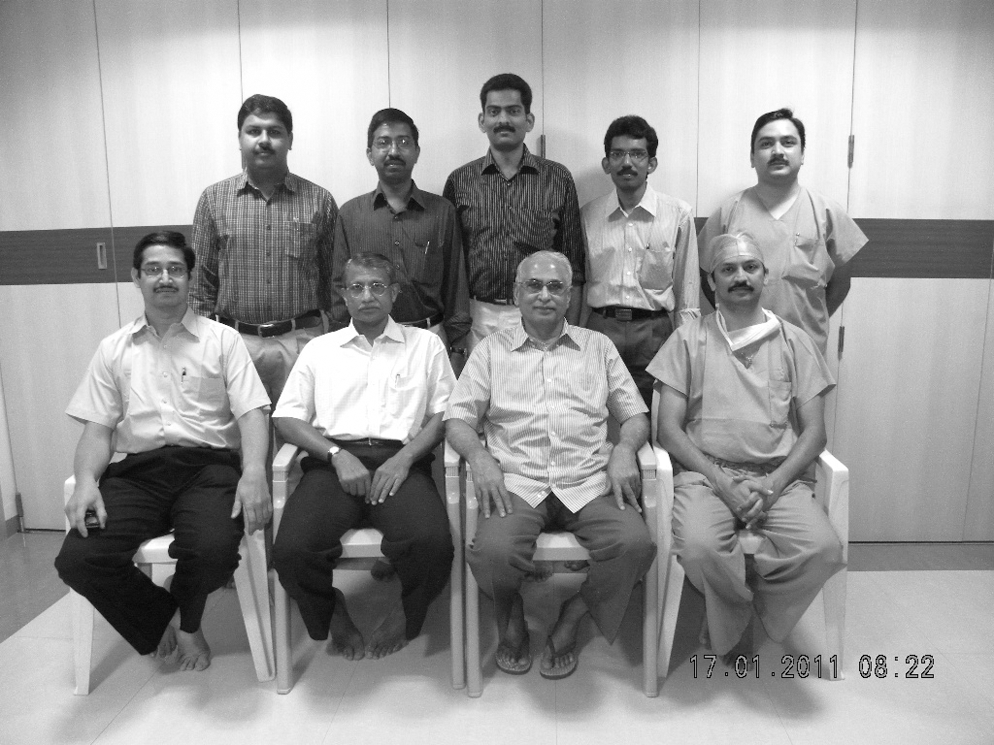
The Staff of the Vedanayagam Hospital.
“We were very excited about the CROES initiative and have been involved in recruitment of data for PCNL, URS, and partial nephrectomy. It is not surprising, considering our workload, that we were nominated as one of the leading participants among the CROES URS institutions. We believe that the CROES Study has a tremendous global impact. It showcases the quantum of work performed across the globe and also the differences in management perspectives pertaining to prevailing socioeconomic conditions. We hope the CROES Study will be able to formulate the best guideline policies based on the huge amount of data they are collecting and provide thrust for future development with special focus also on the developing world.”
Prof. M.H. Radfar
“Hasheminejad Kidney Center is a university hospital affiliated with Tehran University of Medical Sciences. Nephrology, radiology, cardiology, and four urology wards with various focuses are active in the center. Different urology fields, including endourology, kidney transplantation, pediatrics, uro-oncology, and female urology, are practiced by urologists of the center. The endourology ward is one of the most active wards of the hospital in which a high number of patients are admitted and treated using different modern modalities including extracorporeal shockwave lithotripsy, URS, and PCNL. Actually, our center admits the highest number of urolithiasis patients in Iran. Three to four urology residents, three endourology fellows, and one transplantation fellow start their course in the hospital each year. Clinical research activities of the hospital are centralized in Hasheminejad Clinical Research Development Center, which was established recently. Several research projects with urology, nephrology, anesthesia, and cardiology topics are performed by attending specialists of the center.
“We are proudly involved in two CROES projects: Renal Mass Study and URS Study. Considering the high incidence of urolithiasis in the current industrialized world, improving the available treatment options is of high priority. We think international studies can determine advantages and disadvantages of each therapeutic option and lead to better outcomes for the patients.”