




Abstract
Background and Purpose:
Flexible working angles and fine optical visualization are major requisite factors in performing laparoendoscopic single-site (LESS) urologic procedures. Multiple mechanical design approaches have been used to develop deflectable laparoscopes for LESS procedures. We compared the optical characteristics of three such devices using a bench top approach to simulate LESS in straight and deflected positions.
Materials and Methods:
A 10-mm fixed-rod rotating lens device (Storz EndoCameleon) and two 5-mm articulating devices (Olympus EndoEye and Stryker IdealEye) were compared using standard industry testing protocols for image resolution (United States Air Force-1951 test target), distortion (multifrequency grid distortion target), and color reproducibility (Gretag Macbeth color checker).
Results:
The 10-mm fixed-rod rotating lens system demonstrated the highest image resolution (5.04 line pairs/mm), but also the highest distortion (22.8%). Among the 5-mm flexible articulating laparoscopes, resolution was superior with the Olympus EndoEye (4.00 line pairs/mm) compared with the Stryker IdealEye (3.17 line pairs/mm). Distortion (7.0%) and color reproduction (1.18) were superior with the IdealEye vs the EndoEye (18.8 %, 1.27). Laparoscope deflection resulted in attenuation of resolution by 11% with both articulating models, but not with the fixed rod system.
Conclusions:
Definition of these optical characteristics may inform further development and selection of laparoscopic systems optimized for LESS surgery. A narrow but flexible camera can be crucial in the limited working space available during these procedures. Further investigation is warranted to determine if these objective findings translate into improved surgeon performance.
Introduction
A variety of deflectable laparoscopes with different mechanical design properties have recently been developed. One approach involves a traditional fixed-rod telescope that contains a rotating lens at the distal tip. An alternate design makes use of the “chip on the tip” model by placing an image processor at the distal tip of an articulating laparoscope. Therefore, minimally invasive surgeons are currently faced with multiple design options when selecting laparoscopes for LESS procedures.
We hypothesized that optical performance characteristics would vary among laparoscopes of different mechanical designs. Therefore, we performed an objective direct comparison of three deflectable laparoscopes using industry standard protocols of optical performance in a laboratory setting to simulate LESS in straight and deflected positions.
Materials and Methods
Three endoscope manufacturers were asked to provide their latest-generation deflectable laparoscopes for LESS urologic applications. One fixed-rod telescope with a rotating lens mechanism was assessed (Karl Storz EndoCameleon,® Tuttlingen, Germany). With this 10-mm telescope, the lens rotates only in the downward direction and is adjusted by a rotary handle located at the proximal end (Fig. 1). This system is compatible with standard high definition (HD) camera heads and light source connectors. In addition, two articulating laparoscopes were assessed: The EndoEye™ Flex 5 LTF Type VP-S (Olympus, Center Valley, PA), and the IdealEye™ (Stryker, San Jose, CA) (Fig. 1). Both models are 5-mm HD laparoscopes with a charge coupled device (CCD) chip located at the distal tip. The distal segments of both models fully articulate in both the up-down and left-right axes and are controlled by levers located near the hand piece. Both models use auto-focus, and contain an integrated single-cord camera and light source attachment. The EndoEye is designed to be used with a dedicated video tower and light source (Olympus, Visera Elite).
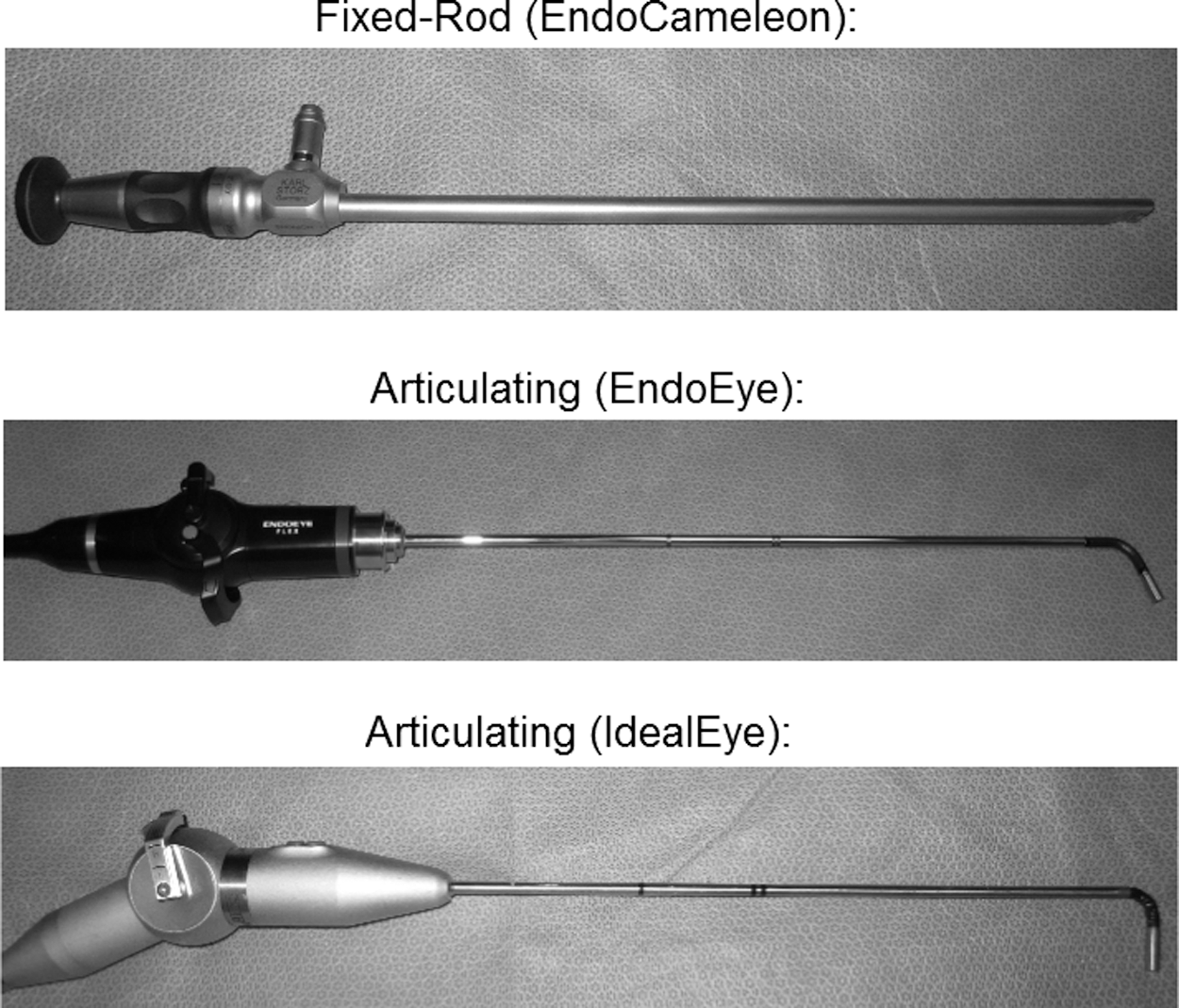
Deflectable laparoscopes for laparoendoscopic single-site urologic procedures include a fixed-rod rotating lens design (Karl Storz EndoCameleon) and articulating designs (Olympus EndoEye and Stryker IdealEye).
To serve as a control for comparison measurements, a standard (nondeflectable) 0-degree 5-mm Storz telescope with 1288 HD Stryker camera was also included. This system was selected for control measurements based on the standard optics and narrow width, which makes this design an alternative to deflectable telescopes for LESS applications.
Optical assessment of resolution, distortion, and color reproducibility were performed using standard industry-accepted techniques, as previously described by our laboratory. 7,8 For each laparoscope, a single image measurement was obtained in the straight and maximally deflected position, using test targets at a fixed distance of 55 mm. Each test was performed by two persons, and agreement was reached for optimization of image quality, including focus. Resolution was determined by imaging a United States Air Force-1951 test target, in which a number of line pairs per millimeter in the captured image is determined using a standard reference chart. Distortion was determined by imaging a multifrequency grid distortion target. For each image, dot-pair distance was measured at four peripheral locations, and average distortion was calculated using the difference between the observed and actual dot-pair distance: Distortion (%)=(observed distance – actual distance)/actual distance×100. Color reproduction was determined by imaging a Gretag Macbeth Color Checker Target, and ratio of observed to actual red, green, and blue (RGB) values was calculated for red, yellow, and blue hues using a standard reference chart, such that 1.00 represents perfect color reproduction.
Angle of deflection was measured for the articulating laparoscopes by locking each device in its position of maximum downward deflection and measuring the angle between the body and tip of the scope using AutoCAD software (Autodesk Inc, San Rafael, CA). All images were displayed onto HD monitors using S-video connection. The dedicated Olympus Visera Elite CLV-S190 monitor was used for the EndoEye, and the Stryker Vision Elect monitor was used for the EndoCameleon, IdealEye, and 5-mm control lens.
Results
Optical performance varied among the laparoscopes. For image resolution (Fig. 2), the 10-mm fixed-rod rotating lens model was superior (5.04 line pairs/mm). Image resolution with this model was equivalent to the 5-mm nondeflectable control (Table 1). Among the articulating 5-mm instruments, the EndoEye demonstrated superior resolution (4.00 line pairs/mm), compared to the IdealEye (3.17 line pairs/mm). Deflection of the laparoscope resulted in attenuated image resolution for both the EndoEye (3.56 line pairs/mm) and IdealEye (2.83 line pairs/mm). In both models, this effect was of a similar magnitude (11%) reduction of image resolution compared with images captured in the straight position. In contrast, image resolution remained constant for the fixed-rod system in the straight and deflected lens position (5.04 line pairs/mm).

Resolution of deflectable laparoscopes. The United States Air Force test target for resolution was imaged at a fixed distance of 55 mm using a fixed-rod and two articulating laparoscopes, in the straight and maximally deflected position. A standard nondeflectable control was included for comparison measurements.
For image distortion (Fig. 3), the 5-mm articulating IdealEye was superior (7%). Image distortion with this model was equivalent to the nondeflectable control (7%). The articulating EndoEye demonstrated 19% distortion. Notably, the fixed-rod instrument demonstrated the highest level of image distortion (23%) among all models tested (Table 1). Color reproduction (Fig. 4) was superior with the fixed-rod model (0.96). Color reproduction with this device was comparable to the nondeflectable control (1.01), and approached perfect color reproduction ratio (1.00). Among the articulating devices, the IdealEye demonstrated superior color reproduction ratio (1.18) as compared with the EndoEye (1.27). Maximum angle of downward deflection for the articulating laparoscopes was slightly wider with the IdealEye (78 degrees) compared with the EndoEye (70 degrees). Angle of lens rotation in the fixed-rod system was not assessed. As compared with resolution, distortion or color reproduction did not appear to significantly change with deflection (Table 1).
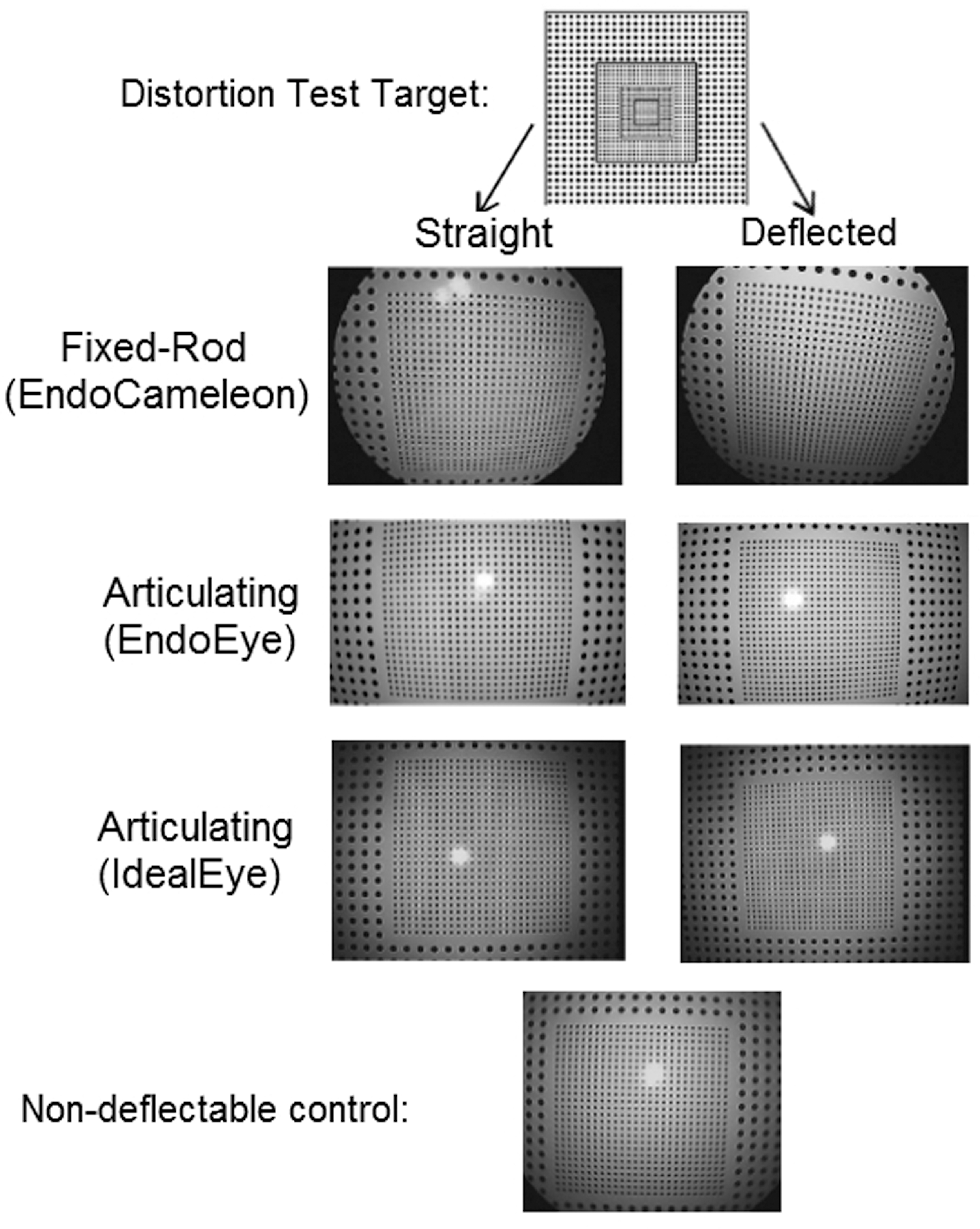
Distortion of deflectable laparoscopes. The multifrequency grid distortion test target was imaged at a fixed distance of 55 mm using a fixed-rod and two articulating laparoscopes, in the straight and maximally deflected position. A standard nondeflectable control was included for comparison measurements.
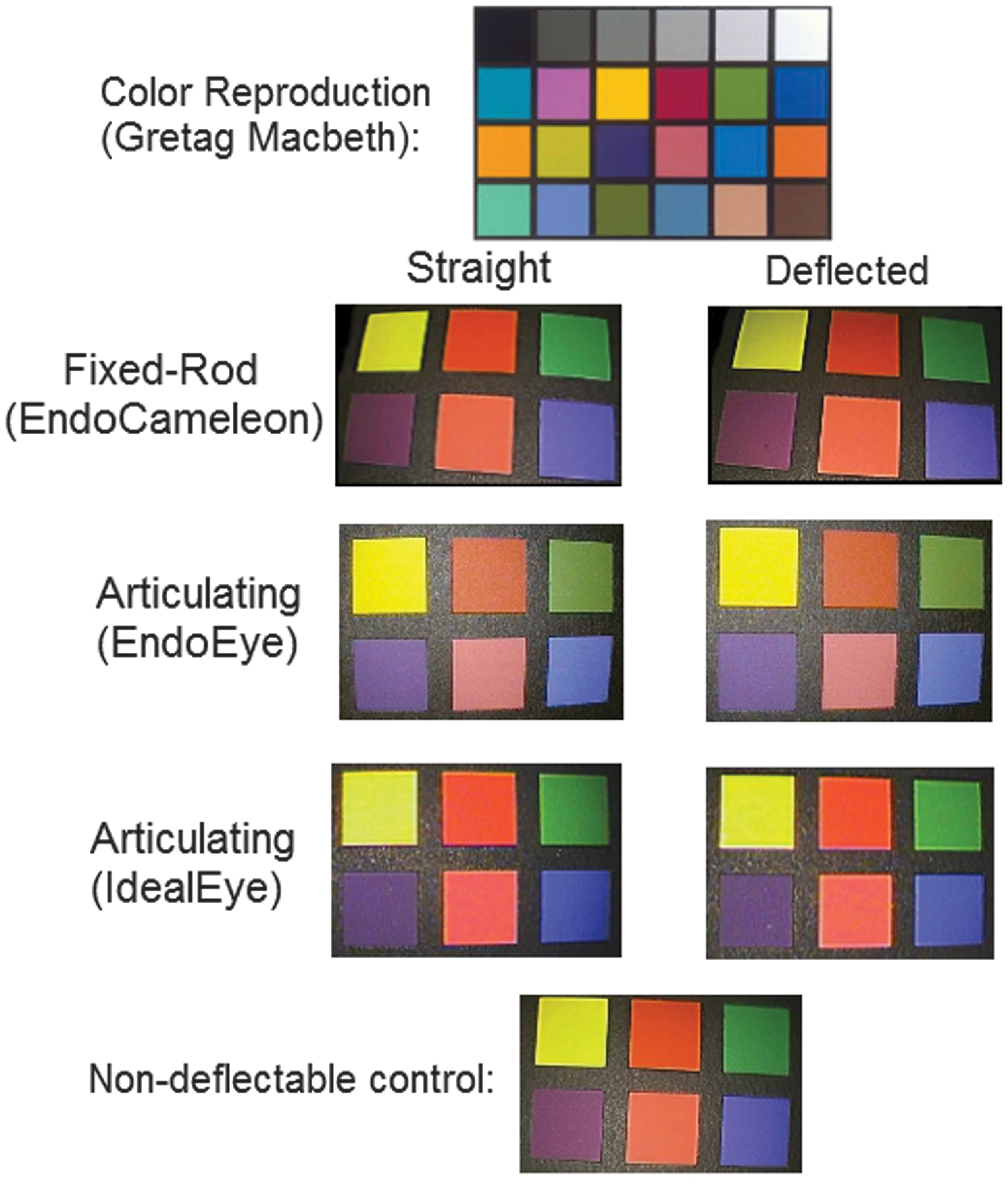
Color reproduction of deflectable laparoscopes. The Gretag Macbeth color checker target was imaged at a fixed distance of 55 mm using a fixed-rod and two articulating laparoscopes, in the straight and maximally deflected position. A standard nondeflectable control was included for comparison measurements.
Discussion
LESS surgery has been applied to multiple urologic procedures, including radical nephrectomy, 2,3 adrenalectomy, 4 renal cryoablation, 5 and abdominal sacrocolpopexy. 6 Progress in this field is dependent on advances in laparoscopic technology, including multichannel access ports, articulating instruments, and most recently, deflectable laparoscopes. 1 Decreased maneuverability (ie, clashing instruments) and limited working angles have been identified as challenges to performing LESS procedures. In this context, the development of deflectable laparoscopes—with either rotating lens mechanisms or articulating distal segments (Fig. 1)—represents a major advancement in this field. We have presented, for the first time, a systematic comparison of the optical performance characteristics of three competing deflectable laparoscopes with these different design features.
It has been demonstrated that laparoscopic performance deteriorates as the angle of vision deviates from the horizontal plane. 9 Standard laparoscopy relies on port position to place the camera trocar between the two working instruments to simulate this intuitive 0 degree angle of vision. Using bench top simulators of standard multiport laparoscopic tasks, it has been demonstrated that flexible laparoscopes were not associated with decreased operative times or improved operative precision compared with rigid models. 10 In single-site surgery, however, a flexible camera tip allows the assistant to maneuver his or her hands below the operating surgeon's working planes, while maintaining an ideal image plane with the surgical instruments. This is a major operative advantage, because it gives the surgeon greater working space on the outside of the body and provides a standard, accepted field of view.
In addition to these mechanical properties, such laparoscopes must possess optical characteristics required for optimal visualization of the surgical field. Resolution is defined as the minimum distance at which two lines can be to each other and still be visibly identified as two separate lines. 7 It is thought that with increased resolution, there is improved three-dimensional appreciation of the surgical field, easier identification of structures, and thus increased efficiency and efficacy of task performance. 11 High resolution was a particular strength of the fixed-rod rotating lens model. It should be noted, however, that overall quality of images captured with this system were subjectively deemed to be inferior by all investigators (Fig. 2), likely as a function of the high degree of image distortion (Fig. 3). Among the two articulating models, the Olympus EndoEye demonstrated superior resolution (Fig. 2 and Table 1). This is consistent with the differences in HD video signal reported by the endoscope manufacturers for the EndoEye (1080i) and the IdeaEye (720p).
One novel observation of the present study was that deflection resulted in attenuation of resolution with both articulating models, but not with the fixed-rod system. Because both models contain a CCD image-processing chip at the distal tip of the device, and distance to the test targets remained fixed in the straight and deflected positions, we hypothesize that this phenomenon may be related to decreased luminescence transmission in the deflected position. Light intensity was not directly measured in the present study.
Distortion is a measure of accuracy of representation on the monitor, defined as the degree to which the straight lines of an object remain straight in the monitor image (referred to as deviation from rectilinear projection). 7 It is thought that with decreased distortion, there is improved spatial orientation and hence decreased potential for injury to adjacent organs. The articulating Stryker IdealEye demonstrated minimal distortion (7%) compared with the articulating EndoEye, the fixed-rod EndoCameleon, and even approached the performance of the standard (nondeflectable) 5-mm Storz laparoscope control (Fig. 3 and Table 1). Distortion in digital systems is dependent primarily on mathematical manipulation of image data via software systems. 12 In this context, the Stryker IdealEye system was superior.
Digital color reproduction requires capturing the image as RGB components and subsequently reproducing each component in a recombined metameric color match. 7 Given that surgical planes of dissection often lie within fairly homogenous tissues with similar color hues, it is thought that increased color reproduction improves identification of structures and task performance. 13 The fixed-rod Storz EndoCameleon demonstrated superior color reproduction, with a correlation coefficient approaching 1.0 (Fig. 4). Among the articulating laparoscopes, the Stryker IdealEye demonstrated a slightly superior color reproduction ratio (1.18) vs the Olympus EndoEye (1.27).
Although not directly assessed in the present study, we noted some ergonomic and practical differences among these laparoscope models. Both the Olympus EndoEye and Stryker IdealEye 5-mm articulating models have similar all-in-one design, with an integrated single-cord camera and light source attachment. Both laparoscopes articulate in both the up-down and left-right axes, which is controlled by levers located near the proximal hand piece. These design features result in a smooth ergonomic interface, which can be maneuvered with one hand, although manipulation is optimized with a two-hand technique.
In contrast, lens rotation in the fixed-rod Storz Endocameleon system occurs only in the downward direction, and is controlled by a rotary device located at the proximal end of the laparoscope. This system requires two-hand operation to rotate the lens while stabilizing the laparoscope. One advantage to this device, however, is compatibility with standard camera heads and light sources, thus allowing easy integration with existing operative infrastructure.
Taken together, the articulating EndoEye (Olympus) scored best overall for optical image quality and subjective ease of use, because of the following factors: Highest optical resolution among the 5-mm articulating designs, the comfortable hand piece that interfaced smoothly with the lever controls, and convenient integrated single-cord camera and light source attachment.
We have performed for the first time a systematic comparison of the optical characteristics of three competing deflectable laparoscopes with different mechanical design properties. This study has the limitations inherent to all single-institution, initial experience reports with new technology. We have chosen to assess objective optical parameters, however, which may be referenced when selecting laparoscopes for minimally invasive applications. The overall quality in digital endoscopic imaging is known to be dependent on a number of components, including display monitor, light source, and connection cables. The components used in this optical assessment included only factory-recommended systems, thus reproducing a valid end-user experience for minimally invasive surgeons. In addition, because no skill simulation assessments were performed, further investigation is warranted to determine if these objective findings translate into improved surgeon performance.
Conclusions
This study presents, for the first time, a direct comparison of optical performance characteristics of three commercially available, novel deflectable laparoscopes. Characteristics such as resolution, distortion, and color reproduction vary among the fixed-rod rotating lens and the articulating design systems. Excellent optical performance (particularly for distortion and color reproduction) can be achieved with 5-mm articulating laparoscopes, which appear to contain ergonomic advantages over the fixed-rod rotating lens system. Image resolution was superior with the 10-mm fixed-rod laparoscope, but surgeons must weigh this against the increased size of the instrument, which can be especially significant in a small incision LESS setting. When selecting laparoscopic equipment, urologists should be aware of optical performance characteristics, in addition to the mechanical properties required for minimally invasive applications. Further investigation is warranted to determine if these objective findings translate into improved surgeon performance.
Footnotes
Acknowledgments
We thank Olympus, Stryker, and Storz for providing study material for this work. Dr. Andreas Neisius provided a critical reading of this manuscript.
Disclosure Statement
Dr. Lipkin is a consultant for Boston Scientific; Dr. Ferrandino is a consultant for Intuitive Surgical. For the remaining authors, no competing financial interests exist.