




Abstract
Objective:
The PolyScope
Methods:
Optical properties evaluated were resolution, distortion, and light transmission. Two different optical fibers were tested, one for each sterilization method. Measurements on each fiber were obtained at baseline and were repeated after each set of 10 sterilization cycles for a total of 100 cycles. To measure resolution, the 1951 USAF Contrast Resolution Chart Target was used to subjectively identify the clearest image on the grid by two different operators. To measure distortion, three images of the distortion grid target were captured with a digital camera and analyzed within Image Pro Plus Software. Light transmission was measured using a digital light meter at 50% and 100% transmission.
Results:
There was no significant difference in resolution after 100 sterilization cycles between either Steris or Sterrad NX. Distortion changed by 8.7% and 11.2% for Steris and Sterrad NX, respectively. For Steris at 100% light transmission, baseline was 59 foot-candles and this increased to 85 foot-candles after 100 cycles. For Sterrad NX at 100% light transmission, baseline was 50 foot-candles and this increased to 92 foot-candles after 100 cycles. Results were similar at 50%. There was no significant difference between groups at 50%, 100%, or between sterilization modalities.
Conclusion:
The PolyScope fiber optic bundle appears durable after 100 cycles of sterilization with either Steris or Sterrad NX.
Introduction
The PolyScope® (Lumenis, Santa Clara, CA) is a U.S. Food and Drug Administration–approved flexible unidirectional ureteroscope that combines a disposable, single-use outer catheter with a reusable 10,000 pixel optical fiber. The fiber optic bundle has a sealed fiber optical channel with a ≥180° bend radius that operates in a single direction and utilizes a 1.2-mm working and irrigation channel (Fig. 1). Currently, neither the U.S. Food and Drug Administration labeling nor the manufacturer sterilization specifications necessitate sterilization of the reusable fiber optic bundle prior to its use. However, there are practical concerns of the outer catheter becoming compromised, such as a perforation developing during laser lithotripsy. This would lead to the fiber optic bundle becoming exposed directly to the patient. If it were not properly sterilized, then it could become a source of contamination and possible infection.
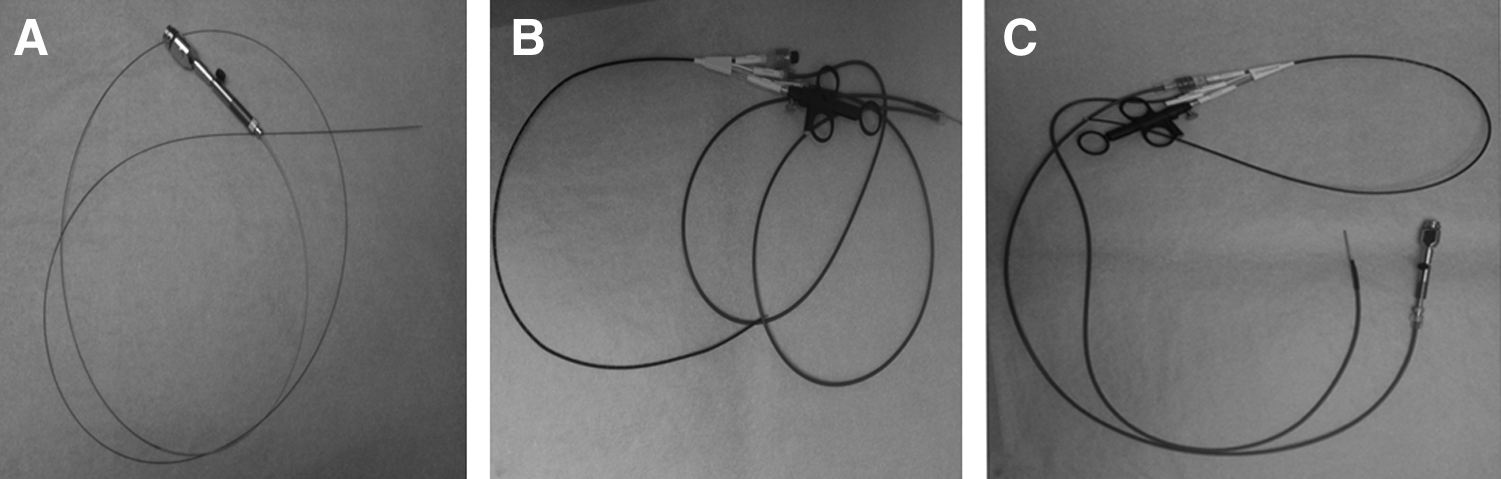
Display parts of PolyScope
It has been previously shown that sterilization with Steris can deleteriously affect the optical properties of flexible ureteroscopes.
4
Our aim was to test the durability of the reusable PolyScope optical fiber by assessing the optical properties during a total of 100 sterilization cycles with the Steris System 1
Materials and Methods
Two fiber optic bundles that were designed to be used with the PolyScope were reprocessed with the Steris System 1 or Sterrad NX, respectively. The PolyScope consists of both a reusable optical fiber and a disposable outer catheter. Baseline measurements using the PolyScope were made prior to processing of the optical fiber with either Steris System 1 or Sterrad NX and repeated on the same optical fiber after every 10 cycles until a total of 100 cycles were completed. Resolution, distortion, and light transmission were tested using each fiber optic bundle before and after sterilization with Steris System 1 or Sterrad NX, respectively.
The PolyScope #1 reusable fiber optic was sterilized using the Steris System 1. This was achieved utilizing a mechanical processor that continuously irrigated the fiber optic through the lumen of the protective outer sheath with peracetic acid for 25 minutes. The average total cycle time is 35 minutes, of which 12 minutes is exposure to the antimicrobial agent Steris 20 (0.2% peracetic acid) at 51°C. During the sterilization phase, the temperature was maintained between 53°C and 55°C. This active ingredient was mixed with buffering and anticorrosive agents to protect the fiber optic. After exposure to this agent, the fiber optic was rinsed mechanically four times with sterile water.
The PolyScope #2 reusable fiber optic was sterilized using the Sterrad NX mechanical processor, a system that utilizes low-temperature hydrogen peroxide gas. In addition to the sterilization properties of the hydrogen peroxide, an electromagnetic field is created in which the hydrogen peroxide vapor breaks apart, producing a low-temperature plasma cloud that contains ultraviolet light and free radicals that contribute to the sterilization process. The average total cycle time was 40 minutes. The cycle runs at a temperature range of 18°C–35°C.
Resolution was defined as the ability to distinguish object detail. Contrast was defined as the degree of tonal separation or gradation in the range from black to white. To test these parameters, the 1951 USAF Contrast Resolution Chart Target (Edmund Industrial Optics™, Stock Number NT36_275) was used. This commonly used chart target measures resolution in terms of line pairs per millimeter and contains a repeating series of parallel bars decreasing sequentially in size. These parallel bars are separated into group and element numbers. System resolution was defined as the highest group and element at which there were three distinct bars. The ureteroscope was held on top of the resolution slide, and a light was shined through the other end. The ureteroscope was brought closer to the test target until the clearest and best-resolution image was available. The results of two individuals were recorded.
Distortion was defined as the optical error in the lens that causes a difference in object magnification at different points in the image. This was measured using an industry standard Distortion Grid Target (Edmund Industrial Optics, Stock Number NT46-250) and was calculated per test target manufacturer instructions as a percentage. The ureteroscope was placed 3.0 mm away from the distortion grid and the image displayed on the flat screen monitor was photographed with a digital camera. All initial and subsequent postcycle pictures were taken during the same session. Images were measured digitally using Image Pro Plus PC Software (MediaCybernetics, Bethesda, MD). To obtain consistent measurements of distortion and resolution, all ureteroscopes were tested using the same digital camera and flat screen monitor settings under the same experiment and room conditions. A digital camera was placed on a tripod, and pictures were taken of the image that appeared on the screen.
Light transmission was tested using the manufacturer's specific light source and light cables. A digital light meter (Mastech Digital 4-range 200,000 Lux Luxmeter, LX1330B) was used to record light transmission at 50% and 100% light intensity. A baseline level of illumination in the dark room where the experiments were done was read and accounted for before each measurement. To reduce background light, the scope tip was placed in direct contact on the light meter and the measurements were performed in the same dark room under the same conditions.
Results
Resolution was tested by two independent observers, with good concordance between both operators as confirmed by Lin's concordance test with a concordance correlation coefficient (ρc)=0.92. Figure 2 graphically illustrates the mean observed resolution values with increasing cycles. There was no significant decrease in resolution after 100 sterilization cycles between Steris System 1 and Sterrad NX (p=1.0).
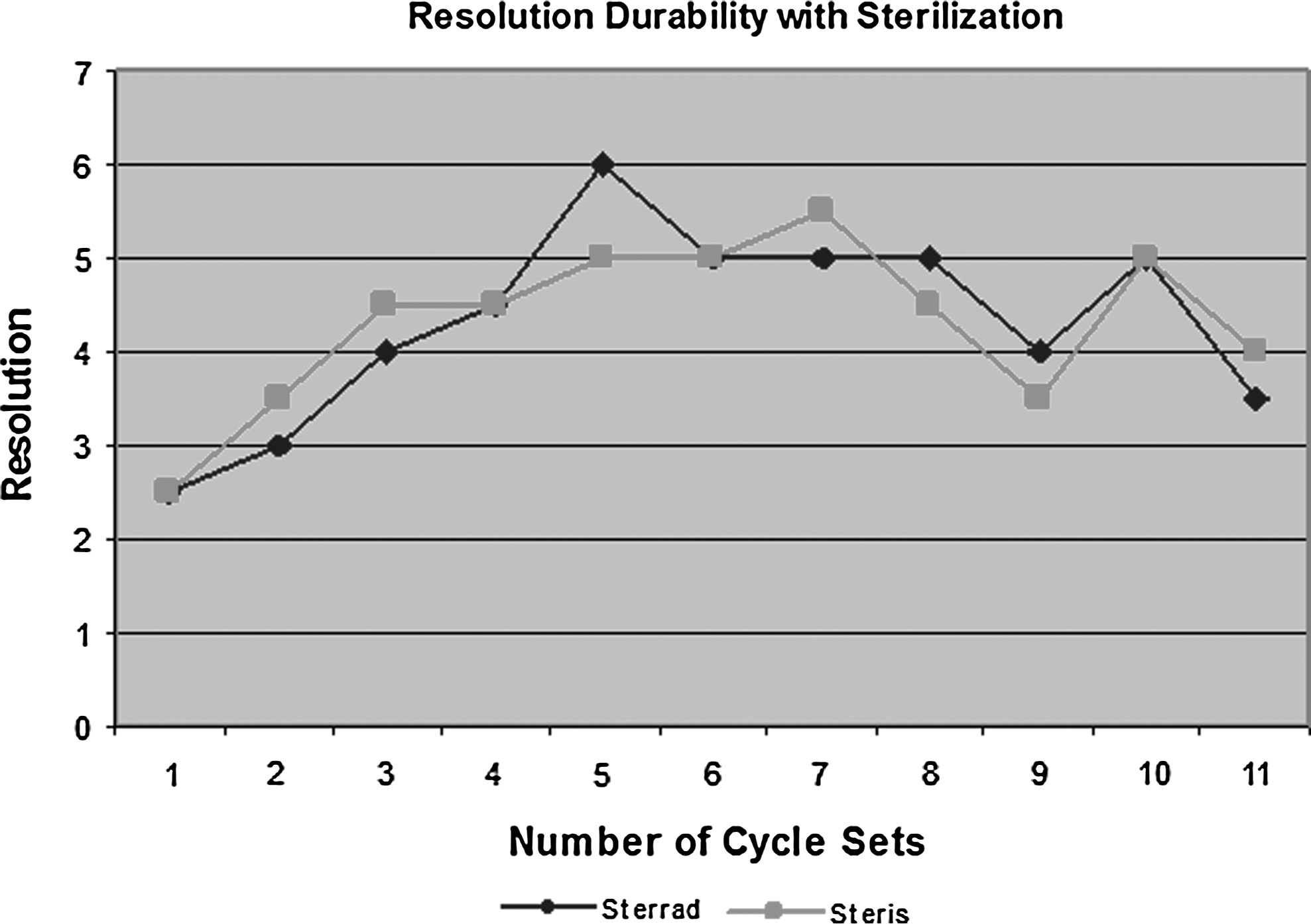
Graphically represents the mean durability of resolution presterilization and then per 10 cycles of sterilization with both Steris System 1
There was a change in distortion of 8.7% after 100 cycles of Steris System 1 and 11.2% with Sterrad NX, which was not statistically significant (p=0.16). Figure 3 depicts the change in distortion per 10 cycles of each sterilant.
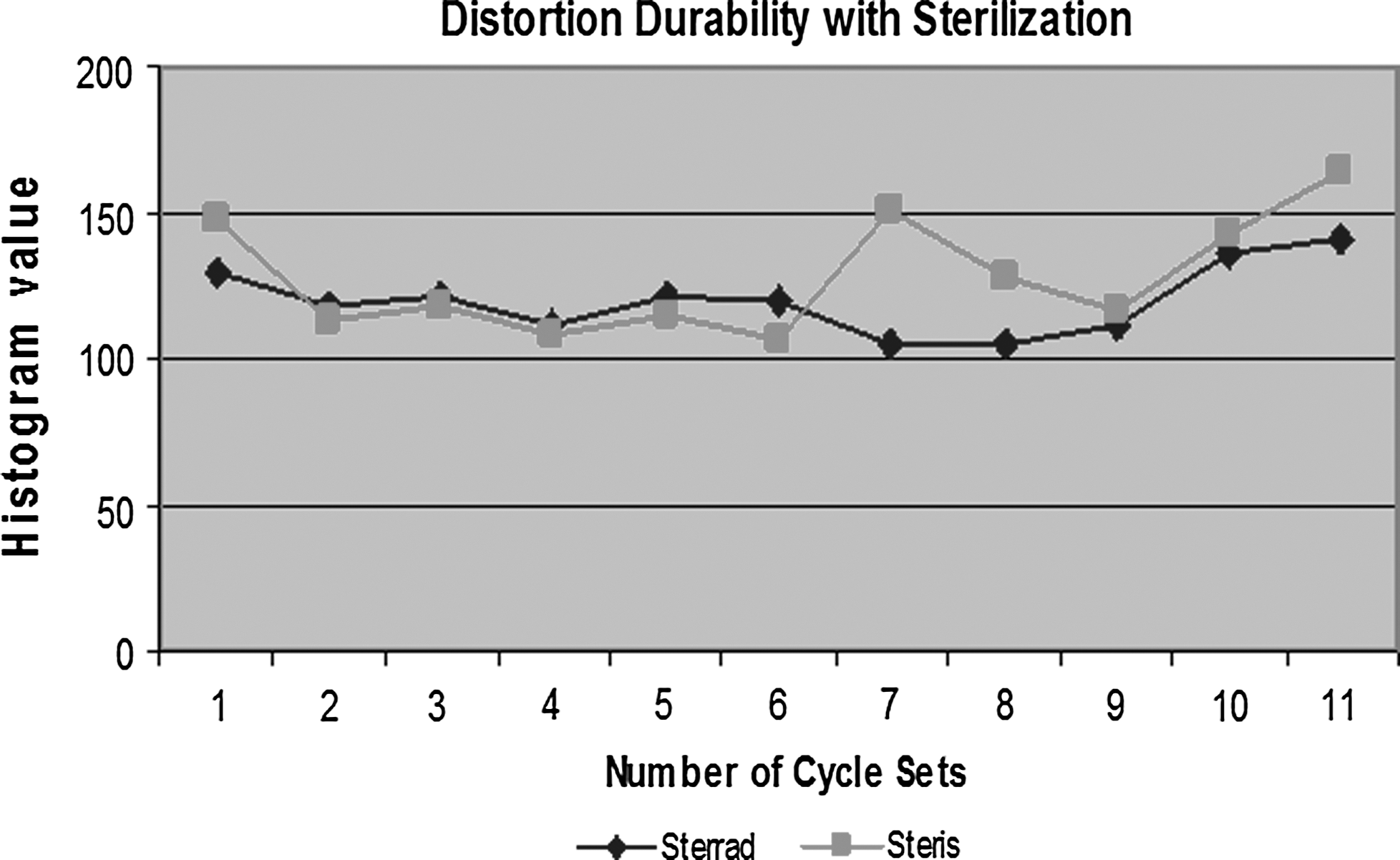
Graphically represents the effect of sterilization on distortion presterilization and then per 10 cycles of sterilization with both Steris System 1 and Sterrad NX.
For Steris System 1 at 100% light transmission, baseline was 59 foot-candles and this increased to 85 foot-candles after 100 cycles. For Sterrad NX at 100% light transmission, baseline was 50 foot-candles and this increased to 92 foot-candles after 100 cycles; results were similar at 50%. There was no significant difference between the sterilization modalities at 50% or 100% light transmission, respectively (p=0.30, p=0.30). Further, there was no significant difference between Steris at 50% versus 100% or Sterrad NX at 50% versus 100%, respectively (p=0.58, p=0.34).
Although there was no deterioration of the optical properties tested after 100 sterilization cycles, the optical gaskets were damaged in both fibers as can be seen in Figure 4. The Sterrad NX–processed fiber optic rubber gasket first displayed visible damage after 90 cycles while the damage to the Steris System 1–processed fiber optic rubber gasket was visible after 100 cycles.

Displays the PolyScope reusable optical fiber damage. Sterrad NX–sterilized fiber (right) showed damage after 90 cycles while Steris System 1 damage occurred after 100 cycles (left).
Discussion
The PolyScope is the first flexible ureteroscope to combine a reusable optical fiber with a disposable outer catheter. This aims to decrease the overall cost of ureteroscopy by eliminating repair costs. However, it is imperative that any novel technology be able to function in an expected and safe manner. Bader et al investigated the characteristics of the PolyScope in 32 patients to treat renal stones.
5
They reported that no damage to the fiber occurred and that the optical system had an average on/off axis of 0.013 and 0.02 LP/mm, respectively. They could identify an object of 0.125 mm at a distance of 2–4 mm. Overall stone-free rate was 87.5%. They reported four urinary tract infections in 32 patients. In addition, Bansal et al treated 22 patients, 6 for hematuria and 16 for stones with Dormia basket retrieval of stones <1 cm.
6
They used three PolyScope outer catheters to complete all the procedures, which implies that the disposable catheters can be sterilized and reused, that is, not simply for single use. Consistent with manufacturer and U.S. Food and Drug Administration guidelines, they suggested that there is no need to sterilize the reusable optical fiber and simply rinsed the optic dispenser containing the optical cable with plain water. However, given the possibility of breaking the sterile field and subsequent risks to the patient, we would not advocate this approach. This becomes even more imperative if the PolyScope outer catheters are utilized for multiple uses instead of for single use. In an effort to reduce the risk of patient contamination, we recommend that the fiber optic bundle of the PolyScope be sterilized between uses. Recently, the FDA issued a warning regarding the use of Steris System 1 and its use as an adequate sterilization method (
Importantly, sterilization has previously been shown to cause scope damage. Abraham et al 4 performed a similar study using flexible ureteroscopes testing the optical durability following 100 cycles of Steris System 1 and Cidex Ortho-Phthaldehyde High-level disinfection and found that the flexible ureteroscope became unusable after 100 Steris System 1 cycles; however, there was minimal damage in the scope treated with Cidex. 4 In our study, while the optical properties were maintained after sterilization, we noticed damage to the rubber gaskets after 90 and 100 cycles of Sterrad NX and Steris System 1, respectively. What effect this has on the long-term reusability of the optical fiber is not known. While Abraham et al noted occurrence of visible damage to ureteroscope shaft and marked deterioration of the optical properties of the flexible ureteroscopes after sterilization with Steris System 1, 4 we did not see a similar decline, although we did notice damage to the rubber gaskets on both fiber optics. The difference between the durability of the optical properties between the two studies may in part be due to the fact that they put their scopes into maximal deflection prior to each measurement. It may be possible that additional damage to the fiber optic bundles occurred with the mechanical deflection. As we did not use scope deflection in our experimental model, our study may accurately reflect the actual effect of sterilization itself on the optical properties with the limitation of not being representative of the scope use in the in vivo setting. Further, with the breakdown of the rubber gasket seal occurred with both sterilization systems used in our study, if a sterilant fluid or vapors were able to accumulate inside the fiber optic, this may compromise image quality and durability. Although we did not see this decrease in the optical properties of the PolyScope, we believe this may be related that we only noted a compromise of the rubber gaskets at the end of our study. Running the fiber optic bundles through additional sterilization cycles may be needed to determine whether the deterioration in the rubber gasket seal adversely affects image quality.
Unexpectedly we noted an improvement in the light transmission over time. It is unclear what led to this increase but this should not impair function of the ureteroscope. While others have investigated light transmission, these studies have not tracked the changes in light transmission over time. Bader et al found that the PolyScope had a light transmission output of 27 mW. However, this was a single measurement and they did not comment on whether this value changed with use. 5 Similarly, Abdelshehid et al reported on the maximal light transmission of five different flexible nondisposable ureteroscopes, but did not test whether there were any changes in light transmission over time. 7 In addition, we noted a rise in the resolution during the middle of the study that may be related to subjective nature of this measurement and observer effect. Limitations of our study is that the measurements were all in the ex vivo setting. Further, the extent that in vivo usage of the scope coupled with repeat sterilization is not known, nor was this study designed to answer this question. The durability of the scope in the in vivo setting after sterilization also was not able to be tested given the study design and it is not known whether repeat sterilization of the reusable fiber optic affects the flexibility or practical usage of the PolyScope outer catheter in the in vivo or ex vivo setting as neither was tested. However, the study design provides an important baseline to initially assess the optical properties of this new technology. Further study is warranted to determine clinical efficacy and cost effectiveness of PolyScope versus existing reusable fiber optic scopes.
With the continued trend toward single-use products in endourology, it is imperative that devices meet or exceed the standards established by existing reusable products.
Conclusion
In the ex vivo setting, the optical properties of the reusable fiber optic bundle of the PolyScope flexible ureteroscope were maintained after 100 sterilization cycles with either Steris System 1 or Sterrad NX.
Footnotes
Disclosure Statement
Dr. Bodo Knudsen: Consultant—Boston Scientific Hands-on course instructor, Storz and Cook; Dr. Matthew Johnson: Lumenis Educational Grant; and Dr. Tariq A. Khemees: not applicable.