




Abstract

Croes Council
Chairman
Jean de la Rosette, M.D.
Amsterdam (The Netherlands)
Adrian Joyce, M.S.
Leeds (UK)
Stavros Gravas, M.D.
Larissa (Greece)
Margaret Pearle, M.D.
Dallas, TX (USA)
Dean Assimos, M.D.
Wake Forest, NC (USA)
Ying-Hao Sun, M.D.
Shanghai (China)
Tadashi Matsuda, M.D.
Osaka (Japan)
Treasurer
John Denstedt, M.D.
London (Canada)
Executive Director
Sonja van Rees Vellinga
Amsterdam (The Netherlands)
Mission
Through worldwide collaboration, CROES seeks to assess, using evidence based scientific methodology, the various aspects of clinical endourology.
Vision
By applying rigorous scientific evaluation to the field of clinical endourology, CROES will enable all urologic surgeons to bring to their patients the most effective and efficient care possible.
Projects
• Global PCNL study
• Global URS study
• Global GreenLight Laser study
• Global Renal Mass study
• Global NBI study
Contact
For more information please contact Sonja van Rees Vellinga (
Croes Global PCNL Project: Completing the Puzzle of Quality
Jean de la Rosette, Sonja van Rees Vellinga, and Stavros Gravas
In the era of evidence-based endourology, it has been universally recognized that there is still plenty of room to further improve the quality of our research. It has been underlined that the quality of our scientific work may be regarded as an audit of our clinical work and consequently reflects our scientific integrity. The initiative of the Endourological Society to establish the Clinical Research Office of the Endourological Society (CROES) is a good step in the right direction. In line with this, CROES has become the premier platform for global endourologic research. 1 As such, CROES promotes and supports international research in endourology, provides the necessary infrastructure to support and conduct high quality studies, and can serve as a platform for technologic developments in partnership with industry.
Research quality represents a puzzle that challenges our scientific and organizational skills. In a basic puzzle, one is intended to put together pieces in a logical way to come up with the desired solution. Solutions to puzzles may necessitate recognizing patterns and creating a particular order.
The Four Pieces of Quality Puzzle and the right assembly order
The Four Pieces of Quality Puzzle and how to solve it.
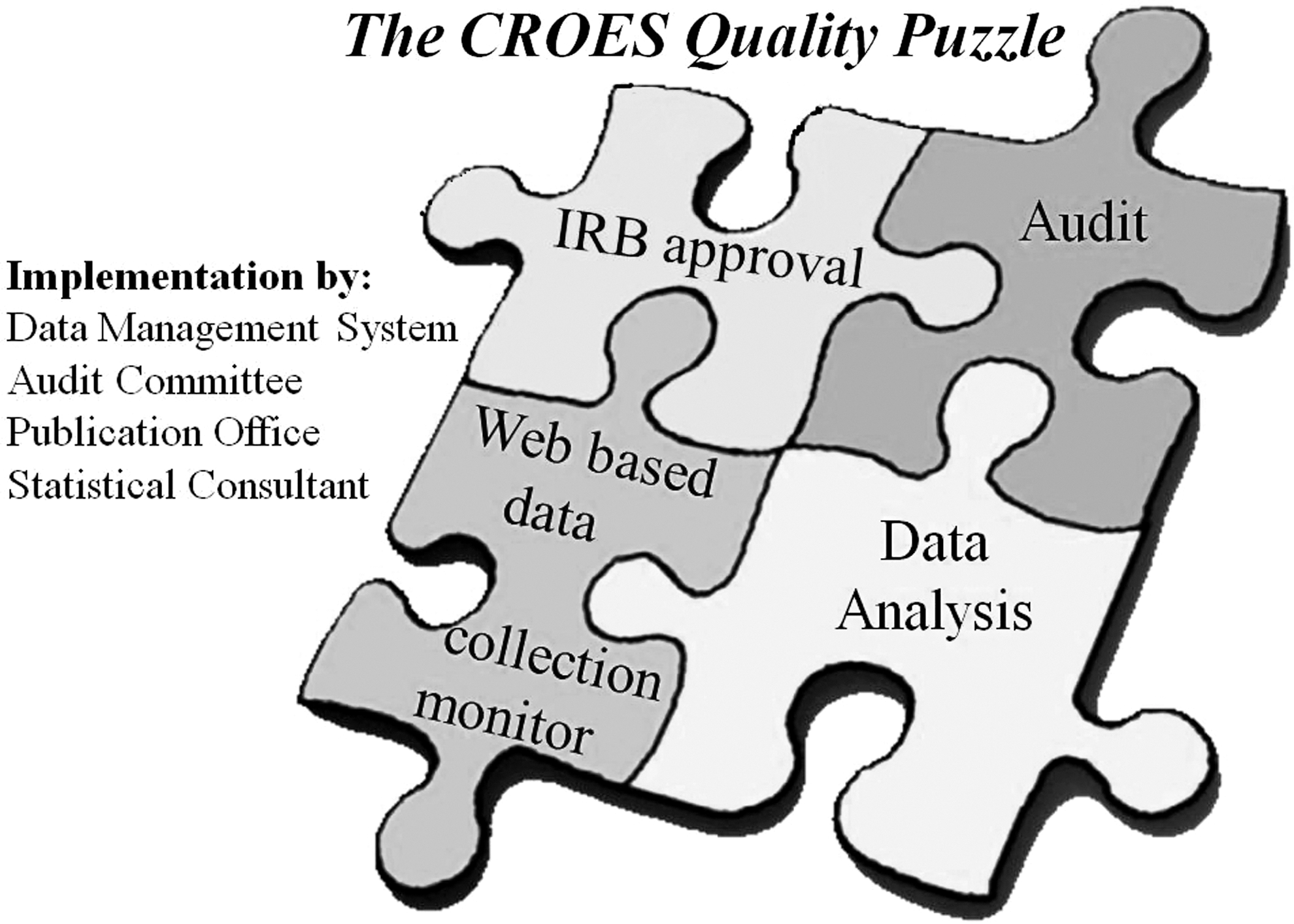
The last two CROES articles that have accepted for publication in European Urology represent an excellent example of the quality data provided by CROES. 5,6 The first article explicitly investigates the relationship between case volume and outcome of PCNL for the first time. 5 Analysis was based on the guidelines for executing reliable volume-outcome studies. 7 The outcome of PCNL in terms of stone free, complication rates, and length of hospital stay was evaluated simultaneously while risk adjustment for known confounders of the outcomes under study was performed. Furthermore, the case volume was used as a continuous variable, which gives a clearer relationship with outcomes instead of using arbitrary cutoff volumes according to Hong and associates. 8 It was found that centers that perform large numbers of PCNLs (>120 per year) achieve higher levels of team efficiency, leading to better efficacy and safety results.
The idea behind the second article was to evaluate the agreement of interurologist rating of PCNL complications to the Clavien score and to guide assignment of specific complications to Clavien score categories based on the large dataset of the CROES PCNL project. 6 The regression models contained the following factors: Presence of staghorn stone, preoperative urine culture status, operative time, and the presence of nephrostomy tube postoperatively, whereas, by including the identity of the centers, the models also adjusted for systematic differences in hospital stay between the participating centers. Thanks to the high quality data, this article will be extremely helpful for urologists to standardize reports of adverse outcomes of PCNL, resulting in improvement of comparability between studies of complications and specific morbidities in PCNL.
The ultimate goal of the Global PCNL project is to further improve our daily practice, implementing what we have learned from our own real-life work. Moreover, the findings will help us to understand the limitations of our surgical tools and work in close collaboration with our partners from industry to further improve them. Consequently, we will be able to provide the absolute best, least invasive, quality of care for all our patients.