




Abstract

Croes Council
Chairman
Jean de la Rosette, MD
Amsterdam (The Netherlands)
Adrian Joyce, MS
Leeds (UK)
Stavros Gravas, MD
Larissa (Greece)
Margaret Pearle, MD
Dallas, TX (USA)
Dean Assimos, MD
Wake Forest, NC (USA)
Ying‐Hao Sun, MD
Shanghai (China)
Tadashi Matsuda, MD
Osaka (Japan)
Treasurer
John Denstedt, MD
London (Canada)
Executive Director
Sonja van Rees Vellinga
Amsterdam (The Netherlands)
Mission
Through worldwide collaboration, CROES seeks to assess, using evidence based scientific methodology, the various aspects of clinical endourology.
Vision
By applying rigorous scientific evaluation to the field of clinical endourology, CROES will enable all urologic surgeons to bring to their patients the most effective and efficient care possible.
Projects
• Global PCNL study
• Global URS study
• Global GreenLight Laser study
• Global Renal Mass study
• Global NBI study
Contact
For more information please contact Sonja van Rees Vellinga (
Global Randomized Narrow Band Imaging Versus White Light Study in Nonmuscle Invasive Bladder Cancer: Accession tO the First Milestone—Enrollment of 600 Patients
Seiji Naito, Sonja van Rees Vellinga, and Jean de la Rosette
Narrow band imaging (NBI) is a high-resolution endoscopic technique that enhances the fine structure of the mucosal surface without need for dyes. NBI is based on the phenomenon that the depth of light penetration depends on its wavelength; the longer the wavelength, the deeper the penetration. Blue light penetrates only superficially, whereas red light penetrates into the deeper layer. In the NBI system (Olympus Corp, Tokyo, Japan), the relative intensity of blue and green light is increased while the intensities of red light are decreased to a minimum.
Recent reports have indicated that NBI cystoscopy is more effective than standard white light (WL) cystoscopy for the detection of bladder cancer. 1 –5 Therefore, NBI is expected to achieve better outcome compared with WL in the diagnosis and treatment of nonmuscle invasive bladder cancer (NMIBC): A more thorough primary tumor resection may be achievable as well as reducing the number of tumors that are missed. This may decrease the subsequent recurrence rate, reduce the number of required cystoscopy procedures during their disease course, and ultimately lead to a better quality of life and a reduction in the cost of their care.
Thus, a multicenter international study was planned in the Clinical Research Office of the Endourological Society (CROES) to compare the safety (morbidity) and efficacy between NBI-assisted transurethral resection of the bladder (TURB) and WL-assisted TURB for cancer. 6 The study flow chart is shown in Figure 1. The primary study objective is to compare the recurrence rate at 1 year after NBI-assisted TURB (Arm A) with WL-assisted TURB (Arm B) in patients with NMIBC.
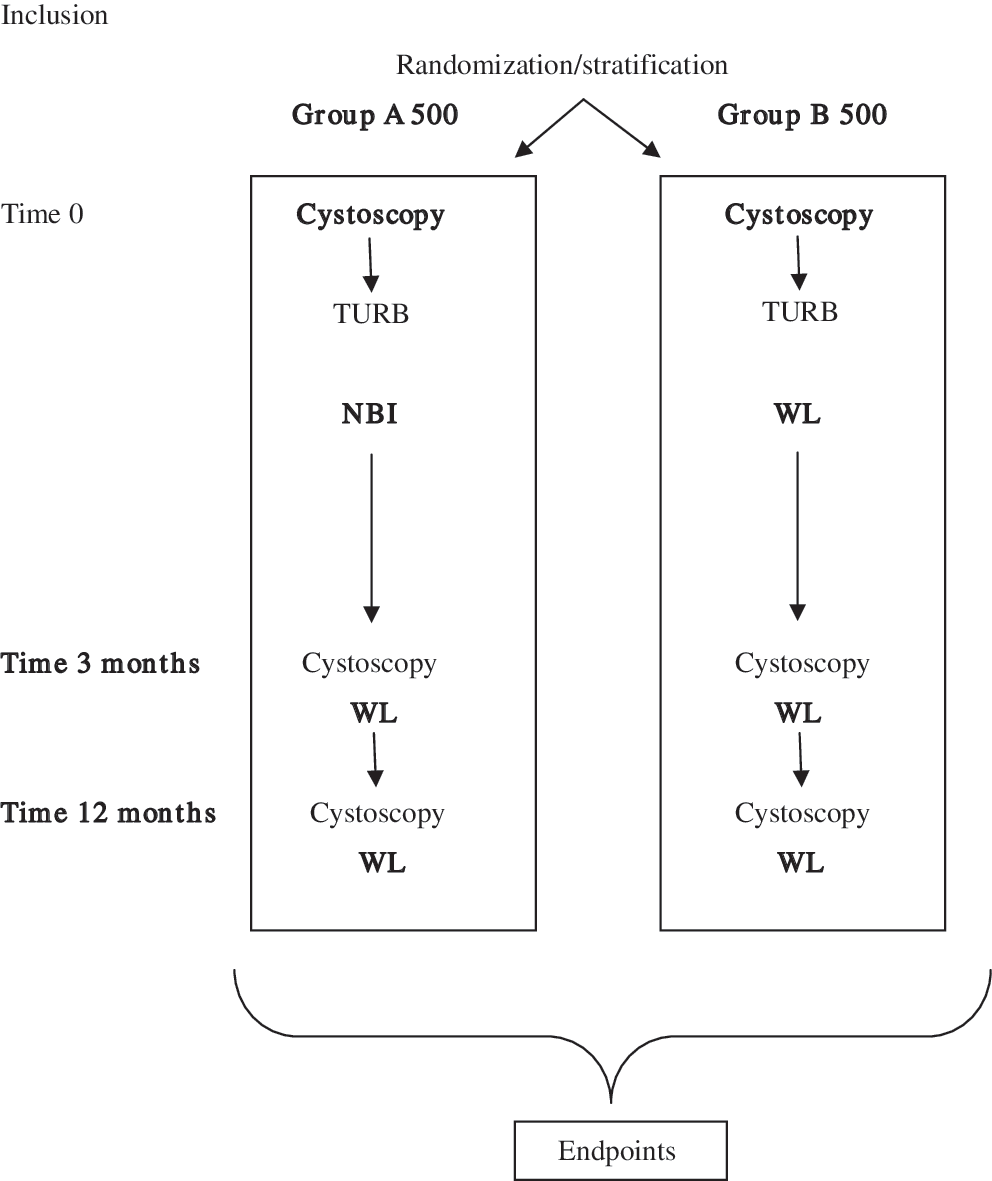
Study flowchart. TURB = transurethral resection of the bladder; NBI = narrow band imaging; WL = white light.
The secondary study objectives are: (1) To assess the recurrence of tumor at first follow-up (3 months) after NBI-assisted TURB or WL-assisted TURB in patients with NMIBC; (2) to assess the perioperative morbidity (30 days) of transurethral resection of bladder tumor (TURBT) between NBI and WL resection by using the Clavien score; (3) to define risk factors for the development of perioperative morbidity after instrumental treatment; (4) to assess the recurrence rate related to the surgeon performing the procedure; (5) to assess the recurrence rate related to additional treatment after TURB.
The required sample size per arm was calculated to be 392 patients (784 patients in total). We aimed to enroll 500 patients in each arm, however, in consideration of withdrawal cases or follow-up failure. This study started in August 2010 as the first global randomized study coordinated by CROES. At present, 24 centers are actively participating, and almost 600 patients have been enrolled. We can say that we have accessed to the first milestone—over half of the scheduled enrollment.
The top three contributing doctors are Dr. Antonin Brisuda (Hospital Motol, Prague, Czech Republic), Dr. Young Deuk Choi (University College of Medicine, Seoul, Korea), and Dr. Luc Valiquette (University of Montreal Health Center, Montreal, Canada). Another 10 centers are ready to soon start data collection as well. We would like to speed up and complete the enrollment of the scheduled 1000 patients in 1 year from now.
This study is still open for new centers. Success or failure of this study will be the first real test of the future possibility of such a global randomized study coordinated by the CROES.