




Abstract
Purpose:
Robotic surgical technology has been adopted by surgeons with and without previous standard laparoscopic experience. The necessity or benefit of prior training and experience in laparoscopic surgery is unknown. We hypothesized that laparoscopic training enhances performance in robotic surgery.
Materials and Methods:
Fourteen medical students with no surgical experience were instructed to incise a spiral using the da Vinci® surgical robot with time to completion and errors recorded. Each student was then trained for 1 month in standard laparoscopy, but with no further robotic exposure. Training included a validated laparoscopic training program, including timed and scored parameters. After completion of the month-long training, the students repeated the cutting exercise using the da Vinci robot as well as with standard laparoscopic instruments and were scored within the same parameters.
Results:
The mean time to completely incise the spiral robotically before training was 16.72 min with a mean of 6.21 errors. After 1 month of validated laparoscopic training, the mean robotic time fell to 9:03 min (p=0.0002) with 3.57 errors (p=0.02). Laparoscopic performance after 1 month of validated laparoscopic training was 13.95 min with 6.14 errors, which was no better than pretraining robotic performance (p=0.20) and worse than post-training robotic performance (p=0.01).
Conclusions:
Formal laparoscopic training improved the performance of a complex robotic task. The initial robotic performance without any robotic or laparoscopic training was equivalent to standard laparoscopic performance after extensive training. Additionally, after laparoscopic training, the robot allowed significantly superior speed and precision of the task. Laparoscopic training may improve the proficiency in operation of the robot. This may explain the perceived ease with which robotics is adopted by laparoscopically trained surgeons and may be important in training future robotic surgeons.
Introduction
The adoption of robotic surgery appears to be growing even more rapidly than did laparoscopy after its introduction only approximately a decade ago. While some have suggested that robotic surgery has a shorter learning curve than standard laparoscopy, 9 the optimal method of robotic training has yet to be determined. 9,10 Many surgeons embarking on their initial robotic procedures are not trained in standard laparoscopy before learning robotic techniques. 11 In some fields, surgical disciplines where robotic surgery is largely replacing laparoscopy, it is debatable whether trainees should any longer be trained in traditional laparoscopic techniques. 12
We sought to determine whether training in standard laparoscopy has crossover value in regard to improved robotic performance, which would have implications for surgical education as well as for predicting the success of surgeons in their initial robotic experience. We compared the objective performance of surgical skills both laparoscopically and robotically in naïve learners after a validated laparoscopic training program, but no robotic training.
Materials and Methods
Fourteen medical students with no prior laparoscopic or robotic surgical experience were enrolled in the study with institutional review board approval. All laparoscopic training and skills assessment were conducted using a pelvic trainer and disposable laparoscopic instruments in a dedicated training laboratory. Robotic skills were performed on the da Vinci® robotic surgical system (Intuitive Surgical, Inc., Sunnyvale, CA).
On day 0 of the study, all medical students were asked to perform a validated task involving incision along a demarcated 2.5 cm2 spiral using the da Vinci robot. Time to complete the exercise and errors in technique were recorded. Errors were defined as an unintentional incision off of the demarcated line of the spiral with need for readjustment of trajectory (Fig. 1).

Robotic spiral cutting before laparoscopic training by student NF.
All students then underwent 1 month (30 days) of laparoscopic skills training with no further exposure to the robot. The course consisted of validated training exercises that have been used to train more than 5000 learners. 11 The skills practiced included rope transfer exercise, bean drop exercise, and freehand suturing with knot tying as well as sutured anastomosis of vascular graft material (Fig. 2). Time for practicing skills and mentoring were standardized across students with additional opportunities for independent training at the discretion of the trainee. Each student underwent a minimum of 40 h of training across the various skills during the 30-day training period.
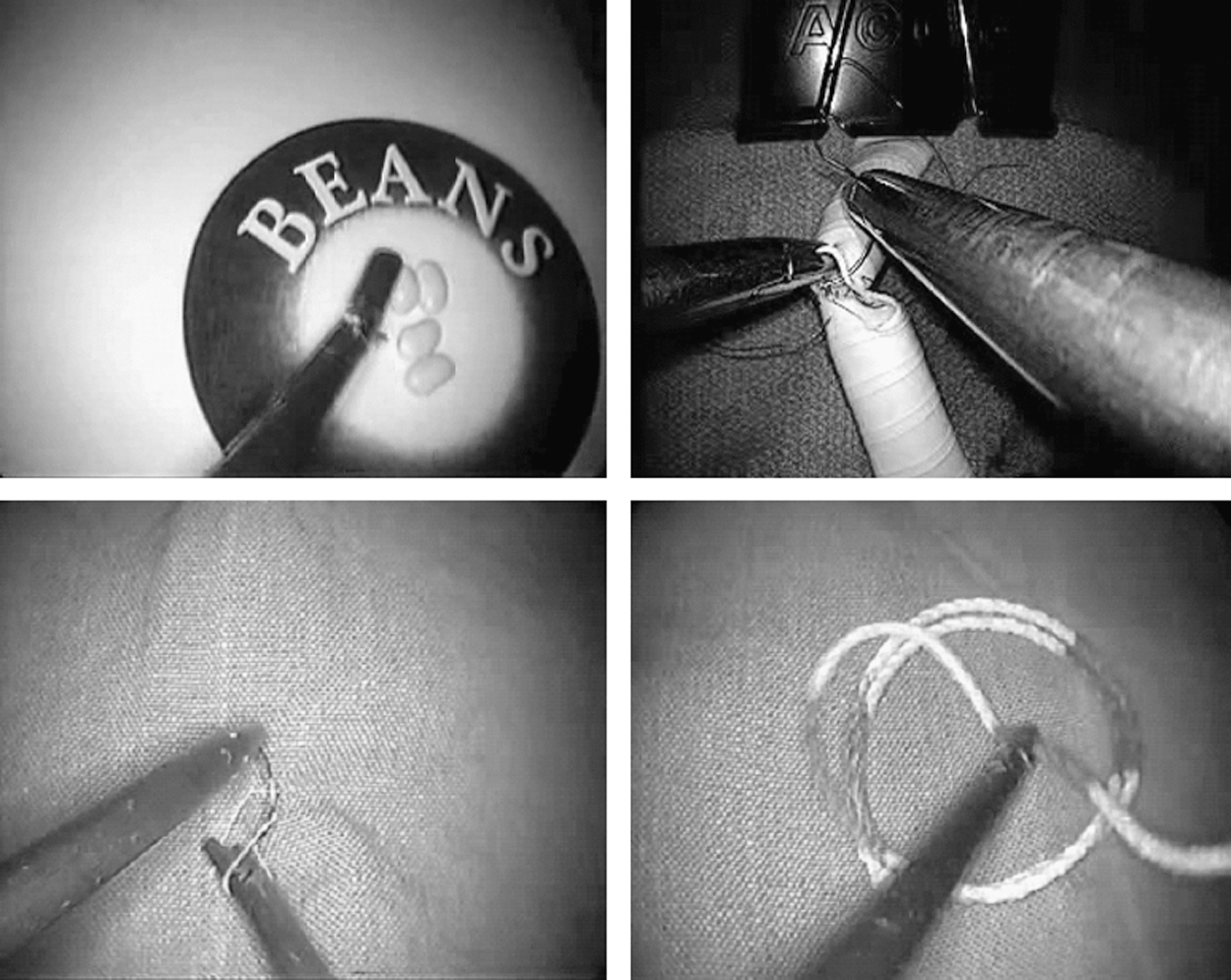
Laparoscopic skills.
After completion of the training, on day 31, the students repeated the spiral cutting exercise with the da Vinci robot. (Fig. 3) Time to completion and errors were again recorded, and then compared to the day 0 times and errors. In addition, on day 31, the students performed the spiral cutting exercise using standard laparoscopy. Times and errors were recorded and compared to robotic times and errors for each student such that each one acted as their own internal control. Statistical analysis was performed using the Student's t-Test with statistical significance defined as a p-value <0.05.

Robotic spiral cutting after laparoscopic training by student NF.
Results
On day 0, the students completed the robotic spiral cutting exercise with a mean time to completion of 16.70 min (range, 11.4–30.0 min). The mean number of errors was 6.2 (range, 3–17 errors). On day 31 after the month-long laparoscopic training, the students repeated the same spiral cutting exercise robotically. The mean time to completion of the robotic spiral cutting exercise after training was 9.0 min (range, 4.2–15.0 min). The mean number of errors after training was 3.6 errors (range, 0–3 errors). The improvement in mean time and errors for robotic performance before and after laparoscopic training (day 0 vs. day 31) was statistically significant (p=0.0002 and p=0.02, respectively) (Table 1).
Laparoscopic and robotic performance before and after training was also compared. On day 31 after laparoscopic training, the students performed the same spiral cutting exercise with standard laparoscopy as well. The mean time to completion was 13.9 min (range, 8.5–20.8 min) with a mean of 6.1 errors (range, 2–10 errors). After the 30-day laparoscopic training, the mean time to complete the task was faster and with less errors when performed robotically as compared to laparoscopically (p<0.001 and p<0.01, respectively), despite no interval robotic training (Table 2).
Laparoscopic performance of the task on day 31 (after laparoscopy training) was not different than the initial robotic performance on day 0 in both time to complete and errors (p=0.20, 0.95, respectively).
Discussion
Since its approval by the Food and Drug Administration, the da Vinci robotic surgical system has been used in urologic, general, cardiac, vascular, and gynecologic surgery. 13 Despite the growing use of robotic surgery, the optimal method of training is still unknown.
The adoption of the radically different technique of laparoscopy necessitated a fundamental change in surgical education. 14,15 Traditional methods of honing operative skills through hands-on experience in the operating room with veteran mentors is less practical given the peculiar nature of laparoscopy skills, including reversal of movements, instruments acting as a lever arm with consequent alteration of force, and lack of three-dimensionality. Specialized training and practice exercises were developed to help surgeons acquire the skills needed to perform laparoscopic cases before operating on human patients. 5,6
A demonstrated correlation exists between such skills acquired in the laboratory and success in the operating room, 7,8 supporting the requirement of the American Board of Surgery to require proficiency in the Fundamentals of Laparoscopy for board eligibility. Similar curricula are under development for robotic surgical skills as well. While this process is ongoing, it has not previously been investigated what role, if any, training in standard laparoscopy contributes to robotic skill acquisition. While some may believe that the two are independent, our study suggests otherwise.
Previous studies have compared laparoscopic learning curves with that of robotic surgery, 16,17 involving comparisons of performance in exercises both laparoscopically and robotically. Most have suggested that robotic surgery has a shorter learning curve than standard laparoscopy, although this view is not held uniformly. 18,19 To our knowledge, ours is the first experiment aimed at determining whether a structured, validated laparoscopic training curriculum can impact robotic performance.
Our study did show that use of the robot allowed better performance of a complex task as compared with laparoscopic performance and that equal performance laparoscopically was only reached after a month of laparoscopic training. This agrees with previous studies showing shorter learning curves with robotic surgery. 9,20,21 More important and unique were our findings as regard robotic performance after laparoscopic training. We found that formal laparoscopic skills training improved performance of the task robotically both in speed and performance despite no training in robotics after the initial attempt 1 month previously. In fact, robotic performance was not only improved by laparoscopic training, but exceeded laparoscopic speed and precision at the end of the study with laparoscopic, but no robotic training.
It remains unclear why laparoscopy training should improve robotic performance, but we believe that both laparoscopic and robotic surgery consist of both physical and cognitive elements and that there is likely crossover in the latter. While robotic technology may improve the initial performance by providing the novice with three-dimensional vision and more intuitive movement (principally elimination of movement reversal), our findings suggest that there is more than this physical element that accounts for robotic ability. We believe, as we did when we generated the hypothesis for this study that the cognitive skills gained by laparoscopic training contribute to robotic skills.
If this is true, this has implications for how residents and surgeons naïve to robotics are trained in robotic surgery. While some may believe that laparoscopy training is unnecessary for robotic proficiency and have designed discrete robotic training curricula without a laparoscopic component, 22 we continue to train residents in the laparoscopic dry lab before robotic skills training.
Increasingly, other strategies such as virtual reality simulation training and animal labs are being incorporated into both laparoscopic and robotic training. 4,11,23 While individually, such training elements have been validated by various investigators, complete curricula and the impact of such elements on overall training of learners remain unclear. Similarly, while our study suggests a benefit to laparoscopy training in robotic skills acquisition, the role of laparoscopy training in an overall robotic training curriculum is uncertain. For example, if the goal of training is to create robotic surgeons regardless of whether they have any laparoscopic ability, the time spent in laparoscopy training, despite our findings showing that it will likely improve robotic skills, might be better spent elsewhere.
Therefore, our study represents an opportunity for further study of optimal methods for training in robotics. The limitations of our study suggest future directions for investigation. One limitation to the study was the number of students tested. Only 14 students were studied secondary to the limitations of the logistics of enrolling active medical students for 31 days and the availability of resources to study the group. While this number should be larger in future studies, the current study was powered enough to reach statistical significance. Another limitation was our lack of control groups in our study that included learners of various training levels (such as residents or surgeons) nor learners who had no laparoscopy training during the 30 days or instead robotics training for 30 days, all of these elements would be worthy components of future experiments. To improve future studies, investigators should include controls with no training at all, controls with nonrelated type of manual training, and a control group who underwent a 30-day robotic-only training regimen. Another possible area of bias could be that the robot provides the learners with a superior platform to complete the studied exercises, and therefore, comparison of robotic and laparoscopic skills are not equal. With this being said, a third group of students tested could have no exposure to the robot on day 0, then undergo the laparoscopic training regimen and be tested both laparoscopically and robotically to control for possible surgical platform biases.
Conclusions
Traditional laparoscopic skills training improved robotic proficiency among surgically naïve learners. Robotic performance of a standardized task was improved and was superior as compared to laparoscopic performance after laparoscopy training. Further research regarding the contribution of laparoscopy skills training to robotic proficiency will be needed to create optimal training regimens for the next generation of surgeons.
Footnotes
Author Disclosure Statement
No competing financial interests exist.