




Abstract
Purpose:
To present our experience with case selection and operative skills of laparoendoscopic single-site (LESS) retroperitoneoscopic adrenalectomy for pheochromocytoma and evaluate its feasibility.
Patients and Methods:
Between June 2011 and December 2012, we performed LESS retroperitoneoscopic adrenalectomy for 16 patients with pheochromocytoma. In all patients, the diameter of the pheochromocytoma was less than 4.0 cm. During the operation, a single-port access was inserted through a 2.5–3.0 cm transverse incision below the tip of the 12th rib. Internally, the operative procedure duplicates the conventional retroperitoneoscopic adrenalectomy for pheochromocytoma.
Results:
No conversions to open surgery or standard laparoscopy with additional trocars were necessary. The mean operative duration was 68.1 minutes (range 41–125 min). The mean blood loss was negligible (<50 mL), and no patient needed blood transfusion. Intraoperative hypertension (SBP>180 mmHg) occurred in 12.5% (2/16) of the patients. No patient had sustained hypertension, and none experienced intraoperative hypotension (systolic blood pressure <80 mm Hg). The only postoperative complication was one case of pneumonia successfully treated with antibiotics. The average postoperative hospital stay was 3.1 days (range 2–5 days). All patients left the hospital with a good cosmetic appearance.
Conclusions:
In properly selected patients, LESS retroperitoneoscopic adrenalectomy is a feasible and safe procedure for pheochromocytoma.
Introduction
T
Initially, we completed LESS retroperitoneoscopic adrenalectomies for two patients with pheochromocytomas (5.2 cm and 6.0 cm, respectively). Blood pressure fluctuations were usually transient and easily controlled during the procedure; however, we installed an additional ancillary trocar because of difficultly with tumor retraction and rupture of the peritoneum that occurred in the second case. The operative times were 192 and 215 minutes, respectively, and the incisions were extended for specimen extraction. Subsequently, for cosmetic and safety concerns, we consciously chose pheochromocytomas less than 4.0 cm in diameter for LESS adrenalectomy.
We describe our initial experience with case selection and operative skills of LESS retroperitoneoscopic adrenalectomy for pheochromocytoma and our evaluation of its feasibility. To our knowledge, this report represents the first specialized study and the largest series of LESS adrenalectomy for pheochromocytoma.
Patients and Methods
This was a retrospective study that was approved by the ethics committee at Xiangya Hospital, Central South University, Changsha, Hunan Province, China. We obtained written informed consent from all of the participants in our study. Between June 2011 and December 2012, we performed LESS retroperitoneoscopic adrenalectomy for 16 patients with pheochromocytoma including seven men and nine women with a median age of 39.4 years (range 20–58 years). All procedures were performed by the same experienced surgeon (XC) and, in all patients, the diameter of the pheochromocytoma was less than 4.0 cm. Patients who had bilateral pheochromocytomas or for whom there was a high suspicion of malignancy were excluded from this study.
All patients were evaluated by MRI or CT abdominal scan and/or 131I–meta–iodobenzylguanidine preoperatively. Biochemical assessment included plasma and urinary catecholamine concentration and/or concentrations of 24-hour urinary vanillylmandelic acid. All patients received alpha-blockade (prazosin or phenoxybenzamine) at least 2 weeks before surgery, and eight patients received beta–blockade (metoprolol or labetalol) when cardiac arrhythmias were prominent. We recorded the surgical details, perioperative complications, and postoperative data. Intraoperative hypertension was defined as systolic blood pressure (SBP) higher than 180 mm Hg, and hypotension was defined as SBP lower than 80 mm Hg.
Operative technique
Patients were placed in the lateral decubitus position with appropriate flexion under general anesthesia. A 2.5–3.0 cm transverse skin incision was made along the lower margin of the 12th rib in the midaxillary line. Vessel forceps were used to bluntly dissect the fascia and muscle, and the retroperitoneal space was initially developed by blunt finger dissection as previously described. 9 A single-port access (Shikonghou, Hangzhou Tonglu, China) was placed in the lumbar incision. After insufflation of the retroperitoneal cavity with CO2 at 12–14 mm Hg, a 10-mm 30-degree rigid laparoscope was inserted through the 10-mm lumina for monitoring. A standard straight instrument and a curved instrument were then inserted under direct visualization to perform the procedures (Fig. 1). The standard straight instruments were 5 cm shorter than the curved instruments to minimize interaction.
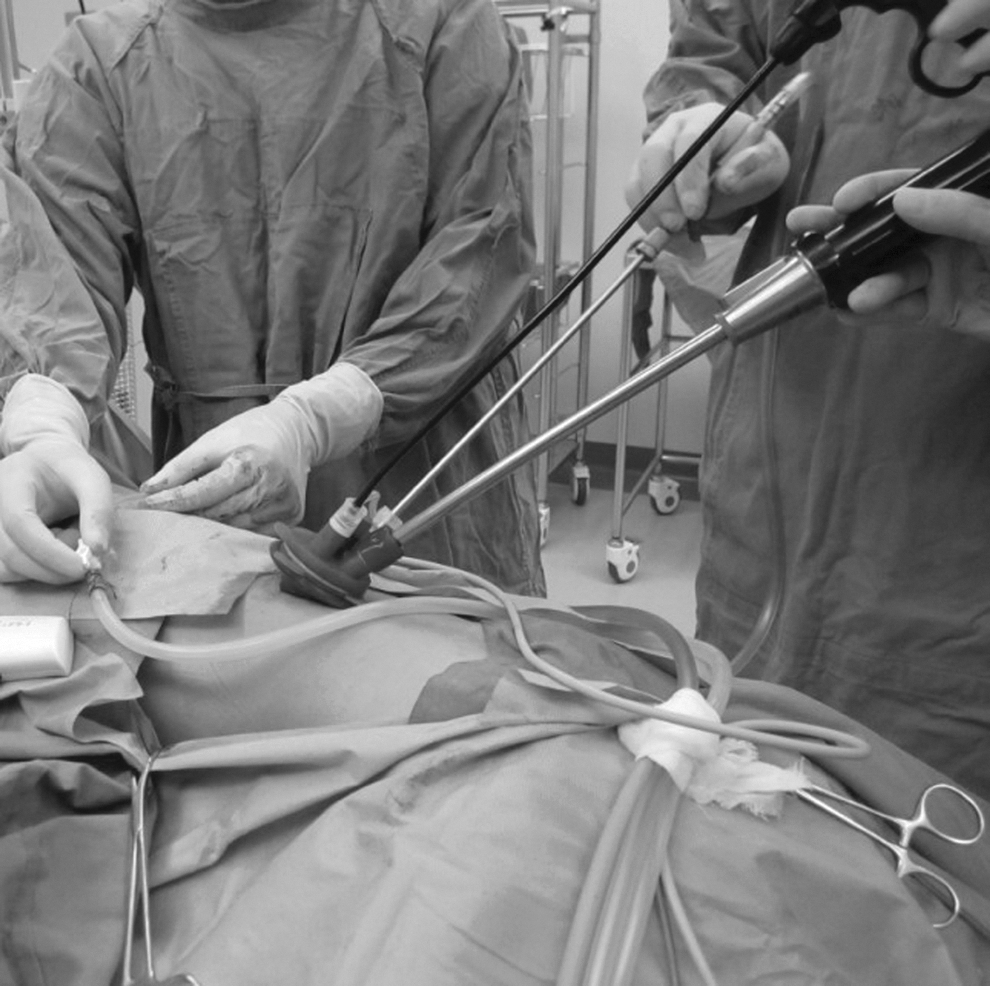
A single-port access (Shikonghou, Hangzhou Tonglu, China) was placed in the lumbar incision. A 10-mm 30-degree rigid laparoscope was inserted through the 10-mm lumina for monitoring. A standard straight instrument and a curved instrument were then inserted to perform the procedures.
Internally, the operative procedure duplicates conventional retroperitoneoscopic adrenalectomy for pheochromocytoma. After dissecting and removing some of the retroperitoneal fat and adjacent tissue, the Gerota fascia was then opened longitudinally. The dissection was effected by blunt identification of the plane between the perirenal fat and the anterior renal fascia, and an ultrasonic scalpel was used to sharply divide the tissue. The superior pole of the kidney was exposed, and the mass was then visible. Surrounding fat or adjacent tissue was used to manipulate the mass and the adrenal gland to minimize blood pressure fluctuations and bleeding. After the mass was almost completely dissected, the adrenal vein was clamped with 2 Hem-o-lok clips (Weck Closure Systems, Research Triangle Park, NC) and divided. After resection, the specimen was captured in a custom-made laparoscopic bag and retrieved through the single-port site. A rubber drain placed through the incision was left in situ when necessary.
Results
Table 1 summarizes the demographic, intraoperative, and postoperative data of the patients. No conversions to open surgery or standard laparoscopy with additional trocars were necessary. The mean operative duration was 68.1 minutes (range 41–125 min). The mean blood loss was negligible (<50 mL), and no patient needed blood transfusion. Intraoperative hypertension (SBP >180 mm Hg) occurred in 12.5% (2/16) of the patients. A single episode was noted in one patient during intubation and two episodes in another patient during tumor manipulation. No patient had sustained hypertension, and none experienced intraoperative hypotension (SBP <80 mm Hg).
BMI=body mass index; EBL=estimated blood loss; SBP=systolic blood pressure.
The median in-hospital analgesic requirement was 4.7 mg morphine equivalent. Eleven patients did not request any analgesic and, more than 24 h after surgery, only two patients asked for pain medication. The only postoperative complication was one case of pneumonia successfully treated with antibiotics. The average postoperative hospital stay was 3.1 days (range 2–5 days), and the mean time to resume oral nutrition was 1.2 days (range 1–2 days). All of the patients left the hospital with a good cosmetic appearance (Fig. 2), and the mean follow-up was 10.5 months (range 3–22 mos). During the short-term follow-up, postoperative blood pressure was controlled without drugs, and no recurrences or mortalities were documented in any of the 16 patients.
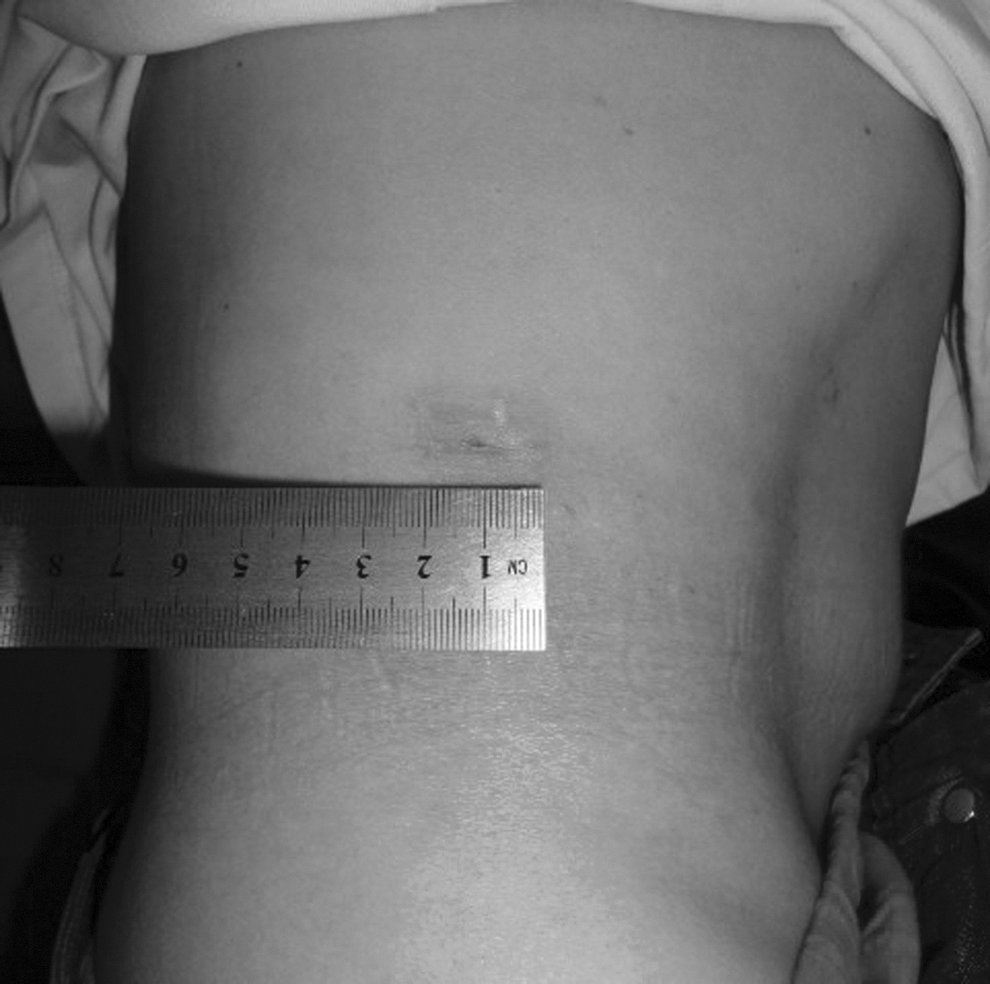
The surgical scar of a 41-year-old man on postoperative day 30.
Discussion
Pheochromocytomas are tumors arising from both the chromaffin cells of the adrenal medulla and extra-adrenal sites, which produce and often secrete catecholamines. These vasoactive tumors tend to be larger, with prominent vascularity and preoperative uncertainty about malignancy. 10,11 Pneumoperitoneum and tumor manipulation cause excessive catecholamine release, which may cause further intraoperative cardiovascular instability. 12 Based on these complex clinical features, laparoscopic adrenalectomy for pheochromocytoma was once considered risky and was performed with caution. 13,14
In recent years, advances in preoperative medical management and improvements in surgical and anesthetic techniques have resulted in widespread use of this procedure. 15 –18 Some investigators have even suggested that laparoscopy should be considered the gold standard of care for pheochromocytoma. 19
Recently, LESS, a new alternative to conventional laparoscopic surgery, has been performed successfully in various urologic procedures. Compared with standard laparoscopic surgery, its advantage lies in consolidating multiple ports within a single skin incision to enhance the cosmetic outcome and minimize the potential morbidity associated with multiple incisions. 20,21 LESS adrenalectomy for pheochromocytoma, however, is still an infrequently described technique. To our knowledge, our study is the largest reported series to date from a single institution.
According to the few published studies, almost all surgeons reported LESS adrenalectomies only for benign pheochromocytomas confined to the adrenal gland and without invasion of adjacent structures. Interestingly, no consensus exists regarding the recommended size of pheochromocytoma for LESS adrenalectomy.
Most investigators have performed LESS adrenalectomy for pheochromocytomas of smaller sizes; however, Chung and associates 3 recently reported two LESS retroperitoneoscopic adrenalectomies in patients with pheochromocytomas more than 6 cm. Although the two cases were completed without conversion, the surgeons required a third instrument for kidney retraction because of tight adhesions of the tumor to the peripheral tissues and a bloody operative field. Therefore, longer operative times (190 minutes and 237 minutes, respectively) were needed. Furthermore, lengthening the incision for ultimate specimen extraction may have diminished the usual excellent cosmetic outcomes of single-port surgery.
We suggest that LESS adrenalectomies should be considered for management of pheochromocytomas less than 4.0 cm in diameter for the following reasons: First, the larger the size, the more prominent the vascularity, the higher malignancy potential, and the higher the risk and difficulty of the procedure. 22,23 Choosing smaller-sized pheochromocytomas for LESS adrenalectomies in the early phases of the use of this procedure follows the principles of putting ease before difficulty, thus ensuring the safety and efficacy of the procedure.
Second, after attempting to perform LESS retroperitoneoscopic adrenalectomies for adrenal tumors of varying diameters, we found that adrenal tumors less than 4.0 cm in diameter can be completely removed from a 2.5–3.0-cm incision without incision extension or morcellation, thus ensuring the cosmetic advantage of single-port surgery. Our results also demonstrated that LESS retroperitoneal adrenalectomies for pheochromocytomas less than 4.0 cm in diameter can be completed successfully in less time without an additional trocar or lengthening the incision.
Most surgeons prefer transumbilical LESS adrenalectomy over the retroperitoneal approach. The transumbilical approach has the benefit of a better cosmetic outcome, more ample working space, and earlier ligation of the adrenal vein. Intraperitoneal organ retraction and mobilization, however, are usually necessary in transperitoneal LESS adrenalectomy, which are troublesome and time-consuming and may cause trauma to the intraperitoneal organs.
In contrast to the transumbilical approach, the retroperitoneal approach allows for less invasiveness, because it provides more direct access to the retroperitoneal organs without maneuvering in the peritoneal space. The major disadvantage of the retroperitoneal approach is the limited working space. In our cases, dissecting and removing some of the retroperitoneal fat and adjacent tissues outside of the Gerota fascia not only provided a larger working space but also reduced the potential damage because fat interference in the operation field was reduced. Although the transumbilical approach leaves virtually no scars, in our study, a small port site scar on the back was usually acceptable to patients.
Agha and colleagues 8 considered that both transumbilical LESS adrenalectomy and retroperitoneoscopic LESS adrenalectomy have significant technical similarities to standard multiple-trocar procedures, resulting in a short learning curve in experienced hands. Their research shows that both surgical procedures are technically feasible, and the choice depends on the surgeon's proficiency level. We have completed more than 900 retroperitoneoscopic adrenalectomies (including more than 100 retroperitoneoscopic adrenalectomies for pheochromocytomas) during the last decade. Therefore, we chose the retroperitoneal approach in LESS adrenalectomy for pheochromocytoma.
Because several parallel instruments are inserted through a single access with no additional assistant trocars, LESS retroperitoneoscopic adrenalectomy for pheochromocytoma is more challenging when compared with conventional laparoscopy. The first challenge is how to restore instrument triangulation and minimize instrument crowding. Wen and colleagues 24 reported that the use of flexible and curved instruments can decrease handling difficulties, reduce instrument crowding, and restore instrument triangulation. In our view, using one conventional straight instrument in the dominant hand and one curved instrument in the other hand not only forms a satisfactory degree of triangulation but also overcomes the operational inconvenience caused by the frequent crossover of two curved instruments. Moreover, our choice of incision below the 12th rib allows a short distance between the incision and the adrenal gland, which may provide instruments a wider range of motion and overcome the limited working space of the retroperitoneal approach.
The second challenge is how to control the intraoperative hemodynamic changes. Because it is difficult to expose the adrenal vein before tumor manipulation using the retroperitoneal approach, we did not painstakingly ligate the adrenal vein early. In our study, intraoperative blood pressure fluctuations were usually transient and easily controlled. Just as Kercher and coworkers 25 and Inabnet and associates 26 reported, early ligation of the adrenal vein did not avoid the excessive catecholamine release caused by tumor manipulation or pressure.
In our opinion, sufficient preoperative preparation, close intraoperative hemodynamic monitoring and management, and meticulous manipulation during the operation are the key points to reduce the risk of intraoperative hypertensive events. Before ligation of the central adrenal vein, we performed the major handling within the soft tissues, 0.5–1.0 cm away from the tumor rather than directly manipulating the tumor or adrenal gland. In cases of right-sided tumors, meticulous manipulation during dissection and clipping of the adrenal vein is necessary, because the short suprarenal vein enters the inferior vena cava directly. For left-sided tumors, extended mobilization of the kidney's upper pole is essential, because the inferior portion of the adrenal gland lies in front of the kidney. Flávio Rocha and colleagues 27 reported that high retroperitoneal insufflation pressures (20–24 mm Hg) may be a stimulus for increased catecholamine release and resultant hypertension. In our study, pneumoretroperitoneum was maintained at 12–14 mm Hg throughout the procedure without sharp hemodynamic changes.
Our study has several limitations. Because this study described only the short–term outcomes in a limited number of patients, we did not obtain enough data to compare LESS with conventional multi-incision laparoscopic adrenalectomy for pheochromocytomas. There was no recurrence among our patients, but the follow-up duration was short (mean, 10.5 mos; range 3–22 mos). It is necessary to observe pheochromocytoma patients during a long-term follow-up. 28,29 There have been no previously specialized studies in LESS adrenalectomy for pheochromocytoma, however. Our study could serve as a basis for future studies with more cases and longer follow–up.
Conclusions
Our initial experience shows that in properly selected patients, LESS retroperitoneoscopic adrenalectomy is a feasible and safe procedure for pheochromocytoma. Further prospective studies based on larger numbers of patients and longer follow-up are warranted to evaluate the advantages of LESS compared with conventional multi-incision laparoscopic surgery.
Footnotes
Disclosure Statement
No competing financial interests exist.