




Abstract
Purpose:
To describe a novel laparoscopic-assisted technique for ureteroureterostomy for the surgical management of a completely duplicated collecting system with an obstructed and/or ectopic ureter.
Patients and Methods:
A camera is placed through a 5-mm infraumbilical port and the duplicated ureters identified and delivered through a small inguinal incision with a laparoscopic Babcock clamp. The ureteroureterostomy is performed in an open fashion. The mean operative time, length of stay, success, and complications of nine patients who underwent this technique were reviewed and compared with a cohort of patients who underwent open ureteroureterostomy at a single institution. In addition, the existing literature on laparoscopic and robot-assisted ureteroureterostomy is reviewed.
Results:
There were no statistically significant differences in operative time (134 vs 133 min, P=0.950), length of stay (0.32 vs 0.33 days, P=0.929), complications (2 and 2, P=0.574), or rates of success (95% vs 100%, P=1.00) between the open and laparoscopic-assisted ureteroureterostomy groups. In addition, the operative times and length of stay in our laparoscopic cohort were shorter than a majority of the laparoscopic and robotic cases reported in the literature.
Conclusions:
Laparoscopic-assisted ureteroureterostomy is a successful technique for the management of an ectopic and/or obstructed ureter in a completely duplicated collecting system. This technique combines the speed and ease of the open technique with the improved cosmesis and visualization of a laparoscopic approach and is thus a useful approach for the pediatric urologist.
Introduction
T
The novel technique of performing an open ureteroureterostomy through a small inguinal type or modified Gibson incision has been previously reported from this institution with excellent success and cosmesis. 3 A minimally invasive technique was desired, however, especially for older children. The purpose of this report is to share the technique and outcomes of a new laparoscopic-assisted ureteroureterostomy technique for the management of an ectopic or obstructed ureter associated with a completely duplicated collecting system. In addition, the outcomes of the laparoscopic technique are compared with an open cohort as well as a review of the laparoscopic and robotic ureteroureterostomies reported in the literature to date.
Patients and Methods
After Institutional Review Board approval, a review was performed of all patients who underwent ureteroureterostomy at Children's Medical Center from June 2009 to October 2013 by six pediatric urologists. Patients who underwent laparoscopic and robotic approaches were kept in a prospective database, and the open cohort was identified by Current Procedural Terminology code. Data collected included diagnosis, concomitant procedures performed at time of the ureteroureterostomy, length of surgery, length of hospital stay, complications, and outcome. A successful procedure was defined as resolution of urinary incontinence (if present from an ectopic ureter), and resolution or improvement of hydroureteronephrosis of the effected renal moiety as confirmed on postoperative renal ultrasonography.
Preoperative demographic information as well as intraoperative data and surgical outcomes were compared between the open and laparoscopic-assisted cohorts. Robotic procedures were not included in the comparison secondary to numbers too small for statistical analysis. In addition, operations that included a concomitant procedure at the time of ureteroureterostomy, which would affect the overall operative time, were excluded from the comparison. Categorical data were compared via Fischer exact test, and continuous variables were compared via unpaired t tests with Graphpad statistical software. An alpha of <0.05 was considered significant.
The open ureteroureterostomy technique was similar to that described previously. 3 The laparoscopic-assisted technique was performed as follows: After a ureteral stent was placed into the upper ureter via cystourethroscopy, the patient was reprepped and draped. With the patient in the supine position, an umbilical trocar was placed through which a camera was placed to visualize the pelvic structures. Staying extraperitoneally, a plane was dissected after making a skin incision in the inguinal crease on the appropriate side and taken down to the duplicated ureters. A Babcock clamp was used to grasp and deliver the ureters into the inguinal incision under laparoscopic visualization.
A Penrose drain was passed underneath the ureters, the 5-mm laparoscope removed, and the ureters dissected proximally and distally. The stent was identified and removed and the upper pole ureter transected distally and suture ligated with a 3-0 polydioxanone suture. The upper pole ureter was spatulated proximally, and an ureterotomy made in the lower pole recipient ureter. The spatulated upper pole ureter was then anastomosed to the ureterotomy of the lower pole ureter using two running 6-0 polydiaxanone sutures, one up each side. A ureteral stent was placed at the discretion of the treating surgeon and when placed, removed 4 to 6 weeks postoperatively. Patients were seen in follow-up 3 months after surgery with renal ultrasonography.
Results
A total of 50 ureteroureterostomies were performed—37 open, 9 laparoscopic-assisted, and 7 robot-assisted. After exclusion of 15 open and 3 robotic cases that were performed with a concomitant procedure (most commonly ureteral reimplantation), a total of 32 cases were left for review (Fig. 1). As noted above, because of the small number of remaining robot-assisted procedures, statistical analysis was only performed between the open and laparoscopic-assisted cohorts.

Breakdown of patients. UU=ureteroureterostomy; lap=laparoscopic.
All procedures were performed for a duplicated collecting system with either an ectopic or obstructed ureter. Mean age was 2.73 years (0.23–21.32), and 26 (82%) patients were female. In the four robot-assisted cases, mean operative time was 189 minutes, and all patients spent one night in the hospital after the procedure. There were no complications and no surgical failures in the robotic group.
In comparing the open and laparoscopic-assisted groups, there were no differences between mean age or sex (Table 1). There was, however, a significant difference in the number of patients who received a stent in the laparoscopic group (89%) compared with the open cohort (21%), P=0.0012. In addition, there was no statistically significant difference in mean operative time between the open and laparoscopic groups: Open, 134 minutes; laparoscopic, 133 minutes (P=0.950). There was also no difference in length of stay between the two groups because a majority of patients (70%) went home the same day as the surgery.
UU=ureteroureterostomy; lap=laparoscopic; SD=standard deviation; OR=operative; LOS=length of stay.
There was no statistically significant difference in number of complications or failures between the two groups (Table 1). In the open group, there were two complications: One hospital readmission for a febrile urinary tract infection (UTI) and one urine leak necessitating percutaneous drainage. The patient with the urine leak had a ureteral stent placed at the time of the initial procedure. In the laparoscopic group, there were two hospital readmissions after surgery—one for emesis and one for a febrile UTI.
Mean follow-up after surgery was 21 months. Of the 28 total patients compared between the open and laparoscopic-assisted groups, there was one failure in a patient who had undergone an open ureteroureterostomy. This was defined by worsening renal cortical thinning on postoperative ultrasonography and two febrile UTIs after surgery, both of which necessitated hospital admission. A postoperative photograph of a patient who underwent the laparoscopic technique can be seen in Figure 2.
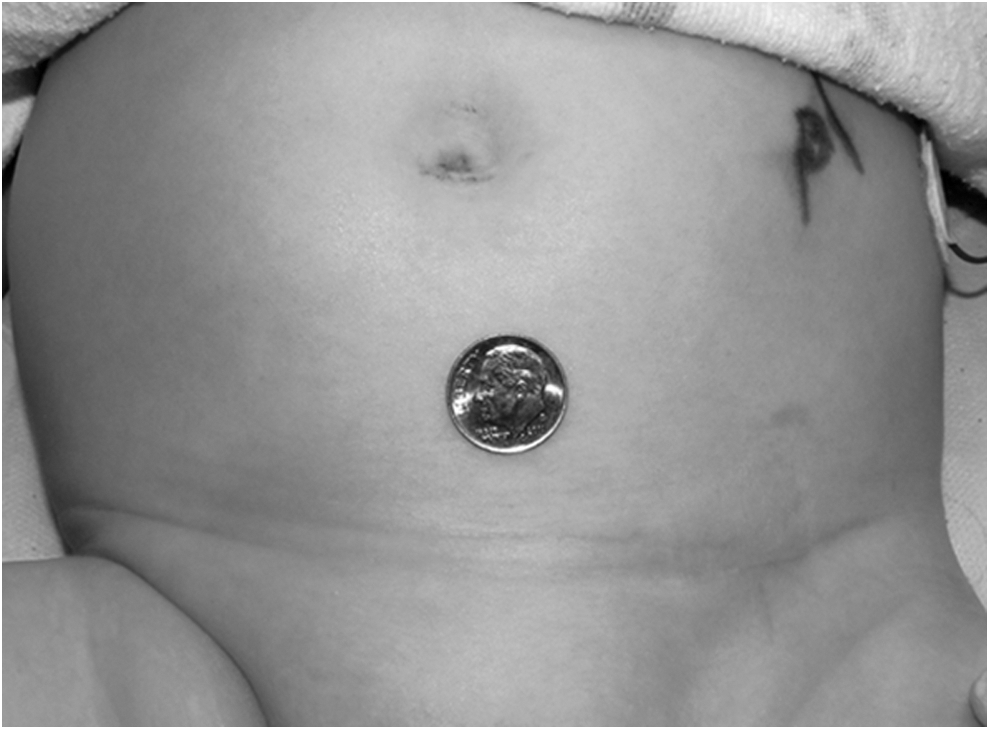
Laparoscopic ureteroureterostomy incisions.
Discussion
Laparoscopic-assisted ureteroureterostomy is a novel technique for the management of an ectopic or obstructed ureter in a completely duplicated collecting system without reflux. After success with the open technique as reported previously by Prieto and coworkers, 3 it was thought that a minimally invasive endoscopic procedure would be valuable, especially for older children where dissection deep in the pelvis can be more cumbersome. Initially, a robotic approach seemed an attractive option for these patients. Despite minimal complications and 100% success, however, the length of stay was 1 day for all patients treated robotically whereas a majority of the patients treated with the open technique were discharged on the same day as the procedure. In addition, operative times were an average of 60 minutes longer for the robotic ureteroureterostomies than the open technique. Finally, the overall cost of obtaining and maintaining a robotic platform is high and may not be available at all centers.
These findings led to the development of the novel laparoscopic-assisted open technique as described above. Because the most challenging part of the case is identification of the ureter through a small inguinal incision, the laparoscopic-assisted method allows for direct visualization and retrieval of the ureters, which simplifies this surgical step. In addition, the approach provides smaller incisions and thus better cosmesis, which is desirable especially for older children. With the laparoscopic-assisted approaches, these advantages of minimally invasive surgery were maintained without sacrificing operative time or length of stay; the comparison with the open technique revealed no differences in operative time, length of stay, complications, or failures. Because this series includes the learning curve of the surgeon with this procedure, one can hypothesize that surgical times may continue to improve with more experience.
A complete ureteral duplication with associated ectopic or obstructed ureter may be managed by a variety of operations including ureteral reimplantation and pyeloureterostomy, or heminephroureterectomy when upper pole function is poor. 2 In addition, multiple previous reports have documented the success of a simple ureteroureterostomy for the management of ectopic ureters, ureteroceles, and vesicoureteral reflux in a duplicated collecting system. 1 –3 Advantages of this approach include preservation of the upper pole moiety, technical ease, improved exposure and visualization, decreased morbidity compared with a flank or transvesical approach, improved cosmesis because the procedure may be performed through a small hernia type incision, avoidance of ureteral tailoring and bulky ureteral reimplantation for associated ureteral dilation, and a high success rate of 94% to 98%. 1 –3
Multiple authors have also reported the technique and results of minimally invasive approaches to ureteroureterostomy including laparoscopic, single site, and robot-assisted approaches for the repair of proximal and distal obstruction in the duplicated system, midureteral pathology, as well as for the management of reflux and ectopic ureters in a duplicated system. 5 –14 A summary of the existing literature on laparoscopic and robotic ureteroureterostomy in children is provided in Table 2. A pooled analysis of all results reveals a mean operative time of 182 minutes (78–244 min) and a mean length of stay of 2.8 days (1–9 d). Overall, the procedure has an excellent success rate with no reported failures in the literature. Minimal complications included one episode of pyelonephritis that prolonged the initial hospital stay, one hospital readmission for febrile UTI, and two urine leaks, 5,6,11
Upper urinary tract obstruction in a duplicated system.
Single trocar laparoscopic approach.
UU performed for midureteral obstructions.
UU=ureteroureterostomy; LOS=length of stay.
Our report of nine children treated with a minimally invasive approach for ureteroureterostomy is comparable in size with the largest reported study by Liem and associates 10 who reported the results of nine patients treated with a single port technique. Our reported success rate and complication profile is similar to that reported in other laparoscopic and robotic series. Our mean operative time of 133 minutes, however, is much less than a majority of the series reported, many of which have operative times more than 200 minutes, more than 1 hour longer than in this series. In addition, our operative time included stent placement while the fastest reported operative time reported in the literature (78 min) was without ureteral stent placement. 10 The performing surgeon recorded his own time to secure the ureter during the laparoscopic-assisted ureteroureterostomy procedure, which averaged 10 minutes (6–15). In addition, 6/9 (67%) of patients in the laparoscopic-assisted group went home the day of surgery and the remaining three spent one night in the hospital. This, too, is superior to the reported mean of 2.8 days (1–9) spent in the hospital by those patients who underwent a minimally invasive ureteroureterostomy as reported in the literature.
Advantages of the laparoscopic-assisted ureteroureterostomy thus include shorter operative times and length of stay compared with contemporary laparoscopic and robot-assisted techniques in the literature. These times are no different when compared with our established cohort of open ureteroureterostomies. In addition, we think that the cosmesis of small inguinal and single periumbilical port incisions are superior to the three to four port site incisions created with a robotic approach. The laparoscopic-assisted approach provides improved visualization of the ureters and aids in the identification the affected ureter. The approach also allows for the smallest possible inguinal incision because the identification and delivery of the ureters occur laparoscopically. Last, the most difficult and time-consuming portion of a pure laparoscopic case, the ureteral reconstruction, is eliminated because this part is performed rapidly in an open fashion through the small inguinal incision.
Finally, a comment should be made on the use of ureteral stent placement because there was a significant difference in stents used between the laparoscopic and open cohorts. This was secondary to surgeon preference. Previous reports have established the success of ureteroureterstomy without the use of a ureteral stent. 3 Other authors, however, have championed the use of one or two ureteral stents because the stent often aids in identification, and thus assists in avoiding inadvertent injury to the lower pole ureter. 1,2 This choice should thus be left to the treating surgeon's preference and comfort level and if left out from our reported technique would only shorten the operative time.
Conclusion
Laparoscopic-assisted ureteroureterostomy is a successful technique for the management of an ectopic or obstructed ureter in a completely duplicated collecting system. Operative time and length of stay were similar to an established open cohort and shorter than a majority of minimally invasive procedures reported in the literature as well as our own robotic experience. In addition, this technique has improved cosmesis and less overall cost compared with a robotic approach. The novel technique combines the speed of the open procedure with the improved ureteral identification and retrieval offered with a laparoscopic approach and is thus a useful technique for the pediatric urologist.
Footnotes
Disclosure Statement
No competing financial interests exist.