




Abstract
Background and Purpose:
Mitomycin C (MMC), bevacizumab, and 5-fluorouracil (5-FU) are frequently used in cancer treatment. Each of these agents also exhibits antiproliferative properties in different tissues. We compared the efficacy of MMC, bevacizumab, and 5-FU may inhibit urethral fibrosis (UF) without statistically significant differences among them.
Materials and Methods:
Forty male rabbits with traumatized urethras were divided into four groups: Group 1 (control), no medical treatment; group 2, MMC applied to the traumatized area; group 3, bevacizumab applied to the traumatized area; and group 4, 5-FU applied to the traumatized area. All animals were euthanized after 28 days to evaluate the presence of chronic inflammation and fibrosis. Tissue samples were subjected to hematoxylin and eosin and Masson trichrome staining to assess the presence of fibrosis, the state of the epithelium, and collagen density.
Results:
The MMC and control groups showed the most significant difference in outcomes (P<0.001), followed by the bevacizumab (P=0.002) and 5-FU groups (P=0.005). No statistically significant difference was noted when all three treatment groups were compared with one another. Histopathologic examination revealed inflammatory cell infiltration in the connective tissue, irregular collagen bundles, increased fibroblasts, and a moderate degree of fibrosis in the control group. Compared with controls, all treatment groups exhibited mild fibrosis, less collagen bundle irregularity, and lower numbers of fibroblasts.
Conclusion:
MMC, bevacizumab, and 5-FU may inhibit UF. There were no statistically significant differences in the effectiveness among the three agents.
Introduction
U
Dilation and internal urethrotomy (IU) are the most commonly performed interventions for the treatment of patients with internal US. The long-term success rate of endoscopic treatments, however, is not high. 2 Moreover, recurrent IU can cause an increase in the density and extent of fibrotic tissue. The success rate after one direct vision urethrotomy (DVIU) was a mere 8% and after multiple urethrotomies fell to 0%. 3 Although there are different treatment strategies, still we do not have a proper, ideal solution for the condition. 4
Mitomycin C (MMC) is a chemotherapeutic agent isolated from Streptomyces caespitosus. It exerts antitumor and antibiotic activity by inhibiting DNA synthesis. It also inhibits mitosis, fibroblast proliferation, protein and collagen synthesis, and angiogenesis. This agent plays an important role in tissue healing and scar formation by reducing the release of matrix proteins via the inhibition of proliferative fibroblasts. 5 Therefore, it has been used to reduce complications from scar formation. 6 Clinical studies have also shown that MMC has the potential to prevent US. 7 Although MMC use for this purpose has not been applied to routine practice of anterior US management, its significant benefit to bladder neck narrowing has been shown by some authors. 8
Bevacizumab is a monoclonal antibody of human origin that suppresses vascular endothelial growth factor (VEGF). It is used for the treatment of various cancers, including colorectal, breast, prostate, pancreas, lung, and metastatic renal cancers. 9 It exerts antiproliferative effects by reducing fibroblast proliferation and inducing fibroblast death. These effects in turn facilitate wound healing. Bevacizumab has reportedly been used to alleviate scar formation after trabeculectomy and laminectomy. 10,11
5-Fluorouracil (5-FU) is an antimetabolite chemotherapeutic agent that inhibits thymidylatesynthetase and acts on both DNA and RNA synthesis. It is used for the treatment of various types of cancer, especially colorectal cancers. 12 In recent years, the effects of 5-FU on fibroblast proliferation and collagen synthesis have also been shown. 13 This property has prompted the use of 5-FU for reducing scar formation in addition to its use in anticancer treatment. 14
In the present study, we compared the efficacy of MMC, bevacizumab, and 5-FU for the inhibition of urethral fibrosis (UF), which plays an important role in US. All three agents are frequently used in cancer treatment and exhibit antiproliferative and anticicatricial properties in different tissues.
Materials and Methods
This study was performed at Abant Izzet Baysal University Experimental Animals, Application and Research Center after approval from the Ethics Board for Animal Studies of Abant Izzet Baysal University. Forty healthy New Zealand white male rabbits (weight, 2.5–3.5 kg) provided by the Experimental Animal Center of the University were used. The animals were housed in a temperature-controlled (19°C±2°C), humidity-controlled, (40%–70%), and light period-controlled (12 h/12 h light/dark cycle) environment. They were fed a standard rabbit pellet diet and had access to tap water ad libitum.
Before the interventional procedures, ketamine HCl at a dose of 35 mg/kg and xylazine at a dose of 10 mg/kg were administered intramuscularly for general anesthesia. Rabbit urethras were traumatized as described by Faydaci and associates. 15 Briefly, the animals were placed in a supine position, and their genitalia were scrubbed with povidone-iodine solution. A 13F pediatric resectoscope was used for the endoscopic operation. The rabbits underwent a 2- to 3-mm–wide resection from the anterior urethral spongiosum from the 5- to 7-o'clock position to 10 mm proximal to the external meatus using a loop with a pediatric resectoscope. The resection was deep enough to uncover the periurethral tissue to allow urine leakage from the lumen. All electroresection procedures were performed by the same urologist who intended to use the same depth and length for all animals. The urine was deliberately not diverted. No antibiotics were administered.
Then the animals were randomly divided into four groups of 10 rabbits each. In group 1 (control), the urethra was traumatized and irrigated with 10 mL saline without medical treatment. In group 2, the urethra was traumatized, cotton wool soaked with 0.5 mg/mL MMC was applied to the traumatized area for 5 minutes, and then the urethra was irrigated with 10 mL saline. In group 3, the urethra was traumatized, cotton wool soaked with 25 mg/mL bevacizumab was applied to the traumatized area for 5 minutes, and then the urethra was irrigated with 10 mL saline. In group 4, the urethra was traumatized, cotton wool soaked with 25 mg/mL 5-FU was applied to the traumatized area for 5 minutes, and then the urethra was irrigated with 10 mL saline.
The rabbits were euthanized at the end of 28 days, and the injured portions of the urethras were harvested for histopathologic investigation.
Histologic examination
The tissue samples were fixed in 10% neutral formaldehyde. Following routine histologic processing, 4-μm–thick sections were obtained and subjected to hematoxylin and eosin and Masson trichrome staining to assess fibrosis, epithelium, and collagen density. A score of 0 to 3 was assigned as follows based on the degree of staining and fibrosis: Negative, absence of staining and fibrosis (0 points); mildly positive, slight staining and fibrosis (<25%) (1 point); moderately positive, moderate staining and fibrosis (25%–50%) (2 points); and strongly positive, strong staining and severe fibrosis (>50%) (3 points). Progression from strongly positive to negative was considered to be significant. 16 Sections were photographed using a Nikon 50i photomicroscope and NIS elementary software.
Statistical analysis
Data analysis was performed with SPSS software, version 17 for Windows. We assessed whether the distribution of continuous variables was normal using the Shapiro-Wilk test. The data are presented as medians with interquartile ranges. The Kruskal-Wallis test was used to compare medians. The Mann-Whitney U test for nonparametric data was used to determine the significance of differences among groups. A P<0.05 was considered to be statistically significant. Bonferroni adjustment (P<0.0125) was used for all multiple comparisons to control for type I errors.
Results
All rabbits survived the experiments and voided spontaneously after the procedure. We encountered no major clinical complications, and no rabbits died during the study. There were statistically significant differences in the scores between the control and study groups (Table 1). The most significant difference was between the MMC and control groups (P<0.001), followed by the bevacizumab (P=0.002) and 5-FU groups (P=0.005). When the MMC, bevacizumab, and 5-FU groups were compared with one another, there was no statistically significant difference (Table 2).
Bonferroni adjusted Mann Whitney U test (a P value <0.0125 was considered statistically significant).
Significance at Kruskal Wallis test P<0.05.
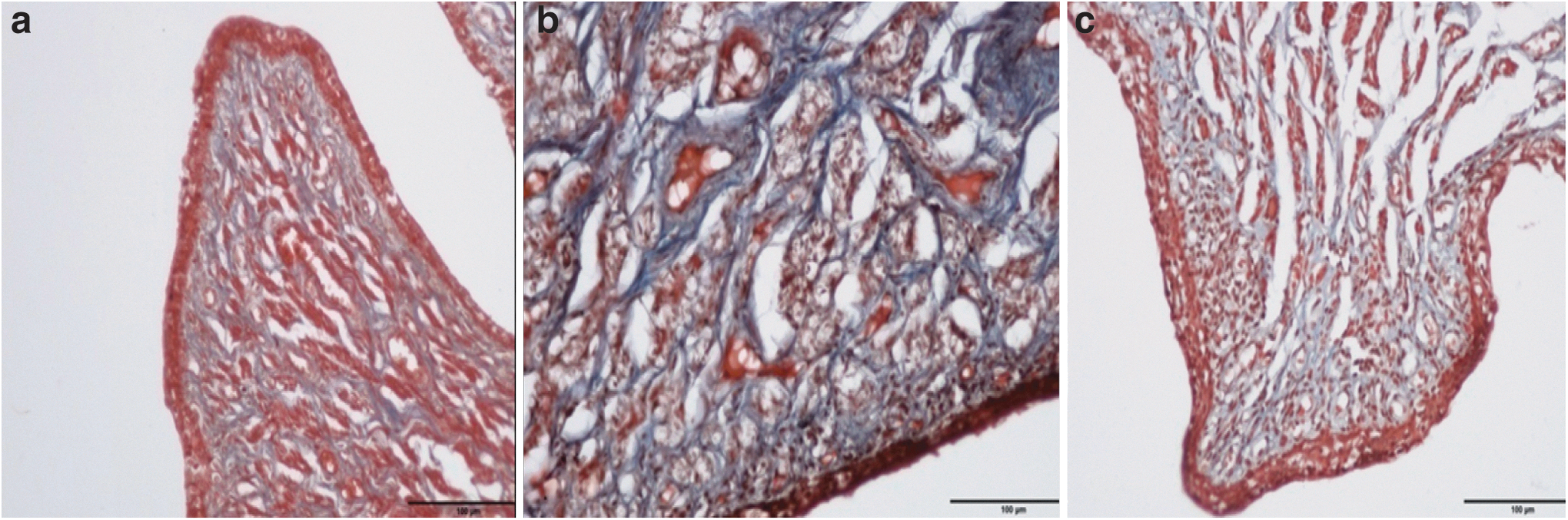
Light microscopic examination in the control group revealed inflammatory cell infiltration in the connective tissue (Fig. 1a), irregular collagen bundles, increased fibroblasts, and a moderate degree of fibrosis (Fig. 1b). Compared with controls, all treatment groups exhibited mild fibrosis, less collagen bundle irregularity, and lower numbers of fibroblasts. Capillary congestion in the MMC group was observed in the MMC group (Fig. 2a, 2b, 2c). The epithelium was generally smooth in the treatment groups.
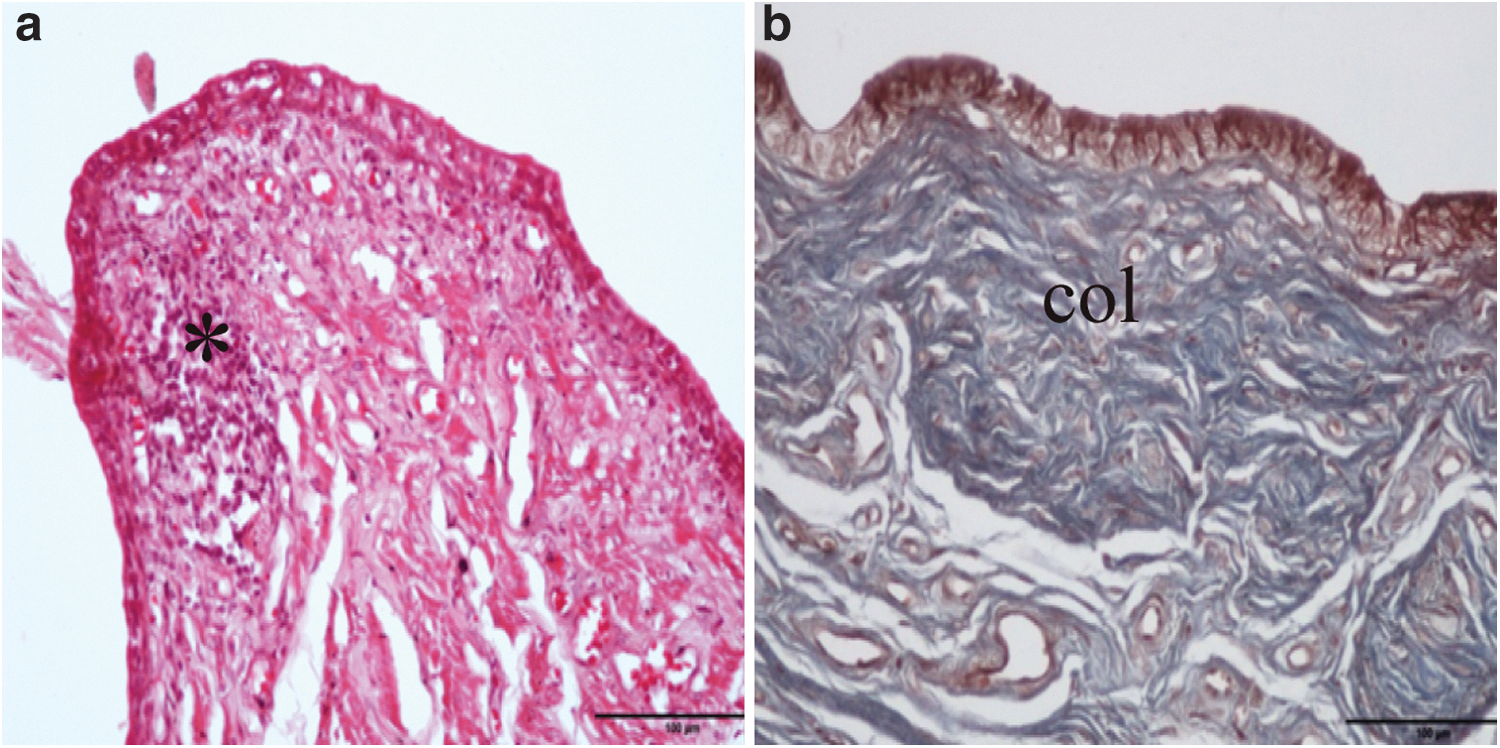
Higher numbers of inflammatory cells (*) in the connective tissue (
Reduced collagen bundles and numbers of fibroblasts (
Discussion
US is a common condition, especially in male patients. Although its frequency in the general population is 0.09%, its incidence increases with age, reaching a maximum of 1.90%. 17 Disturbances in micturition secondary to US adversely affect quality of life and can trigger a chain of events that lead to renal insufficiency. 18 Endoscopic or open surgery is widely used for the treatment of patients with US. The success rate of open surgery for anterior strictures has been reported in the high 90% range, whereas the cure rate of DVIU is lower than 10%. 3,19 Reduction of these high recurrence rates would ultimately result in an increase in patient comfort and a decrease in treatment costs. Therefore, experimental and clinical studies have been performed to explore the efficacies of different molecules for preventing US formation. 20 –22
Metalloproteinase-1 is another agent that has been used in an attempt to alleviate US after urethral injury. In one study, metalloproteinase-1 reportedly induced a lower collagen concentration in the traumatized region of the experimental group than the control group, and the researchers concluded that it contributed to the maintenance of urethral patency. 21 In another study, rapamycin was shown to be effective for inhibiting fibroblast proliferation and collagen expression. 20 Both experimental studies showed that inhibition of fibroblast proliferation and collagen expression is critical for preserving the patency of the urethral lumen. In the present study, we used similar criteria to assess the efficacy of MMC, bevacizumab, and 5-FU.
Another clinical study was conducted to evaluate the efficacy of MMC. The researchers injected MMC into the submucosa of the urethra and found that recurrence of US was lower in patients who received MMC postoperatively than in the control group. 7 The administration route of the drug has been criticized, however; some researchers have argued that such an injection could increase the complication rate and reduce the duration of the effective dose within the tissue. 23,24 Ayyildiz and colleagues 25 assessed the efficacy of MMC for preventing urethral scar by applying the agent topically to the traumatized region in rats. They concluded that locally applied MMC significantly reduced fibrosis in a dose-independent manner. We also applied MMC topically in the present study, and also found that it was effective for reducing UF.
Bevacizumab has been shown to reduce scar formation in different tissues by acting on VEGF. Its efficacy for the prevention of UF, however, has not been thoroughly investigated. Karatay and coworkers 10 applied bevacizumab topically to the dura of rats to prevent spinal epidural fibrosis after laminectomy and found that fibrosis was significantly less severe in the bevacizumab-applied group. Memarzadeh and associates 11 investigated the antifibrotic effects of this agent after trabeculectomy and suggested that it may be useful for increasing the treatment success rate and limiting scar tissue formation after trabeculectomy. On the other hand, Jian-Sheng Diao and colleagues 26 reported that overexpression of VEGF observed in the early stages of pathologic scar formation could be blocked by bevacizumab and that it can therefore be used to prevent and treat hypertrophic scarring. In the present study, scar formation was significantly less severe in the bevacizumab-treated group than in the control group, a finding that lends support to the results of the study by Jian-Sheng Diao and colleagues. 26
5-FU is a chemotherapeutic agent that inhibits fibroblast proliferation, diminishes collagen synthesis, and inhibits collagenase inhibitors. Therefore, it is used to prevent or alleviate scar formation. Crowston and coworkers 27 showed that 5-FU induced apoptosis in cultured Tenon fibroblasts and argued that it could also be used to prevent scar formation because of its apoptosis-regulating effects in fibroblasts. In another study, researchers investigated the effects of intralesional administration of 5-FU on scar formation and showed that 5-FU was effective for treating scars and preventing recurrence. 28 Mizutani and colleagues 14 explored the efficacy of 5-FU for preventing the development of stricture after endoscopic surgery of the esophagus. The authors injected the agent into the ulcer immediately after the operation and concluded that 5-FU was a good choice for preventing postoperative esophageal strictures. We preferred to use 5-FU topically to reduce the complications secondary to injection. 23 We found that this agent effectively reduced the formation of UF by topical application.
Studies in which more than one agent was used make it possible to compare the efficacy of multiple agents. Sun and associates 29 compared the efficacy of topically applied MMC and 5-FU after laminectomy and found that the extent of scar tissue and the number of fibroblasts were significantly lower in the MMC group than in the 5-FU and control groups. Esme and coworkers 30 also compared MMC and 5-FU and concluded that MMC, and to a lesser degree 5-FU, are effective for decreasing postoperative scarring after strabismus surgery in rabbits. These results suggest that antimetabolites can be used in patients with an increased risk of postoperative adhesion formation.
Ozkan and colleagues, 31 on the other hand, compared the efficacy of bevacizumab and 5-FU for preventing scar formation after laminectomy and reported that bevacizumab significantly reduced epidural fibrosis while no statistically significant difference was observed between the 5-FU and control groups. Sengupta and associates 6 examined the effects of topical MMC and bevacizumab after phacotrabeculectomy and reported significant differences between the control group and bevacizumab and MMC groups, but not between the bevacizumab and MMC groups.
In the present study, we compared the efficacy of various agents to determine whether one or more of them are superior to the others in preventing UF. Our results revealed that scar formation was least severe in the MMC group, followed by the bevacizumab and 5-FU groups. The differences among treatment groups were not statistically significant, however.
Conclusion
Topical use of MMC, bevacizumab, and 5-FU, which are frequently used in routine oncology practice, may effectively inhibit UF. There were no statistically significant differences among the three agents in preventing fibrotic reaction in the present study. Therefore, although we believe that the inhibiting effects of all three agents on UF might be beneficial for US treatment, their effects at different concentrations must be further investigated in long-term studies.
Footnotes
Disclosure Statement
No competing financial interests exist.