




Abstract
Purpose:
To evaluate outcomes of percutaneous ablation of small renal tumors in the elderly population.
Patients and Methods:
Using our tumor ablation database, we searched for percutaneous ablation procedures for clinical T1a renal masses in octogenarians and nonagenarians between June 2001 and May 2012. Altogether, 105 tumors from 99 procedures among 95 patients (mean age 84.0±3.0 years, range 80–92) were identified. Oncologic outcomes and major complications were evaluated. Assessment also included patient hospital stays and renal functional outcomes.
Results:
Technical success was achieved in 60/61 (98.4%) tumors managed with cryoablation and 43/44 (97.7%) after radiofrequency ablation (RFA). Of 87 renal tumors with at least 3 months imaging follow-up, 2 (5.4%) tumors progressed at 1.2 and 2.2 years after RFA. None recurred after cryoablation. Estimated progression-free survival rates at 1, 3, and 5 years after ablation were 99%, 97%, and 97%, respectively. Thirty-four patients died at a mean of 3.7 years after ablation (median 3.7; range 0.4–9.6). Estimated overall survival rates were 98%, 83%, and 61%, respectively. Among 33 patients with sporadic, biopsy-proven renal-cell carcinoma, estimated cancer-specific survival rates were 100%, 100%, and 86%, respectively. Five (8.6%) major complications developed after renal cryoablation with no (0%) major complication after RFA. Mean decrease in serum creatinine level within 1 week after ablation was 0.1 mg/dL. Mean hospitalization was 1.2 days.
Conclusion:
Percutaneous thermal ablation is safe and effective in the active management of clinical T1a renal masses in elderly patients. These results should help urologists appropriately assess expected outcomes when counseling octogenarian and nonagenarian patients.
Introduction
T
Given the morbidity associated with surgery in patients with limited life expectancy, active surveillance is increasingly recommended and used in elderly patients. 4 –6 Despite an expanding role of ablation in the overall management of renal masses, 7,8 however, outcome data specific to the elderly population are lacking and may influence the strategy chosen by these patients and recommended by their physicians. The goal of this study was to evaluate oncologic outcomes and morbidity after percutaneous ablation of small (≤4 cm) renal masses in patients aged ≥80 years old.
Patients and Methods
Patient selection
Our Institutional Review Board approved this retrospective study, which was compliant with the Health Insurance Portability and Accountability Act, and waived the need for informed consent of this retrospective review. Informed consent was obtained for each procedure and for prospective collection of data from patients included in our institutional tumor ablation database, however. Retrospective review of the database was conducted for consecutive percutaneous renal ablation procedures performed to treat clinical T1a renal masses in octogenarian and nonagenarian patients between June 2001 and May 2012.
Sixty-one tumors among 58 patients were treated in 58 cryoablation procedures. Forty-four tumors among 38 patients were treated with 41 RFA procedures. Altogether, 105 tumors among 95 patients treated in 99 ablation procedures were identified for study. This cohort included one patient who was treated with RFA in 2005 and cryoablation in 2006 for different renal masses. All patients were managed through the Department of Urology and offered percutaneous ablation as appropriate using available guidelines. 2 Patients were then approved for percutaneous ablation by an interventional radiologist based on technical feasibility.
Procedure
All renal tumors were managed for cure in a single session by an interventional radiologist as described previously. 9 Cryoablation became available at our institution in 2003, and since that time, percutaneous treatment of patients with larger (typically ≥3cm) and/or more central renal tumors has been performed primarily with that modality. 9 The Endocare Cryocare® system (HealthTronics, Austin, TX) was used in all cryoablation treatments in the current patient cohort. The RITA StarBurst® device (AngioDynamics, Latham, NY) was used for RFA from 2000 to 2002, and subsequently the Cool-tip™ system (Covidien, Mansfield, MA) has been used.
Procedures were performed with patients under general anesthesia in a CT suite. Applicators were placed using combined ultrasound (Acuson Sequoia, Siemens Medical Solutions, Mountain View, CA or GE Medical Systems, Milwaukee, WI) and CT (SOMATOM Sensation Open 40-slice CT, Siemens AG, Munich, Germany) guidance. Percutaneous biopsy of solid renal masses was not routinely performed prior to renal ablation before 2004. Since then, biopsy has been performed, except when the operator felt biopsy unsafe, typically because of decreased visibility after ablation applicator placement, or not indicated, as in patients with a history of pathologically proven RCC. Biopsies were performed using 18-gauge core biopsy devices (Monopty Biopsy Instrument, C.R. Bard, Covington, GA) to obtain one to three samples during the ablation procedures. Ablations proceeded before pathology results were known. Patients were admitted for overnight observation to the urology hospital service.
Follow-up
Patients were imaged with CT or MRI within 24 hours after ablation to assess for complications and technical success. In addition, contrast-enhanced CT or MRI was obtained at 3, 6, and 12 months after ablation and yearly thereafter. Technical success was defined as extension of ablation defect beyond the tumor margin with absence of residual enhancing tumor in the ablation bed on the immediate postablation examination. 10 Local tumor progression was defined as new enhancement in the ablation bed or enlargement of the ablation bed on follow-up imaging. 10 Only patients with 3 months or greater imaging follow-up (using CT or MRI) were included in evaluation for local tumor progression. Postablation biopsies were not performed.
Data collection
For each patient reviewed, data regarding age, sex, American Society of Anesthesiologists (ASA) physical status classification, tumor size, tumor location, pathology, nights of hospitalization, and complications and creatinine levels (within 1 week before ablation and 1 week after ablation) were obtained from our prospectively acquired and maintained renal ablation database through October 2013. Using a semi-automated system to analyze medical record data, the Charlson comorbidity index was calculated for each patient as described previously. 11,12 Complications were graded using the Clavien-Dindo classification to better allow comparison with surgical series with grades ≥III considered major complications. 13,14
Statistical methods
Continuous features were summarized with means, standard deviations, medians, and ranges and compared between RFA and cryoablation using Wilcoxon rank sum tests. Categorical features were summarized with frequency counts and percentages and were compared using chi-square or Fisher exact tests. Progression-free, overall, and cancer-specific survival were estimated using the Kaplan-Meier method. The duration of follow-up for progression-free survival was defined from the date of percutaneous ablation to the date of last tumor follow-up. The duration of follow-up for overall and cancer-specific survival was defined from the date of first percutaneous ablation procedure for each patient to the date of death or the date the patient was last known to be alive. Cancer-specific survival was estimated for patients with renal tumors that proved to be RCC on biopsy and that were sporadic at the time of first ablation procedure.
Statistical analyses were performed using SAS version 9.2 (SAS Institute, Cary, NC). All tests were two-sided, and P values <0.05 were considered statistically significant. Complications were assessed on a per procedure basis, local tumor progression on a per tumor basis, and survival on a per patient basis.
Results
Patient and tumor characteristics are summarized in Table 1. Patient characteristics were similar between those treated with RFA and cryoablation. Larger (P<0.001) and more central (P<0.001) tumors were treated preferentially with cryoablation. Single technical failures occurred in the treatment of patients with renal masses using cryoablation (1/61; 1.6%) and RFA (1/44; 2.3%).
RFA=radiofrequency ablation; SD=standard deviation; ASA=American Society of Anesthesiologists.
Progression-free survival
Fifty tumors managed with cryoablation were followed with imaging for at least 3 months. Of these, none recurred after a mean of 2.0 years of follow-up (median 1.9; range 0.3–6.2). Thirty-seven tumors managed with RFA were followed with imaging for at least 3 months. Of these, two showed local tumor progression at 0.5 and 1.2 years after RFA, respectively. Altogether, 87 tumors were followed for at least 3 months. The mean duration of follow-up for the 85 tumors that did not recur was 2.9 years (median 2.3; range 0.3–8.9). Estimated progression-free survival rates (95% confidence interval [CI]; number still at risk) at 1, 3, and 5 years after cryoablation or RFA were 99% (96–100; 72), 97% (94–100; 32), and 97% (94–100; 17), respectively (Fig. 1A).
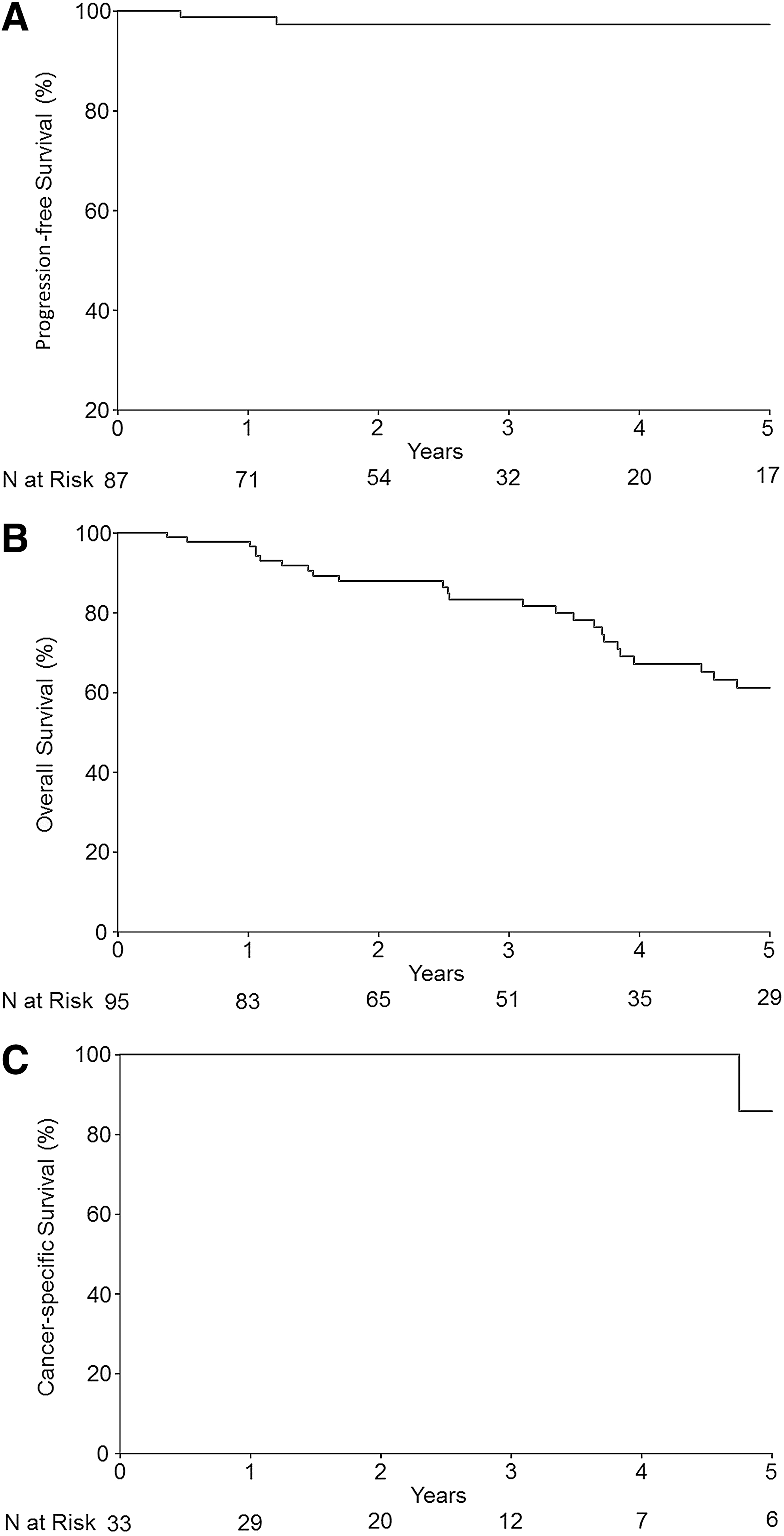
Kaplan-Meier curves estimating survival characteristics for octogenarian and nonagenarian patients after renal cryoablation or radiofrequency ablation, including (
Overall and cancer-specific survival
Of the 95 patients included in the study, 34 died at a mean of 3.7 years after cryoablation or RFA (median 3.7; range 0.4–9.6). Among the 61 patients who were still alive, the mean duration of follow-up was 3.7 years (median 2.8; range 0.1–9.3). Estimated overall survival rates (95% CI; number still at risk) at 1, 3, and 5 years were 98% (95–100; 83), 83% (75–92; 51), and 61% (50–75; 29), respectively (Fig. 1B). At the time of their first procedures, 33 patients had sporadic, biopsy-proven RCC, including one patient who died from RCC at 4.8 years. This patient had a centrally located 3.9 cm clear-cell RCC treated with a single RF applicator for 20 minutes early in our experience. Local recurrence at 10 months after ablation led to subsequent radical nephrectomy and development of metastatic disease 4 years later. Estimated cancer-specific survival rates (95% CI; number still at risk) at 1, 3, and 5 years for this subset were 100% (100–100; 29), 100% (100–100; 12), and 86% (63–100; 6), respectively (Fig. 1C).
Complications, hospital stays, and renal functional outcomes
Patient complications, hospital stay data, and renal functional outcomes are summarized in Table 2. Overall complication rate was 13%. Five (8.6%) cryoablation procedures resulted in major complications, while no RFA procedure resulted in a major complication (P=0.17). The major renal cryoablation complications included three retroperitoneal hemorrhages that necessitated postablation renal angiography and embolization, including two that were immediate and one that was treated after 9 days because of persistent hematuria. Additional major complications included one intra-abdominal abscess detected on a 1-month postablation CT scan, which was drained and subsequently resolved in 6 weeks, and a pneumothorax, which was successfully managed with overnight percutaneous catheter drainage. Patients with major complications did not have significantly higher mean Charlson comorbidity indices (3.4±3.7 vs 2.1±2.3, P=0.22) or ASA scores (2.8±0.5 vs 2.8±0.4, P=0.93) compared with those without major complications.
Cr=serum creatinine.
Among the 99 procedures, the mean hospital stay was 1.1±0.5 days (median 0.5; range 0–3) after RFA and 1.2±0.7 days (median 1; range 1–5) after cryoablation (P=0.22). Eighty-two (83%) patients were hospitalized for 1 day, 11 (11%) patients for 2 days, and 3 (3%) patients for 3 to 5 days after either cryoablation or RFA. Hospital stays were not significantly longer for patients with major complications compared with those without major complications (1.2±0.5 vs 1.1±0.4, P=0.73). Renal function as measured by serum creatinine level did not change significantly after cryoablation or RFA, with mean decreases in serum creatinine level of 0.1±0.3 mg/dL and 0.1±0.2 mg/dL, respectively.
Discussion
The management of small renal masses in the elderly population is a complex topic because of competing clinical concerns and evolving techniques. Elderly patients often have limited life expectancy, have higher rates of comorbidities, are frequently poor surgical candidates, and commonly die of causes other than incidentally discovered, localized RCC. 5,15 Thus, the potential for complications from active management may outweigh the oncologic benefits of extirpative or ablative therapy.
The current study shows that percutaneous renal ablation is a safe procedure in octogenarian and nonagenarian patients. Few patients experienced major complications, and hospital stays were short. Morbidity and hospital stays for elderly patients after renal surgery vary in the literature, in part because of differing tumor sizes and surgical approaches in reported series. Many authors have concluded that renal surgery is safe in the elderly population with complication rates comparable to those obtained with younger patients. 16 –20 Others have shown that elderly patients experience overall complication rates, however, up to 32% to 47%, 15,21 –23 major complication rates up to 17.2% to 26.7%, 21,24 and mortality rates up to 1.7% to 8.1%. 15,16,21
Hospital stays are typically longer for elderly patients after renal surgery, ranging from 3.4 to 10.5 days in several series. 15,17,19,20,22,25,26 Many authors have noted that surgical complication rates correlate more with patient comorbidity than increasing age, 15,16,21,27 and essentially all series show increased comorbidity within the elderly population facing treatment for renal masses.
The current study also showed little change in serum creatinine levels after ablation. Renal preservation is critical because the adverse cardiovascular implications from decreased renal function after intervention are paramount in older and patients with comorbidities. 28 –30 According to current guidelines, radical nephrectomy remains a treatment standard for clinical T1a renal masses if partial nephrectomy is not technically feasible, despite the negative effects of renal functional decline. 2 Unfortunately, a review of the Surveillance, Epidemiology, and End Results database revealed that octogenarians with stage T1aN0M0 disease were more likely to undergo radical nephrectomy compared with younger patients. 31 This may relate to selection bias, concerns regarding complication rates of partial nephrectomy, or technical demands of partial nephrectomy. 32
High progression-free and cancer-specific survivals in our study demonstrate that ablation is also efficacious in this group. These oncologic outcomes compare favorably with those reported in other percutaneous ablation series in a more general population. Long-term recurrence- or progression-free survival rates of 88% to 95.2% have been reported after RFA 33,34 and 97% for cryoablation. 35 These rates are also similar to the local progression-free survival rates after surgery in general populations. 2,36 Psutka and associates 33 found that old age (>75 years) and comorbidity (Charlson score >4) did not adversely affect disease-free survival after renal RFA in multivariate analysis. 33
Estimated overall survival at 5 years in the current elderly cohort was moderate at 61%, underscoring the comorbidity within patients of advanced age. This rate is lower than reported overall survival in long-term ablation series in general populations at 66% to 97.8%. 33 –35 Our reported overall survival rates, however, are comparable with other dedicated studies of treated elderly patients with renal tumors. 4,5
Active surveillance is increasingly advocated for elderly patients with small renal masses because of their comorbidities and shorter life expectancies. 1,4,5,37 This approach is supported by studies showing active treatment of patients with localized renal tumors not to be associated with increased overall survival compared with active surveillance in the elderly. 5,37 Both surgical and ablative nephron-sparing approaches, however, have generally been combined in these analyses. For elderly patients with reasonable life expectancy, observation may not be acceptable to patients themselves or their physicians. The current study validates ablation specifically within the elderly population. It may be that percutaneous ablation represents an attractive “middle ground” as an active intervention for elderly patients in whom more aggressive, surgical therapy may not be warranted because of the risk of morbidity and mortality. Likewise, ablation may be appropriate for elderly patients whose incidental tumors demonstrate significant growth after an initial period of observation.
The current study has several limitations, including its retrospective design. Some patients had insufficient imaging follow-up to evaluate for local tumor progression, and some patients did not have serum creatinine levels recorded to assess for functional changes. A large number of tumors were not biopsied or had nondiagnostic biopsies and could not be used for evaluation of cancer-specific outcomes. Also, because our institution does not maintain a registry of patients undergoing active surveillance for renal masses, outcomes could not be compared between these two patient populations; such a comparison would be important to elucidate any potential survival benefit of thermal ablation vs observation alone.
Conclusion
Percutaneous ablation is a safe and effective option in the active management of clinical T1a renal masses in elderly patients. Thus, the role of renal ablation in current management algorithms may warrant greater emphasis in this patient population.
Footnotes
Disclosure Statement
Matthew Callstrom has received research support from Galil Medical, GE Medical, Siemens Medical, and Thermedical. He is also a consultant for Covidien, Endocare, and Medtronic. No competing financial interests exist for the remaining authors.