




Abstract
Purpose:
To assess the degree of postoperative storage symptoms after GreenLight™ laser photoselective vaporization of the prostate (PVP) and Holmium laser enucleation of the prostate (HoLEP) for management of benign prostatic hyperplasia (BPH) and its predictors.
Methods:
A retrospective review was performed for patients who underwent HoLEP or PVP for non catheter-dependent patients with BPH. Patients were followed up at 1, 3, 6, and 12 months and then annually by International Prostate Symptoms Score (IPSS), quality of life index, peak flow rate, residual urine volume, and prostate-specific antigen (PSA) level. Moderate or severe storage symptoms were defined as IPSS storage subscore ≥9.
Results:
Of 1673 laser procedures, a total of 1100 procedures met the inclusion criteria including 809 HoLEPs and 291 PVPs. The HoLEP group had significantly larger preoperative prostates and longer operative time. In the HoLEP group, postoperative IPSS was significantly better than in the PVP group at all follow-up points (P<0.05). Storage subscore was significantly higher after PVP and did not improve until 6 months postoperatively when it became comparable with that of the HoLEP group. The number of patients with IPSS-storage score ≥9 were significantly higher in the PVP group at 1 and 3 months follow-up (37.3% vs 15.1%, P<0.001) and (26.4% vs 17.5%, P=0.004), respectively. XPS-180W was associated with the lowest storage symptoms among the three GreenLight generations at all follow-up visits. In multivariate analysis, baseline IPSS-storage subscore ≥9, prolonged operative time >100 minutes, and lower percent of postoperative PSA level reduction significantly predicted less improvement of postoperative storage symptoms regardless of the laser procedure.
Conclusion:
Storage urinary symptoms significantly improved more after HoLEP compared with PVP, irrespective of the generation of GreenLight laser used. Recovery from bothersome storage urinary symptoms after prostate vaporization is time dependent, and baseline degree of storage symptoms, prolonged operative time, and lower percent of postoperative PSA level reduction negatively predicts postoperative improvement of storage symptoms regardless of the laser procedure.
Introduction
I
The laser energy applied during these procedures, however, might be associated with postoperative urgency or dysuria, 7 which could be even more bothersome with increasing severity of the storage symptoms. 8,9 Despite the fact that voiding dysfunction associated with BPH adversely affects quality of life (QoL), storage symptoms in particular are more troubling than voiding symptoms and could significantly interfere with the patients' daily activities. 10 The Proscar Long-term Efficacy and Safety Study showed that the storage subscore and overall symptom score can usefully predicts the outcome of BPH-related surgery in men who had not experienced a preceding episode of acute urine retention. 11
Improvement of voiding symptoms after TURP was more obvious, 12 while storage symptoms may persist or worsen in a considerable number of patients. 8 Currently, there is discrepancy of data regarding the temporary exacerbation of bladder storage symptoms after prostate vaporization in comparison with prostate enucleation. Bladder storage symptoms significantly improved after GreenLight laser PVP in men with detrusor overactivity (DO) more than those without DO. 13 Dybowski and colleagues, 14 however, recently reported that DO could not predict improvement of storage symptoms after PVP unless accompanied by severe urgency.
To the best of our knowledge, data on postoperative storage symptoms after 1 year are lacking, particularly after different laser prostatectomy procedures. Furthermore, the impact of different generations of GreenLight laser on postoperative storage symptoms has not been previously reported. Therefore, the aim of the present study was to compare the degree of change of storage symptoms after PVP and HoLEP and to assess factors that could predict improvement of postoperative symptoms in a large series of patients. In addition, a subgroup analysis was performed to differentiate the impact of the three GreenLight laser generations on the postoperative storage symptoms.
Methods
Study design and patient enrollment
A prospectively maintained laser prostate database was reviewed for patients undergoing HoLEP and PVP for management of symptomatic BPH between March 1998 and July 2014. All patients were operated on or supervised by a single surgeon (MME). Patients undergoing PVP were treated with potassium-titanyl-phosphate (KTP)/80W, high performance system (HPS)/120W, and Xcelerated performance system (XPS)/180W laser systems (AMS, Minnetonka, MN). HoLEP was performed using a100W holmium laser (Versapulse; Lumenis Inc., Santa Clara, CA) with a 550-μm quartz end-firing fiber (SlimLine™ 550, Lumenis Inc.).
Data collection and preoperative workup
Patients were excluded from data analysis if they presented with urethral catheters secondary to urinary retention or if they had urethral stricture, previous prostate surgery, prostate cancer, or known history of neurogenic voiding dysfunction. Patients were followed up at 1, 3, 6, and 12 months postoperatively and then annually. Demographic and preoperative data included age at surgery, presentation, presence of diabetes mellitus or coagulopathy, use of any medications for treatment of BPH, history of previous operation of the lower urinary tract including the prostate.
Baseline data included prostate volume determined by transrectal ultrasonography, International Prostate Symptom Score (IPSS), QoL, peak flow rate (Qmax), postvoiding residual (PVR) urine volume, and prostate-specific antigen (PSA) level. Change in PSA level was used as a surrogate measure for the reduction in postoperative prostate volume.
The subtotal voiding and storage symptom scores of the IPSS were compared within and between groups, including the frequency, urgency, and nocturia scores. Moderate or severe storage symptoms were defined as IPSS storage score ≥9. 14
Outcome measures
The primary outcome of the current study was to assess the pattern of improvement of storage symptoms at 1, 3, 6, and 12 months after HoLEP and PVP and to determine the possible covariates influencing postoperative improvement. The secondary outcome was to compare the impact of the three different generations of GreenLight laser on the postoperative storage symptoms at different times of follow-up.
Statistical analysis
Descriptive statistics were reported in terms of number and percentages or means/standard deviation for categoric and continuous variables, respectively. The Fisher exact test was used to compare categoric variables. Baseline and follow-up continuous data were compared with the paired t-test. Continuous variables were compared using an independent t-test, Mann-Whitney U test and Kruskal-Wallis H test, depending on data distribution. The significant variables in the univariate analyses were further included in a multivariate logistic regression model to determine possible covariates influencing improvement of postoperative storage symptoms. Multivariate regression analysis included prostate volume, type of laser procedure, preoperative IPSS, and QoL, lasing energy, operative time, and percent PSA reduction at 12 months.
Links between quantitative variables were measured by the Spearman rank correlation coefficient with a critical two-sided P value <0.05 used for statistically significant differences. Data were analyzed using the commercially available Statistical Package for Social Sciences for windows, version 20 (IBM© SPSS, Armonk, NY).
Results
Of 1673 HoLEP and PVP procedures that were performed between March 1998 and July 2014, 1100 patients were included in the final analysis, including 809 patients undergoing HoLEP and 291 patients undergoing PVP (74 KTP/80W, 133 HPS/120W, and 84 XPS/180W). Preoperatively, patients undergoing HoLEP had significantly larger prostates (94.9±50.3 vs 49.9±25.3 cc, P<0.001), higher PSA levels (5.79±10.1 vs 3.22±9.5 ng/mL, P<0.001), higher total IPSS (19.6±6.8 vs 18.3±7.7, P=0.026), and longer operative time (101.5±45.2 vs 65.7±34.9 min, P<0.001). Otherwise, both groups were comparable in all other perioperative parameters (Table 1).
HoLEP=holmium laser enucleation of the prostate; PVP=photoselective vaporization of the prostate; ASA=American Society of Anesthesiologists; PSA=prostate-specific antigen.
The total IPSS, including its subscores, QoL index, and PVR significantly decreased in both HoLEP and PVP groups compared with baseline values, starting at the first month postoperatively. PSA reduction at 12 months was significantly lower in the HoLEP group compared with the PVP group (81% vs 34%, P<0.001). Moreover, Qmax significantly improved in both groups immediately after the surgical procedure.
Improvement of the IPSS-storage subscore, however, started at the first month follow-up visit only in patients undergoing HoLEP compared with its baseline values (5.2±3.1 vs 8.6±3.4, P<0.001) and maintained its significant improvement at all subsequent follow-up visits. This pattern of changes in IPSS-storage subscore was not similarly achieved in patients undergoing PVP. The storage subscore was comparable with its baseline levels in the PVP group until the 6-month follow-up visit; (8.1±3.2 vs 8.5±3.4, P=0.27) and (8.6±3.8 vs 8.4±3.2, P=0.34) at 1 and 3 months, respectively.
Compared with the PVP group, HoLEP patients had significantly lower postoperative total IPSS score up to 36 months and significantly lower IPSS-storage subscore until the 3-month follow-up visit. At the 6-month follow-up, the IPSS-storage subscore significantly improved from its baseline records for the PVP group and became comparable with that of patients undergoing HoLEP (Figs. 1, 2). After 24 months, however, the IPSS-storage subscore significantly decreased more in the HoLEP group than in those undergoing PVP, where it started to rise again in the latter group (Table 2 and Fig. 1).

Changes in the International Prostate Symptom Score (IPSS) and its subscores at different follow-up times between holmium laser enucleaction of the prostate (HoLEP) and photoselective vaporization of the prostate (PVP).
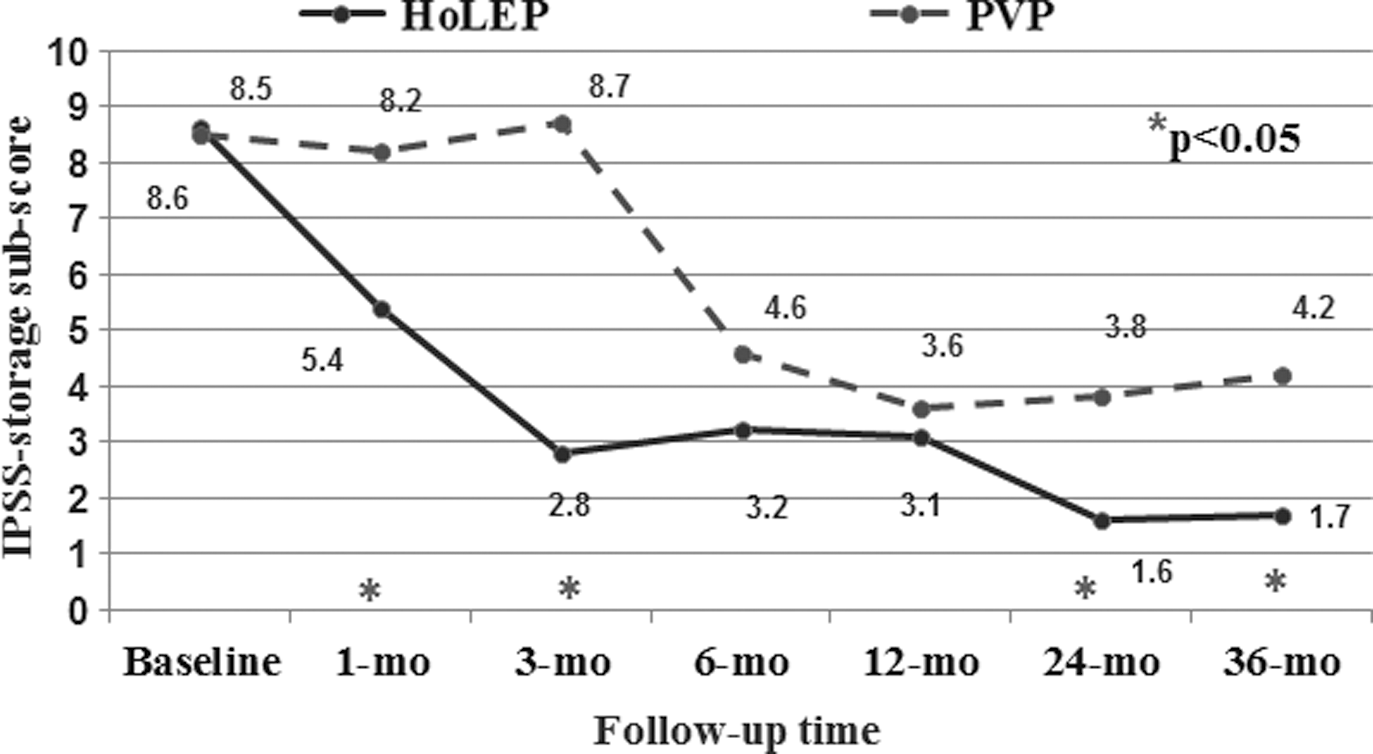
Changes in IPSS-storage subscores at different follow-up times between HoLEP and PVP.
IPSS=International Prostate Symptoms Score.
Similarly, the QoL index score and PSA levels were significantly lower in patients undergoing HoLEP in comparison with the PVP group at all follow-up visits apart from the 6-month visit when both variables were comparable between both groups. In terms of severity, the number of patients with IPSS-storage subscore ≥9 were significantly higher in the PVP group at the 1 and 3 month follow-ups (37.3% vs 15.1%, P<0.001) and (26.4% vs 17.5%, P=0.004), respectively. There was a positive moderate correlation between the baseline IPSS-storage subscore and its postoperative values after 3 months (r=0.67) and (r=0.53), 6 months (r=0.56) and (r=0.48), and 12 months (r=0.41) and (r=0.43) in PVP and HoLEP groups, respectively. This means that the higher the baseline storage scores, the higher the follow-up scores.
At the most recent follow-up, patients undergoing HoLEP and PVP were respectively comparable in terms of reoperation rates (4.3% vs 7.2%, P=0.06) for recurrent obstructing adenoma (1.1% vs 2.7%, P=0/09), bladder neck contracture (1.2% vs 2.7%, P=0.10) and de novo urethral stricture (2% vs 1.7%).
Perioperative parameters among the three different GreenLight generations are described in Table 3. The XPS/180W was associated with the lowest storage symptoms among the three GreenLight laser generations at all follow-up visits. These differences were statistically significant starting at the first month postoperatively, and then they became comparable until the 12-month follow-up. At the 24-month visit, however, the XPS laser regains its significantly lower storage symptoms compared with KTP and HPS (Fig. 3).
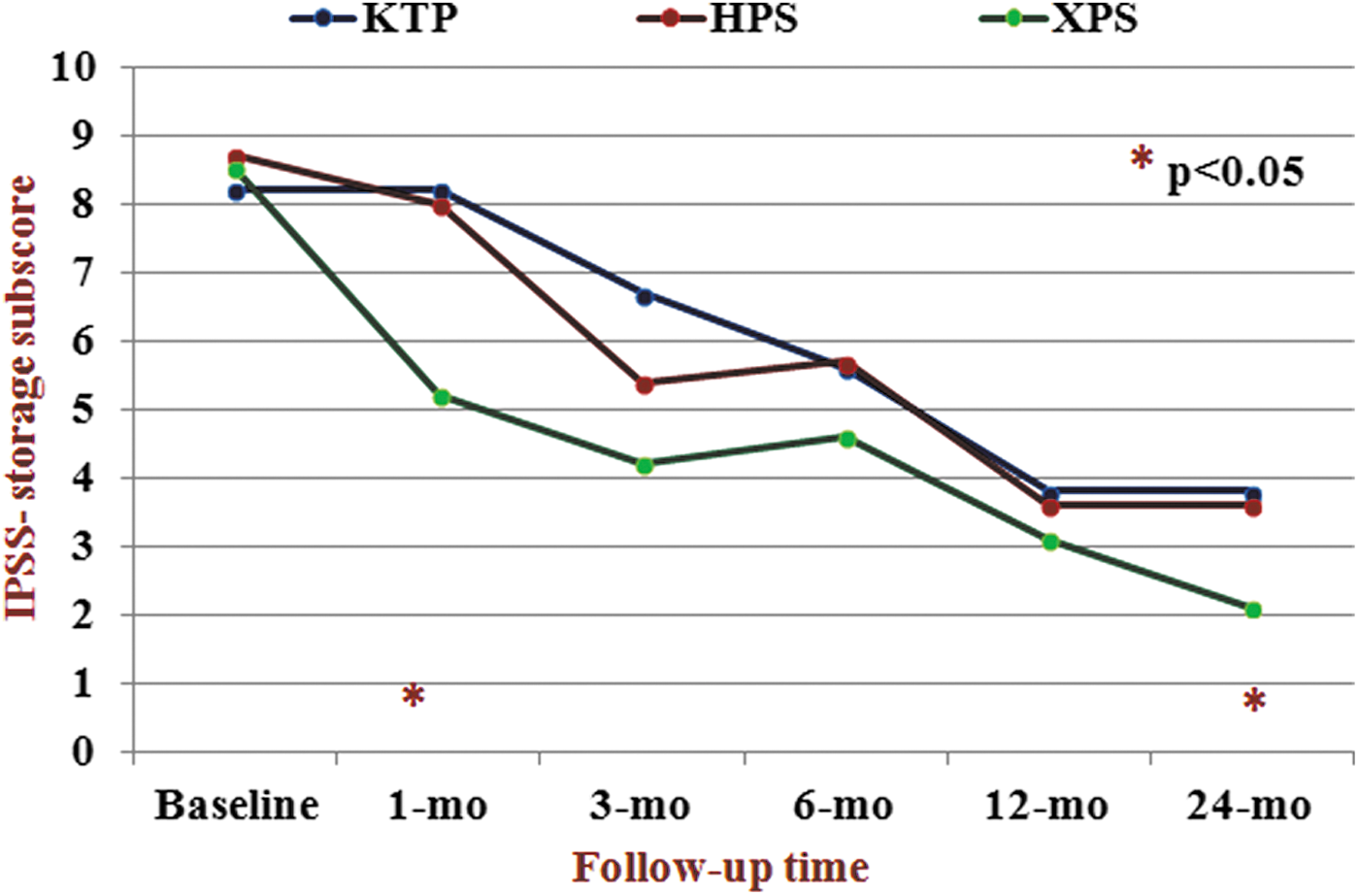
Changes in IPSS-storage subscores among the three GreenLight laser generations at different follow-up points. KTP=potassium-titanyl-phosphate; HPS=high performance system; XPS=Xcelerated performance system.
KTP=potassium-titanyl-phosphate; HPS=high performance system; XPS=Xcelerated performance system.
After adjusting for the prostate size and baseline IPSS in multivariate analysis, the baseline IPSS-storage subscore ≥9 (adjusted odds ratio [aOR], 95% confidence interval: 1.65 [1.32–2.18], P<0.001), prolonged operative time >100 minutes (aOR: 1.28 [1.09–1.44], P=0.04), and the percent reduction of PSA <50% (aOR: 3.24 [1.86–4.52], P=0.01) were significantly associated with less improvement of postoperative storage symptoms in patients undergoing laser prostatectomy.
Discussion
Storage symptoms secondary to BPH could result from structural and/or functional changes of the urinary bladder induced by bladder outlet obstruction that show variable degrees of improvement after BPH surgery. 15
Most of the reported data about post-PVP storage symptoms included only the earlier generations of GreenLight HPS laser, with sparse data of GreenLight XPS. 14 The discrepancy in the temporary exacerbation or persistence of bladder storage symptoms especially after PVP in comparison with HoLEP and the paucity of detailed data that differentiate the outcomes after the three GreenLight laser generations were the main rationale to present the current study.
Despite the multifactorial pathophysiology of lower urinary tract symptoms, including storage symptoms, some authors tried to explain improvement of these symptoms after relief of obstruction. A decrease in the PVR urine may increase the time for bladder filling with consequent reduction in frequency and nocturia. 16 Cho and associates, 17 however, found that urgency was the last symptom to show improvement after PVP and was associated with an improvement of patient QoL. This might explain the persistence or even aggravation of storage bladder symptoms in some patients undergoing PVP.
Previous studies on TURP showed that storage symptoms might remain in up to 25% of patients, 18 which could be negatively predicted by the baseline DO. 19 In another study, storage symptoms significantly improved after KTP GreenLight laser PVP in men with DO, 15 especially when accompanied by severe urgency. 14
Our results confirm the significant improvement of storage urinary symptoms after HoLEP compared with GreenLight laser PVP, irrespective of the type of GreenLight laser applied. Whereas storage symptoms significantly improved early post-HoLEP, starting from the first postoperative month, patients undergoing GreenLight laser PVP may have to wait at least for 3 months postoperatively to have their storage symptoms relieved. This was consistent with what has been recently reported after KTP/80W and HPS/120W. 14,17,20 Moreover, the severity of initial storage symptoms was associated with persistent storage symptoms after GreenLight PVP as previously reported. 14,20
Cho and coworkers, 17 however, reported that post-PVP improvement was more obvious in patients with severe baseline storage symptoms compared with those with less severe symptoms, despite the positive correlation coefficients reported by the authors. Positive correlation means that an increase or decrease in one variable always predicts the same directional change for the second variable.
This has been confirmed by multivariate regression analysis reported by Choi and colleagues 20 where the higher initial storage symptoms score has an OR of 8.32 for persistent storage symptoms after KTP. Similarly, severe preoperative urgency predicted persistent storage symptoms and decreased QoL after HPS/XPS-PVP. 14 These findings support our data that baseline IPSS-storage subscore ≥9 negatively predicted improvement of postoperative storage symptoms.
As expected, the QoL index of our patients who underwent PVP was significantly worse than those undergoing HoLEP as a result of their significantly higher storage symptoms until the 6-month visit when the storage bladder symptoms became comparable between both groups. Therefore, irritative bladder symptoms in particular adversely affect QoL because they are more troubling than voiding symptoms and significantly interfere with the patients' daily activities. Data from a randomized urodynamic-based trial showed significant storage symptoms of limited duration (3–12 months) in patients undergoing PVP (120W/HPS) when compared with TURP. 21
It seems that the recovery of detrusor function after a surgical procedure for BPH may be influenced by the degree of de-obstruction. After prostate enucleation, we obtain more reduction of prostate volume in comparison with prostate vaporization. This was supported in the current study by the fact that the HoLEP group regained significantly lower values of storage symptoms subscore at the 24-month follow-up compared with PVP. Moreover, postoperative PSA reduction could be used as a surrogate for the amount of tissue removed. Therefore, the significantly greater reduction in PSA after 12 months in our HoLEP group in comparison with those undergoing PVP (81% vs 34%, P<0.001) may confirm the impact of de-obstruction on postoperative storage symptoms.
Similarly, among the PVP group, the more powerful XPS-180W GreenLight resulted in significantly lower values of storage symptoms subscore at the 24-month follow-up compared with KTP/80W and HPS/120W. This is supported by the recently reported randomized controlled trial that IPSS storage and voiding subscores were comparable between HoLEP and vapoenucleation of the prostate using GreenLight laser XPS/180W at different follow-up points, starting at the first month postoperatively. 22
Of interest, the type of GreenLight laser applied in the current study did affect post-PVP outcomes of storage symptoms despite the significantly higher operative time and total energy used with the latest XPS/180W generation. This could be explained by the significantly lower lasing time associated with XPS laser because of the increased learning curve in comparison with the previous GreenLight laser generations. This further may support the results of improvement of storage symptoms after enucleation more than vaporization procedures considering that most XPS/180W involved vapoenucleation of the prostate.
This study is limited by its retrospective nature and the lack of urodynamic workup to identify the impact of DO on storage symptoms. Moreover, the significantly larger preoperative prostate size and higher PSA in patients undergoing HoLEP represent a selection bias, which may impact the comparison between the groups. The multivariate analysis, however, was performed to adjust for such confounders, including baseline IPSS. Nevertheless, to our knowledge, this is the first study to compare the impact of the three different generations of GreenLight laser on the storage symptoms after PVP. Moreover, this study presents a follow-up for the storage symptoms beyond 12 months, giving long-term expectations of these symptoms.
Conclusion
Storage urinary symptoms significantly improved after HoLEP compared with GreenLight laser PVP, irrespective of the type of GreenLight applied. Patients undergoing GreenLight PVP may have to wait at least for 3 months postoperatively to have their storage symptoms relieved. The XPS/180W was associated with the lowest storage symptoms among the three GreenLight laser generations. Baseline IPSS-storage subscore ≥9, prolonged operative time, and lower percent of postoperative PSA reduction negatively predicted improvement of postoperative storage symptoms regardless of the type of laser procedure. This should be considered in choosing the appropriate option for treatment of patients presenting with severe storage voiding symptoms, and should be discussed with the patients before the surgical procedure.
Footnotes
Author Disclosure Statement
No competing financial interests exist.