




Abstract
Introduction:
The current experimental study aimed into evaluating the temperature raise of the irrigation fluid caused by the use of the Thulium:Yttrium aluminum garnet (Tm:YAG) laser. The study setting was designed to replicate conditions of upper urinary tract (UT) surgery.
Materials and Methods:
An experimental setting was designed for the investigation of differences in the temperature of the irrigation fluid in different flow rates, laser power settings, and laser activation times and modes. The experimental configuration included a burette equipped with a micrometric stopcock, a thermocouple, and a modified 40-mL vessel. A Tm:YAG and Holmium:Yttrium aluminum garnet (Ho:YAG) laser devices were used.
Results:
The Tm:YAG in the continuous mode and in power settings of 5, 10, and 20 W showed similar temperature changes during the 10-minute observation period. The temperatures of the Tm:YAG in the pulsed mode tended to range within similar levels (46.8°C–61°C) with the continuous mode (47.8°C–68°C) when power settings up to 20 W were considered. When the higher power settings (50 and 100 W) were investigated, the temperatures reached were significantly higher in both pulsed and continuous modes. The Ho:YAG showed similar temperatures in comparison to the Tm:YAG in all the flow rates and power settings. The temperatures ranged between 45.6°C and 68.7°C.
Conclusion:
The Tm:YAG in the pulsed and continuous mode with power settings up to 20 W seemed to have potential for UT use. By combining a power setting at the above limit and a low flow rate (as low as 2 mL/minute), it is possible to use the Tm:YAG with safety in terms of temperature.
Introduction
T
Materials and Methods
An experimental setting was designed to investigate differences in the temperature of the irrigation fluid in different flow rates, laser power settings, and laser activation times and modes. For the study, a Revolix 200 Tm:YAG Laser system (Lisa Laser Products OHG, Katlenburg-Lindau, Germany) and a Rhapsody H-30 Holmium:Yttrium aluminum garnet (Ho:YAG) Laser system (COOK Medical, Limerick, Ireland) were used.
Small-volume vessel setting
The setting included a common urine collection vessel modified by puncturing small holes at the level of 40 mL volume (Fig. 1). The vessel was filled with saline, and the holes allowed the outflow of any excessive fluid during the experiment so that the volume in the vessel is maintained at 40 mL. The selection of the volume was based on the volume of the pelvicaliceal system.
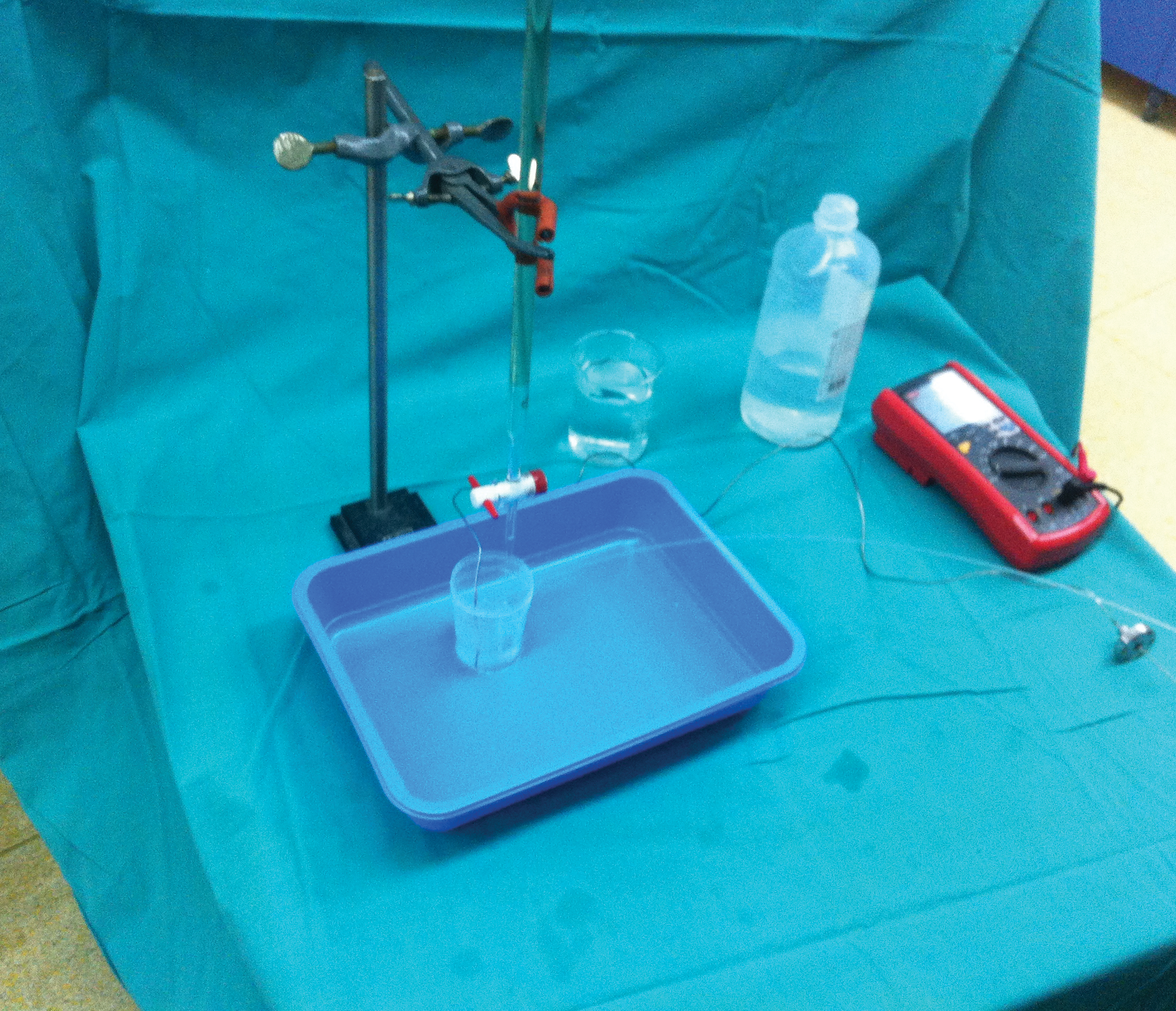
The experimental setup for the performance of the experiment with the 40-mL vessel. The 50-mL burette equipped with micrometric stopcock saline controlled the volumetric flow rate. A vessel with 40 mL saline was placed under the burette in a bath. A type K thermocouple was immersed in the saline vessel. Color images available online at
A 50-mL burette equipped with micrometric stopcock saline was used for the volumetric flow rate tuning. The initial volume of burette was maintained at 40 mL, and the proper tuning of the ball valve allowed controlling the liquid flow rate from values as low as 0.5 mL/minute to 60 mL/minute. During the experiment, the burette provided saline with the desired flow rates in the saline vessel while a laser fiber was immersed in the saline vessel and was activated according to the desired protocol settings. Variations of the temperature of the saline imposed by laser heating were monitored by using a type K (chromel–alumel) thermocouple (UT700; Uni-Trend Technology, Kowloon, Hong Kong), which was immersed in the saline vessel. The laser device and flow parameters are presented in Table 1.
Before the initiation of the experiments, the thermocouple was calibrated to the temperature of the saline, which was 22°C, and measured differences in the saline temperature during the activation of the fiber for 1, 2, 5, and 10 minutes. The saline in the vessel was exchanged after each measurement to reset the temperature indication of the thermocouple. Measurements for each setting were performed thrice, and the average values were calculated. An OptiLite 273 nm (COOK Medical) and a 271 nm Laser fiber (Lisa Laser Products OHG) were used for the Rhapsody device and Revolix devices, respectively.
Results
Continuous mode
The Tm:YAG showed linear increase of irrigation fluid temperature during the 10-minute observation period, regardless of the power settings and flow rates (Table 2 and Fig. 2). The Tm:YAG in power settings of 5, 10, and 20 W showed similar temperature changes during the observation period. The 5 and 10 W power settings had practically an identical curve in all flow rates. The 50, 100, and 200 W power settings resulted in a steeper curve showing a faster increase of the temperature in all flow rates. The 100 W showed a rapid increase in temperature, especially in the flow rates of 2, 5, and 10 mL/minute. The 200 W setting was characterized by a rapid increase of the temperature in all flow rates and reached the point of 100°C at 2 minutes of activation. It should be noted that the temperatures were higher than 48°C, regardless of the power setting and the flow rate within the first minute.

Temperature changes with Thulium:Yttrium aluminum garnet (TM:YAG) laser in the continuous mode.
ΔT represents the difference in temperature measured by the thermocouple. The initial temperature of the irrigation fluid was 22°C.
Pulsed mode
The Tm:YAG with 5, 10, and 20 W power settings resulted in almost uniform temperature throughout the 10-minute period in all flow rates. The temperature increase ranged between 24.8°C and 32.9°C (Table 3 and Fig. 3). These settings practically reached a plateau that remained throughout the 10-minute period after an initial temperature increase, which took place within the first minute of the investigations. The 50 and 100 W power settings resulted in a rapid increase of the temperature and in high temperatures reaching 100°C at the lowest flow rate. The temperatures of the Tm:YAG in the pulsed mode tended to range within similar levels (46.8°C–61°C) with the continuous mode (47.8°C–68°C) when power settings up to 20 W were considered. When the higher power settings (50 and 100 W) were investigated, the temperatures reached were significantly higher.
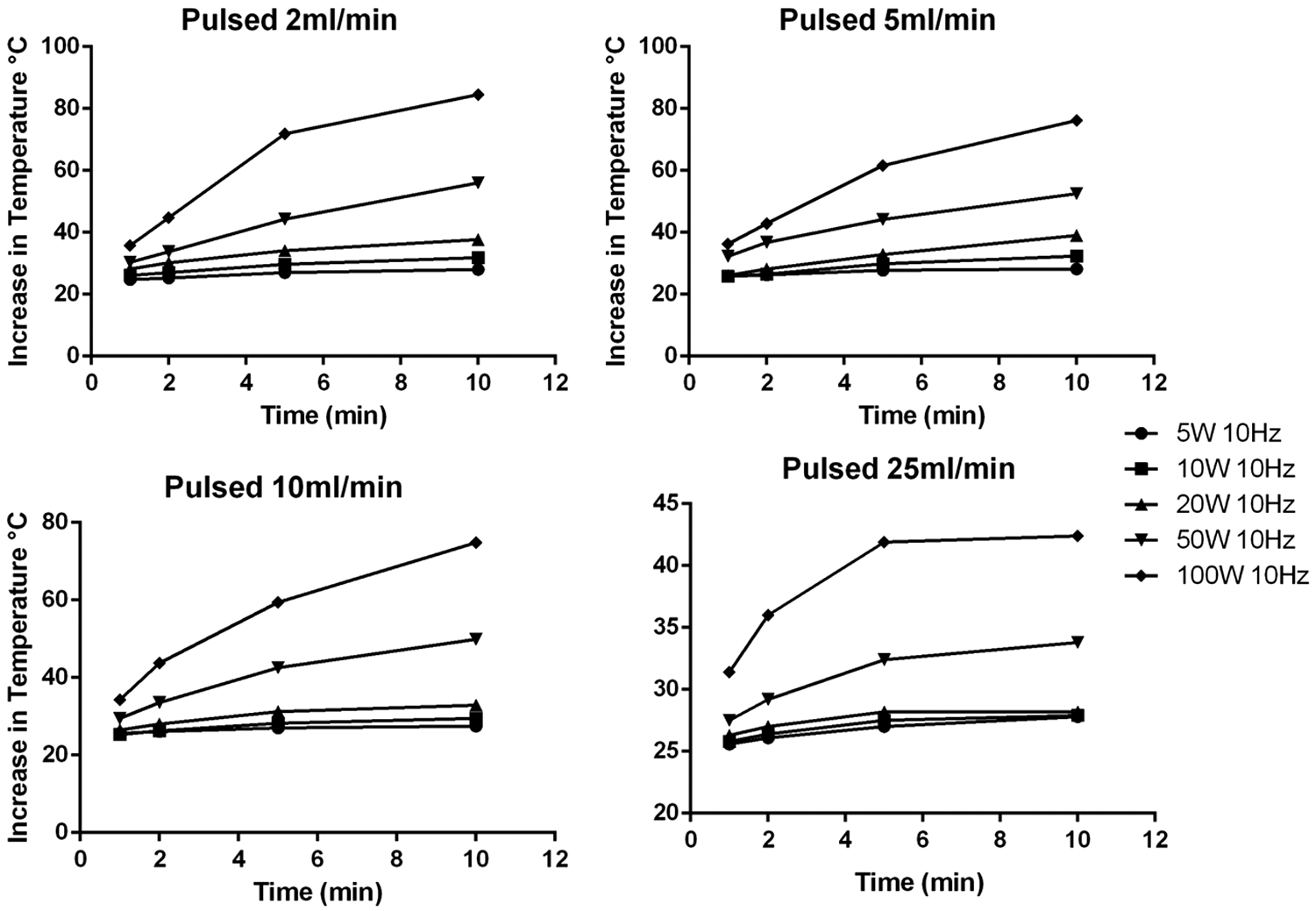
Temperature changes with TM:YAG in the pulsed mode.
ΔT represents the difference in temperature measured by the thermocouple. The initial temperature of the irrigation fluid was 22°C.
The Ho:YAG (Pulsed mode) showed similar temperatures in comparison to the Tm:YAG in all the flow rates and power settings up to 20 W (Table 3 and Fig. 4). The temperatures ranged between 45.6°C and 68.7°C.
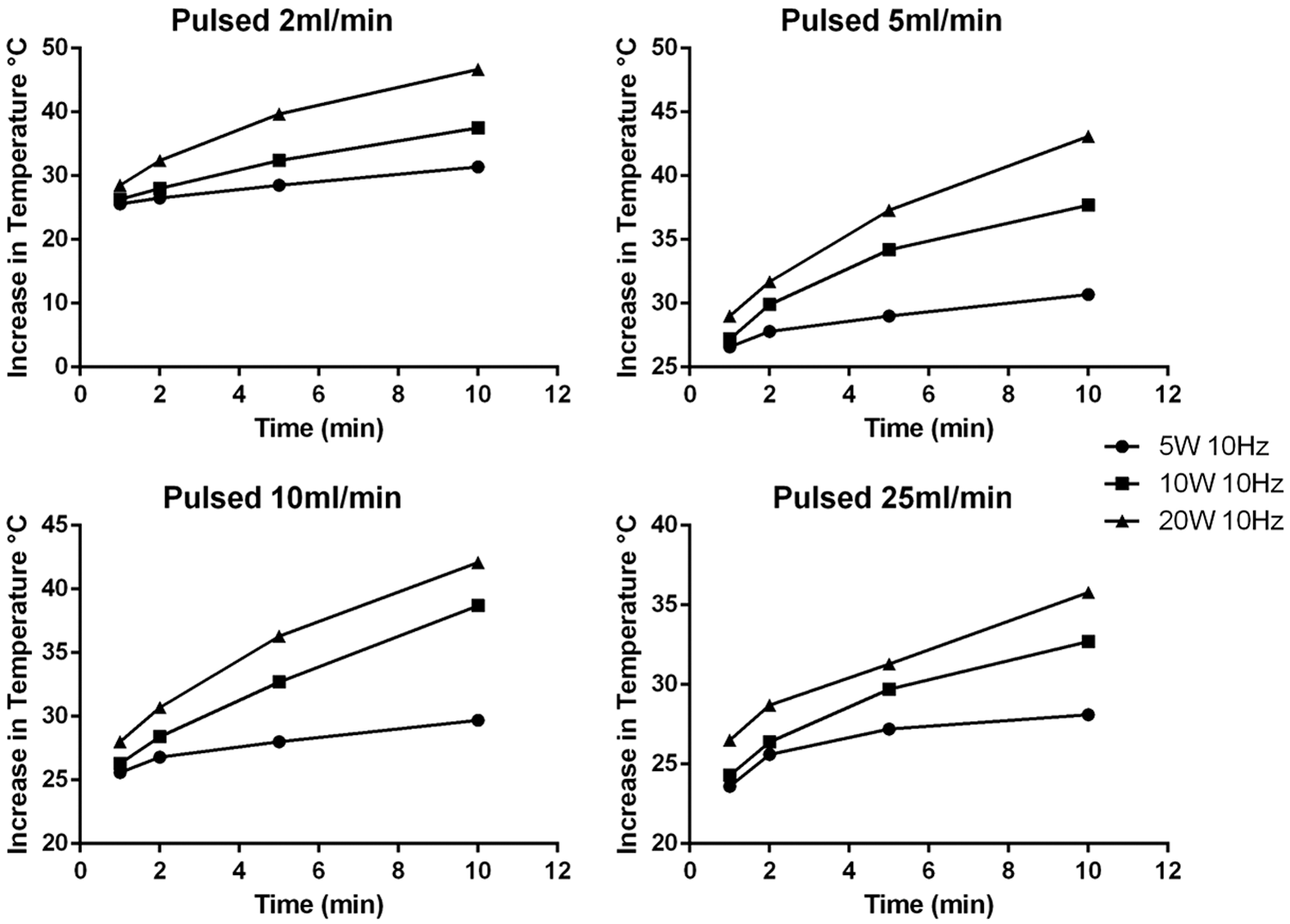
Temperature changes with Holmium:Yttrium aluminum garnet (HO:YAG) laser in the pulsed mode.
Discussion
The possible thermal effect and the subsequent increase in the irrigation fluid temperature have not been well investigated in the literature. Only one study provided some information on the temperature of the irrigation fluid during the activation of the Tm:YAG. 9 The results of the latter study were based on a limited number of flow rates, power settings, and activation duration. As a result, an experimental protocol was designed to elucidate different aspects of the Tm:YAG thermal effect in the irrigation fluid and further strengthen the potential use of Tm:YAG in the UT. The study design was based on a previous investigation, which provided information on the flow rates through a flexible ureteroscope placed in an in vitro model of the upper UT. 10 The investigators used different configurations for the use of the ureteroscope, including the insertion of baskets of different diameters and different ureteral access sheaths. This study showed adequate information so that the selection of flow rates for the current investigation was possible. The lowest flow rates were achieved with the use of a 12F Flexor and the presence of a basket in the working channel. The latter configuration was selected to replicate a worst-case scenario for the use of the Tm:YAG in the UT. Specifically, the flow rates used in the current investigation were those achieved with a 1.4F basket in the working channel. Other studies investigating the flow rate of modern flexible ureteroscopes have also reported flow rates up to 28 mL/minute when a larger than 300 nm optic fiber is inserted in their working channel. 11 –13
The selection of the power settings was based on previous investigations, which showed efficacy of the Tm:YAG in stone fragmentation, and our efforts to investigate the feasibility of higher power settings, such as 50 W power or higher, for upper UT use. 8,9,14 Measurements with the same configuration and settings were obtained by the Ho:YAG available at the institution in an attempt to reveal any differences among the two laser energy sources. The Ho:YAG has a well-established safety profile in the upper UT. 15 –17 The comparison of the temperatures obtained by the current investigation showed that the Tm:YAG in the continuous and pulsed mode had a similar increase in temperature with Ho:YAG when power settings up to 20 W were considered. The above finding contributes to the evidence that the Tm:YAG could be used for UT endoscopic surgery. The 50 W and higher settings showed high temperatures in the investigated flow rates, which are probably not appropriate for in vivo use with the flow rates of a flexible ureteroscope. It should be noted that the high temperatures achieved by both laser systems were related to long activation periods, which also represented a worst-case scenario. It is highly unlikely to continuously activate a laser for the treatment of a calculus or a UUT for 5 or 10 minutes without any pause. Nevertheless, the evidence obtained by the study does not allow for any solid conclusions regarding the superiority of the one laser systems over the other for upper tract use.
Limitations of the current study are the lack of multiple measurements with the same setting, which could allow for a statistical analysis. More measurements with a higher range of settings would have been also interesting and would provide a more accurate depiction of the real intraoperative conditions in terms of the temperature fluctuation. Moreover, an in vivo study could provide additional intergrity to the current evidence. Another limitation of the study is the lack of a specific study evaluating the pelvicaliceal volume in the case of a pelvicaliceal system that undergoes continuous irrigation fluid flow while a combination of instruments are inserted in the ureter. Thus, the current model was designed to resemble the condition of the pelvicalyceal system intraoperatively without having specific information on its dimensious under the above conditions. Further experimental evaluation would provide more solid results.
Conclusion
The Tm:YAG in the pulsed and continuous mode with power settings up to 20 W seemed to have potential for UT use. By combining a power setting at the above limit and a low flow rate (as low as 2 mL/minute), it is possible to use the Tm:YAG with safety in terms of temperature. The use of Tm:YAG in higher power settings requires further investigation.
Footnotes
Author Disclosure Statement
No competing financial interests exist.