




Abstract
Objectives:
To compare outcomes and survival of open-, robotic-, and laparoscopic nephroureterectomy (ONU, RNU, LNU) using population-based data.
Methods:
Using the National Cancer Database, we identified patients who underwent nephroureterectomy for localized upper tract urothelial carcinoma between 2010 and 2013. Demographic and clinicopathologic characteristics were compared among the three operative approaches. Multivariate regression analyses were used to determine the impact of approach on performance of lymphadenectomy (LND), positive surgical margins (PSM), and overall survival (OS).
Results:
In total, there were 9401 cases identified for analysis, including 3199 ONU (34%), 2098 RNU (22%), and 4104 LNU (44%). From 2010 to 2013, utilization of RNU increased from 14% to 30%. On multivariate analysis, LND was more likely in RNU (odds ratio [OR] 1.52; p < 0.01) and less likely in LNU (OR 0.77; p < 0.01) compared with ONU. RNU was associated with decreased PSM compared with ONU (OR = 0.73; p = 0.04). After adjusting for other factors, OS was not significantly associated with surgical approach.
Conclusions:
RNU utilization doubled over the study period. While RNU was associated with greater likelihood of LND performance as well as lower PSM rates when compared with ONU and LNU, surgical approach did not independently affect OS.
Introduction
U
Laparoscopic nephroureterectomy (LNU) was first reported in 1991. 3 Widespread adoption was initially limited by technical challenges and concerns of tumor cell dissemination via pneumoperitoneum, 4 which were subsequently allayed by a report demonstrating no difference in risk of local recurrence following ONU versus LNU. 5 Since this initial controversy, several multicenter retrospective studies, 6,7 a randomized trial, 8 and a systematic review 9 have evaluated the oncologic outcomes of ONU versus LNU and demonstrated equivalence. LNU has also been shown to be associated with shorter length of hospital stay, less blood loss, fewer complications, and decreased postoperative pain. 4,7,9 It is not surprising, therefore, that utilization of LNU has increased in recent years. 10
Utilization of robot-assisted laparoscopic nephroureterectomy (RNU) has also increased, as the improved visualization and dexterity offered by the da Vinci surgical system (Intuitive Surgical, Sunnyvale, California) have decreased the technical challenges of minimally invasive NU. Single-institution studies have shown similar oncologic outcomes among RNU, ONU, and LNU, 11,12 but no studies have directly compared oncologic outcomes from each approach on a population level. Therefore, we sought to assess national trends in utilization of currently available surgical techniques, and compare their associated perioperative and oncologic outcomes.
Methods
The National Cancer Database (NCDB) is a national cancer registry developed by the Commission on Cancer of the American College of Surgeons and the American Cancer Society in 1989. It compiles data from more than 1500 accredited cancer programs in the United States and Puerto Rico, and captures roughly 70% of all newly diagnosed cancer cases. 13 A variable for surgical approach was added to the database in 2010.
The NCDB was queried between 2010 and 2013 for patients younger than 90 years who underwent NU for clinically nonmetastatic cancer of the kidney, renal pelvis, or ureter as determined by surgery of primary site procedure codes. Only those with urothelial (or transitional cell) histology were included using International Classification of Diseases for Oncology, third edition histology codes (8120, 8130). Patients were then separated into open, robotic, and laparoscopic groups for analysis.
Demographic information assessed included age, sex, race, primary insurance type, and hospital setting. Age was treated as a continuous variable for intergroup comparison and logistic regression. Facility types were categorized as academic, comprehensive community cancer, community cancer program, or “other.” Comprehensive community cancer centers report more than 500 newly diagnosed cancer cases per year to the NCDB, whereas community cancer programs report 100 to 500 cases per year to the NCDB. Patient comorbidity was determined by the Charlson/Deyo score, which has been validated in large, population-based studies. 14
Disease characteristics used in analysis include tumor location (renal pelvis vs ureter), pathologic tumor stage, tumor size, WHO/ISUP tumor grade, presence of lymphovascular invasion (LVI), and clinical nodal stage. Stages were defined by American Joint Committee on Cancer classification. Pathologic tumor staging was utilized for classification given the wide variability and limitations associated with clinical staging of UTUC. 15 Clinical nodal stage was classified as N0 or ≥N1.
Baseline patient characteristics were compared using Pearson's chi-squared and analysis of variance tests as appropriate. Multivariate logistic regression was used to determine independent association of surgical approach on the performance of lymphadenectomy (LND) as well as on positive surgical margins (PSM). A Cox proportional hazards model was constructed to determine the association of surgical approach on overall survival (OS). A two-sided p < 0.05 was considered significant for all statistical tests. All statistical analyses were performed using STATA v13.0 (StataCorp, College Station, Texas).
Results
In total, there were 9401 cases identified for analysis, including 3199 ONU (34%), 2098 RNU (22%), and 4104 LNU (44%). From 2010 to 2013, the percentage of cases completed robotically increased from 14.2% to 30% and open cases decreased from 42.3% to 28.6% (Fig. 1). Patient clinical and disease-specific characteristics are shown in Table 1. Those undergoing RNU were more likely to be male and slightly younger. Surgical approach differed by facility type. Forty-six percentage of all RNU were completed at academic centers compared to 35% of all LNU and 35% of all ONU (p < 0.01). ONU was more likely to have high grade (p < 0.01), stage pT2 or greater (p < 0.01), and tumors located within the ureter (p < 0.01) compared with RNU and LNU, but tumor size was not significantly different among groups.
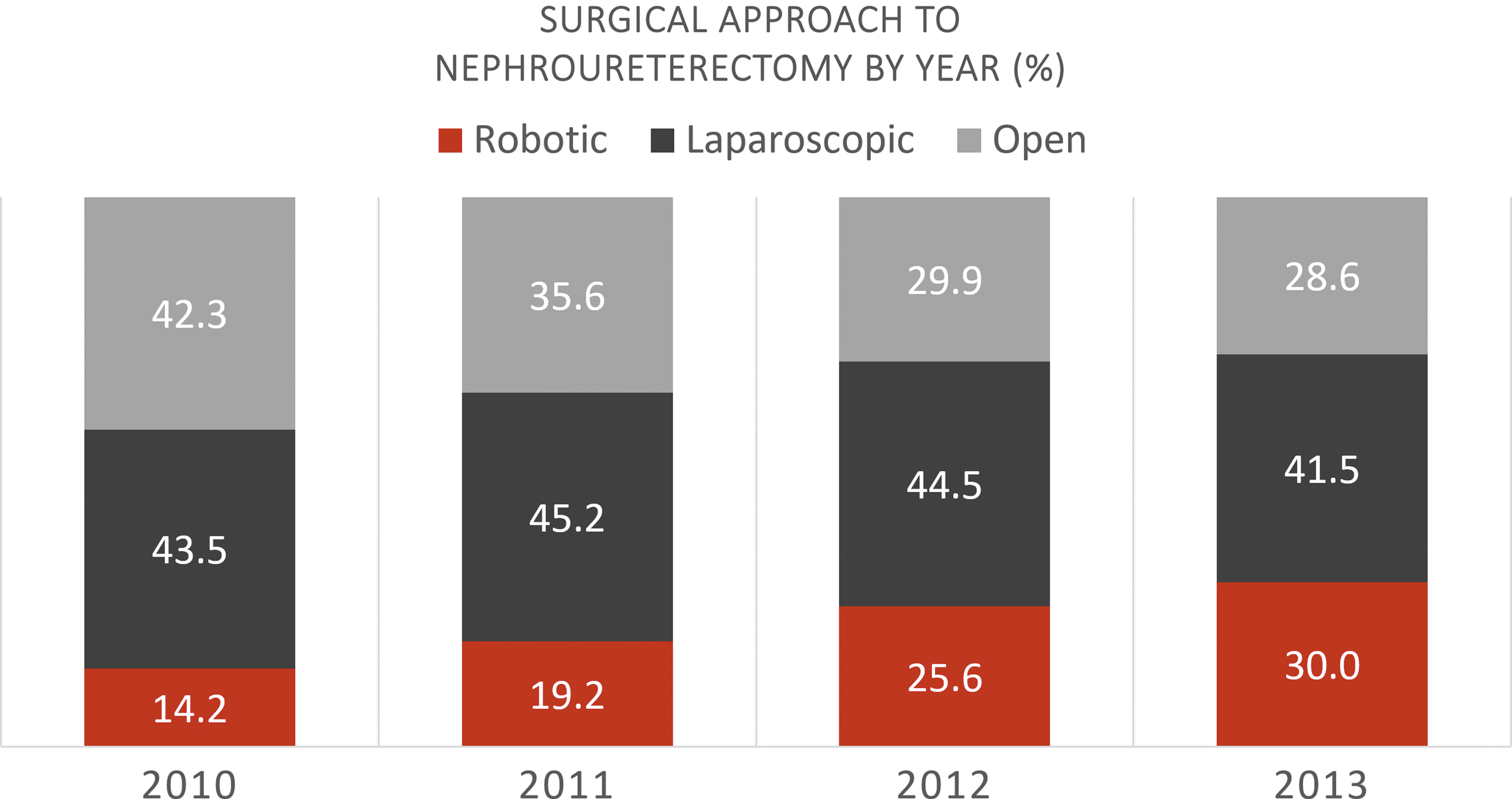
Surgical approach to nephroureterectomy by year (%). Robotic nephroureterectomy utilization has increased significantly while the open approach is on the decline.
Bold indicates p < 0.05.
LVI = lymphovascular invasion.
On multivariate analysis, age, facility type, pathologic stage, tumor size, grade, tumor location, and surgical approach were independent predictors of LND (Table 2). LND was more likely in RNU (odds ratio [OR] 1.52; p < 0.01) and less likely in LNU (OR 0.77; p < 0.01) compared with ONU.
Bold indicates p < 0.05.
Sex, race, Charlson score, and insurance status were not significant.
CI = confidence interval.
RNU was also associated with decreased PSM rate on multivariate analysis compared with ONU (OR = 0.73; p = 0.04). There was no difference in PSM rate for LNU compared with ONU (p = 0.24). Clinical nodal status, pathologic stage, tumor size, grade, presence of LVI, and tumor location were also independently associated with PSM (Table 3).
Bold indicates p < 0.05.
Age, sex, race, Charlson score, and facility type were not significant.
On multivariate Cox proportional hazards analysis, OS was not significantly associated with surgical approach (Table 4).
Bold indicates p < 0.05.
Insurance and facility type were not significant.
LND = lymphadenectomy; PSM, positive surgical margin.
Comment
We report on utilization of surgical approach, performance of LND, and oncologic outcomes, including PSM and OS among ONU, RNU, and LNU in a large, population-based database. Our results suggest that utilization of RNU is increasing mostly with a commensurate decrease in ONU. This likely reflects the high utilization of minimally invasive approaches at training centers as well as the widespread availability of the robotic platform. As we have shown, those with advanced disease may be more likely to undergo ONU, however, after adjusting for stage, there was no difference in OS among approaches despite a lower PSM rate in RNU and increased performance of LND in both LNU and RNU.
Pearce and colleagues first demonstrated significant differences in rates of LND performance by surgical approach in a large series. 16 Our data support the finding that RNU is independently associated with increased odds of LND performance while LNU is associated with decreased odds of LND. The differing utilization rates of LND by surgical approach may be explained by surgeon-specific factors such as fellowship training, experience, or practice patterns. Another possibility is that there are inherent differences in the technical difficulty of LND based on surgical approach. Pathologic lymph node status plays a significant role in staging and prognosis, 17 but whether there is a therapeutic role of LND is unclear and controversial. Our analysis shows no association of LND performance with OS.
In addition to its association with increased rates of performance of LND, RNU was also associated with decreased rates of PSM. Colin and colleagues demonstrated an independent association of PSM with decreased metastasis-free survival in a retrospective series of 472 patients undergoing ONU. 18 This supports our finding of decreased OS with PSM on multivariable analysis. We postulate that the robotic approach allows for improved maneuverability and visualization in the deep pelvis. This in turn may allow for a consistently wide excision of the bladder cuff, especially in comparison to a single-incision, open approach. Another possibility is that our multivariate analysis is insufficient to account for differences in disease characteristics in those patients with the most advanced disease who likely receive ONU at a disproportionally higher rate. While we do account for tumor location, size, stage, grade, and presence of LVI, we do not know about concomitant carcinoma in situ, for example.
Although there were significant differences in LND performance and PSM rates among surgical approaches in our study, we show no independent association of surgical approach on OS. While NU provides a unique challenge given the requirement of dissection within two anatomic compartments, surgical experience and adherence to principles of oncologic surgery likely stave off any differences in OS regardless of approach. This points to the need for further studies to determine how best to manage aggressive tumor biology through the use of perioperative chemo- or immunotherapy.
There are several limitations to this study in addition to what has been previously discussed. Retrospective, nonrandomized design remains a significant source of bias even when using multivariate analysis. Additionally, we could not account for surgical history, prior topical therapy, history of radiation, or prior attempts at nephron-sparing treatments. PSM was reported as a binary variable and we were unable to differentiate microscopically positive from grossly PSMs. Additionally, the distal ureter and bladder cuff can be excised using a number of techniques regardless of overall surgical approach and this information is not captured in the NCDB.
Conclusions
In the 4 years studied, RNU utilization doubled. RNU is independently associated with higher odds of LND and lower odds of PSM. However, there was no association between surgical approach and OS.
Data Source
National Cancer Database 2013 PUF files.
Footnotes
Author Disclosure Statement
No competing financial interests exist.