




Abstract
We have developed the Peralta Stone Extraction System to increase the safety of ureteral stone extraction. The device combines a nitinol stone basket and low-pressure balloon into a single device. After visualization, the stone is captured in the tipless nitinol basket and enveloped by a low-pressure balloon. We tested the performance of device prototypes in a porcine model using stone mimics with diameters ranging from 4.2 to 6.2 mm. Stones extracted with the device required less force when compared with stones in a standard ureteral stone basket. The force reduction was most pronounced for stones greater than 4.2 mm in diameter, and when traversing a ureteral stenosis model. In conclusion, a combination stone basket and balloon device may provide a new and safer way to extract ureteral stones.
Introduction
T
Guidelines endorse the use of ureteroscopy or shock wave lithotripsy as surgical treatments for ureteral stones. Since the efficacy of medical expulsive therapy has been limited in large clinical trials, 4,5 it is possible that surgical treatment of patients with ureteral stones will become more prevalent. Currently, ureteroscopy is the predominant surgical approach for ureteral stones in part due to advances in ureteroscope technology, including the reduced size of endoscopes, and improved stone visualization with digital imaging. 6 –8 Despite these improvements, one aspect of ureteral stone extraction, the design of the stone basket, has not significantly changed since the first nitinol basket was introduced in the 1990s. 9
We have developed a novel ureteral stone extraction device with the goal of expediting stone retrieval while reducing the risk of ureteral injury. The Peralta Stone Extraction System combines a tipless, four-wire nitinol stone basket and a 5 mm diameter balloon (Fig. 1). We sought to test whether the Peralta Stone Extraction System would reduce the force required to extract ureteral stones in a preclinical porcine ureter model.

The Peralta Stone Extraction System incorporates a tipless nitinol stone basket and a low-pressure balloon that can surround the captured stone for safe extraction.
Discussion of Technology
The Peralta Stone Extraction System catheter has a 3F outer diameter and a 110 mm working length, similar to standard stone baskets, and is compatible with the majority of flexible and semi-rigid ureteroscopes. The 5 mm diameter low-pressure balloon is 30 mm in length, transparent, and can be inflated with 1.25 cc of air to a pressure of ∼1 ATM. After capturing the stone in the basket, both can be retracted into the inflated balloon, causing the balloon to evert around the stone. The everted polyethylene balloon surrounds the stone with a smooth, protective layer designed to reduce friction within the ureter during extraction (Fig. 2). A 5- to 10-cc syringe can be used to vacuum the air from the balloon to allow the device to be removed through the working channel after use. In the case that the device is to be reinserted, the balloon can be refolded using a standard balloon sheath. The device is designed for single-handed actuation, and can be held in the same manner as traditional stone baskets. The handle consists of two levers, one to control the basket and one to retract the stone into the balloon. The device is intended to capture stones and stone fragments between 2 and 5 mm in diameter, and larger stones if they have an elongated shape (e.g., a long axis less than 8 mm and a short axis less than 5 mm). Additionally, the balloon can be inflated up to a pressure of 8 ATM when gentle ureteral dilation is required to facilitate stone extraction.
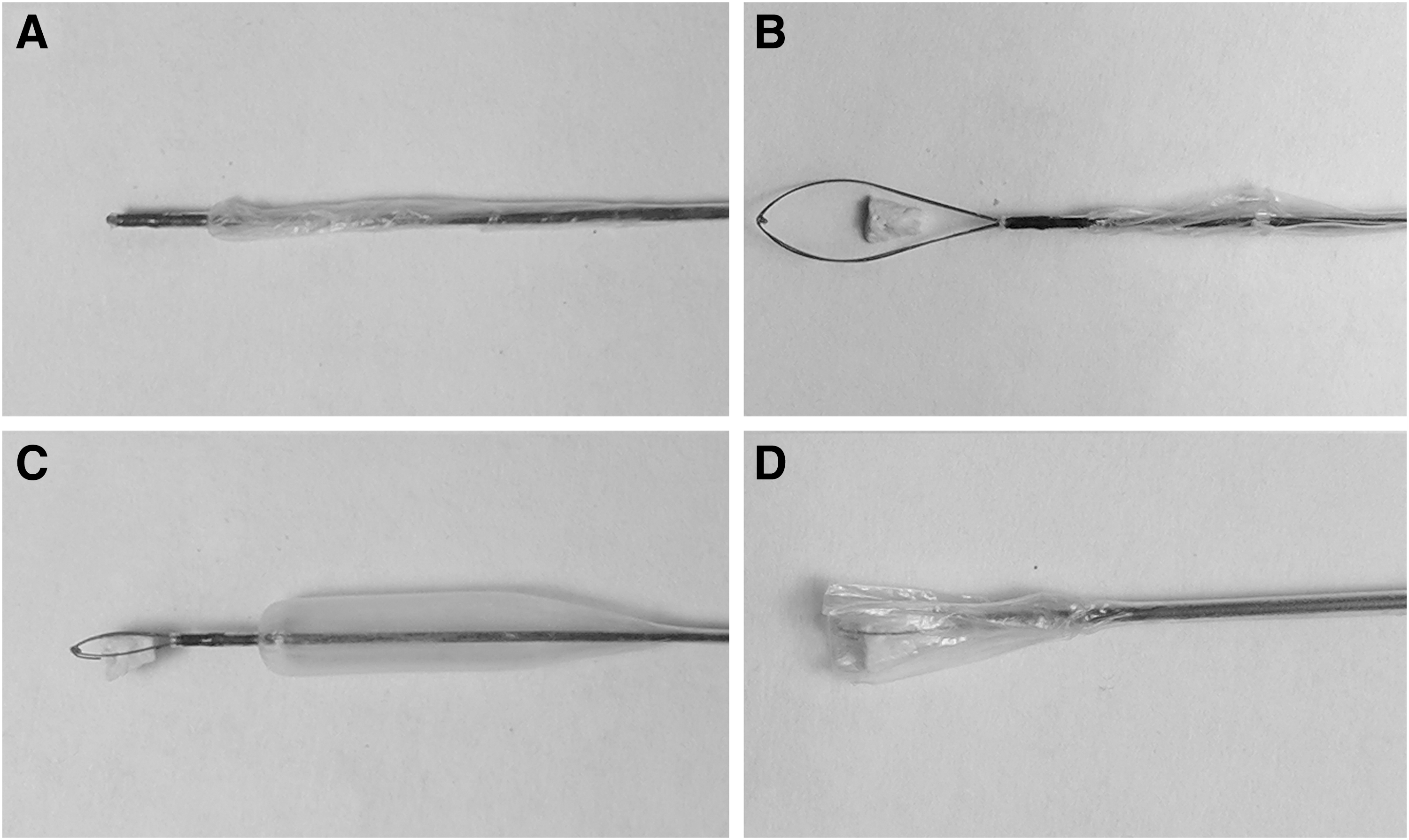
The Peralta Stone Extraction System is seen in
Preclinical testing
We tested the ability of the Peralta Stone Extraction System to reduce the force required for stone extraction in a porcine ureter model, using fresh intact urinary tract systems from female pigs (50–75 kg). Each ureter was divided into two sections and mounted on a procedure board (Fig. 3A). We prepared stone mimics made from calcium carbonate measuring 4.2 × 2.4 mm and 6.2 × 3.6 mm. The stone baskets were placed through a semi-rigid ureteroscope (ACMI MR-6K) with a 3.4F working channel. We compared the extraction force while traversing the ureters using a force meter (Model DS2-44; Imada) secured to the end of the device. We compared the baseline forces required to traverse the ureter model with various commercially available stone baskets (1.5F–3F) without any stone mimics to establish the friction within the model. We then compared the forces required to extract stone mimics using a 2.4F tipless nitinol stone basket (Cook Medical, Bloomington, IN). Each extraction was replicated four times for each stone size. Additionally, we tested the extraction force required to pass through a simulated ureteral stenosis. We created this model using rubber orthodontic bands placed around the ureter and a 6 mm stone mimic (Fig. 3B).

Images showing the bovine ureter model with a stone secured within the Peralta device
The Peralta Stone Extraction System successfully captured the stone mimics in all trials. The Peralta device was associated with a similar extraction force for the 4.2 × 2.4 mm stone mimic (mean 0.068 N [SD 0.02] vs 0.063 N [SD 0.01]), and reduced extraction force for the 6.2 × 3.6 mm stone, when compared with the standard stone basket (0.053 N [SD 0.01] vs 0.088 N [SD 0.053]). The force reduction was more pronounced in the ureteral stenosis model, which utilized a 6 mm stone mimic and did not deploy the balloon to dilate the stenosis (0.67 N [SD 0.063] vs 1.16 N [SD 0.72]) (Fig. 4). Using the previously reported postureteroscopic lesion scale, 10 ureteral inspection following ureteral stone extraction did not identify any grade 2 or greater ureteral trauma in any of the experiments.
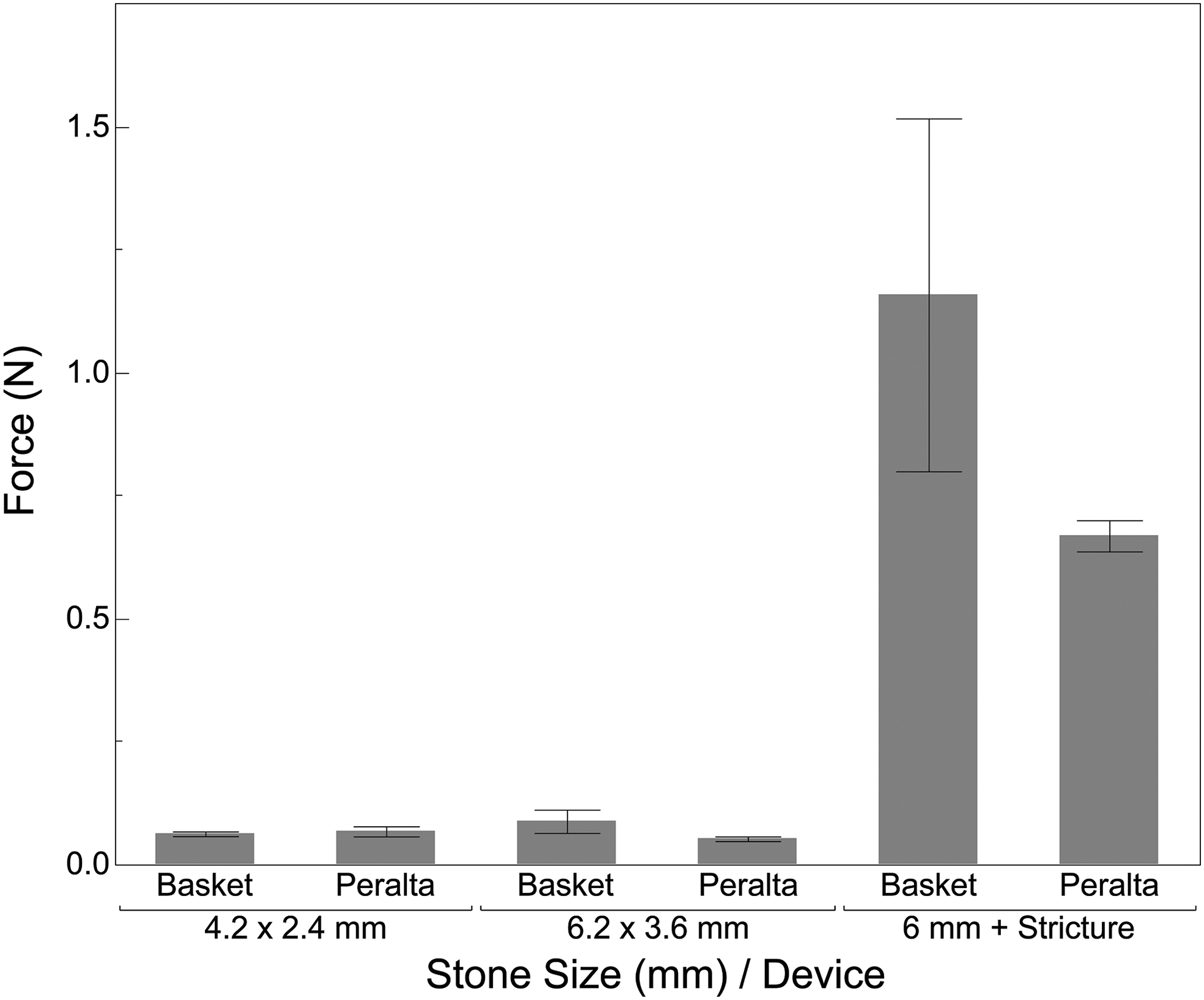
Comparison of force required to extract intact ureteral stones using a standard tipless stone basket and the Peralta Stone Extraction System.
Role in Endourology
Urologists have adopted several approaches to improve the safety and efficacy of surgery to treat ureteral stones. These include the use of ureteral access sheaths and stents, devices to prevent stone retropulsion, 11 and laser lithotripsy with stone dusting techniques. Despite these efforts, ureteroscopy is associated with complications, which can include ureteral injury (estimated to occur in 1% to 4% of procedures), perforation, stricture, and even avulsion. 12,13 In 2016, the American Urological Association (AUA) and the Endourological Society published guidelines for the surgical management of USD, and suggest, “there is a need for mechanical devices that more efficiently and safely fragment and evacuate stone material; at present, this process is cumbersome and potentially dangerous as ureteral injury may occur during stone extraction.” 14,15
The Peralta Stone Extraction System is designed to address these concerns using a novel combination of devices already in clinical use and familiar to urologists performing endourology treating USD. It can be used as a regular basket for the extraction of smaller stones, but it also allows for larger stones (currently limited to 5 mm in the transverse dimension) to be enveloped within the balloon, providing ureteral protection and facilitating the extraction of stones that previously would require treatment with laser lithotripsy. Similarly, it could also be used to extract larger stone fragments created during routine laser lithotripsy. The low-pressure balloon can also be used to partially dilate stenotic areas, facilitating the extraction of small intact stone fragments. Future testing in clinical trials will be required to determine if there is reduced ureteral trauma that may also allow some procedures to be performed without the need for ureteral stents, or minimize the postoperative ureteral stent indwelling period. 16 Finally, the Peralta Stone Extraction System may improve stone-free rates following ureteroscopy for ureteral stones by increasing the number of stones that can be extracted intact, without concern for retained stone fragments after laser lithotripsy.
In summary, we have developed a prototype device that combines a stone basket with a ureteral balloon. This allows for ureteral stones to be enveloped by the low-friction ureteral balloon during extraction. This reduced the force required to extract ureteral stones less than 5 mm and for stones navigating a ureteral stenosis in preclinical models. We look forward to future clinical testing of this system.
Footnotes
Author Disclosure Statement
B.B.: CEO, Calcula Technologies. T.C.N.: Investment interest in Calcula Technologies. R.S.: Investment interest in Calcula Technologies. J.T.L.: Investment interest in Calcula Technologies. No competing financial interests exist for the authors R.M. and T.J.M.