




Abstract
Objective:
To study the functional outcome of patients undergoing transurethral enucleation and resection of the prostate (TUERP) vs patients undergoing holmium laser enucleation of the prostate (HoLEP) in men with bladder outlet obstruction.
Materials and Methods:
We retrospectively analyzed our prospectively collected database of two groups of patients. Twenty-four patients underwent TUERP (group 1), and 27 underwent HoLEP (group 2). Preoperative characteristics, intervention parameters, postoperative functional outcomes, uroflowmetry, and complications were collected.
Results:
Mean prostate size in groups 1 and 2 were 87.2 and 93.5 cc, respectively. The mean duration of surgery was 110 minutes in group 1 and 136 minutes in group 2. In group 1, prostate-specific antigen (PSA) dropped from 4.4 to 1.2 ng/cc after 12 months. International Prostate Symptom Score (IPSS) was 3.75 at 12 months with a preoperative value of 20.9. With respect to maximum urinary flow rate (Qmax), it increased to 21.8 mL/s from a preoperative value of 6.4 mL/s. In group 2, the PSA dropped from 7.6 to 1.3 ng/cc. IPSS dropped from 22.3 to 3.8, Qmax increased from 7.7 to 22.5 mL/s. Hemoglobin, complications, and all studied parameters were not statistically significant between both groups.
Conclusion:
In this study, TUERP was safe and efficacious in benign prostatic hyperplasia patients with large glands. Modifications can be implemented on the standard transurethral resection of the prostate technique to treat patients with prostate sizes >70 cc.
Introduction
B
Alike other surgeries, TURP has its own limitations. Transfusion rates can reach up to 7.1% post TURP. Moreover, retreatment rate ranges from 3% to 14.5%. 3 –5 Furthermore, TURP is associated with safety issues particularly in patients with large prostates (>80 g). 6 This has led to the development of many alternative procedures aiming at either reducing complications or improving the safety profile in larger prostates. One of these procedures is holmium laser enucleation of the prostate (HoLEP), which has proven its efficacy and safety as an alternative to the conventional TURP. 7 Elzayat et al. 8 stated that HoLEP is the new gold standard for any prostate size. It has been reported that HoLEP offers shorter catheterization time, shorter hospital stay, and fewer complications when compared with TURP. 9 This has encouraged many surgeons to include enucleation as part of the well-known TURP technique in larger prostates creating a hybrid procedure, namely transurethral enucleation and resection of the prostate (TUERP). Plasmakinetic bipolar TUERP was shown to be safe and effective according to Yu et al. 10 However, given its relatively recent introduction in practice there is still lack of systematic clinical training. 10
In view of the difficult learning curve of HoLEP and minimal market penetrance, we thought to evaluate the relatively new TUERP technique. We adopted monopolar TUERP as it combines standard TURP instrumentation with a known enucleation technique. Our objective was to compare short-term results of TUERP to our contemporary HoLEP cohort. The main impetus was the perceived easier learning curve of TUERP as compared with HoLEP especially for residents and HoLEP naive surgeons. Additionally, TURP instrumentation is available in all urology services in Canada and worldwide.
This article reports the efficacy and safety of monopolar TUERP vs HoLEP in a Canadian cohort over a 12-month period. Functional outcomes and complication rates are presented. To our knowledge, this is the first study comparing monopolar TUERP to HoLEP.
Materials and Methods
Patient characteristics
After approval of the Institutional Review Board, data were prospectively collected and retrospectively analyzed for 26 men who underwent TUERP, and 29 men who underwent HoLEP for BPH in 2015. To note, no nodules were encountered in the digital rectal examination preoperatively. Surgeries were done by a single surgeon at a single institution. Patients diagnosed with prostate cancer were excluded from the study, which was the case for two patients from each group (n = 4). Men who underwent TUERP or HoLEP had at least one of the indications listed in the American Urological Association guidelines. 1 We had a protocol implemented at our hospital, where the duration of catheterization and hospital stay is 2 to 3 days.
Surgical procedures
Holmium laser enucleation of the prostate
Our technique has been previously published. 11 In summary, using a 26F resectoscope with a laser bridge and the 550 μm holmium laser fiber, the anterior commissure is divided and an incision is made at 5 and 7 o'clock from the bladder neck to the verumontanum and deepened down to the capsule. Afterward, the median lobe is excised and enucleated. Then, the lateral lobes are enucleated starting at the level of the apex with low energy (70 W). Both lobes were further enucleated with higher setting (100 W) and dropped into the bladder. 11
Transurethral enucleation and resection of the prostate
Using the 26 F resectoscope, monopolar thin loop (Fig. 1), and monopolar electric current (Fig. 2) rescetion of the median lobe is perfomed in a similar manner to TURP. Then, enucleation starts at the apex similarly to HoLEP by using a combination of blunt (tork) and sharp (electrical) dissection. Complete enucleation was attempted but was not successful in all cases; therefore, a combination of enucleation and resection was performed.
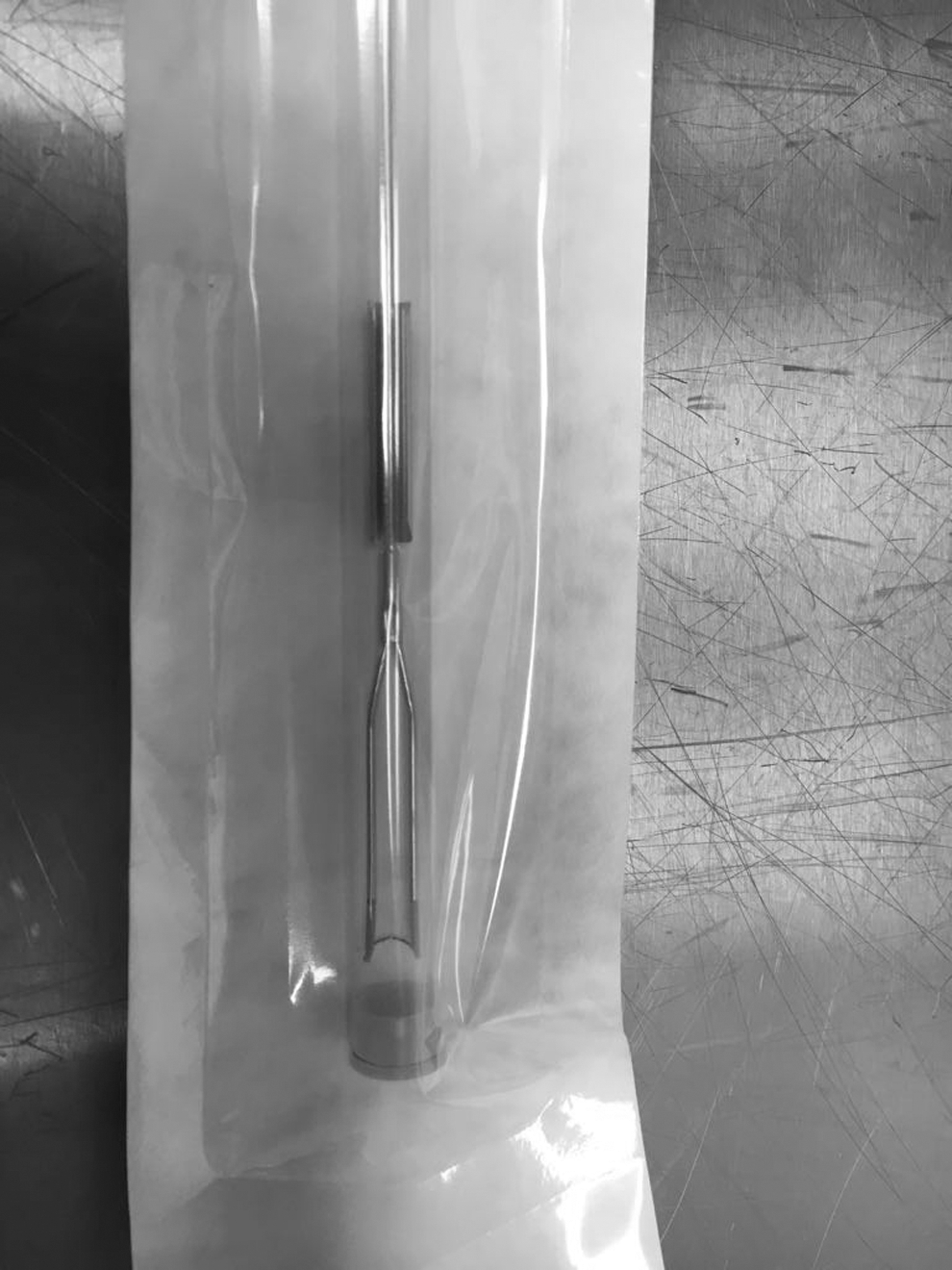
Monopolar thin loop.
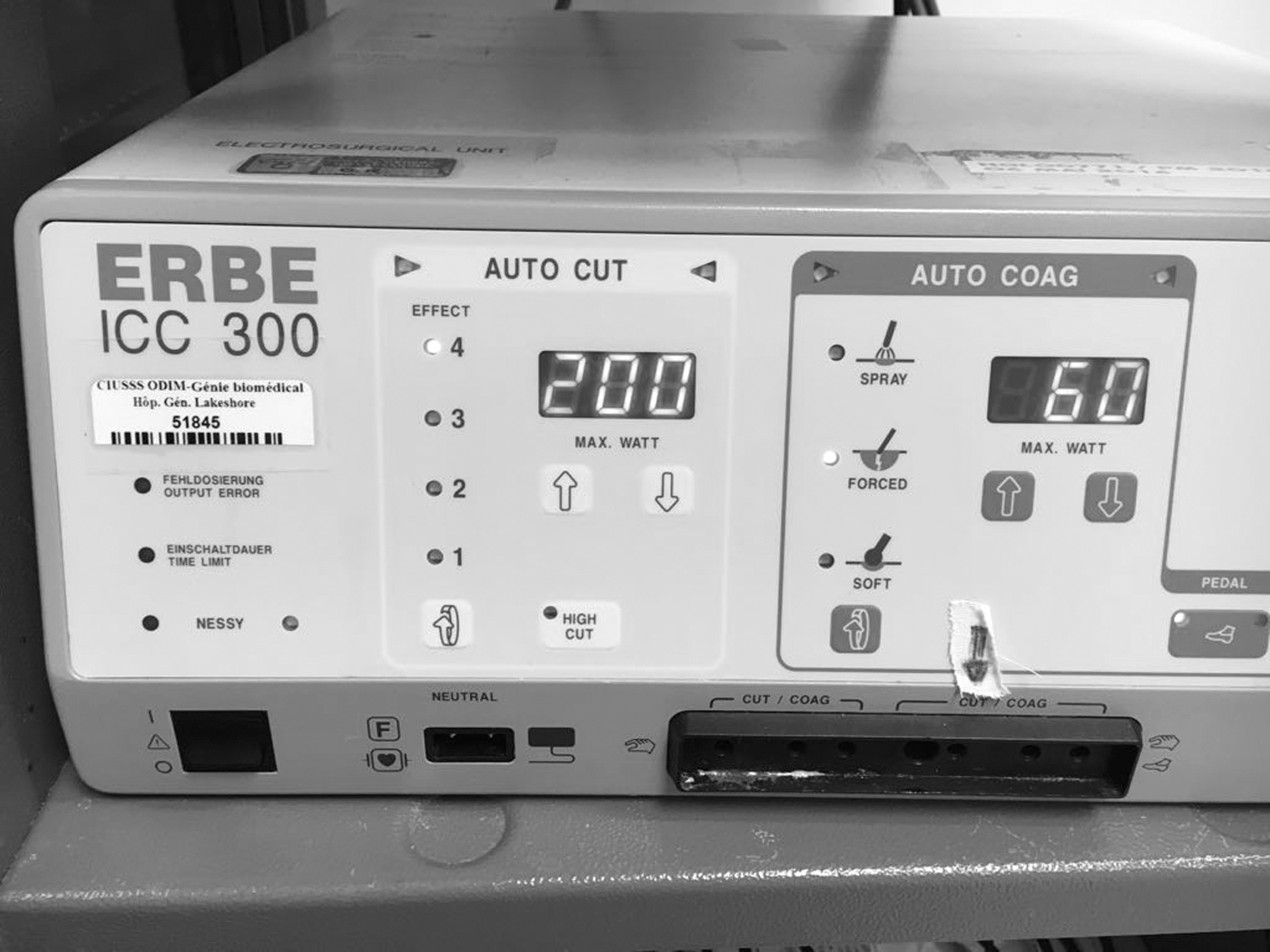
Monopolar device set-up.
Morcellation
In all HoLEP and some TUERP cases, prostatic morcellation was needed to retrieve the prostatic adenomas. 12
Study design
Group 1 (n = 24) underwent TUERP and group 2 (n = 27) underwent HoLEP. Patients were assigned in both groups according to their prostate-specific antigen (PSA), International Prostate Symptom Score (IPSS), quality of life (QoL), post-void residual (PVR), and maximum urinary flow rate (Qmax). Patients were followed at 3, 6, and 12 months. Parameters at each visit were compared with preoperative values.
Postoperative complications were described according to the Clavien–Dindo classification. 13
Statistical analyses
Mean and standard deviation were reported for continuous variables. Independent and paired t-tests were performed to compare mean differences between the two groups and pre- and postdata, respectively. Chi-square test was performed for categorical variables. A p-value <0.05 was considered as statistically significant. Analyses were conducted using Stata 13.
Results
Table 1 shows the baseline characteristics of group 1 (TUERP) and group 2 (HoLEP). The mean age was 68.5 years (95% confidence interval [65.5–71.5]) in group 1 and 67 years [63.7–70.3] in group 2. Mean prostate volume was 87.2 cc [69.6–104.9] for group 1 and 93.5 cc [80.4–106.5] for group 2. In group 1, nine patients (37.5%) were on anticoagulation treatment before surgery, eight of whom were on Aspirin and one on Coumadin. With respect to group 2, six (22%) men were on anticoagulation; four on aspirin and two on aspirin and clopidogrel. All patients receiving anticoagulation had to stop their mediation before the surgery in both groups.
BMI = body mass index; CI = confidence interval; HoLEP = holmium laser enucleation of the prostate; IPSS = International Prostate Symptom Score; PSA = prostate-specific antigen; PVR = post-void residual; Qmax = maximum urinary flow rate; QoL = quality of life; TUERP = transurethral enucleation and resection of the prostate.
Table 2 shows the operative parameters of both groups. Mean duration of surgery was 110 minutes [94.9–125.2] and 136 minutes [114.8–157.2] for groups 1 and 2, respectively. For the HoLEP group, the mean energy used and energy per cc were 244.3 kJ [201.8–286.9] and 2.2 kJ/cc [1.6–2.7], respectively. Of note, only one laser fiber was used in each HoLEP surgery. Moreover, the mean number of normal saline 3000 mL bag, for one surgery, was 18.3 [15.1–21.6]. One TUERP patient had to be converted to HoLEP, because of the inability to do a proper enucleation with the TUERP. Mean hospital stay was 3.1 days [1.8–4.3] in group 1 and 2.5 days [1.2–3.8] in group 2. Additionally, mean catheterization time was 2.6 days [2.1–3.1] in group 1 and 2.5 days [1.3–3.8] in group 2.
NS = normal saline; NA = not assessed.
In group 1, PSA dropped from 4.4 ng/cc [3.1–5.8] to 1.2 ng/cc [0.6–1.8] after 12 months. IPSS dropped to 3.8 [0.6–6.8] from a preoperative value of 20.9 [16.4–25.4] (81.8% decrease). With respect to the Qmax, it increased from 6.4 mL/s [4.3–8.5] to 21.8 mL/s [12.9–30.6] (240.6% increase). PVR decreased from 53.5 [22.8–84.2] to 354.2 mL [219.3–489.1] (84.9% decrease).
In comparison, group 2 men had a PSA drop from 7.6 ng/cc [5.1–10.1] to 1.3 ng/cc [0.7–1.9] after 12 months. Additionally, Qmax increased from 7.7 mL/s [5.3–10] to 22.5 mL/s [18.2–33.6] (192.2% increase). Furthermore, PVR dropped from 145.6 mL [71.2–219.9] to 13 mL [3.4–22.6] (91.1% decrease). All differences were not statistically significant as seen in Table 3.
Table 4 shows the change in serum sodium, and hemoglobin between preoperative and postoperative day 1 in both groups. Differences between groups 1 and 2 were not statistically significant.
postop, postoperative; preop, preoperative.
Complications were reported in this study (Table 5) and classified according to the Clavien–Dindo classification. Postoperatively, the most common reported symptom in group 1 was dysuria (58%) compared with only 26% in group 2. Three patients (12.5%) had gross hematuria in group 1, two of which required blood transfusion. On the other hand, only two patients (7%) had gross hematuria in group 2 without the need for transfusion. Two patients (7%) in group 2 had persistent signs of overactive bladder (OAB) 3 months after the surgery.
CAD = coronary artery disease; OAB = overactive bladder.
Only one patient had a urethral stricture 3 months after HoLEP. One patient required a TURP redo 3 months after his TUERP surgery.
Discussion
Lower urinary tract symptoms (LUTS) are common in men above the age of 50 years. These symptoms are often secondary to BOO caused by BPH. 3,14 Despite the increasing popularity of laser prostate surgery, TURP remains the gold standard surgical treatment for BPH. 1 Morbidity associated with TURP has led to the development of several minimally invasive procedures. 3 HoLEP has fewer postoperative complications and longer durability when compared with TURP. 9 Patients who underwent HoLEP benefited from shorter catheterization time and hospital stay. 9 The hospitalization time in this study was 2.5 days [1.2–3.8] compared with 1.3 days in Krambeck and colleagues' study. 15 This has been the routine in our hospital to remove foley catheters on day 2 for all transurethral prostate surgeries.
Patients undergoing HoLEP have the advantage of receiving a complete prostatic enucleation. 16 The procedure involves a blunt dissection between the adenoma and the surgical capsule, and it is the only endoscopic technique similar to the traditional open prostatectomy. 17,18 The advantages of HoLEP are clear in patients with large prostates. 9 In this study, the mean prostatic size was 93.5 cc. Additionally, Michalak and colleagues 9 recommend that the urological community should embrace HoLEP as the new gold standard especially in patients with large prostates. Among 1065 patients enrolled in the study, Krambeck and colleagues 15 reported significant improvements in Qmax, PVR volume, QoL, IPSS, and PSA levels. 15 With respect to our study, all functional outcomes improved 12 months after surgery. Qmax increased by 192% and PVR decreased by 91%. These results are similar to the 133% increase in Qmax reported by Krambeck and colleagues' study. 15 Since the majority of patients had chronic obstruction and neurogenic bladder, urodynamic studies were not indicated in the follow-up. After analysis, there was no statistically significant difference between the two groups in terms of complications. Moreover, PSA drop is another marker used to assess the success of BPH surgery. Herein, we had a drop to 1.4 ng/cc from a preoperative value of 7.6 ng/cc. This is similar to the PSA drop reported in the Gilling et al. 19 study where the PSA dropped to 1.8 ng/cc from a preoperative value of 4.6 ng/cc.
On the other hand, the main disadvantage of HoLEP is its steep learning curve that is estimated between 20 and 50 cases. 11,20 This has prevented its widespread use. Furthermore, HoLEP requires high-energy (80–100 W) holmium laser machine along with disposable laser fibers. This can impose more expenses on small centers. For these reasons TUERP was designed and implemented in some centers. TUERP can be performed without any extra cost since it is a modification of the conventional TURP. 21 It can be achieved with monopolar or bipolar energy. Salam and colleagues 21 add that it has a minimal complication risk and blood loss. Moreover, Zuo and colleagues 22 stated that TUERP was better than TURP in terms of higher resection rate, shorter operation time, less intraoperative blood loss, and faster recovery. One of the theoretical advantages of TUERP is that it minimizes the risk of capsular perforation because it defines the depth of resection after detaching the adenoma. 23 Nevertheless, this procedure lacks systemic preclinical training and is taught in centers mainly in china. 10 Yu and colleagues reported that surgical skills are improved with experience. 10 Among 47 patients who underwent TUERP, one study has shown a decrease of 76%, 68%, and 68% in IPSS, QoL, and PVR volume, respectively. This same study has shown an increase of 263% in the Qmax with a preoperative value of 5.9 mL/s. 23 A Chinese study, including 620 patients who underwent TURP or TUERP showed a better improvement in IPSS, QoL, and Qmax in the TUERP group. 22 Our study marked an increase of 240% in Qmax. The same improvement was seen in the PVR with a drop of 85% from a preoperative value of 354.2 mL.
In our study, the drop in hemoglobin was higher in the TUERP group (18.0 g/dL drop) compared with the HoLEP group (9.5) (p-value 0.184). Moreover, 2 patients undergoing HoLEP had gross hematuria, but none required blood transfusion knowing that the prostate size for these patients was 131 and 104 cc. On the other hand, three TUERP patients had gross hematuria two of whom required transfusion. It has been stated that PSA value and prostate volume are significant parameters to estimate the number of bleeding vessels. 24 In TUERP, Palaniappan et al. 25 mentioned that the rate of blood transfusion was around 3%. On the other hand, another study showed a lower transfusion rate when comparing TUERP to TURP. 26 To add, El Tayeb and colleagues 27 mentioned that the use of anticoagulant therapy did not adversely affect the outcomes of HoLEP. The drop in sodium with TUERP was not significant according to our results, which shows that the risk of TUR syndrome is low.
One of the main complaints reported by TUERP patients was dysuria up to 3 months postoperatively (58%). However, only seven HoLEP patients (26%) had dysuria postoperatively for a period of <3 months. With respect to urinary incontinence, it was not reported in the HoLEP group compared with 13.6% in the Palaniappan and colleagues' study. 25,28 In the TUERP group, 17% of the patients had incontinence at 3 months compared with 8% at 6 months. Another undesirable complication is urethral strictures, which was reported in one HoLEP patient (3.7%) at 3 months compared with 2.5% in the Palaniappan and colleagues' study. 25 Additionally, one TUERP patient required a TURP redo 3 months after surgery for persistent adenoma with obstructive LUTS.
The mean prostate size in the TUERP group was 87.2 cc. It was shown that a size >80 cc could be a challenge to TURP. 4,29 Hence, we can say that TUERP can be a good alternative to HoLEP in moderate-to-severe benign prostatic enlargement.
A proper approach to the capsular plane of the prostate will facilitate hemostasis since most bleeders are at the level of the capsule, and 2–5 and 7-10 o'clock positions close to the bladder neck. 24 It was reported that only 0.43% required reoperation for a residual adenoma. 29 Furthermore, enucleation techniques offer good speed, good cutting, and little penetration during prostatic adenoma resection. 30 In our series. only one case of TUERP had to be converted to HoLEP for better enucleation and another patient required a TURP 3 months after the surgery. Instruments used in the traditional monopolar TURP can be modified for better enucleation. However, in some cases there is a need for morcellation, which requires extra equipment.
Despite its merits, this study has several limitations. The results were evaluated retrospectively and patients were not randomized to the surgical options. Moreover, the number of patients in both groups is low. The study was performed in a single center by a single surgeon. Despite these limitations, it has an added value because it compares monopolar TUERP to HoLEP. This study showed the importance of introducing modifications to the TURP technique to facilitate surgery in large adenomas.
Conclusion
TURP can be modified into TUERP in centers with no HoLEP experience. Monopolar TUERP is a viable alternative to HoLEP in moderate-to-large prostate sizes in which regular TURP poses a technical challenge.
Footnotes
Acknowledgment
The authors acknowledge all the help received in this research.
Author Disclosure Statement
No competing financial interests exist.