




Abstract
Introduction:
Different techniques of laser lithotripsy (fragmentation, dusting, and popcorning) are commonly used during ureteroscopy. The efficiency of a single laser pulse is dependent on minimizing laser fiber-stone distance, yet it has not been reported how often the laser fiber is in contact with the stone during laser lithotripsy. In this study, we sought to measure laser fiber to stone distance using light reflectance for each technique of laser lithotripsy.
Methods:
Continuous light from a 660 nm (red) light-emitting diode (LED) was coupled into a 200 μm fiber using a fiber X-coupler. The LED fiber was positioned immediately next to a 242 μm holmium fiber, and both were passed through the working channel of an ureteroscope. One fiber was used to deliver laser energy to the stone, and the other fiber was used to measure distance based on light reflected from the stone back into the fiber. For fragmentation and dusting experiments, a 5 mm BegoStone was placed into a 20 mm three-dimensional printed caliceal model. For popcorn experiments, 10 BegoStones (3 × 3 × 1.5 mm) were placed in an 11 mm caliceal model and the laser fiber positioned 2 mm away from the stone surface. Data were analyzed using a MATLAB software to report fiber to stone distance at each laser pulse.
Results:
With fragmentation, 52% of laser pulses were delivered when the fiber was within 0.5 mm of the stone compared to 23% and 4% for dusting and popcorning, respectively. Laser pulses delivered when fiber to stone distance was >1 mm (least effective) accounted for 34%, 48%, and >80% of total pulses during fragmentation, dusting, and popcorning, respectively.
Conclusion:
Current methods of laser lithotripsy that rely on fixed firing rates are inefficient, especially for the popcorn technique. These data highlight areas for improvement by appropriately gating pulse delivery to maximize lithotripsy effect for each pulse fired.
Introduction
Laser lithotripsy is the most common surgical treatment option for urinary tract stones, and holmium:yttrium-aluminum-garnet (Ho:YAG) laser is the most common laser system used. 1,2 The Ho:YAG laser operates at a wavelength of 2.1 μm, which is highly absorbed in water. 3 This is an important safety feature that limits laser energy from reaching the surrounding tissue. However, this also means a reduction in the amount of energy reaching the stone if the distance between the laser fiber and the stone increases. 4 Reduced ablation with increasing fiber to stone distance was recently demonstrated in in vitro studies. 5,6
Laser lithotripsy is commonly performed with contact and noncontact lithotripsy techniques. 7 The intent of contact laser lithotripsy is to keep the laser fiber in contact with the stone as much as possible to fragment the stone into larger pieces for basket retrieval (fragmentation) or to erode the stone into dust that can pass spontaneously after the procedure (dusting). With noncontact laser lithotripsy, the “popcorn” technique, the laser fiber is activated away from stone to create a dynamic cloud of fragments that are further disintegrated when they cross the path of the laser beam. 7 The percentage of laser pulses that strike stone and the range of distances between fiber tip and stone at each laser pulse for these different techniques is yet to be quantified. A recent study of popcorn laser lithotripsy using high-speed video found that only 17.5% of laser pulses were delivered when the laser tip was sufficiently close to the stone to produce ablation. 8 Lange and colleagues have demonstrated that light reflectance is a more accurate and efficient way of determining laser tip to stone distance. 9
The aim of our study was to measure laser fiber to stone distance using light reflectance during each technique of laser lithotripsy. We hypothesized that current strategies of fixed laser firing result in a low percentage of pulses being delivered when the stone is within 0.5 mm of the laser tip.
Methods
Experimental setup
The experimental setup consisted of continuous light (400 mA; <1 mW) from a 660 nm red LED that coupled into a 200 μm sensing fiber (Thorlabs, NJ) using a fiber X-coupler (Fig. 1). Light reflected back in the same fiber was measured using a photodetector (DET36A, Thorlabs, NJ) connected through the X-coupler. In addition, the photodetector was connected to a digital oscilloscope (PicoScope 4224, Pico Technology, United Kingdom) for data capture. Laser energy was delivered from a 120 W Ho:YAG laser system (Moses P120, Lumenis, CA) using a 242 μm core laser fiber.
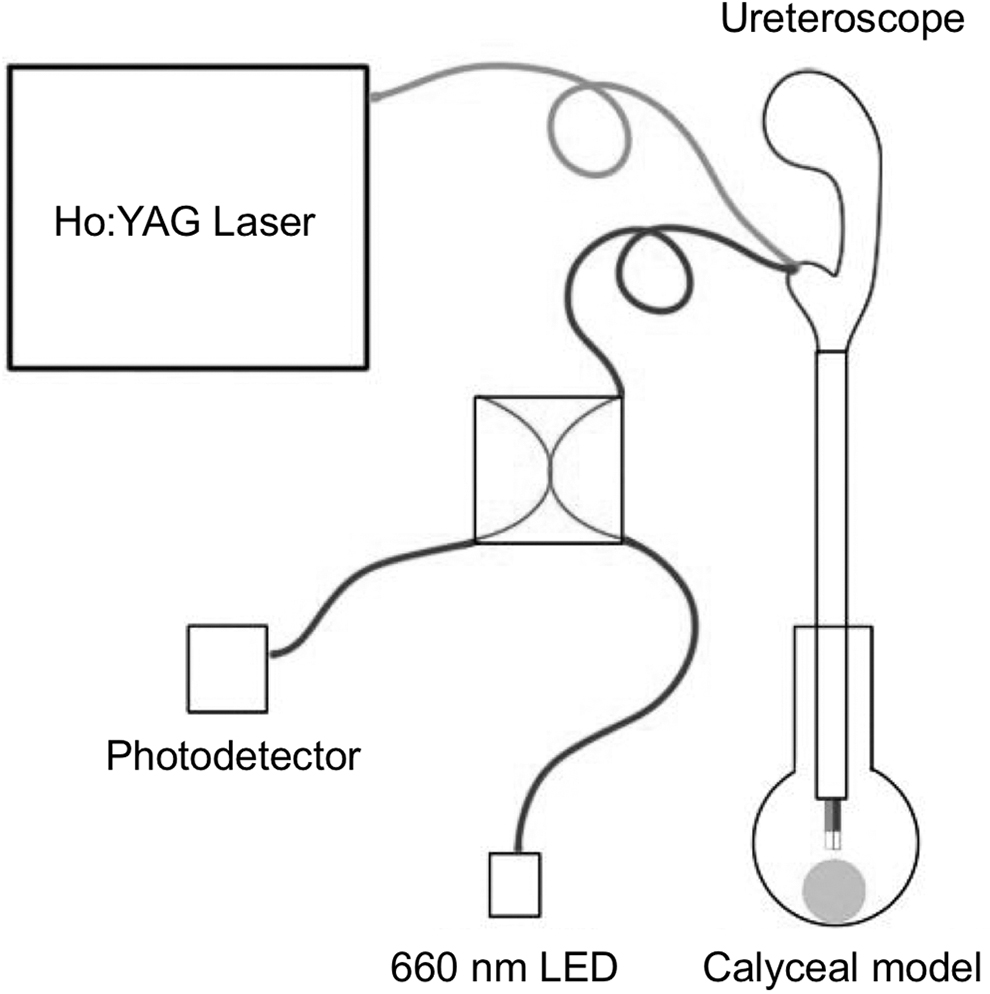
Experimental setup illustrating the laser sensing component (black fibers) and energy delivery component (gray fiber).
Pulse duration for pulse energies ranging between 0.5 and 1.0 J was measured using a photodetector (DTE05D2, Thorlabs, NJ) and ranged between 206 and 265 μs for short pulse and 244 and 390 μs for long pulse. Both the laser and sensing fibers were positioned immediately next to each other and passed through the working channel of an ureteroscope (LithoVue, Boston Scientific, MA). The fibers were attached to each other from the distal end just before the tip using a hot glue to ensure that both fibers were at the same level during the experiment. An ultrathin 600 nm shortpass filter (Edmund Optics, NJ) was placed on the ureteroscope camera to limit the red-light brightness and improve operator vision during the experiment.
Baseline reflectance assessment
Reflectance change with respect to change in stone to fiber distance was first assessed using a flat BegoStone (composition 15:5) model that was 30 × 30 × 3 mm. The sensing fiber was attached to a three-dimensional (3D) positioning system, which was programmed to position the fiber at 0, 0.5, 1.0, 1.5, 2.0, 2.5, and 3.0 mm from the stone. Five trials were performed to measure reflectance and compare to the reflectance when no stone was present.
Sensing setup validation
To assess the accuracy of the sensing system, a pilot experiment was conducted to compare the results obtained from the sensing setup with results obtained from direct visualization of video recordings of laser pulses. A noncontact lithotripsy model was used in this experiment with five spherical BegoStones that were 3 mm with laser setting of 0.5 J × 80 Hz (short pulse mode) for 1.5 seconds. Sensing data and high-speed video were recorded simultaneously during the experiment. High-speed video (Photron Fastcam SA1.1, Tokyo, Japan) was recorded at 10,000 frames per second. Videos were reviewed to calculate the number of laser pulses that were delivered when the stone was in direct contact with the fiber as demonstrated by the plume of dust ejecting from the stone.
Contact lithotripsy experiments
A spherical 5 mm BegoStone (15:5) was placed in a 20 mm 3D printed bulb like model to simulate a large renal calix. Experiments were performed by two endourologists. At the beginning of each experiment calibration was performed by recording reflectance with the fiber in contact with the stone. One set of experiments was conducted using fragmentation technique with laser settings of 0.8 J × 10 Hz (short pulse). Reflectance was recorded in 50-second intervals during treatment until the surgeon deemed that the fragments were small enough for retrieval. A second set of experiments was conducted using dusting technique with laser settings of 0.3 J × 50 Hz (long pulse). Reflectance was recorded in 50-second intervals during treatment until the surgeon deemed that the fragments were small enough that noncontact lithotripsy (popcorn technique) would next be performed. The laser fiber pairs were examined to be sure that the tips were even and remained secured to each other before each trial.
Noncontact lithotripsy experiments
A total of 10 cuboid BegoStones (3 × 3 × 1.5 mm) were placed in an 11 mm bulb caliceal model to simulate small renal calix. The ureteroscope was attached to a 3D positioning system (Velmex, NY), and the laser fiber was positioned 2 mm from the top surface of the collection of stones. Experiments were conducted using settings of 0.5 J × 40 Hz (20 W), 1.0 J × 20 Hz (20 W), 1.0 J × 40 Hz (40 W), and 0.5 J × 80 Hz (40 W) in short pulse mode. Energy was kept constant at 4.8 kJ equating to 2 and 4 minutes for the 40 W and 20 W settings, respectively. Sensing data were recorded for all experiments in 30-second interval. Each experiment was repeated five times, and fibers were reattached to each other before each trial.
Data analysis and study outcomes
Sensing data were analyzed using MATLAB (MathWorks, MA). After plotting the raw data, baseline and contact reflectance were manually extracted for contact lithotripsy experiments. It was not possible to make contact with the stone collection at the beginning of noncontact lithotripsy experiments, so the value of contact reflectance obtained in the baseline reflectance experiment was used. Laser pulses produce a sharp increase in reflectance, which was used to identify timing of each laser pulse from the recorded reflectance data. Stone to laser fiber distance for each laser pulse was measured with the reflectance method and categorized as ≤0.5, 0.5–1.0, and >1.0 mm. The percentage of pulses delivered within these distance ranges was the primary study outcome. Statistical analysis was performed using Microsoft Excel (Redmond, WA).
Results
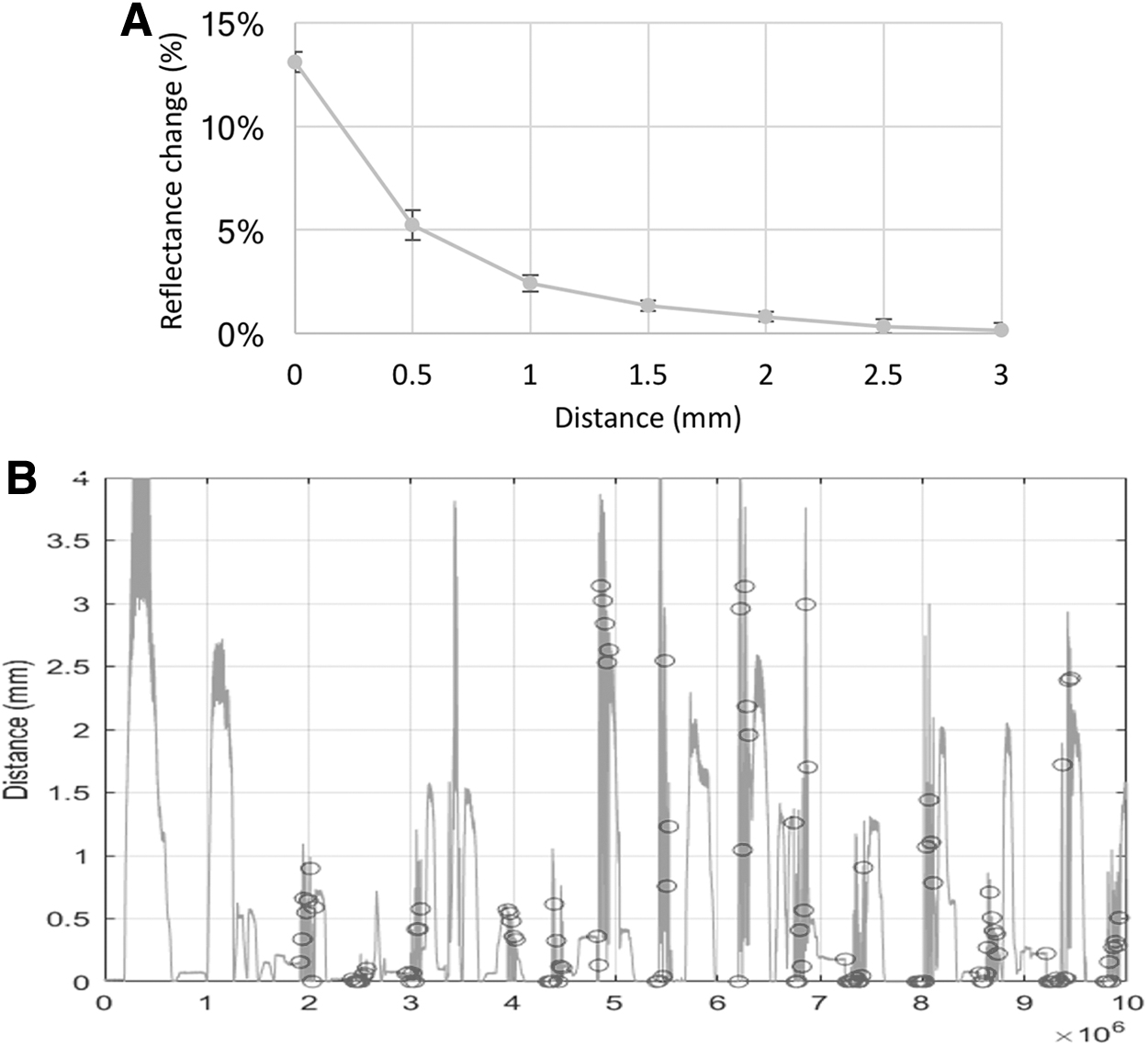
Measurable changes in reflectance occurred when the distance from the laser fiber tip to the stone differed (Fig. 2A) making it possible to determine this distance in real time with high accuracy when the stone to fiber distance was <1.5 mm. In addition, a pilot study demonstrated 86% agreement (range 79%–94%) between the sensing data and manual video analysis. Disagreement between the video and sensing data was observed when a stone struck the sensing fiber but not the treatment fiber or vice versa. Figure 2B illustrates an example of measured laser tip to stone distance during one of the trials.
The percentage of laser pulses delivered at various fiber to stone distance ranges was notably different for fragmentation, dusting, and popcorn lithotripsy techniques (Fig. 3). Data from experiments performed by the two surgeons were combined because there were no significant differences. The percentage of pulses delivered when the stone was within 0.5 mm of the fiber was 52% (±16), 23% (±11), and 4% (±3) for fragmentation, dusting, and popcorn technique, respectively. Not surprisingly, the difference between fragmentation and dusting was statistically significant (p-value <0.0001). The percentage of pulses delivered when the stone was “out of range,” greater than 1 mm away, was 34% (±16), 48% (±17), and 88% (±5) for fragmentation, dusting, and popcorn technique, respectively.
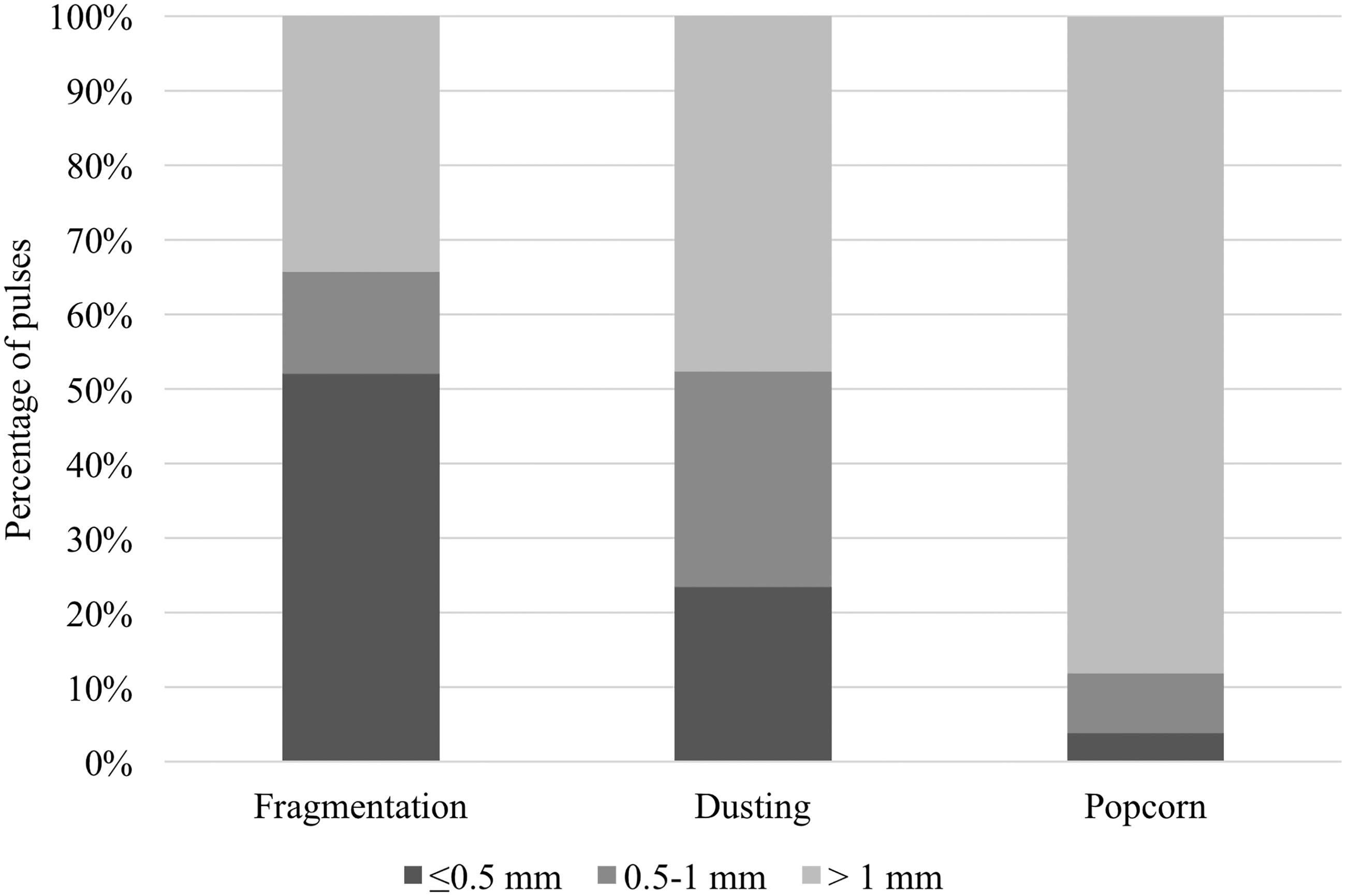
Percentage of pulses delivered at ≤0.5, 0.5–1.0, and >1.0 mm fiber to stone distance during contact lithotripsy (fragmentation and dusting) and noncontact lithotripsy (popcorn) techniques.
For noncontact lithotripsy experiments several different laser settings were used. The percentage of pulses ranged between 1% and 7%, 6% and 11%, and 82% and 91% when the stone to fiber distance was ≤0.5, 0.5–1.0, and >1.0 mm, respectively (Fig. 4). Laser settings of 0.5 J × 80 Hz demonstrated statistically higher percentage of pulses delivered when the fiber to stone distance was ≤1 mm, although still substantially inefficient with 82% of pulses delivered when stones were >1 mm away from the laser fiber (p-value >0.0001).
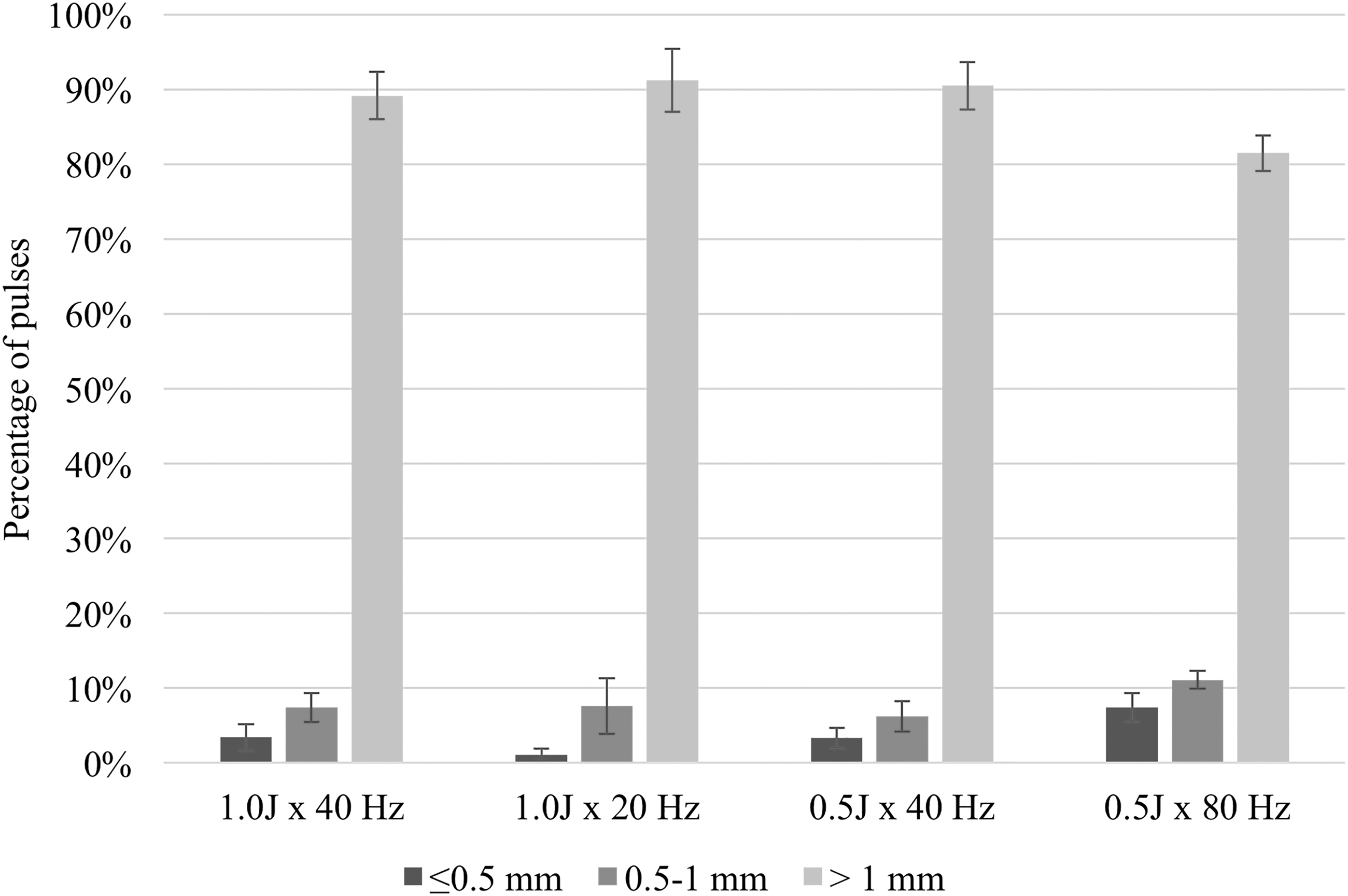
Percentage of pulses delivered at ≤0.5, 0.5–1.0, and >1.0 mm fiber to stone distance during noncontact lithotripsy (popcorning) using different laser settings.
Discussion
Laser lithotripsy is most efficient when performed with the fiber in direct contact with the stone surface. 4,5 While stone ablation can be observed when the fiber is not in contact with the stone, the decay in ablation effectiveness is steeply associated with distance. 5 Van Leeuwen and colleagues measured the reduction in holmium laser energy transmission through fluid with different pulse energies and reported that only 37% of the 0.25 J pulse energy was recorded when the separation distance between the laser fiber and energy meter was 1.5 mm. 4 However, 60% of the energy was recorded at the same distance when using pulse energy of 1.0 J. This highlights the importance of working distance when using low pulse energy.
Dusting involves using low pulse energy and high pulse frequency so this technique would be affected by working distance more than fragmentation and active retrieval techniques which utilize high pulse energy and low pulse frequency. 7 Moreover, energy transmission in fluid is also affected by laser wavelength. For example, thulium laser energy (wavelength 1.94 μm) is more highly absorbed in water 10 and, thus, results in more energy loss when traversing equal distance compared to holmium laser (wavelength 2.1 μm).
There are two other studies that have explored using reflectance to assess stone to fiber distance. 9,11 Schlager and colleagues created a fiber–fiber coupling box in which they combined holmium laser light with an external green light beam into one fiber. 11 Light reflected back from the stone was diverted to a photodetector to record reflectance data for analysis. Similar to our study, they demonstrated that reflectance decreases dramatically with distance and can be used to detect a stone when it is within 1.5 mm from the fiber. Moreover, Lange and coworkers reported on the possibility of using the aiming beam to record reflectance and use it to measure stone to fiber distance. 9
In our study, we determined the percentage of pulses delivered at each fiber to stone distance category of ≤0.5, 0.5–1.0, and >1.0 mm. Since we are interested in the pulses that strike the stone and result in ablation, the concept of strike rate is proposed. For example, “0.5 mm strike rate,” meaning the percentage of pulses fired when the fiber to stone distance is 0.5 mm or less, and “1 mm strike rate,” meaning the percentage of pulses fired when the fiber to stone distance is “1 mm or less,” incorporate both directional targeting and stone to fiber distance into a measure of laser pulse efficiency. This may be useful for other laser systems and lithotripsy techniques. Moreover, the strike rate concept provides a uniform method to assess efficiency of energy delivery for different laser settings, laser systems, and lithotripsy techniques.
Data presented in this study showed that a substantial fraction of laser pulses were delivered when the stone was beyond the effective ablation distance especially when performing noncontact laser lithotripsy technique. This “wasted” energy does not contribute to stone fragmentation but does increase heat production during laser lithotripsy. 12,13 Data from these experiments reveal that using lower pulse frequency, such as 10 Hz, during contact lithotripsy can increase the percentage of pulses delivered when the stone is in close proximity to the fiber. One could then infer that frequency reduction could be used as a strategy to improve efficiency of energy delivery. However, reducing pulse frequency will increase time needed to complete the procedure and be time inefficient.
The ideal solution is to develop a system which can automatically gate laser pulse firing to only those instances when the stone is in close range and hence improve both energy efficiency and time efficiency. This idea was explored by Schlager and colleagues in which they created a feedback loop between an external sensing setup and the laser system. 11 They were able to use reflectance data to trigger the laser system whenever the stone was within 1 mm from the laser fiber. Another way to improve lithotripsy efficiency is to improve energy transmission through fluid with pulse modulation technologies such as Moses Technology™ and Virtual Basket™. 14,15 However, even with these technologies, stone ablation is most efficient when the stone is close to the laser fiber. 5,6
This study has several limitations. First, reflectance was measured using a secondary fiber placed next to the treatment fiber. This reduced the accuracy of our setup to 86% as reported for the pilot experiment. This was because the stone was occasionally observed to be closer or in contact with one fiber but not the other. However, the difference between lithotripsy techniques tested in this study was found to be large enough to not be affected by this reduction in accuracy. It is possible to improve the accuracy if access to the internal components of the laser can be obtained.
Second, only expert endourologists from our institution were included in this study. These findings might not be generalizable to other endourologists; however, our aim was to understand differences in laser fiber to stone distance as a result of lithotripsy technique (fragment, dust, or popcorn) and highlight areas for technologic improvement. Once technologic solutions are developed, they will need to be evaluated across a broader range of skill levels to determine overall benefit. In addition, it was not possible to bring the fiber in contact with the stone at the beginning of noncontact lithotripsy experiments in the same way as it was done with the contact lithotripsy experiments. Instead, we used contact reflectance data from the baseline experiment performed at the beginning of the study. This should not have affected the data because there was minimal variation in reflectance.
Laser settings used in this study do not cover all settings used clinically; however, commonly used laser settings were selected to be representative of clinical practice. The trends that have emerged from this research study based on technique are likely to persist despite some variation in laser parameters within a particular laser mode of operation (fragment, dust, popcorn). 16 Finally, a BegoStone model was used in this study. It has been reported that different stone compositions have different reflectance values. 11 Even though reflectance differs based on stone composition, all stone compositions demonstrated the same reflectance trend with accuracy of detecting stone location within 1.5 mm from the fiber. We saw the same trend with BegoStone model in this study.
In conclusion, laser fiber to stone distance was effectively measured with light reflectance during different modes of laser lithotripsy. Current methods of laser lithotripsy that rely on fixed firing rates are inefficient, especially for the popcorn technique. These data highlight areas for improvement by developing laser systems capable of sensing laser fiber to stone distance and appropriately gating pulse delivery to maximize lithotripsy efficiency for each pulse fired.
Footnotes
Author Disclosure Statement
K.R.G. is a consultant for Lumenis and Boston Scientific. W.W.R. is a consultant for Boston Scientific.
Funding Information
This study was supported by a scientific research grant from Boston Scientific.