




Abstract
Purpose:
To compare a novel Thulium laser device with the commonly used Holmium:Yttrium-Aluminum-Garnet (Ho:YAG) laser in terms of the in vitro temperatures generated.
Methods:
Our study investigated and compared an evaluation model of a solid-state Thulium laser with a Medilas H Solvo 35 Holmium laser device, both by Dornier (Dornier MedTech Laser GmbH, Wessling, Germany). Our in vitro model consisted of a 20 mL test tube placed in a 37°C water bath. Constant irrigation was set at 50 mL/minute with a Reglo Z Digital pump (Cole Parmer, Chicago, IL). Four hundred micrometers of Dornier laser fibers were used. The temperature was measured with a type K thermocouple and a real-time data logger from Pico (PICO Technology, Cambridgeshire, United Kingdom). Power settings between 2 and 30 W were investigated. Each measurement lasted 120 seconds and was repeated five times. The data were evaluated by MATLAB® (The Mathworks, Inc., Natick, MA).
Results:
The resulting temperatures were directly proportional to the power supplied. When comparing Holmium with Thulium, we observed maximum deviations of ≤0.82 K in temperatures at 120 seconds. The highest investigated laser power of 30 W yielded maximum temperatures differing by 6.7 K from the initial value. Out of the five comparisons, Thulium showed marginally yet significantly lower end temperatures in four cases and slightly lower cumulative equivalent minutes at 43°C (CEM43) values in three cases.
Conclusion:
The Thulium laser resembles the Holmium device in the temperatures generated during in vitro application. An increase in laser power, thus, leads to equivalent increases in temperature that are largely independent of frequency, pulse duration, and single pulse energy. Pulsed Thulium:Yttrium-Aluminum-Garnet (Tm:YAG), Ho:YAG, and Thulium fiber laser seem to share a similar risk profile for patients in terms of temperature development. Intrarenal power outputs exceeding 10 W during clinical application should be compensated by ensuring sufficient irrigation.
Introduction
Over the past few decades, Holmium:Yttrium-Aluminum-Garnet (Ho:YAG) laser lithotripsy has been established as the gold standard for endoscopic stone treatment, 1 with its first application reported in 1992. 2 Among the main reasons for its widespread use are its straight-forward operability, suitability for all stone types, instrument versatility, short absorption distance, and a low complication rate. 3 Thulium laser lithotripsy has recently undergone further improvements, especially Thulium fiber lasers (TFL), and has been extensively investigated in terms of dusting/fragmenting efficiency, stone ablation threshold/rates, gas bubble formation, and collateral damage assessment. 4 –15 Taratkin and colleagues showed that TFL and Ho:YAG have a similar temperature behavior at identical power settings. 15
Dornier MedTech Laser GmbH (Wessling, Germany) provided an evaluation model of a novel Thulium pulsed solid-state laser that should not be confused with a TFL. It operates according to the well-known photothermal mechanism 16 and differs mainly in its 2013 nm wavelength. The water absorption coefficient ranges between the Holmium and the TFL technology, with Ho:YAG being 54% and TFL being 210% of Thulium:Yttrium-Aluminum-Garnet's (Tm:YAG's) absorption coefficient (Table 1). Holmium laser lithotripsy can achieve up to 80 Hz (Lumenis, San Jose, CA), whereas TFL can attain values of 2000 Hz through several generating laser diodes. 4,17
Comparison of Wavelengths and Absorption Coefficients Between Holmium:Yttrium-Aluminum-Garnet, Thulium Fiber Laser, and Thulium:Yttrium-Aluminum-Garnet
YAG = Yttrium-Aluminum-Garnet.
Despite its similarity to TFL and Ho:YAG devices, this new solid-state Thulium technology requires extensive testing. As a consequence of the increasing laser powers, interest has grown in recent years regarding the temperatures generated during laser lithotripsy. 18 –25 In clinical practice, irrigation is used to improve visibility and cool down the surrounding fluid; therefore, if irrigation is insufficient or absent, tissue-damaging temperatures may be reached within a short time. 24,25 As a means to limit tissue damage, the cumulative equivalent minutes at 43°C (CEM43) value was defined, which corresponds to the cumulative time equivalent at 43°C. 26 One minute at 43°C corresponds to a CEM43 value of 1, whereby each additional degree is calculated by a factor of 2, and each degree less than 43°C is considered by a factor of 0.5 so that the CEM43 value can never equal 0. In this study, we assessed increasing temperature changes as well as the CEM43 value during laser lithotripsy by comparing a new Thulium solid-state device with a state-of-the-art Holmium laser device.
Materials and Methods
The novel laser device we investigated is an evaluation model of a diode-pumped, pulsed solid-state laser with a possible frequency of 1 to 200 Hz and possible pulse energies starting at below 0.1 J and ranging up to 3.0 J. 27 The device delivers an average power of up to 120 W and operates on a standard single-phase power supply (230 VAC/16 A). Its dimensions, weight, heat dissipation, and noise emission are comparable to 35 W Holmium laser devices.
Our experimental setup consisted of a 20 mL water-filled test tube that aimed at replicating the pyelocaliceal system's volume. The water tank was circulated by a hose pump (SP 04 L; Otto Huber GmbH, Böttingen, Germany). The test tube was partially submerged in a 37°C water bath whose temperature was kept constant with a heating rod (thermocontrol 3604; Eheim, Deizisau, Germany) and simulated the surrounding heat absorption and distribution of the renal parenchyma (Fig. 1). The test tube was sealed with a perforated plug to ensure a constant volume, whereas the irrigation rate was maintained at 50 mL/minute through a Reglo Z Digital pump (Cole Parmer, Chicago, IL). The irrigation rate was calculated in previous experiments as a mean value of five stone treatment modalities performed with a flexible ureterorenoscope (Cobra Vision®; Richard Wolf, Knittlingen, Germany). 28 Constant irrigation was applied to achieve comparable conditions and avoid the influence of external factors when directly comparing the two laser devices.

Experimental setup. (A) Water bath, (B) heating rod, (C) circulation pump, (D) USB TC-08, (E). Reglo Z Digital precision pump, (F) type K thermocouples, (G) 400 μm laser fiber, (H) irrigation inflow to test tube, (I) test tube.
A type K thermocouple (PICO Technology, Cambridgeshire, United Kingdom) and a 400 μm Dornier laser fiber were introduced through the plug, while the thermocouple was placed 5 mm away from the laser fiber (Fig. 1, subfigure). A second thermocouple was placed in the water bath adjacent to the test tube. Before each experimental run, the emitted laser energy was measured with an Ophir energymeter (Ophir, Jerusalem, Israel), whereby the fiber was precisely cut and the scattering pattern examined for homogeneity. Three energy measurements were taken before each test series and once again before each test. All the tests' energy outputs amounted to less than ±50 mJ of the set value, and the measured values were recorded. The thermocouples were connected to a PICO data logger USB TC-08, and the data were evaluated in real time by MATLAB® (The Mathworks, Inc., Natick, MA). For a statistical analysis, each experiment was repeated fivefold, resulting in 50 experimental runs. Each measurement followed 120 seconds of continuous laser activation, and various energy settings were evaluated (Table 2). To measure optical pulse duration, we used an optical detector by Vigo System type PVI-4-1x1-BNC (Vigo System S.A., Ozarow Mazowiecki, Poland) and a Tektronics TDS 3032B (Tektronics, Beaverton, OR). Increases in temperature were recorded at 5/10/30/60/120 seconds, and the mean and standard deviation were calculated at each point in time by using Microsoft Excel (Microsoft Corporation, Redmond, WA). Further, a student's t test was performed for statistical comparisons, considering p-values <0.05 as statistically significant.
Temperature Rises of Holmium:Yttrium-Aluminum-Garnet vs Thulium:Yttrium-Aluminum-Garnet, Direct Comparison

The laser settings selected for a direct comparison between Holmium and Thulium correspond to those frequently employed in laser lithotripsy. The obtained temperatures do not resemble those in the clinical setting, but rather serve as a relative comparison between the devices. Nevertheless, these temperatures roughly correspond to those generated in an ex vivo pyelocaliceal system when passive irrigation is applied 28 ; we, therefore, used a similar water volume.
Results
Our direct comparison of the resulting temperatures revealed overall consistency and minimal (≤0.82 K) variation between Holmium and Thulium during 120 seconds of laser activation (Table 2). Thulium produced significantly lower final temperatures (p < 0.05) in four out of five comparisons and overall lower CEM43 values in three out of five comparisons. The obtained CEM43 values were calculated by integrating the entire temperature curve, taking each data point into account. This calculation reflects the actual heat input over 120 seconds more reliably than in a comparison of the temperature readings at exactly 120 seconds. In our results, the CEM43 values contradict the results of the 120 seconds end temperatures in the 0.6 J and the 3.0 J comparisons.
The adjusted single pulse energies showed minor deviations, the maximum mean being + mJ from the set value at a narrow standard deviations with a maximum of ±11 mJ for 2.0 J/10 Hz in the Tm:YAG device.
The laser settings used for direct comparison are those usually applied clinically for stone fragmentation and dusting. The maximum measured temperature was 6.73 K or 43.7°C in Thulium, and thus slightly over the 43°C threshold for thermal damage. The CEM43 values were less than 2 minutes in all experimental runs.
Overall, standard deviations of the measured temperatures at specific time frames are narrow, amounting to a maximum ±0.96 K at the final temperatures (Tm:YAG, 10 Hz, 3.0 J). The highest temperature increase was 6.73 K or 43.7°C and it was achieved with the Thulium device at 30 W (3.0 J/10 Hz). The highest CEM43 value was also measured at this setting, though for the Ho:YAG device, and it amounted to 1.83 minutes. No CEM43 values fell into the questionable or critical range above 20 or 70 minutes, respectively. Temperature changes above +6 K may not automatically cause thermal damage, as the CEM43 suggest in the 3.0 J experiments.
Figure 2 illustrates a representative example of the temperature curve over 120 seconds at a medium frequency/high pulse energy setting of 10 Hz/2.0 J with the Thulium laser device. The temperature curve plateaus at 60 seconds and around 4.3 K.
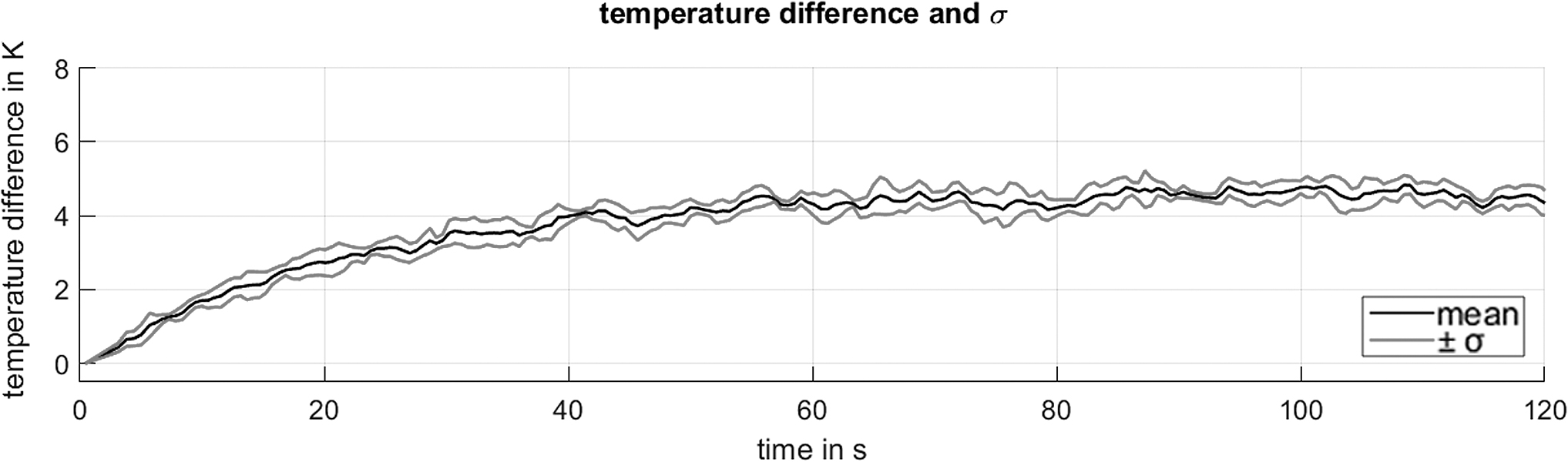
Temperature rise for the Tm:YAG device at 2.0 J, 10 Hz, and 661 μseconds pulse length. Tm:YAG, Thulium:Yttrium-Aluminum-Garnet.
Figure 3 shows two different curves at similar 5 W settings, revealing greater fluctuation and broader standard deviations for the Holmium device.
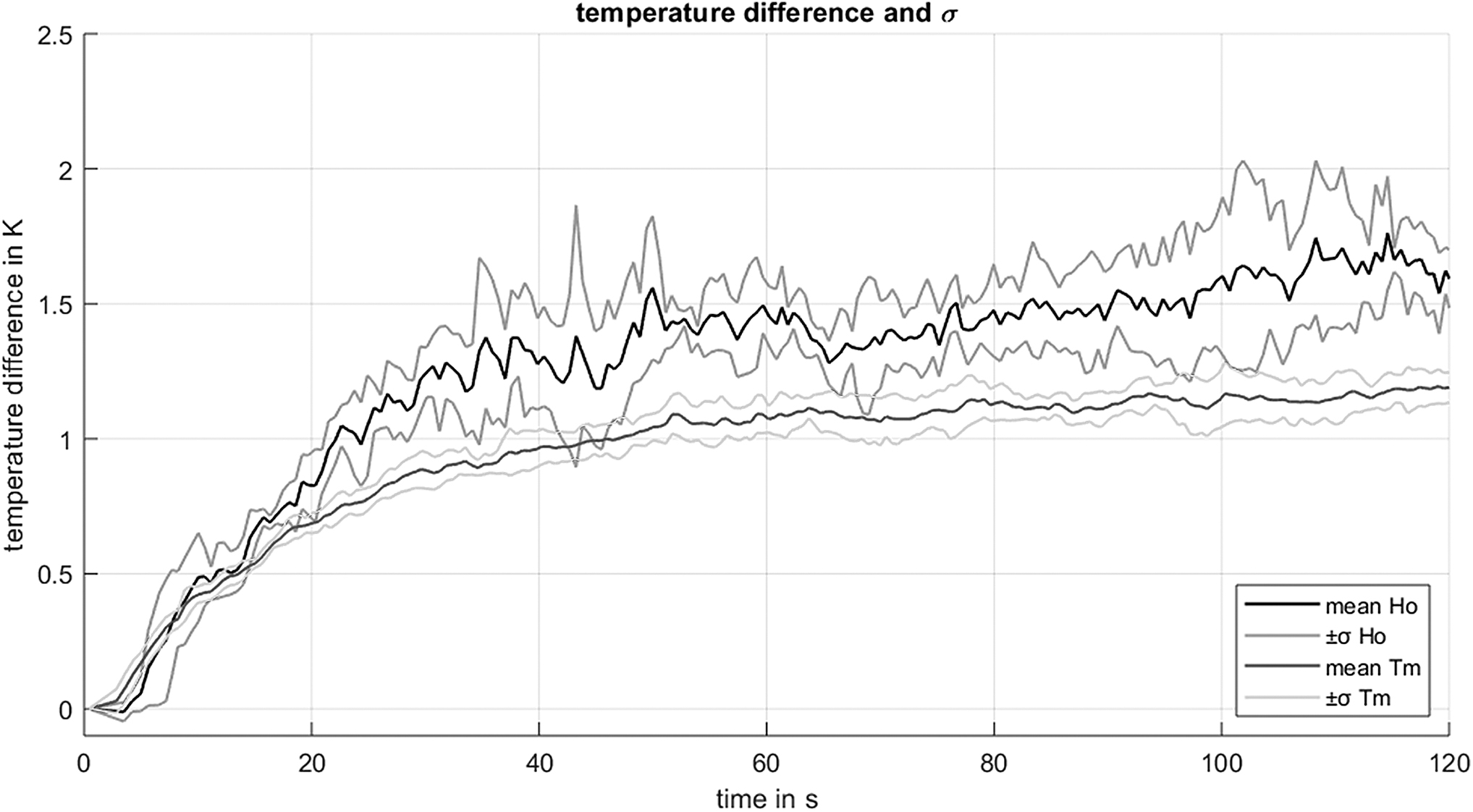
Temperature rise for Ho:YAG and Tm:YAG, 0.2 J, 25 Hz, pulse length Ho 140 μseconds vs Tm 150 μseconds. Ho:YAG, Holmium:Yttrium-Aluminum-Garnet.
Discussion
From a purely physical point of view and as our experiments demonstrate, the laser power exerts the main influence on the resulting temperatures. The dependency of temperatures on the combination of frequency, pulse duration, and single pulse energy has been extensively investigated and revealed inconsistencies. 18 –25 For example, most of these studies did not use a energy meter, thus the actual laser power output was not considered as a source of deviation. In addition, several studies use passive irrigation and do not measure the flow rate.
In previous experiments with a LISA Laser Ho:YAG device, small variations of around 10% were detected in final temperature changes at different laser settings. 28 Although the calculated laser power output may remain same with different frequency and pulse energy combinations, the actual emitted laser energy measured by the energy meter may significantly vary and lead to differing end temperatures. Similarly, pulse duration changes should not affect the energy output. However, we showed that with pulse duration changes there are variations in the energy meter readings and the resulting temperatures. In this previous study, we did not examine the impact of the fiber's condition conclusively, as the energy meter does not gather scattered radiation from degraded fibers, which—nonetheless—is transferred to water. Therefore, to obtain reproducible results, laser fibers should be cut before any investigation. Measured energy values are to be regarded as only indicators of the actual total power emitted. All studies should still be performed by using a energy meter to ensure accurate conclusions from the results. The resulting end temperature deviations in our previous study in the order of 10.5% can be considered as not clinically relevant.
The turbulence inside the test tube is a key influencing factor for temperature changes and depends on the frequency, single pulse energy, water absorption coefficient, and pulse duration. Our comparison of curves with exactly or nearly identical settings revealed smoother curves for the Thulium device, suggesting less water turbulence possibly due to the differing water absorption coefficients (Fig. 3).
The 0.2 J single pulse energy at 10 Hz, with 150 μseconds Thulium pulse duration vs 140 μseconds Holmium pulse duration allows for almost identical settings for a direct comparison between both devices. It was not technically feasible to approximate pulse durations further. The almost similar temperature readings at power settings above 0.2 J revealed that pulse duration does not seem to impact temperature development.
The heat dissipation by forced convection along the test tube wall depends on the passing mass flow, which, in turn, depends on the turbulence generated. The turbulence has an additional effect not only on the heat dissipation via the test tube wall, but also on the temperature probe's detection. On laser activation, the heat generated was not immediately conveyed to the 20 mL of water in the test tube. Instead, it swirled within the turbulences generated by the laser pulses, causing fluctuating temperature readings, and was then distributed more slowly throughout the entire volume. On laser deactivation during pretesting, the curves showed only minimal fluctuation.
Blackmon and colleagues first published turbulence investigations and resulting suction effects. 29 All adjustable laser parameters exert a direct influence on turbulence and thus on the temperature measured. The generated curves, therefore, are only as meaningful as average curves. In investigations involving additional irrigation, the irrigation rate and position of the associated inflow and outflow also play a decisive role in the measured temperatures. At higher irrigation rates, a steady state can be calculated at which the supplied power is theoretically completely converted into a temperature increase in the mass flow: Q = m × c × ΔT (Q—heat flow, m—mass, c—specific heat capacity, ΔT—temperature difference). The derivation of this formula results in P = m′ × c × ΔT (P—power, m′—mass flow), which, together with the resulting temperature difference, can be estimated as a function of the power supplied and the irrigation rate. This can be simplified to: ΔT = 14.4 K × |Power [W]|/|Irrigation rate [mL/minute]| (or also with 15 K for everyday clinical use, as published by Hein and coworkers 30 ), which shows enough accordance starting from irrigation rates of 30 mL/minute. At lower irrigation rates, other factors step into the foreground, such as heat dissipating into the surrounding water bath.
Although the CEM43 value is often reported in the literature, it is, in fact, rarely calculated in clinical practice. In an in vivo setting, Aldoukhi and colleagues 19 reported exceeding CEM43 values above 120 minutes in all trials with no irrigation—with maximum values of up to 1022 minutes and corresponding damages. With the medium irrigation rates, they reported values as high as 108 minutes. Even during high irrigation, one value they obtained is in the range of minor but acute damage. 31 van Rhoon and coworkers 32 reported that a temperature of 41°C lasting more than 30 minutes can cause lasting urothelial damage; therefore, they recommend maintaining less than 9 minutes for patients with uncompromised thermoregulation and under controlled conditions. Yarmolenko and colleagues 31 reported minor but acute damage in the renal cavities after 20 minutes and significant damage after 70 minutes. Although the laser in our experiments was activated for just 120 seconds, we calculated the CEM43 value because we consider it to be more relevant than the maximum temperatures reached. This approach was supported by the ostensible differences in the end temperatures compared with the CEM43 value. In summary, the CEM43 value is more precise and does not draw overrated conclusions from punctual fluctuations and short temperature peaks.
Absolute temperatures were not considered since the initial temperature differed slightly from 37°C in each experiment, and a direct CEM43 calculation would not enable a useful comparison. Therefore, we assumed a + 6 K temperature difference to be equivalent to 43°C. Since the CEM43 value cannot correspond to 0 minute, we also obtained values for tests with temperature differences of <6 K.
The CEM43 values for clinical settings with a maximum of 1.83 minutes are far below the 20-minute threshold for minor tissue damage, as Yarmalenko and colleagues reported. 31 Thus, more than 2 minutes of continuous laser application with 30 W laser power can also be considered safe assuming sufficient irrigation is provided. Actual in vivo experiments to determine CEM43 in laser lithotripsy should be considered, not only to measure maximum temperatures, but also to determine the total influence and degree of the equivalent heat dose in vivo.
In this study, we showed that Tm:YAG and Ho:YAG share a similar risk profile in terms of temperature changes. With regard to the existing literature on TFL, we can even conclude that all three technologies are similar regarding temperature development. 15 Nonetheless, this investigation is not devoid of limitations. First, our in vitro experiments cannot be compared with in vivo/ex vivo conditions. Second, we used fixed 50 mL/minute irrigation, which is optimal for direct comparison and has fewer error sources, but does not represent clinical situations in which irrigation varies widely. Third, it was not technically possible to match all settings; especially pulse duration technically differs between the two technologies. Fourth, p-value calculation refers only to the punctual 120 seconds values, which suggest significant lower temperatures for Thulium in four out of five comparisons. Regarding the minimal deviations in the CEM43 calculations, no relevant difference between Holmium and Thulium can be observed. In addition, two out of four CEM43 results are even contradicting these statistical significance tests.
Further research on turbulences and their influencing factors should be conducted to confirm the association between retropulsion, pulse duration, and water absorption coefficient as well as the question on how turbulences can be useful in clearing the renal pelvis of residual stones.
Conclusion
The temperatures we measured with the new Thulium solid-state laser resemble those of the Holmium laser. An increase in laser power, thus, leads to equivalent increases in temperature that are largely independent of frequency, pulse duration, and single pulse energy. Both Holmium and Thulium lasers should only be applied in conjunction with sufficient irrigation to ensure patient safety.
Footnotes
Author Disclosure Statement
R.P. and A.M. were consultants to Dornier MedTech Laser GmbH purely for the sake of this investigation.
Funding Information
No funding was received for this article.