




Abstract
Purpose:
The main objective of our prospective, descriptive, monocentric, longitudinal study is to demonstrate the feasibility of vesicoscopic cross-trigonal ureteral reimplantation under CO2 pneumovesicum in treatment on primary vesicoureteral reflux (VUR), analyze results, and specify the age limit of this approach.
Materials and Methods:
A total of 60 patients underwent transvesicoscopic ureteral reimplantation (33 boys, 27 girls) by the same surgeon from May 2011 to May 2015. All patients had primary VUR, and surgery was performed because of breakthrough urinary tract infection despite antibiotic prophylaxis and persistent high grade of VUR, especially in association with significant renal scarring, mean age at operation was 47.47 months (6 month–12 years). Of the 60 patients, 34 had bilateral reflux and 26 had unilateral reflux. The reflux grade in the total of 94 ureters was grade IV, V in 59.57%, grade III in 35.11%, and grade II in 5.32% in association with contralateral high-grade VUR.
Results:
The transvesicoscopic procedure was effectively completed in all patients without perioperative complication except one case of pneumoperitoneum that required exsufflation by open laparoscopy. The mean overall operative time decreased significantly with an average of 58.43 ± 11.26 minutes for unilateral reimplantation and 101.18 ± 26.5 minutes for bilateral reimplantation. The postoperative hospital stay was 3 days for all patients. The mean follow-up period was 3 years. Cystography was performed 3 months after surgery in all patients and showed the disappearance of VUR in 57/60 patients (95%) or 91/94 of ureters (97%). Persistent VUR was documented in 3 of 94 ureters and had resolved spontaneously at 12 months after reimplantation.
Conclusion:
Our preliminary results indicate that vesicoscopic ureteral reimplantation is safe and effective procedure with minimal morbidity when compared to traditional open method. It can be applied in children younger than 12 months.
Introduction
Vesicoureteral reflux (VUR
Surgical treatment of RVU began with conventional ureteral reimplantation in the 1950s and then generalized and developed with its various extra- and intravesical variants in the 1960s and 1970s, the main criterion of technical choice being the success rate.
The concept of minimally invasive treatment of VUR began in 1980 using endoscopic injections of biomaterial at the vesical ureteral junction; It is attributed a failure rate between 10% and 30% compared to conventional surgery.
With the advent of laparoscopic surgery and the miniaturization of the instrumentation, its application in surgical treatment of vesicoureteral reflux was initially described by extravesical approach “Lich Grégoir” and then by pneumovesicoscopic approach, offering the same success rate as open surgery but with a much lower morbidity rate than in conventional surgery.
The aim of our prospective study is to demonstrate the feasibility of vesicoscopic cross-trigonal ureteral reimplantation under CO2 pneumovesicum in treatment on primary VUR, analyze results, and specify the age limit of this approach.
Materials and Methods
A total of 60 patients underwent transvesicoscopic ureteral reimplantation (33 boys, 27 girls) by the same surgeon from May 2011 to May 2015. All patients had primary VUR, and surgery was performed because of breakthrough urinary tract infection despite antibiotic prophylaxis and persistent high grade of VUR, especially in association with significant renal scarring, mean age at operation was 47.47 months (6 month–12 years).
Of the 60 patients, 34 had bilateral reflux and 26 had unilateral reflux. The reflux grade in the total of 94 ureters was grade IV, V in 59.57%, grade III in 35.11%, and grade II in 5.32% in association with contralateral high grade VUR.
Our surgical methods followed those reported by Valla et al.
Operative technique
Preparation
The surgical technique does not require any particular preparation.
Positioning
According to their age, patients are positioned in two ways;
Transversal position: for patients younger than 3 years of age. The surgeon is placed above the patient's head.
Dorsal lithotomy position with the abdomen and perineum within the sterile field for children older than 3 years of age.
The surgeon is placed laterally.
Cystoscopic step
The first step of pneumovesicoscopic approach is to perform a cystoscopy using telescope 30° on a bladder prefilled with glycocolle in an aim to facilitate and control the placement of the 3 mm trocars after first fixation of the bladder wall to the anterior abdominal wall with the transfixing sutures to prevent any risk of accidental dislodgement during the intervention (Fig. 1

Trocars placement. Color images are available online.
Pneumovesicoscopic step
The bladder is first emptied of the glycocolle and then insufflated with CO2 by one of the operators, trocars with a pressure of 10 mmHg and flow of 4 L/min.
Principles of Conventional Cohen procedure are reproduced as follows:
Ureteral catheterization
Introduction of the ureteral catheter is done through the rigid pediatric cystoscope.
The ureteral catheter is fixed to meatus of the refluxing ureter by 5/0 polyglactin suture after retrograde catheterization to facilitate ureteral dissection and to prevent ureteral tube migration

Ureteral catheter fixation. Color images are available online.
Ureteral dissection
Ureteral dissection is done until hiatus by using hook electrode at a low-power setting, respecting ureteral vascularization

Ureteral dissection. Color images are available online.
Tunnel creation
The submucosal tunnel is created by scissors in accordance with Paquin's rule
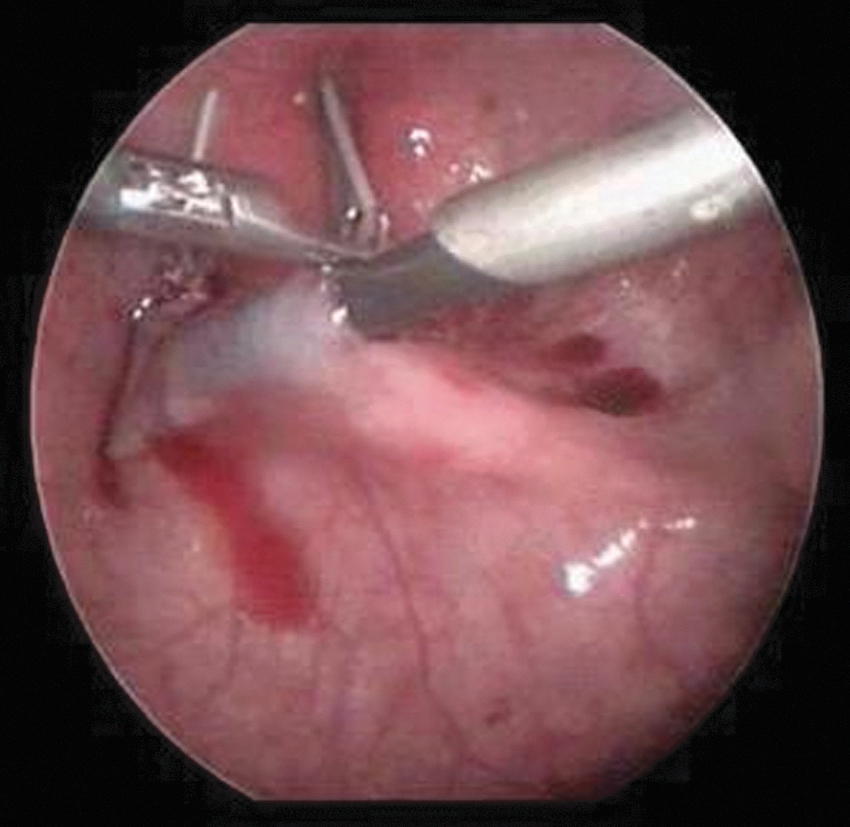
Tunnel creation. Color images are available online.
Using an atraumatic forceps, the ureter pulled by the catheter passes through the submucosal tunnel without tension or torsion

Passage of the ureter in the submucosal tunnel. Color images are available online.
Closure of detrusor muscle defect and ureteral fixation
The defect of detrusor muscle is closed with interrupted 5-zero polyglactin sutures, and the ureter is fixed into position with 5-zero polyglactin interrupted sutures.
Ureteral meatoplasty and mucosa suture
Done by interrupted absorbable suture
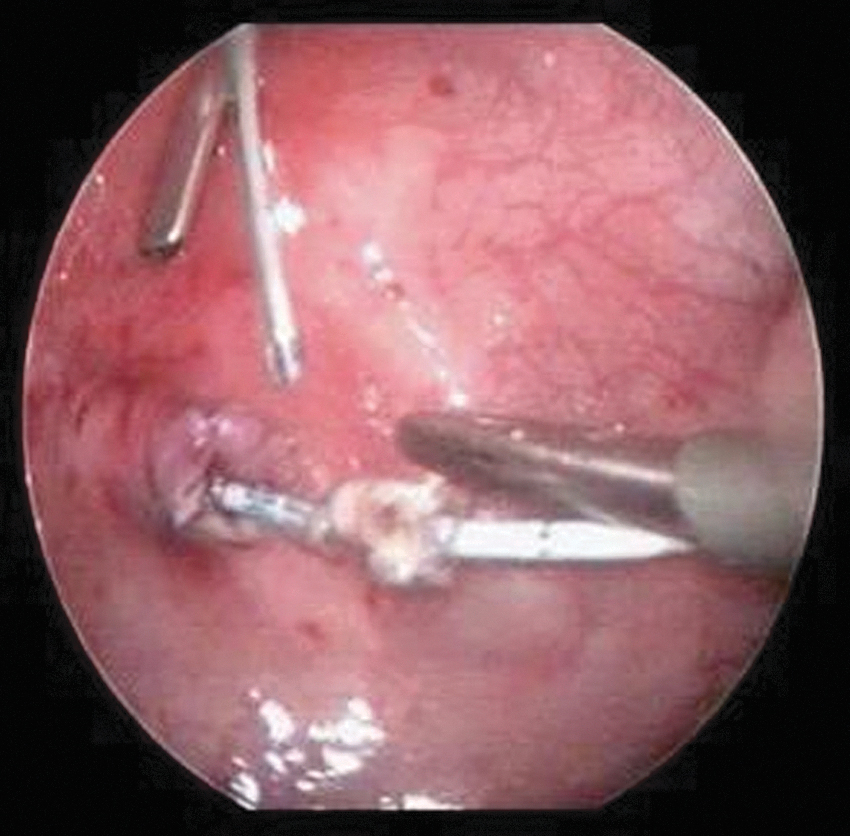
Meatoplasty. Color images are available online.
The surgical procedure ends with ureteral drainage that is carried out through the orifices of the trocars and bladder drainage by a Foley catheter.
Bladder port closure was not necessary.
Results
The transvesicoscopic procedure was effectively completed in all patients without perioperative complication except one case of pneumoperitoneum that required exsufflation by open laparoscopy. The mean overall operative time decreased significantly with an average of 58.43 ± 11.26 minutes for unilateral reimplantation and 101.18 ± 26.5 minutes for bilateral reimplantation. The postoperative hospital stay was 3 days for all patients. The mean follow-up period was 3 years.
Cystography was performed 3 months after surgery in all patients and showed the disappearance of VUR in 57/60 patients (95%) or 91/94 of ureters (97%). Persistent VUR was documented in 3 of 94 ureters and had resolved spontaneously at 12 months after reimplantation.
Discussion
VUR currently remains the most common pathology in pediatric urology predisposing to the risk of renal failure and high blood pressure. 1 Surgical management of VUR has grown considerably in the last four decades with the advent in the 1980s of endoscopic treatment by O'Donnell and Puri 2 as an alternative to surgical treatment, not only with its various techniques known for their effectiveness but also by their high morbidity rates. 3 –5 In terms of morbidity, the results of the endoscopic treatment are satisfactory, the patient could return to normal activity the same day of the intervention, but in terms of efficacy, it remains far below the results of conventional surgery. Recent meta-analysis have shown that the resolution rate of VUR grade I–II was 79%, 72% for grade III, and 65% for grade IV following a first endoscopic injection. 6 The question about the long-term effectiveness of endoscopic treatment remains unanswered. One of the uncertain results of Swedish reflux study showed recurrent cases in 20% of patients initially treated effectively by endoscopic injection after 2 years of follow-up. 7
Seeking to find a solution combining efficiency and low morbidity, pediatric urologists after long years of research have succeeded in applying laparoscopic surgery to treat VUR by an extravesical approach according to lich Gregoir adopted by several pediatric surgical centers and by transvesicoscopic approach initially described by Yeung et al. 8 and used by only a few centers around the world reproducing the same surgical principles of Cohen technique. The results obtained by the supporters of this new approach in term of efficacy and low rate of morbidity are promising and encouraging. In the literature, we found only a dozen studies, where pneumovesicoscopy was used as a new approach in the treatment of VUR and most of published studies report the beginning of experiments and relate to small samples 8 –19 ; Therefore, our choice of pneumovesicoscopic approach was quickly taken. The aim of our study is to try to prove the feasibility on our patients with primary VUR as well as its effectiveness in terms of success rate. It is a prospective, descriptive, monocentric, and longitudinal study. A population of 60 patients was well defined to avoid selection bias. This sample was calculated based on an accuracy of 2.7% with 95% confidence interval. Recruitment of patients was done in our department, and no significant difficulty was encountered.
Our prospective, descriptive study concerns 60 patients with primary VUR corresponding to 94 refluxing ureters, all operated within the pediatric surgery department of central army hospital according to Cohen's principles by a pneumovesicoscopic approach.
A male predominance is noted in the 0–24 months age group with 16 boys against only 4 girls, then there is an inversion of the rates beyond 24 months with 17 boys against 23 girls, which joins the data of the literature. 20
We did not observe in our series a large difference in the distribution of VUR between the unilateral or bilateral cases with, respectively, 43% against 57%, which joins the data of Canon and Valla. 10,13
The high-grade VUR represents the major part in our series with a rate of 59.57%, which joins the results of Su Chung.
Dimercaptosuccinic acid (DMSA) renal scintigraphy systematically done in all our patients to look for possible renal scars; objectified the presence of bilateral renal scars in 24 children and unilateral in 32, which corresponds to 80 renal units affected.
Surgery was performed because of breakthrough urinary tract infection, despite antibiotic prophylaxis, persistent high-grade reflux especially in association with significant renal scarring.
We performed 94 ureteral reimplantation (34 bilateral and 26 unilateral reimplantation), according to Cohen's technical principles by pneumovesicoscopic approach. Thirty-one patients were installed transversely and 29 in the lithotomy position, taking into account the age as 3 years. The transverse position described by Valla is interesting because it allows a certain freedom of movement and great comfort for the surgeon. 13 Three 3 mm trocars are placed under cystoscopic control (one trocar for 30° lens in the vesical dome and two operator trocars in the anterolateral bladder wall), this placement is preceded by bladder wall suspension to anterior abdominal wall achieved by passing a suture through the abdominal wall to facilitate trocar placement and avoid any further dislodgement. Pneumovesicum is created using CO2 introduced through the operator trocar at maximal pressures of 10 mm Hg. Technical difficulties which prolonged operative time were found in two patients caused by significant periureteritis. Doing bilateral reimplantation in a small working space remains a big challenge, especially in case of high-grade reflux in a young patient, the difficulty in this situation was how to make suture of hiatus in the presence of two huge ureters; so to avoid this problem, we found two solutions, either by using the cystoscope in both sexes or 3 mm grasping forceps, especially in girls introduced by urethra for better exposure.
Chung et al. describes an interesting trick by using a device type ENDOCLOSE 2 mm “TycoHealth” inserted into the bladder between the two operating trocars, which allows good exposure of hiatus for its closure. 17
No ureteral tapering was done for high-grade VUR and ureteral drainage was not systematic in our patients and because of using 3 mm trocars, no bladder and no skin suture were done.
Several complications encountered in the pneumovesicoscopic approach have been reported in the literature such as dislodgement of trocar, scrotum, and suprapubic emphysema, hematuria, 8 ureteral catheter migration, pneumoperitoneum, ureteral stenosis due to an urinoma, extra peritoneal urinary fistula, 9 and parietal hematoma. 13 In our series, the transvesicoscopic procedure was effectively completed in all patients without perioperative complication except one case of pneumoperitoneum that required exsufflation by open laparoscopy. After the first 15 cases, we noted a subjective improvement in average operative time between 2011 and 2015 due to increased experience, and it was 58.43 ± 11.26 minutes for unilateral and 101.18 ± 26.5 minutes for bilateral reimplantation. The mean operating time was 130 minutes in bilateral ureteral reimplantation in the Valla series. 13
In their reports, Canon and Chung comparing the average operating time between ureteral reimplantation by conventional and pneumovesicoscopic approaches found a longer operative time in the second group. They explain their results by technical difficulties in the pneumovesicoscopic approach (small working space, intracorporeal suturing, and dissection and tunneling of the ureters). 10,12
Cystography performed systematically at 3 months postoperatively found a total disappearance of the VUR in 57 patients and persistence with improvement in grade within three patients. Two of these patients saw their VUR passed from grade III preoperatively to grade II and one patient from IV to grade III.
The three patients in whom persistence VUR was observed underwent clinical and ultrasound control during the year following surgery and remained asymptomatic without any urinary tract infection. Their Cystographic control at 1-year postoperatively showed a total disappearance of the VUR, which gives to our series a radiologic success rate of 95% per patient operated and clinical rate of 100% and per ureteral unit, a success rate of 97%, which joins the data of the literature.
We were able to operate four infants of 8 months old without difficulty and an infant of 6 months with slight difficulty in the gestures. In the literature, the youngest patients in the Valla and Chung series were 6 and 7 months old, respectively, which agrees with data from our study. We found that below 6 months old the technique becomes difficult to achieve.
Valla and Kutikov in their respective reports defined a bladder capacity of 130 cc as a limiting factor in the practice of this approach, 9,13 but questions remain unanswered regarding their conclusion: isn't this a false capacity in the presence of the high-grade VUR? How were they able to define bladder capacity of 130 cc as limit to perform pneumovesicoscopy when they were able to operate on infants with a bladder capacity much lower than 130? The theoretical bladder capacity calculated according to the usual formulas (depending on weight or size), isn't it different in this category of patients? And what about the age, wouldn't it be the major criterion to take into consideration?
In our experience, we have never considered bladder capacity alone as a criterion of choice for pneumovesicoscopy, we have set 6 months old as the age limit for carrying out this approach but more studies are therefore needed to clarify this point.
The main advantages of pneumovesicoscopic approach observed in our population were as follows: A less postoperative discomfort with reduction in postoperative pain was observed, a single intake of paracetamol according to the usual dosage in 36 patients, two doses in 20 patients, and three doses in only 4 patients, one of whom needed an additional dose of nonsteroidal anti-inflammatory drugs. This advantage has been well described in the literature. The duration of hospitalization in our study was 3 vs 6 days for open surgery. Better cosmesis.
Conclusion
Our preliminary results indicate that vesicoscopic ureteral reimplantation is a safe and effective procedure with minimal morbidity when compared to traditional open method. It can be apply in children younger than 12 months. We believe that our series, ranked third after those of Jayanthi and Valla, will help to bring more arguments to the generalization of this new approach in pediatric surgical centers in the world.
Consent
Consent has been taken.
Footnotes
Authors' Contributions
A.M.B.: Surgeon performed the operations and follow-up.
Author Disclosure Statement
No competing financial interests exist.
Funding Information
No funding was received.