




Abstract
An increasing number of patients are utilizing the internet to answer their medical questions. Given the lack of verified stone treatment resources on the web, we sought to evaluate online interest in kidney stone surgical interventions and assess the quality of the most popular resources on social media. Google Trends was used to evaluate public interest in different kidney stone interventions between March 2016 and February 2021 and reported as search volume index (SVI). Next, the social media analysis tool, BuzzSumo, was used to identify stone surgery content online on the social media platforms, YouTube, Instagram, Pinterest, Reddit, and Twitter. To evaluate the quality of health information presented in the online resources, the DISCERN instrument was employed by three individual raters. Ureteroscopy (URS), percutaneous nephrolithotomy (PCNL), and extracorporeal shockwave lithotripsy (SWL) were identified as the top search terms on Google Trends with mean SVIs of 47.75, 42.98, and 45.74, respectively (p = 0.012). On YouTube, URS, PCNL, and SWL had 12,549, 116,222, and 20,717 views, respectively. Nine articles and fifteen videos were chosen for analysis using the DISCERN tool with a mean score of 2.82 and 2.27, respectively, among three independent evaluators. The result of our study suggests that online users are interested in URS but engaged more often with PCNL content on social media platforms. We found that the quality of online resources related to stone surgery highlights the need for involvement of urologists in creation of engaging high-quality content and sharing of accurate information in a social media-driven society.
Introduction
Urinary calculi are common in the United States, affecting ∼8.8% of the U.S. population with a slight predilection toward men. 1 Of those suffering from kidney stones, ∼50% will have a recurrence within 5 years. 2 While the mortality rate is low, the pain and discomfort experienced by stone formers can be severe and negatively impact quality of life. 2 As technology continues to advance, a multitude of minimal and moderately invasive treatment options exist for patients, including extracorporeal shockwave lithotripsy (SWL), ureteroscopy (URS), and percutaneous nephrolithotomy (PCNL).
Between 2001 and 2010, an estimated 115,000 patients underwent surgery for kidney stones. 3 Each of these interventions have varying degrees of invasiveness, cost, and stone-free rates that patients must weigh. It has been shown that internet usage has increased from 46% in 2000 to 79% in 2010, and with that a large majority of patients have turned to the internet in search of answers for their medical concerns. 4,5
While studies have been done exploring shared decision-making regarding kidney stone surgery, less is known about the online activity of patients and the quality of the information with which they are interacting. We hypothesized that Facebook and YouTube would be where most of the population engage with health content and URS would have the best quality of health information among the surgical interventions.
Materials and Methods
Google Trends
A retrospective study was conducted using the online tool, Google Trends (
Geographic information for search terms of interest by country as well as U.S. state and metropolitan area was also collected. Special attention was given to conduct all keyword queries by search term instead of topic to ensure accuracy between results. 7 Topic searches include groups of keywords that share the same concept regardless of language or spelling variations. 7,8
BuzzSumo
BuzzSumo (
Online content performance was based on engagements, which are characterized as shares, likes, and comments on articles or videos received on social media platforms. Article and YouTube links were collected and selected for analysis (Fig. 1). Content was excluded from analysis if it had less than 100 engagements, the links were expired, it was not in English, it was not related to kidney stone surgery, or it had duplicates. 10,11
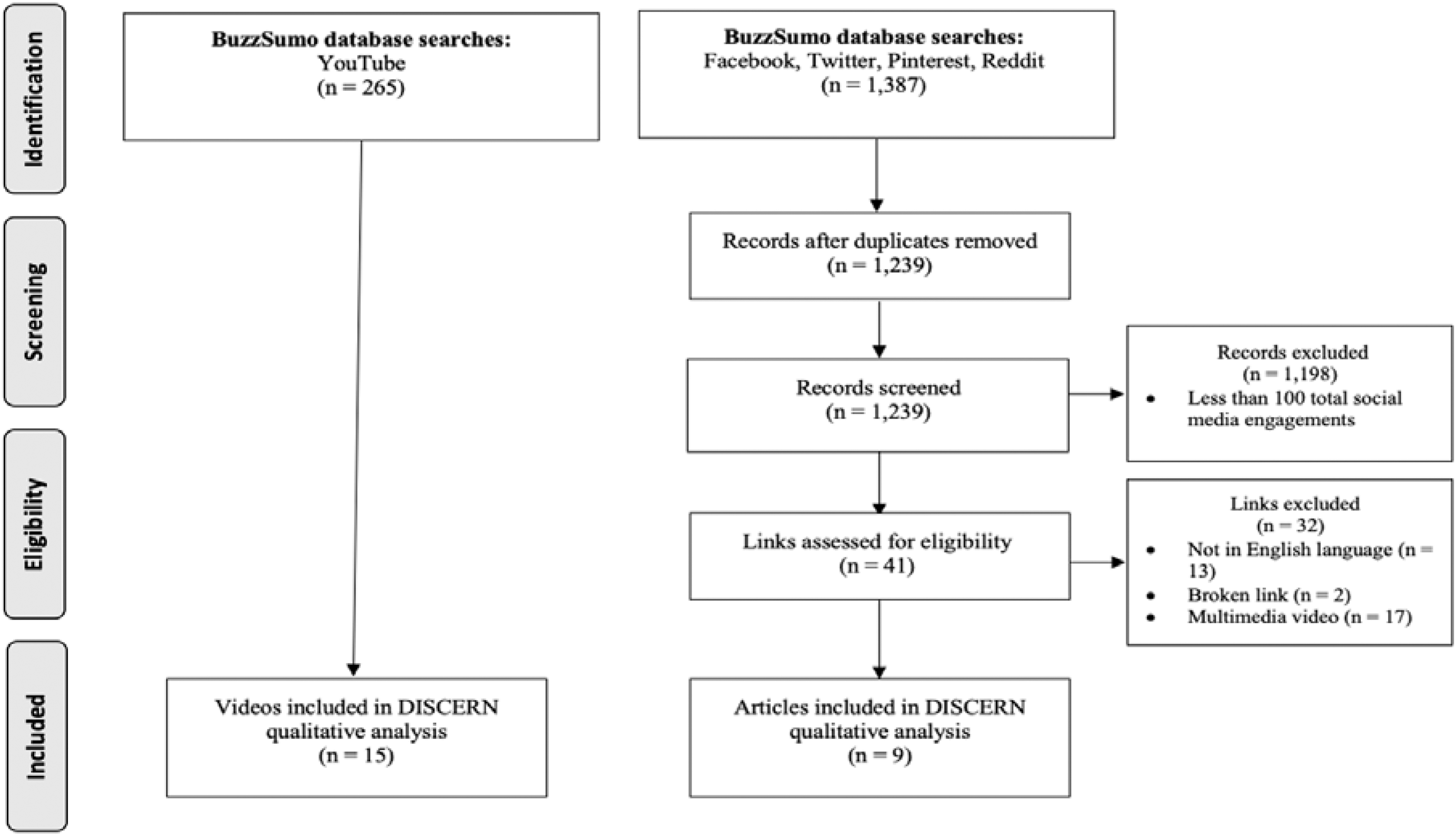
Summary of BuzzSumo database review using PRISMA statement. Engagements = cumulative shares, likes, and comments received on Facebook, Twitter, Pinterest, or Reddit. PRISMA = Preferred Reporting Items for Systematic Reviews and Meta-Analyses.
DISCERN instrument
The DISCERN instrument was originally developed in 1998 to evaluate the quality of written information about treatment choices, but has more recently been used for evaluation of web articles and online videos as well. 12,13 Consisting of 16 individual questions with three distinct sections evaluating reliability (questions 1–8), quality of information on treatment choices (questions 9–15), and overall rating of the publication (question 16), each question is scored from 1 to 5. 12 –14
Mean score ratings between 1 and 3 were identified as low-quality resources with serious or extensive shortcomings; ratings between 3 and 4 were of moderate quality with potentially important, but not serious, shortcomings; and scores greater than 4 were defined as high-quality health information with minimal shortcomings. 14 BuzzSumo articles and YouTube videos that met inclusion criteria were scored independently by three individual raters using the DISCERN instrument. DISCERN scores were collected and average calculated.
Statistical analysis plan
Mean SVI and DISCERN scores were analyzed using analysis of variance (ANOVA) and descriptive statistics on Microsoft Excel, version 16.43.
Results
Between March 1, 2016, and February 15, 2021, there was consistent public interest in the various kidney stone surgical interventions on Google Trends. The top three terms were identified as “Ureteroscopy,” “Percutaneous Nephrolithotomy,” and “Extracorporeal shock wave lithotripsy” with mean SVIs of 47.75, 42.98, and 45.74, respectively (p = 0.012) (Fig. 2). When observing geographic trends, the five countries with highest mean SVI values for PCNL were noted to be in South Asia, while SWL was more popular in South America (Fig. 3).
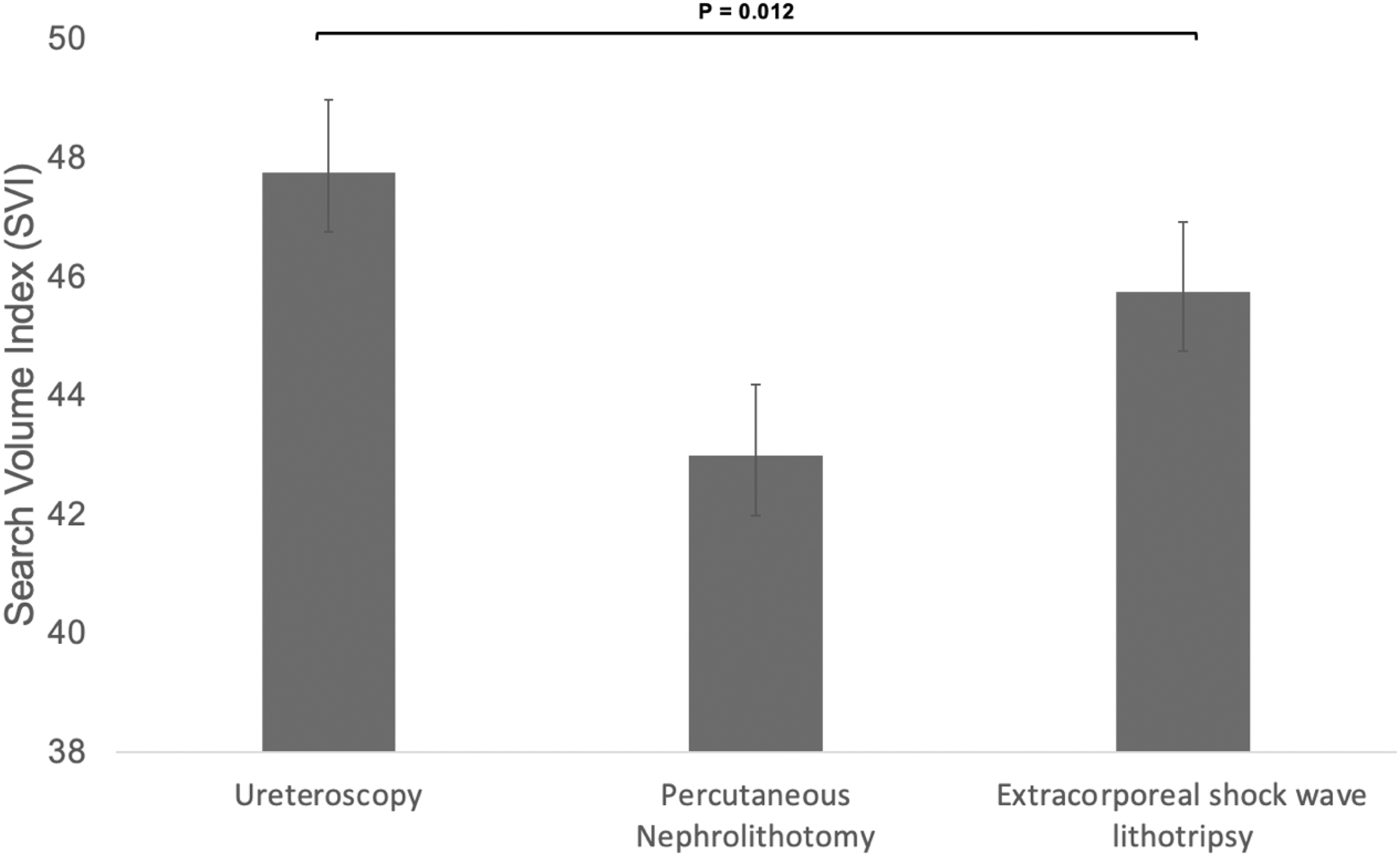
Bar chart demonstrating mean Google Trends SVI values by search term between March 1, 2016, and February 15, 2021. SVI = search volume index.

Table of Google Trends SVI values by geographic region between March 1, 2016, and February 15, 2021. U.S. map demonstrating top 15 states with
Overall, Midwestern regions of the United States had the highest mean SVI values, with Tennessee being the most popular state appearing in the top five of all three search terms. All three surgical interventions had high SVI values in various Midwestern regions of the United States, but URS and PCNL had more representation in the mid-Atlantic, while SWL gathered interest in Western states (Fig. 3A–C).
BuzzSumo analyses revealed that the three surgical interventions queried had similar number of engagements on various social media platforms (Facebook, Twitter, Reddit, and Pinterest) over the course of 5 years, with Facebook being responsible for ∼90% of total engagements (Fig. 4A). Of the various types of Facebook engagements (comments, shares, and likes), likes were the most prevailing, vastly outpacing comments and shares (Fig. 4B).
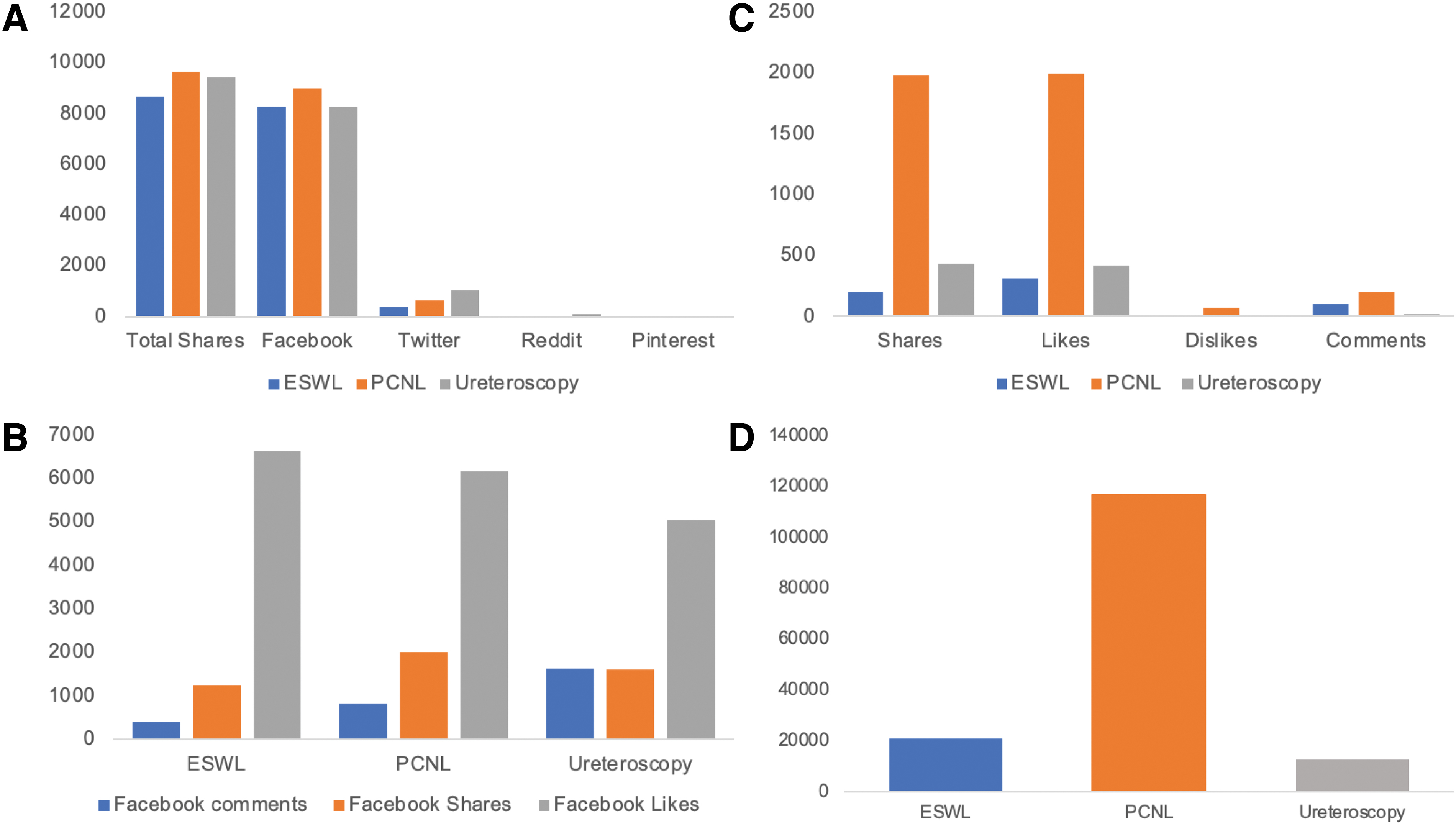
Bar graphs of kidney stone surgical interventions on BuzzSumo by
According to BuzzSumo, PCNL had the most overall YouTube engagements (shares, likes, dislikes, and comments) of all kidney stone surgical interventions (Fig. 4C). YouTube likes were the most popular form of engagement for SWL, followed by shares (Fig. 4C). On YouTube, videos related to the surgical interventions, URS, PCNL, and SWL, garnered 12,549, 116,222, and 20,717 total views, respectively (Fig. 4D). There was a significant difference in performance of PCNL YouTube videos compared with other interventions, with a total of 4242 engagements (shares, dislikes, likes, and comments) and 116,222 views, which was 5.60 times more than SWL and 9.26 times more than URS (Fig. 4C, D).
The mean DISCERN score on articles meeting inclusion criteria was 2.82, thereby classifying the online health information as low quality (Fig. 5A). Overall, YouTube videos had a lower mean DISCERN score of 2.27 when compared with web articles (Fig. 5A, B). URS, PCNL, and SWL YouTube videos had mean DISCERN scores of 3.01, 1.75, and 2.04, respectively. Evaluation of online health information using the DISCERN instrument showed that website articles had fewer shortcomings when compared with the information presented in YouTube videos.
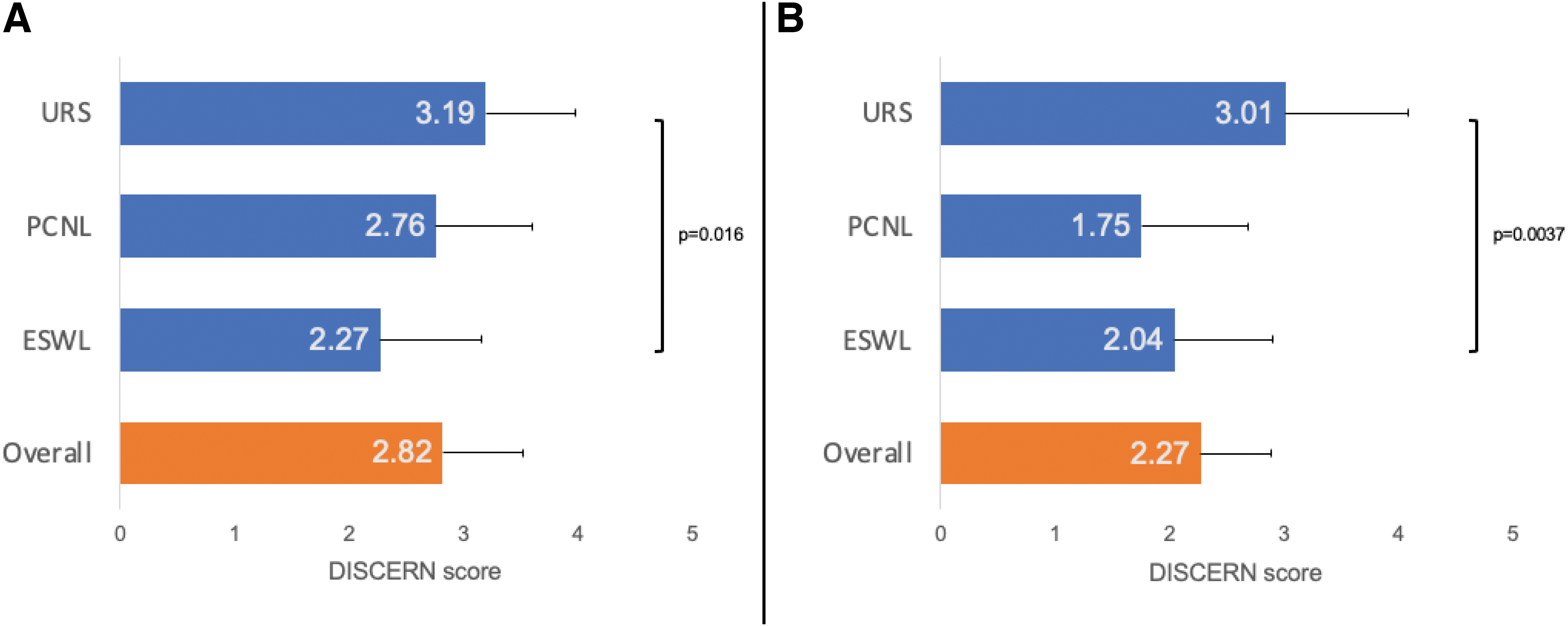
Mean DISCERN score of
In both text and video formats, URS information was rated as moderate quality with potentially important, but not serious, shortcomings, whereas PCNL and SWL fell below that qualification (Figs. 4 and 5).
Discussion
In this study, we found notable differences in public interest in kidney stone surgical interventions over the past 5 years along with variations in quality of health information presented online. Mean SVI values among surgical interventions ranged from 42.98 to 47.75, informing urologists that kidney stone surgery continues to be an important topic of interest for the general public over the past 5 years, although some procedures are being searched for more often than others. Utilizing the DISCERN instrument, it was found that online content regarding stone surgery is of moderate quality at best and lacking pertinent information that may be beneficial for patient decision-making.
When making decisions regarding kidney stone surgery, the internet along with social media is a major source of information for millions. Interestingly, surgical interventions with higher traffic on Google Trends had higher DISCERN scores, while those with lower SVI values had lower DISCERN scores. It is possible that online health information may be contributing to online searches for kidney stone surgeries, with higher quality articles fostering further investigation. Accordingly, this information provides insight into the need for high-quality engaging content about kidney stone treatments to improve decision-making of patients worldwide.
Nationally, URS was the most searched intervention and SWL was the least. This finding is in direct contrast to a previous Google Trends study showing SWL as the most popular and PCNL as the least between 2011 and 2017. 6 However, when looking at the clinical popularity of treatment for upper tract calculi, URS was the predominant surgical approach for kidney stones in the United States accounting for 54.2% of all surgeries and SWL at 33.6%, followed by PCNL at 4.5%. 15
This decrease in popularity of SWL nationwide could be due to the advancement of endoscopic instrumentation and the unpredictability of stone-free rates associated with SWL. 16 Another possibility is that urologists in the United States perform more URS procedures throughout residency training and may feel more comfortable to perform the procedure, thereby making them less likely to offer SWL to patients. 3 Overall, our results indicate that the online landscape of surgical treatment of kidney stones may be steadily shifting.
In the United States, inequalities exist in surgical treatment of kidney stones, with ethnic minorities less likely to undergo URS compared with their white counterparts. 17 However, our study is the first to describe the online trends of kidney stone surgery queries worldwide. Globally, when examining the geographical distribution by country for our search terms, all five of the countries with the highest SVI values for PCNL were found to be in South Asia, and for SWL, four of five countries were Spanish speaking with three of those located in South America.
This may give further support to the idea that lower-resourced countries may prefer or offer open PCNL or less invasive SWL, as opposed to URS commonly performed in the United States. 17 PCNL has long been established as a definitive treatment for kidney stones with the highest stone-free rates, which may be beneficial in clinical settings with advanced disease states or areas with physician shortages. 18 In addition, PCNL is especially useful in resource-limited areas as it does not require sophisticated technology or the associated cost for maintaining this equipment. 18
Unfortunately, while stone-free rates are the highest, the risk of complications associated with PCNL follow a similar trend. While SWL has the lowest stone-free rates of the three surgical interventions, it is the least invasive, requiring no instrumentation or incisions, which may be preferred by some patients. The shorter procedure times and mobility of lithotripter units in conjunction with the lack of ancillary staff required to perform SWL may be more economically beneficial for less affluent nations. 19
The lack of reliable online resources on kidney stone surgery can be dangerous for users. Inaccurate health information has the potential to confuse, frighten, and mislead patients, resulting in delayed care or substantial negative outcomes in the most severe instances. A survey conducted by the Pew Research Center found that ∼1 in 10 online health inquiries had a major impact on individual patient health care or the way in which they cared for someone else. 20
Of note, patients from African American and Latinx/Hispanic communities were more likely than their white peers to be impacted by their online searches, further demonstrating that some groups may disproportionately suffer from unreliable information. 20 Furthermore, it appears that the users and intended audience of many of the online resources, especially videos currently made by urologists, are other urologists who may well find more benefit from information on performing PCNL compared with other kidney stone procedures. Hence, the nuanced information required for all surgical options online largely has not been made available to the public by urologists.
Given the increasing worldwide reliance on online resources, it is imperative that health care institutions and physicians take advantage of the unique ability of the internet to disseminate health information that patients can access at their convenience without sacrificing accuracy. Medical institutions should focus on creation of a consolidated resource platform with content created and curated by health care professionals. In addition, pressure should be placed on search engines and social media platforms to alter their algorithms and provide visibility to resources that have been proven reliable and accurate. Further studies examining the shared decision-making of patients considering kidney stone surgery would help pinpoint shortcomings in currently available patient materials and allow for targeted interventions.
This study is not without limitations. While Google Trends is a helpful tool in gauging public interest in various topics, it is unable to identify the specific inquiries associated with these searches. In addition, as Google Trends and BuzzSumo are unable to provide user demographic information, these databases are not useful for discerning vulnerable populations who can benefit from additional education or targeted interventions. Of note, Google Trends does not include queries made on other search engines such as Bing, Baidu, or Yahoo, which may be preferred by individuals in different countries. 21
Another limitation of this study is that the social media analysis tool, BuzzSumo, only collected data from Facebook, Twitter, Pinterest, Reddit, and YouTube, leaving out other popular social media platforms such as Instagram and TikTok, which may be the sole source of information for many. Additionally, the average social media user is younger than the typical kidney stone patient currently deciding between the various interventions and may not truly represent the behaviors of these individuals. 22
Nevertheless, the ramifications of misinformation may only worsen in the next decade or so as the aging digital-dependent Generation Z and millennials approach 40 years of age and become the demographic associated with peak incidence of kidney stones in the United States. 23 Finally, while we evaluated online health content, we cannot quantify whether these truly influence the decisions of patients considering kidney stone surgery.
Conclusions
The results of this study suggest that among stone surgery interventions, patients are most interested in URS, but engaged more with PCNL content, hinting that there may be a discrepancy between what patients want and what information is available online. The low quality of popular articles on social media and videos on YouTube pertaining to kidney stone surgical interventions highlights the need for involvement of urologists in creation of engaging high-quality content and sharing of accurate information in a social media-driven society.
Data Availability Statement
The data that support the findings of this study are openly available from BuzzSumo at
Ethics Approval Statement
BuzzSumo and Google Trends are publicly available data and this study did not involve human subjects. This fulfills criteria for exemption by the Institution Review Board (IRB) of the University of California, Los Angeles.
Patient Consent Statement
Patients were not used in this study.
Clinical Trial Registration
This study did not involve clinical trials.
Footnotes
Author Disclosure Statement
No competing financial interests exist.
Funding Information
No funding was received for this article.