




Abstract
Urolithiasis is a common disorder born with the first hominids and the earliest texts describing symptoms date back to 3200 BC in Mesopotamia. The symptoms have always been the same, whereas the possibility of treatment has changed throughout the history. Gaius Plinius Secondus, known as Pliny the Elder, in his work “Naturalis Historia,” described the pain produced by a urinary stone as an excruciating torment. When there was not an effective remedy, could this atrocious torment change the lives and choices of men? When the affected people were kings, powerful, or artists, could renal colic affect their political decisions or their artistic works? I answer positively to these questions. I will set some historical facts to demonstrate this. We will see how the surgical treatment of urolithiasis contributed to separating medicine from surgery in medieval Europe. I will tell how an archer's life was saved by perineal lithotomy surgery. I will try to prove that Michelangelo Buonarroti left traces of his stone disease in the Sistine Ceiling. Finally, I will connect the foundation of Rome, capital of the Kingdom of Italy, to bladder stones. A cultural-scientific game, not a historical treatise, in which I will try to connect some important events to urinary calculi.
Urinary Stones in History
Urinary stones are a common disorder born with the first hominids. The earliest medical texts, describing symptoms and prescribing treatments, were found in Mesopotamia between 3200 and 1200 BC. 1,2 The symptoms have always been the same, whereas the possibility of treatment has notably changed. Gaius Plinius Secondus, known as Pliny the Elder, in his work “Naturalis Historia,” described the pain produced by a urinary stone as an excruciating torment.
This could influence the daily decisions of those who were affected. When the people afflicted were kings, emperors, or artists, the pain influenced their decisions in the political and artistic fields, changing the history and culture of millions of people in the following centuries. In the first paragraph, we will see how the problem of managing urinary stones contributed, in the culture of the Middle Ages, to separating surgical art from medical science. Later, we will tell a historical anecdote, to be mentioned at dinner with friends. We will talk about Michelangelo and the urologic references in the Sistine Chapel. And finally, we will connect the personal events of Napoleon III to the creation of Rome as the capital city.
So, here begins this journey through history following a urinary stone.
Can Urinary Stones Separate Medicine from Surgery?
Hippocrates was a Greek physician (460–377 BC) considered the father of medicine. The ethics of the medical profession stems from the famous Hippocrates oath that makes this promise: “I will not cut for the stone but will leave this to be done by practitioners of this work.”
Paraphrasing it, this is my interpretation: as a doctor, I will not perform the specific surgical technique named perineal lithotomy that tries to solve the stone sickness (il mal dellapietra) but does not guarantee any good results. In the Hippocrates oath, there is the premise that will lead to the separation between medicine and surgery in 1215 AD. During the Roman Empire, the main medical texts came from the East and were written in Greek or translated to Latin.
The first recorded details of “perineal lithotomy” are those of Cornelius Celsus (Rome, 25 BC–40 AD), who wrote an encyclopedia of medicine (De Medicina). His description of perineal lithotomy has been a landmark in the history of urology of those times. This technique, aptly called the “operation minor,” has been used without any significative variation for the next 1500 years. However, with the fall of the Western Roman Empire in 476 AD, sanctioned by the deposition of the emperor Romulus Augustus in Ravenna, there was a slow and progressive regression in every area of knowledge.
A period of darkness and barbarism occurred between the 6th and the 9th century when, because of the mediocrity of the invaders, Germans and Goths, every product of the Greek science went almost completely forgotten.
While the West was going through these changes, the Eastern Empire, with its capital Constantinople, although reduced by the Muslim invasion, resisted and attracted many scholars together with their knowledge. The Muslims, after an initial period of settlement, experienced an extraordinary cultural development between the 9th and 11th centuries, followed by a progressive decline. The presence in Spain, Sicily, and southern Italy of several cultures in contact (Arab, Jewish, and Christian) created a fertile context of exchanges and provided the tools for the translation and return to Europe of the texts of the Greek culture. Those texts, translated into Latin thanks to the flourishing of trade, spread throughout the rest of Europe, finding protection in the libraries of Benedictine convents.
Between 500 and 1000 AD monks and clerics having access to the texts kept in libraries were those who practiced as doctors and dentists. They were assisted by barbers who had sharp razors and scissors.
The German Emperor Heinrich II was cut by a Benedictine monk at Monte Cassino in 1022 A.D. at the age of 49, as carved out on his tomb (Fig. 1). He died 2 years later of recurrence. 3

Relief on the tomb of the Emperor Heinrich II in the Cathedral of Bamberg. After being cut in 1022 AD, the emperor is being given the stone by the Benedictine monk who holds the lithotome. The seated servant sleeps.
In 1139, the Lateran Council forbade the monks to perform surgical activities.
In 1163, the Council of Tour sanctioned that surgical interventions were incompatible with priesthood. The famous phrase “ecclesia abhorret sanguine” was attributed to this event, but no trace has been found in the documents drawn up to date. In 1215, the Lateran Council permanently prohibited clerics from carrying out surgical activities, since the death of their patients was considered an irreconcilable sin with their ministry.
Although the surgical activity was taken by the barbers, the noblest medical one was reserved to the monks: that is why botanical gardens, where plants with the virtue of preventing the formation or favoring the expulsion of stones grew, were in monasteries. Mostly these plants had a prevailing diuretic effect.
The “Salerno medical school” was the true starting point of modern medicine, born in the 9th century in the dispensary of a monastery. Lessons were held in Latin, Greek, Arabic, and Jewish. The emperor Frederick II, Stupor Mundi, with the constitution of Melfi (1231 AD), established that only graduates from the Salerno medical school could practice the medical profession in the empire.
Who performed the stone cutting? Who practiced such a risky surgery?
During the medieval period in Europe (XI–XV sec.) lithotomists were essentially commercial travelers moving from town to town looking for business and cutting all who came their way. 4 The procedure was generally performed in public. They were showmen and their motto was “Cut and Run”: cut and run before the relatives of the patient/victim could demand their revenge. 4
However, it remained an extremely risky practice. At the Faculty of Medicine of Montpellier, the Jews were those who carried out the interventions as they were in such miserable conditions that they accepted to shoulder the blame.
Lithotomists remained a category of self-styled surgeons until 1700. The best, however, remained the pig breeders of the Norcia area. Experts in animal castration, they began to emigrate to the citramontane (Italy) and ultramontane (Europe) territories and they were also asked to “pull the stone from the bladder by cutting the parts below.” 5 Bologna paid a municipal butcher for the benefit of poor people.
This is how a urinary stone furthered the separation between medicine and surgery.
Did a Kidney Stone Save the Life of an Archer?
In France in 1474, the king was Louis XI. He, notoriously, was interested in medicine. In that period the surgical treatment for bladder stones was still the “perineal lithotomy” described by Cornelius Celsus (25 BC–40 AD) in “De Medicina.” An archer who had been sentenced to hang for stealing from a church was suffering from stone sickness. When Louis XI learned about this, he proposed the condemned to be operated. If he survived, he would be pardoned for his guilt. The archer accepted, so the King ordered Montfacon, a famous surgeon, to operate on the archer at his presence in the cemetery of Saint-Sevrin. The operation was successful, the archer was stone free, freed from jail, and rewarded in cash.
This is how a urinary stone saved a life.
Did Kidney Stones Paint the Most Important Ceiling?
Michelangelo Buonarroti died in Rome on February 18, 1564. His terminal illness may have been obstructive nephropathy. Throughout his life he has been suffering from uric acid kidney stones. Several autographed writings testify to this. Traces of his illness can also be found in his most important work: the Sistine Ceiling. This insight is from Prof. Garabed Eknoyan of the medical school in Houston, Texas. In this paragraph we will report the conclusions and the methodological path of his (chi il professore o Michelangelo? Se lascicosìintendi il professore) famous work. 6
Indeed, Michelangelo stated that “every painter paints himself,” as reported by one of his two main biographers, Giorgio Vasari. In 1544, he wrote an epitaph containing his symptoms “fever, flanks, aches, diseases, eyes and teeth.” In a letter dated March 15, 1549, to his nephew Lionardo di Buonarroto Simoni, he wrote: “the doctor says I am suffering from the stone.” His doctor was the most prominent physician in Rome, Realdo Colombo. And what was the treatment prescribed?
In a subsequent letter dated March 23, 1549, to Lionardo: “Since then, having been given a certain kind of water to drink, it has caused me to discharge so much thick white matter in the urine, together with some fragments of the stone, that I am much better and hope in a short time I shall be free of it.” The water used in the treatment are now marked in Italy as the Fiuggi waters and remain popular to this day for their purported ability to dissolve urate stones. In a letter dated June 8, 1549, he wrote: “Morning and evening for about two months I've been drinking the water from a spring about 40 miles from Rome (Viterbo), which breaks up the stone. It has done this for me and has caused me to discharge a large part of it in the urine. I have to lay in a supply at home and cannot drink or cook with anything else….”
However, the water therapy was insufficient and in a letter of June 16, 1557, he wrote: “I've been ill recently through not being able to urinate; however, I'm alright now.” So, from this document we understand that urinary problems were central in the artist's life. The main concept of the kidney function at the time was based on the teachings of Galen: the kidney is endowed by attractive forces that allow it to separate solids from the serous part of the blood. He wrote in 1534: “I only draw out of it what's suitable and similar to me.” So, we can argue that the kidney function and dysfunction was familiar to Michelangelo and that left a trace of it in the Sistine Ceiling.
The central unit of the ceiling contains nine panels. In one, Michelangelo painted The Separation of Land from Waters. Giorgio Vasari described it as “the moment when God divides the waters from the earth.” The color and the shape of God's billowing mantle reveals a bisected right kidney with the renal pelvis (the figure of GOD) and the renal pyramids, where the cherubins are located (Fig. 2). Surely Michelangelo knew very well the anatomy and function of the kidney. In fact, the Florentine Academy of Art was the first to institute an obligatory anatomy course. Michelangelo had a lifelong anatomical interest. To quote Condivi, his second more important biographer, “there is no animal whose anatomy he would not dissect, and he worked on so many human anatomies that those who have spent their lives at it and made it their profession hardly know as much as he does.”
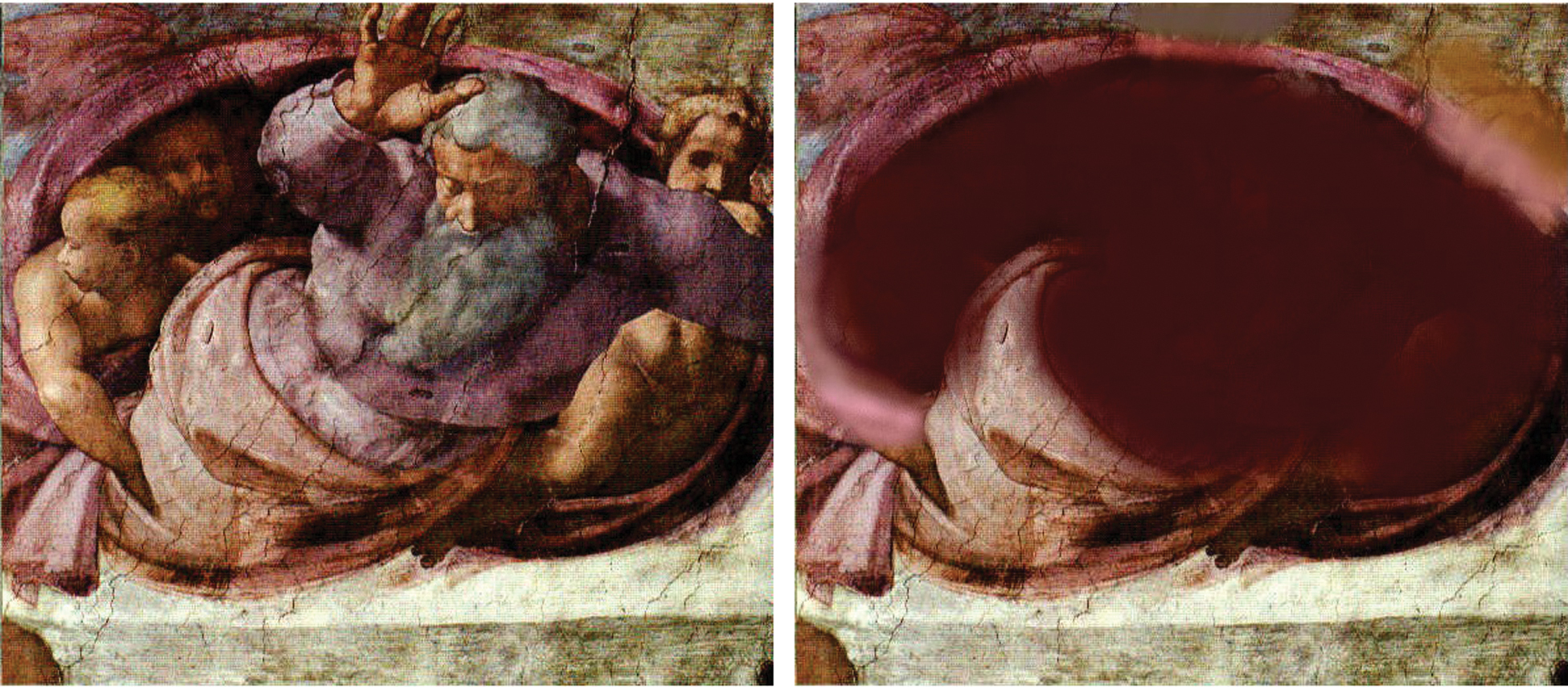
Water–land separation and references to the image of a kidney. Color images are available online.
This is how a urinary stone created a masterpiece.
Did Bladder Stones Create a Capital?
“Our goal, Gentlemen, I declare it openly, is to make the Eternal City, on which 25 centuries have accumulated all kinds of glory, become the splendid capital of the Italian Kingdom.”
On September 11, 1860, Camillo Benso, Count of Cavour, said these words in the parliament of the Kingdom of Sardinia.
On March 17, 1861, in Turin, the birth of the Italian state was proclaimed. There were various attempts to conquer the city of Rome and make it the capital of the newborn kingdom. However, the opposition of the French emperor, Napoleon III, made every action useless. He had political reasons: to keep the favor of French Catholics. In 1862, Giuseppe Garibaldi tried to invade Rome, but he was wounded on the Aspromonte and arrested by the Italian army. Some of those who were with him were immediately condemned and shot. However, Garibaldi had received letters from King Vittorio Emanuele II encouraging him to join the expedition. So, to avoid the scandal, there was an amnesty and those still alive were released.
On September 15, 1864, in Fontainebleau, an agreement was stipulated between the French Empire and the Italian State. The former withdrew the troops placed in defense of Rome, whereas the latter promised not to invade it.
In 1867, Garibaldi tried again to invade the Vatican State, but he was stopped again in Mentana, this time by the French troops. The Franco-Prussian war changed the fate of the Italian state. On September 2, 1870, the French Empire lost the Franco-Prussian war and Napoleon III surrendered in Sedan. The Italian troops took advantage of it and, after only 18 days, invaded Rome by opening a breach in the Aurelian walls near “Porta Pia.” On July 2, 1871, Vittorio Emanuele II moved to the Quirinal palace. The Pope had locked the main door. It was, therefore, necessary to call a blacksmith to allow access to the new monarch.
What happened to Napoleon III? Was it just a military defeat or were there other factors that precipitated the events?
The emperor was not in his best health condition and this state influenced his behavior. His personal doctor wrote in his diary: “If this man did not come here to kill himself, I do not know what he came to do, I have not seen him give an order for the whole morning.”
On September 2, 1870, in the middle of the disastrous battle of Sedan against the Prussians, Napoleon III was suddenly struck by a renal colic. Laudanum (opium tincture) was unable to relieve pain. Neither the enemy bullets, which he deliberately exposed himself to, did not interrupt his suffering.
Charles Louis Napoleon Bonaparte, reigning with the name of Napoleon III, almost exhausted, was no longer able to stand that condition and decided to end the war. He was unable to urinate and suffering a strong pain thus went to surrender personally to the Prussian Command.
After this, he was exiled to England at Camden Place, Chislehurst. In 1872, conditions became critical. Napoleon was suffering all the symptoms of bladder stone, with hematuria, pain, and urinary tract infection. The doctor Sir Henry Thompson visited him, and Napoleon agreed to an operative treatment. Three sessions were necessary to crush the voluminous bladder stones and remove the fragments that obstructed the urethra. Nevertheless, in the morning of January 9, Napoleon relapsed into coma and died on the same day. The autopsy, performed by Professor Burdon-Sanderson, showed pyonephrosis and half of a calculus within the bladder, weighing about three quarters of an ounce. It can be seen in the Hunterian Museum of the Royal College of Surgeons.
This is how a urinary stone made Rome Capital.
Conclusions
Marc Bloch, in the first half of the 20th century, changed historiography. Before him, only dates, battles, and the lives of kings were important. After him, the genesis of marmalade also became an object of study. One can start from any pretext to go backward through the lives of men and learn about mistakes and virtues worth to keep in mind in our present. The rule says Historia magistra vitae.
Footnotes
Author Disclosure Statement
No competing financial interests exist.
Funding Information
No funding was received.