




Abstract
Objective:
Low energy and high frequency settings are used in stone dusting for holmium lasers. Such settings may not be optimal for thulium fiber laser (TFL). With the seemingly endless combination of settings, we aim to provide guidance to the practicing urologists and assess the efficiency of the TFL platform in an automated in vitro “dusting model.”
Materials/Methods:
Three experimental setups were designed to investigate stone dusting produced by an IPG Photonics TLR-50 W TFL system using 200 μm fiber and soft BegoStone phantoms. The most popular 10 and 20 W dusting settings among endourologist familiar with TFL were evaluated. We directly compared short pulse (SP) vs long pulse (LP) mode using various combinations of pulse energy (Ep) and pulse frequency (F). Thereafter, we tested the 10 and 20 W settings and compared them among each other to elucidate the most efficient settings at each power. Treatments were performed under the same total laser energy delivered to the stone at four different standoff distances (SDs) with a clinically relevant scanning speed of either 1 or 2 mm/sec. Ablation volumes were quantified by optical coherence tomography to assess stone dusting efficiency. Fragment size after ablation at different pulse energies was evaluated by sieving and evaluating under a microscope after treatment.
Results:
Overall, SP provided greater ablation volume when compared with LP. Our dusting efficiency model demonstrated that the maximum stone ablation was achieved at the combination of high energy/low frequency settings (p < 0.005) and at a SD of 0.2 mm. At all tested pulse energies, no stone phantoms were broken into fragments >1 mm.
Conclusions:
During stone dusting with TFL, SP offers superior ablation to LP settings. Optimal dusting at clinically relevant scanning speeds of 1 and 2 mm/sec occurs at high energy/low frequency settings. Thulium lithotripsy with high Ep does not result in increased fragment size.
Introduction
Since the mid-1990s, surgical intervention with the holmium:yttrium aluminum garnet (Ho:YAG) laser has been established as the gold standard for urologic care in both stone fragmentation and tissue ablation. 1 Holmium laser lithotripsy has remained uncontested for the better part of 25 years until the thulium fiber laser (TFL) lithotripter was introduced for clinical use in 2018.
The uniform rectangular TFL pulse stands in stark contrast to the asymmetrical nature of the holmium pulse, which has an initial energy spike followed by a rapid decline (Fig. 1). Prior holmium laser studies have shown that optimal dusting settings require a combination of low energy and high frequency. 2 In addition, data on holmium pulse modulation has shown that long pulse (LP) design is superior for dusting as it limits stone retropulsion. 3 When exploring pulse modulation for these two platforms it is important to bear in mind that a traditional holmium “long pulse” ranges between 700 and 1300 μs and even some TFL “short pulse” designs can be longer than the longest possible holmium pulse. 3,4 This inherent property is what makes the TFL platform such an attractive tool for stone dusting. Indeed, multiple benchtop and clinical studies have shown TFL to be superior for stone dusting. 5 –8
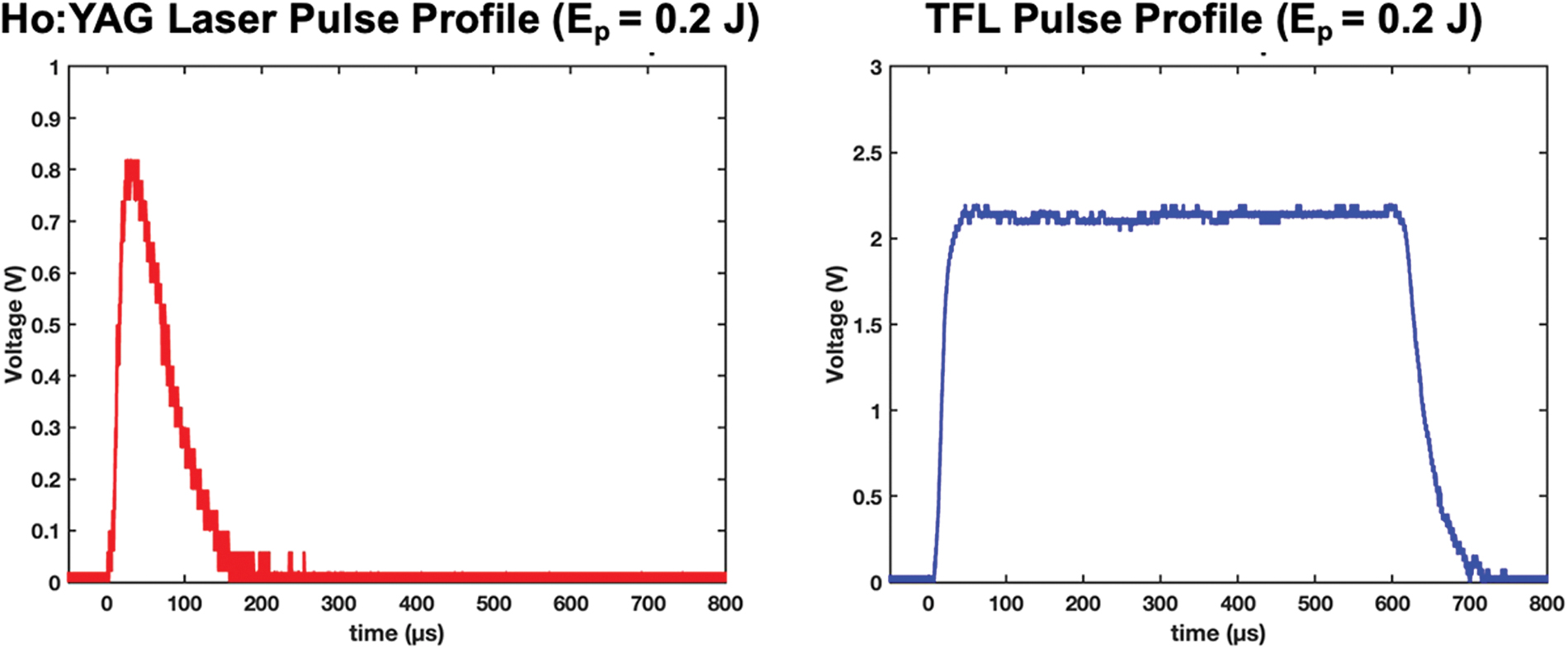
Comparison of the Ho:YAG asymmetric pulse profile with the more rectangular/uniform TFL pulse profile. Ho:YAG = holmium:yttrium aluminum garnet; TFL = thulium fiber laser. Color images are available online.
Many have erroneously relied on these holmium laser data to draw parallel conclusions when, in fact, TFL is an inherently different platform with numerous fundamental differences in its physical properties. Perhaps the most concerning consequence of this assertion was the product recall initiated by the Food and Drug Administration (FDA) related to reports of thermal injury with use of high-power presets. 9 In addition to the safety concerns, there is also a lack of consensus among experts in the field when it comes to preferred dusting settings. 10
The TFL offers endless options from a settings standpoint with a pulse energy (Ep) range of 0.005 to 6 J and a pulse frequency (F) range of 1 to 2200 Hz. With the seemingly endless combination of settings and lack of scientific evidence to support one over the other, we aim to provide guidance to the practicing urologists and assess the efficiency of the TFL platform in an automated in vitro “dusting model.”
Methods
Evaluation of dusting efficiency
To mimic the current clinical TFL platforms, an IPG TFL system (TLR-50 W; IPG Photonics, Oxford, MA) was used to treat 23 × 23 × 4 mm BegoStone samples (5:2 water-to-powder ratio, BEGO USA, Lincoln, RI), which were prepared as described previously, 11 in a water tank. Before treatment, all stones were soaked in water for 24 hours. A 200 μm fiber was positioned perpendicular to the stone surface by a 3D positioning stage (VXM-2 step motors with BiSlide-M02 lead screws; Velmex, Bloomfield, NY) (Fig. 2), which can precisely control the fiber-to-stone standoff distance (SD) and fiber scanning speed by a MATLAB program (Math-Works, Natick, MA).

3D laser positioning system on a fixed stage and a high-speed camera. Color images are available online.
“Short pulse” vs “long pulse”
First, to investigate the impact of pulse duration on treatment efficiency, five popular dusting settings among endourologists 10 with an output power of 10 W were selected as shown in Table 1. Since the conventional TFL pulse profile is rectangular, each Ep can be modified by altering either pulse duration or peak power. In this study, we conducted a direct comparison of “short pulse” (SP) design vs “long pulse” (LP) design by fixing the peak power at 100% and 50%, respectively. In particular, since the shortest pulse duration can be provided by our laser system is 0.20 ms, the peak power of 0.1 J SP design was chosen as 90% (Table 1). The actual laser output was confirmed by a power meter (Ophir, CO).
Short Pulse and Long Pulse Designs for Each 10 W Dusting Setting
Ep = pulse energy; F = pulse frequency; LP = long pulse; SP = short pulse.
At each energy level, four different SDs (0.2, 0.5, 1, and 2 mm), and a clinically relevant fiber scanning speed of 1 mm/s 12 were used to create 15 mm lines of damage troughs on the stone surface. Each setting was tested under the aforementioned conditions four times. Within a fixed total laser energy delivered to the stone of 40 J (i.e., 4 seconds treatment time), the troughs segments with a length of 4 mm were scanned and quantitatively analyzed by optical coherence tomography (OQ Labscope, Lumedica, Durham, NC) 11 after allowing the stone phantoms to dry for 24 hours. The volumes of six different 4 mm damage troughs from each setting outlined in Table 1 were then extracted and averaged to compare the dusting efficiency produced with SP to LP. Statistical analysis was performed using Student's t-test. A p-value <0.05 is considered statistically significant.
Dusting efficiency model
In accordance with the data obtained from the SP vs LP experiment, which will be presented henceforth, we determined to use all SP pulses in further investigation. To determine the optimal combination of Ep and F, we produced damage troughs on BegoStone phantoms by extending Ep range from 0.05 to 1.0 J with either 10 or 20 W of laser power at different SDs (Table 2). To avoid the saturation phenomenon, 12 a fiber speed of 1 mm/s was used for 10 W and 2 mm/s was used for 20 W. For this experiment, quantitative analysis of trough volumes and statistical analysis was performed under the same conditions previously explained in our SP vs LP model.
10 and 20 W Dusting Settings Adjusted to Maximum Peak Power and the Corresponding Pulse Duration Tested in Our Dusting Model
Assessment of dust quality
Finally, we assessed dust quality after TFL lithotripsy at six energy levels (Table 2). To collect all the residue fragments after laser lithotripsy, we treated 6 × 6 mm cylindrical BegoStone phantoms in a glass tube (50 × 7 mm, HxD) filled with water and immersed in a water bath at room temperature (Fig. 3). The laser fiber was advanced beyond the distal end of a flexible ureteroscope (Dornier AXISTM, 3.6F working channel, Munich, Germany) and the stone phantoms were treated under the guidance of ureteroscope view for 1 minute with the 10 W settings, and 30 seconds with the 20 W settings. Each Ep was tested three times with three different stone phantoms. Resultant fragments were sieved, dried for 24 hours and examined under the microscope.
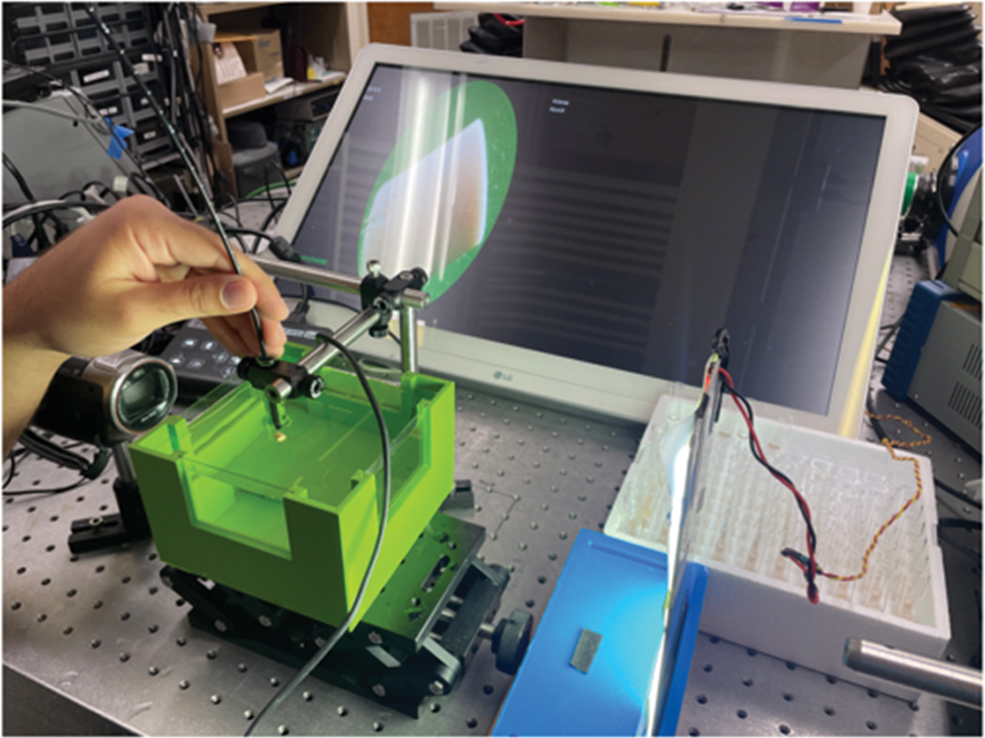
Dust quality experimental setup in which a laser fiber was advanced through the working channel of a disposable flexible ureteroscope and utilized to treat stone phantom for 1 minute (10 W) or 30 seconds (20 W). Color images are available online.
Results
“Short pulse” vs “long pulse”
In general, more stone damage was produced by SP compared to LP with all combinations of Ep and F (Fig. 4a). The greatest difference between SP and LP was observed under 0.5 J/20 Hz at SD = 0.2 mm (1.88 vs 0.87 mm3). The differences are statistically significant (p < 0.005) for all SDs with one exception under the setting of 0.2 J/50 Hz at SD = 0.2 mm, where the damage volume produced by SP is 0.79 mm3, which is comparable with 0.81 mm3 produced by LP (p = 0.7). Out of the 16 performed trials, there was only one instance in which LP outperformed SP: 0.4 J/25 Hz at SD = 2 mm. However, this difference failed to reach statistical significance.

Dusting efficiency model
Figure 5 shows the trough volume produced with Ep ranging from 0.05 to 1 J under the laser power of 10 W (vfiber
= 1 mm/s) and 20 W (vfiber
= 2 mm/s), respectively. Since the inter-pulse distance (i.e.,
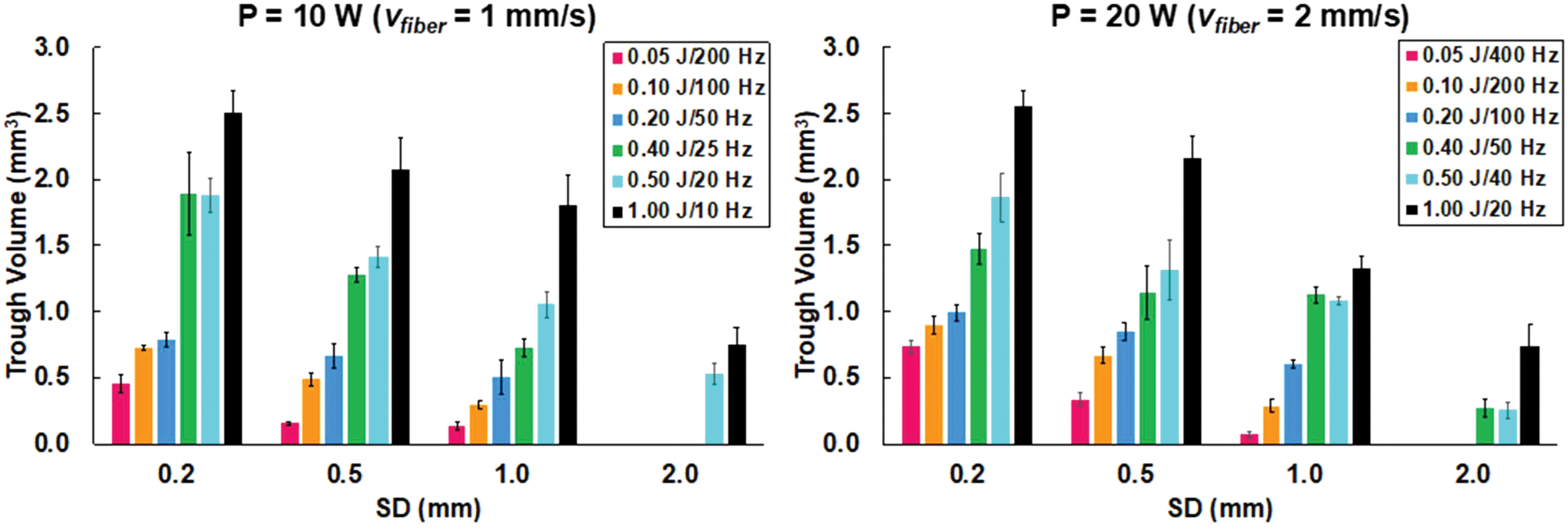
Trough volumes produced by different combinations of Ep and F with the average power of 10 and 20 W (1 and 2 mm/s of fiber scanning speed, respectively) at varying SDs. Ep = pulse energy; F = pulse frequency. Color images are available online.
Assessment of dust quality
At all tested pulse energies, no stone phantoms were broken into large fragments. All stone materials were pulverized into dust, which were <20 μm when examined under the microscope for all the tested settings (Fig. 6). Based on the analysis of dust size distribution, >95% of particles had an area <0.002 mm2 and none of them exceed 0.2 mm2.

The images of dust particles after treatment under different combinations of Ep and F were captured under the microscopic view and their size distribution was analyzed by ImageJ. Color images are available online.
Discussion
As evidenced by published surveys, endourologists have favored the maximum frequency capabilities of the TFL and theorized that these would lead to more efficient stone dusting. However, our data suggest that TFL ablation is most effective at a combination of high energy/low frequency settings and while in contact with the stone (SD: 0.2 mm). Moreover, as opposed to what holmium laser stone fragmentation data has shown, a combination of high Ep and low F while ablating with the TFL does not produce large stone fragments.
To our knowledge, this is the first study showing superiority of one dusting setting over the other. Enikeev et al. prospectively evaluated 40 patients undergoing RIRS (retrograde intrarenal surgery) with TFL lithotripsy but only examined two dusting settings (0.5 J/30 Hz = 15 W and 0.15 J/200 Hz = 30 W). They noted higher ablation efficacy and speed with the higher frequency setting. 13 Nevertheless, the authors themselves acknowledge the major limitation of this study is that the higher frequency setting had twice as much power as the lower frequency setting, which makes a direct comparison difficult. Similarly, this is the first trial showing superior ablative capacity of the SP design as compared with LP. Some might question how these settings could possibly have a negative effect on retropulsion in a real-life clinical scenario. However, what constitutes a TFL “short pulse” is not analogous to what we traditionally recognize as a holmium SP. As an example, our 1 J/10 Hz “short pulse” design (1730 μs) is longer than the longest possible holmium LP (1300 μs).
The main limitation of our study is that we only tested two scanning speeds and likely did not increase scanning speed sufficiently for the higher frequency settings to avoid the saturation phenomenon. Indeed, scanning speed studies for the holmium laser have shown that at higher frequencies, a faster fiber scanning speed is required. 14 Aldoukhi et al. demonstrated that during holmium lithotripsy if scanning speed is not adjusted for higher frequency settings then there is reduction in energy transmission as the ablative crater gets deeper and Ep is absorbed mostly by water. 12 Theoretically, this effect should be even more pronounced in TFL lithotripsy as it has an absorption coefficient in water four times greater than Ho:YAG (α: 129.2 cm-1 vs α: 31.8 cm-1). 15,16 Even though further studies are required to prove this theory, we believe to optimally utilize some of the higher frequency settings for TFL the scanning speed would have to surpass any clinically relevant numbers. Additional limitations of our study include testing only performed on “soft” BegoStone phantoms and not “hard” stone phantoms that potentially can make the data less generalizable. Similarly, testing on real calcium based and non-calcium-based human stones may yield different results. Future studies should mimic similar methodology to ours, ensuring standardization of important variables such as SD and scanning speed, but using real human stones instead of stone phantoms.
Since the introduction of TFL into the market many have focused on head-to-head comparisons with existing Ho:YAG systems. 17,18 Although it is undeniable that there are different advantages to both systems, these laser technologies are not meant to be mutually exclusive. Certainly, there is a major need for more studies regarding heat generation and thermal safety parameters with the TFL. However, the optimal settings presented in this study are lower power and should, therefore, be safer and serve to qualm some of the warranted concerns regarding potential thermal damage with TFL presets. Our results confirm that the TFL is primarily a “dusting” platform that, with proper surgical technique, will create dust regardless of Ep. This quality is likely because of its relative lower peak power when compared with holmium, which consequently is likely the reason it is also an inferior “fragmenting” platform. 19
Conclusions
TFL SP profile offers superior trough ablation volumes than LP during dusting under clinically relevant scanning speed of 1 mm/s with a power of 10 W. The most efficient dusting settings for dusting with the TFL occur at high energy, low frequency, and at a short SD of 0.2 mm. Unlike holmium lithotripsy where higher Ep results in larger fragments, in thulium lithotripsy higher Ep did not result in increased fragment size.
Footnotes
Authors' Contributions
All authors contributed to the research presented in this article. F.S.-P. conceived and designed the study, conducted data analysis, and drafted and revised the article. R.M., J.C., P.Z., J.A., G.M.P., and M.E.L. provided ideas, contributed to the design of the experimental setup, participated in data collection and analysis, and offered critical input during article preparation and revision. All authors have read and approved the final article and take full responsibility for its content.
Ethical Approval
The authors affirm that all the data, figures, and results presented in this publication are accurate and have been obtained through rigorous and ethical research practices. The authors have followed all applicable guidelines and regulations regarding data collection and research ethics.
Author Disclosure Statement
The authors of this journal publication have no financial, personal, or professional interests or affiliations that could be perceived as potential conflicts of interest in relation to the research presented. There are no financial or nonfinancial competing interests that might have influenced the content, interpretation, or conclusions of this article. The authors have received no funding, grants, or support from any organization that could have influenced the design, data collection, analysis, or reporting of this study.
Funding Information
M.E.L., G.M.P., and P.Z. are supported by a P20 Developmental Center grant from the NIDDK, 5P20 DK123970-02, and 2R01DK052985-25.