




Abstract
Introduction:
There is an absence of data on the environmental impact of single-use flexible cystoscopes. We wanted to review the existing literature about carbon footprint of flexible cystoscopy and analyze the environmental impact of the Isiris® (Coloplast©) single-use flexible cystoscope compared to reusable flexible cystoscopes.
Methods:
First, a systematic review on single-use and reusable cystoscope carbon footprint was performed according to the Preferred Reporting Items for Systematic Reviews and Meta-Analyses statement. Second, carbon footprints of Isiris single-use flexible cystoscope and reusable cystoscope were analyzed and compared. Life cycle of the single-use flexible cystoscope was divided in three steps: manufacturing, sterilization, and disposal. For the reusable cystoscope, several steps were considered to estimate the carbon footprint over the life cycle: manufacturing, washing/sterilization, repackaging, repair, and disposal. For each step, the carbon footprint values were collected and adapted from previous comparable published data on flexible ureteroscope.
Results:
The systematic literature review evidenced total carbon emissions within a range of 2.06 to 2.41 kg carbon dioxide (CO2) per each use of single-use flexible cystoscope compared to a wide range of 0.53 to 4.23 kg CO2 per each case of reusable flexible cystoscope. The carbon footprint comparative analysis between Isiris single-use flexible cystoscope and reusable cystoscope concluded in favor of the single-use cystoscope. Based on our calculation, the total carbon emissions for a reusable flexible cystoscope could be refined to an estimated range of 2.40 to 3.99 kg CO2 per case, depending on the endoscopic activity of the unit, and to 1.76 kg CO2 per case for Isiris single-use cystoscope.
Conclusion:
The results and our systematic literature review demonstrated disparate results depending on the calculation method used for carbon footprint analysis. However, the results tend rather toward a lower environmental impact of single-use devices. In comparison to a reusable flexible cystoscope, Isiris compared favorably in terms of carbon footprint.
Introduction
The health care sector plays a significant role in global carbon emissions and accounts for 5% of the total global environmental impact. 1,2 Considering ongoing concerns about sustainability and environmental impact, the discussion about the carbon footprint of single-use endoscopes compared to reusable scopes is highly relevant. Although, initially, reusable scopes were thought to be more environmentally friendly compared to single-use instruments, different analyses have challenged these estimations owing to the elaborate reprocessing process. 2,3 Although reusable endoscopes cause less medical waste, the emissions from the reprocessing of scopes may outweigh waste reduction. 2 However, comprehensive studies are still lacking and recent life-cycle analyses demonstrate deviating results. 2,4
Isiris® is a disposable cystoscope developed by Coloplast© with an integrated grasper that can be used for the removal of double-J stents. Isiris can be connected to a battery-powered portable monitor for use outside dedicated endoscopy suites. 5 The aim of this study is to compare the carbon footprint of the Isiris single-use cystoscope to the a reusable one and provide a systematic review of the existing literature on the topic.
Methods
Evidence acquisition for systematic review
This systematic review was conducted according to the Preferred Reporting Items for Systematic Reviews and Meta-Analyses 2020 statement. 6 The search was conducted on PubMed database to identify all studies reporting on the environmental impact of single-use cystoscopes compared to reusable cystoscopes (March 2023). A comprehensive systematic literature search was performed. Keywords used in our search strategy included (carbon OR environment*) AND (cystoscope OR cystoscopy) AND (single* OR reusable). After removing duplicates, titles and abstracts were screened. Subsequently, authors reviewed full texts of eligible articles for final inclusion and data extraction. In cases of disagreement, the authors (V.J. and N.F.D.) consulted with the senior author (B.S.) and final decisions were reached by consensus.
Inclusion and exclusion criteria
All observational studies that reported on the environmental impact of single-use cystoscopes compared to reusable cystoscopes were included. Review articles, letters, editorials, animal studies, study protocols, case reports, meeting abstracts, replies from authors, and articles not published in English were excluded. References of all articles included were screened for additional studies of interest. 7 –16
Carbon footprint of Isiris flexible cystoscope
Life cycle of Isiris single-use flexible cystoscope and reusable flexible cystoscope was assessed in terms of carbon footprint (Tables 1 –3). Carbon emission in kg carbon dioxide (CO2) per case was calculated using adjusted method and data from Davis et al.'s 7 analysis.
Isiris Composition and Carbon Emission (kg CO2 Per Kilo of Scope)
CO2 = carbon dioxide; NA.
Sensitivity Analysis Used from Data Adapted from the Reusable Ureteroscope for a Reusable Cystoscope
Comparison between Isiris Carbon Footprint and Reusable Cystoscope Carbon Footprint
Reusable flexible cystoscope
Davis et al. 7 had evaluated the carbon footprint of a reusable flexible ureteroscope. These data were adapted to analyze the carbon footprint of a reusable cystoscope based on a sensitivity analysis, considering that cystoscopes are shorter in length, lighter, and more robust than ureteroscopes, resulting in more uses per life cycle and between repairs (Table 2).
Isiris single-use cystoscope
The global carbon footprint of Isiris was calculated according to three phases of the life cycle: Manufacturing, sterilization, and disposal: - Carbon footprint of Manufacturing step was assessed according to the specific composition of Isiris cystoscope, as provided by the manufacturing company (Coloplast, Denmark). The device was dismantled to determine the weight of each component and standard values of carbon footprint per kilogram of raw material
8
–11
were used to estimate the carbon footprint related to scope production. - Carbon footprint of Sterilization step was assessed as equal to the sterilization carbon footprint value of a single-use ureteroscope.
7
- Carbon footprint from Disposal step was calculated considering that 1 kg of disposed solid waste is equivalent to 1 kg CO2.
7,16
Results
Systematic review: description of included studies
The literature search identified 38 unique references and 34 articles were excluded because of unrelated outcomes during the screening process (Fig. 1) and 4 studies were included in the systematic review. 2,4,12,13
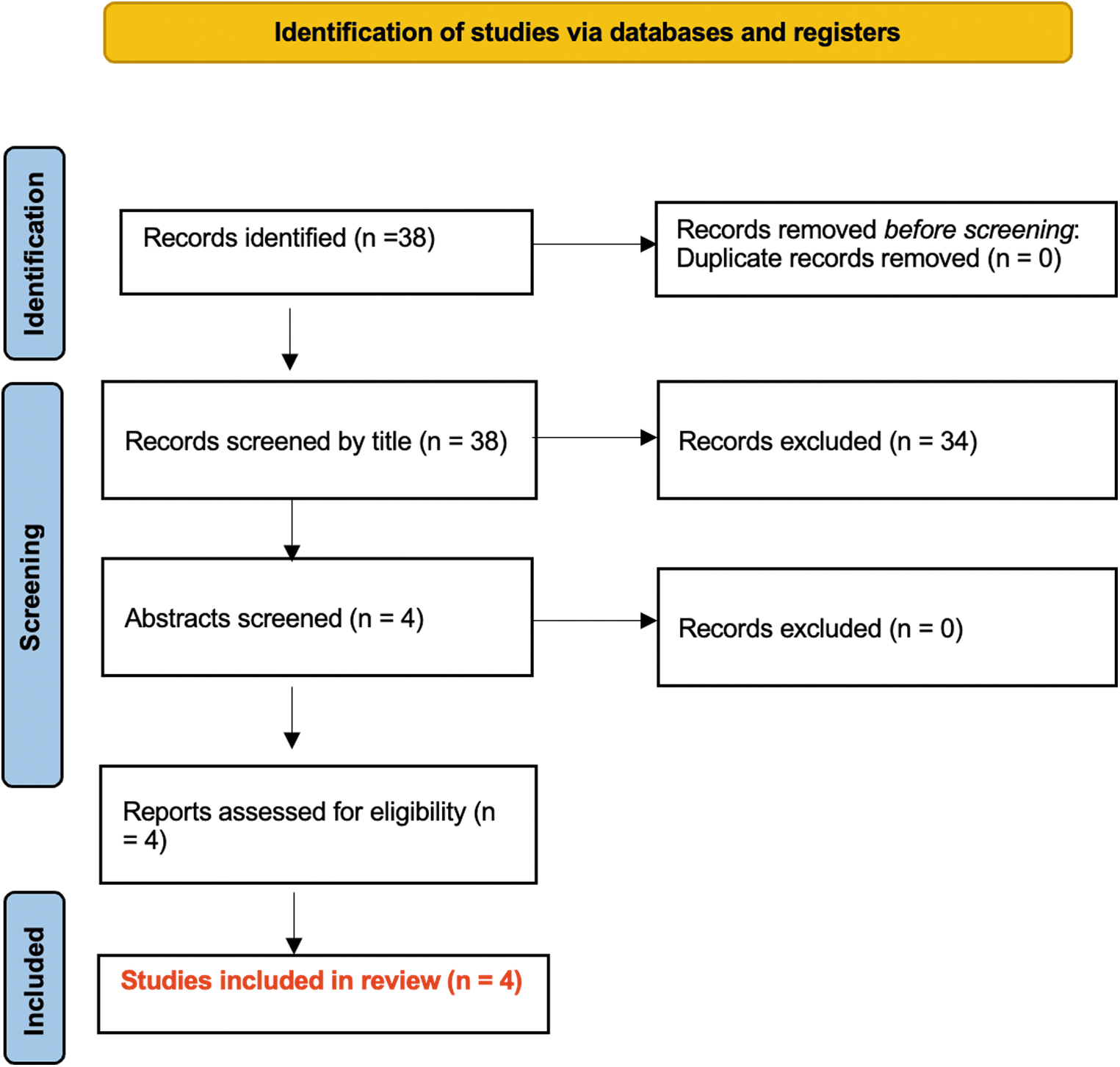
Preferred Reporting Items for Systematic Reviews and Meta-Analyses flow diagram of studies identified, excluded, and included.
Four articles compared the environmental impact of single-use to reusable flexible cystoscopes and are summarized in Table 4. 2,4,12,13 The total carbon emissions ranged from 2.06 to 2.41 kg CO2 per case for single-use flexible cystoscopes compared to 0.53 to 4.23 kg CO2 per case with reusable flexible cystoscopes (Table 3).
Comparison of Carbon Footprint of Single-Use and Reusable Cystoscopes in the Literature
Boucheron et al. performed an assessment of the environmental impact of the disposable Ambu aS4C single-use cystoscope compared to reusable flexible cystoscopes. 12 A total of 1578 flexible cystoscopies using reusable (period of 1 year during 2020) and 550 using single-use cystoscope (October 2021 to February 2022) were performed. The calculated amount of waste per procedure was 200 and 800 g for single-use and reusable cystoscopes, respectively. Furthermore, the water consumption per procedure for the reprocessing of the reusable cystoscope was 60 L, whereas no water was required for the single-use cystoscope. In 2020, where 1578 flexible cystoscopies were realized, the sole use of the single-use cystoscope would reduce waste generation by 946.8 kg and water consumption by 94.68 m3 per year. 12
Kemble et al. 4 compared the environmental impact during life cycle of single-use (aScope™ 4 Cysto; Ambu, Ballerup, Denmark) and reusable (Olympus CYF-V2) flexible cystoscopes, from manufacture to disposal. Based on a manufacturing carbon footprint of 11.49 kg CO2/kg device for reusable flexible endoscopes and 8.54 kg CO2/kg device for single-use endoscopes, the per-case manufacturing cost was 1.37 kg CO2 for single-use devices and 0.0017 kg CO2 for reusable devices. The total estimated per-case carbon footprint of single-use and reusable devices was 2.40 and 0.53 kg CO2, respectively, favoring reusable devices. 4 This very low carbon emission value for the reusable cystoscope was because of low reprocessing carbon footprint as the automatic endoscope reprocessor used only 0.3 to 0.9 kW/scope, compared to power estimates as much as 9.2 and 10.5 kW described in other studies. 7,13
Another study 13 analyzed the carbon footprint and solid waste of 20 single-use flexible cystoscopes (aScope 4 Cysto; Ambu) to that of 20 reusable cystoscopes (Cysto-Nephro Videoscope CYF-VA2, Olympus) based on carbon emission and waste production. The per case emissions for the single-use cystoscopes compared to the reusable cystoscopes were 2.89 kg CO2 and 4.23 kg CO2, respectively. The median weight of the produced weight was 622 g for single use vs 671.5 g for reusable cystoscopes. 13 Rizan and Bhutta raised concerns regarding the calculations of CO2 emissions, particularly regarding the conversion factor used to estimate CO2 emission from reprocessor energy consumption. After corrections, carbon emission per case was calculated to be 3.09 and 1.35 kg CO2 for the single-use and reusable cystoscopes, respectively. 14
Finally, Baboudjian et al. 2 performed a life-cycle assessment of reusable flexible cystoscopes and the aS4C single-use cystoscope (aScope; Ambu). For the single-use cystoscope, the complete life span of the scope was evaluated, whereas for reusable scope, the analysis was limited to the reprocessing using standard high-level disinfection with peracetic acid. The results of the environmental impact analysis were assessed using five categories: the use of the aScope would allow a reduction of at least 33% in the climate change category (2.06 and 3.08 kg CO2 for single-use and reusable cystoscope, respectively), 50% in the mineral resources' depletion category, 51% in the ecotoxicity category, 71% in the acidification category, and 49% in the eutrophication category.
These results are in favor of single-use cystoscope and are interesting because the analysis was not limited to carbon emissions and analyzed the environmental impact as a whole. However, concerning mineral resources, ecotoxicity, acidification, and eutrophication, drawing a parallel with previous results and our own Isiris analysis is not obvious as it was not measured.
The literature review evidenced disparate results according to the assessment method but tends rather toward a lower environmental impact of single-use devices. The reprocessing step, which has the biggest carbon footprint for reusable scope, is strongly dependant on reprocessor energy consumption, which may differ between models, explaining the heterogeneity of results.
Calculation of carbon footprint for Isiris flexible cystoscope and reusable flexible cystoscope
Isiris
The carbon footprint to manufacture an Isiris flexible cystoscope was calculated according to the specific composition of Isiris cystoscope.
After dismantling and weighing of Isiris by the manufacturing company (Coloplast), the raw materials identified for Isiris scopes consisted of 86.21% plastic, 1.38% electronics, 9.1% steel, and 3.31% rubber. The weight of the scope was 0.173 kg. Based on standard values of carbon footprint per kg of raw material 8 –11 (Table 1) used for scope production, the carbon footprint of manufacturing step was calculated at 7.45 kg CO2 per kilo of scope or 7.45 × 0.173 = 1.29 kg CO2 for an Isiris scope.
The carbon footprint of the initial sterilization step of Isiris single-use flexible cystoscope was evaluated as equal to the single-use ureteroscope from Davis et al.'s study 7 : 0.3 kg CO2.
The carbon footprint of disposal step was calculated considering that 1 kg of disposed solid waste is equivalent to 1 kg CO2. 7,17 The carbon footprint for Isiris disposal is equal to the weight of Isiris: 0.173 kg CO2.
Reusable flexible cystoscope
Carbon footprint of reusable cystoscope was estimated based on the assumption that cystoscopes are rather comparable in terms of design and carbon footprint life cycle to ureteroscopes. Data from a reusable flexible video ureteroscope from Davis et al. 7 were analyzed and adapted to a reusable cystoscope based on the sensitivity analysis:
The manufacturing step represents only 1.34% of the total carbon footprint for reusable scopes. The carbon footprint of manufacturing step is affected by the composition of the scope and the number of uses before disposal. 7 Owing to the similar design with shorter shaft length and lighter weight of the cystoscope compared to the ureteroscope, it is assumed that the raw material carbon footprint of a reusable cystoscope would be equal or inferior to the one of ureteroscope. The number of uses before disposal is assumed to be superior compared to the ureteroscope because of higher resistance of the cystoscope (shorter and thicker shaft, access to less tortuous tracts). Data from Kemble et al. confirmed this assumption with 3920 cases/life cycle. 4 The manufacturing carbon footprint of a reusable cystoscope is therefore assessed as equal or inferior to the one of ureteroscope (0.06 kg CO2 per case).
The reprocessing step has the biggest impact on carbon footprint, representing 88% of the total carbon footprint. The carbon footprint of the reprocessing step does not depend on the type of scope, but on the reprocessor used; therefore, ureteroscope sterilization data previously calculated by Davis et al. can be applied to a reusable cystoscope. In Davis et al.'s 7 analysis, reprocessing was calculated with the Olympus EDT4 endoscope washer disinfector, which can wash two endoscopes simultaneously. One wash cycle takes about 70 minutes and utilizes 165 L of water and 9.2 kW per cycle, equating to 7.89 kW per hour. This equates to 7.89 kg of CO2 for simultaneous washing and sterilization of two endoscopes or 3.94 kg CO2 for one endoscope. 7
Repair costs represent 10.07% of total carbon footprint of reusable ureteroscopes. 7 A cystoscope being shorter and thicker than a ureteroscope and introduced less far into the urological apparatus (bladder vs ureter) compared to the ureteroscope, we assumed the number of cases between repair superior for the cystoscope, as conformed by data from Kemble et al. with 207 cases between repairs compared to 16 with the ureteroscope. 4 Analogous to the calculations for reusable ureteroscopes, carbon emissions were assumed at inferior or equal to 0.45 kg CO2 per case.
Repackaging and solid waste represent less than 0.11% of carbon emissions and can therefore be seen as negligible (Table 2). 7
In total, based on the above data, the total carbon footprint per each use of a reusable cystoscope is estimated to be above 3.95 and below 4.47 kg CO2.
However, when considering combination of several published data, 4,7,17 a corrective factor can be applied to refine the estimated approach and take into account the differences between the scopes in weight and number of uses, leading to an estimation of 3.99 kg CO2.
Even if the level of evidence of such calculation, mixing different sources, might be limited, it is most probable that the carbon footprint of each use of a reusable flexible cystoscope should be in the lowest values of the range [3.95–4.47], or possibly less if the hospital unit has a large park of cystoscopes and a big turnover, allowing more than 2 cystoscopes to be sometimes treated together. In this specific case, the carbon footprint using the above referenced washer/disinfector 7 may decrease as low as 2.37 kg CO2 and the total footprint per each cystoscopy can be estimated at 2.40 kg CO2 or above.
Carbon footprint calculations for manufacturing process were 1.29 kg CO2 per case and ≤0.06 kg CO2 per case for the Isiris single-use flexible cystoscope compared to a reusable cystoscope, respectively. Although solid waste was assumed negligible for the reusable cystoscopes, it was calculated with 0.17 kg CO2 per case for the single-use cystoscope. The reprocessing cost was evaluated with 0.3 kg CO2 for the single-use flexible cystoscope and with 3.95 kg CO2 for the reusable flexible cystoscope. Therefore, the total carbon footprint for an Isiris single-use cystoscope is 1.76 kg CO2 per case compared to a minimum of 3.95 kg CO2 estimated per case for a reusable flexible cystoscope (Table 3), or 2.40 kg CO2 in centers with a high-turnover activity with a large park of cystoscopes.
Discussion
Studies on the environmental impact of single-use flexible cystoscopes compared to reusable flexible cystoscopes are lacking with only four published studies on this topic to date. However, two published life-cycle analyses report conflicting results.
Although Kemble et al. 4 found reusable cystoscopes to have a more favorable carbon footprint, Baboudjian et al. 2 (in line with the other existing evidence and our present study) found that single-use cystoscopes have a lower environmental impact.
In Baboudjian et al. analysis, the per case carbon emissions were 2.06 kg CO2 and 3.08 kg CO2 for single-use and reusable cystoscopes, respectively. 2 However, the life-cycle analysis by Kemble et al. found contradictory results. In their study, carbon emissions per case were calculated at 2.40 kg CO2 and 0.53 kg CO2 for single-use and reusable cystoscopes, respectively. 4
According to Baboudjian et al., the observed divergences in emissions can only be attributed to the differences in the life-cycle calculations of the reusable cystoscopes. 15 Although both studies found reprocessing to be the most significant factor when considering the environmental impact of reusables, calculations of the emission linked to the reprocessing of instruments differ greatly. Reprocessing costs were calculated with CO2 emissions per case of 0.71 kg CO2 or 0.20 kg CO2 by Kemble et al., 4 depending on the method of reprocessing using an “ASP Evotech” endoscope cleaner and reprocessor (enzymatic detergent) or Medivators Advantage Plus™ reprocessor (high-level disinfection with peracetic acid), respectively. Baboudjian et al. calculated reprocessing costs of 3.08 kg CO2 per case, using a manual high-level disinfection with peracetic acid. 2 The conflicting results of the two studies can therefore be attributed to the differences in CO2 emissions from the reprocessing of reusable cystoscopes. 15
A limitation of this comparative study is the data retained as a reference for the calculation of different steps and the carbon footprint. In our analysis, we choose to use Davis et al.'s data as a reference, given the clarity of the calculation method, the use of these data in another publication on cystoscopes, 4 and owing to the absence of data on cystoscopes. Indeed, the only four published studies were complex to use as a reference for our analysis because of different calculation parameters (e.g., ecotoxicity, mineral resources depletion 15 ), different objective (considering only the reprocessing step for reusable scope and focusing only on water and solid waste consumption 12 ), or absence of details, as published as an abstract. 13
Even as Davis et al. 7 present a much detailed approach, although a sensitivity analysis was performed by us to estimate the data related to a reusable cystoscope, their results remain that of a single center, potentially limiting generalizability. While there are environmental advantages, disposable scopes are also lighter, prevent cross contamination, and have shown to be more cost-effective. 5,17 –20
Further limitation for our article is the reprocessing methods retained for the analysis, which is, in this study, an automatic technique, used by Davis et al. 7 in their study for their reusable ureteroscope. However, contamination owing to incorrect endoscope reprocessing and human cleaning errors 18,19 creates a tremendous development opportunity for automated endoscope reprocessor. In addition, the use of automatic endoscope reprocessors is recommended by The World Gastroenterology Organisation 20 and according to a study from Persistence Market Research, dual basin automated endoscopic reprocessor led the market with a share of 50.7% at the end of 2021. Finally, it must be noted that even if a corrective factor is applied to consider the smallest space potentially occupied by the cystoscope in the processor, the result remains favorable to Isiris single-use scope with a total carbon footprint of 1.76 compared to 2.41 kg CO2 per case.
However, considering that reprocessing largely impacts the carbon emission for reusable scopes (88.37%), the carbon footprint of other methods of reprocessing needs to be evaluated to assess how it would impact the comparison with the single-use cystoscope carbon footprint.
Divergence in the methods used to reprocess endoscopes across different facilities might result in significant discrepancies in the estimated environmental effects of reusable endoscopes. Exploring different reprocessing methods is a key avenue to potentially mitigate the environmental impact of reusable scopes. However, achieving a comprehensive understanding requires detailed life-cycle analyses focused specifically on the reprocessing phase of these scopes.
The variability in reprocessing methodologies, as seen in different studies and across regions, underlines the potential for reducing the environmental footprint associated with reusable scopes. By examining and comparing various reprocessing methods, whether manual disinfection, automated systems, or other innovative approaches, there is an opportunity to identify more environmentally sustainable practices.
Conducting detailed life-cycle analyses dedicated to the reprocessing phase is pivotal. Such an approach allows for a nuanced evaluation, shedding light on the specific environmental implications of different reprocessing methodologies. This comprehensive understanding will be instrumental in guiding the health care industry toward more sustainable practices. It is a critical step in navigating the complexities of medical device reprocessing, ensuring that environmental considerations are central to decision-making processes.
Another limitation relates to our calculation of the carbon footprint for the single-use scope, which was primarily based on information provided by the manufacturer. Although we utilized manufacturer-provided data, it is worth noting that the calculation was derived from the specific composition of the Isiris cystoscope and standardized values for carbon footprint per kilogram of raw material used in scope production. Existing studies have shown that raw material consumption contributes most to carbon emissions in manufacturing processes. 21 Our study approach aligned with this research, acknowledging the significant impact of raw material consumption, while simplifying the evaluation of the assembly process. However, this simplified approach might not fully capture the entire manufacturing cost associated with these devices.
Our results, based on the data and methods employed in this study, indicate that the environmental footprint of the entire life cycle of single-use scopes is lower compared to environmental footprint for a reusable scope per case. However, these results are contingent upon the specific methods employed for calculating the carbon footprint of both scopes.
The results of this analysis evidence that the use of Isiris can be beneficial in reducing carbon footprint of double-J stent removal procedures; on another note, previous study has demonstrated the value of Isiris in reducing the cost associated with stent removal procedure. Indeed, authors showed Isiris significantly reduced stent dwell time, procedural time, and staff needed to carry out the stent removals. It allowed the procedures to be done in the outpatient setting, thereby reducing the organizational pressure on endoscopy-related diagnostic procedures, and the cost associated to the procedure. 5 Future research will also involve the use of artificial intelligence in scope technology and used in conjunction with their use in different urological conditions. 22
Conclusion
It was widely believed that reusable endoscopes were more sustainable than single-use endoscopes because they were associated with less waste. Recent analyses have questioned these assessments owing to the laborious reprocessing procedures of reusable scopes and have demonstrated evidence in favor of single-use flexible cystoscopes. Importantly, comprehensive comparative studies are still lacking, and recent life-cycle analyses demonstrate conflicting results, particularly regarding emissions during the reprocessing steps of reusable cystoscopes, much variable with the chosen technique.
This Isiris study concludes on lower carbon emissions per case with the Isiris single-use flexible cystoscope compared to reusable flexible cystoscopes, in case of use of an automatic washer/disinfector for the reprocessing step.
Footnotes
Acknowledgment
Our abstract was previously published in Abstracts of the 40th World Congress of Endourology: WCE 2023.
Author Disclosure Statement
Isiris single-use flexible cystoscope composition and weight were provided by Coloplast©, Denmark.
Funding Information
No funding was received for this article.