




Abstract
Background:
Among emerging AI technologies, Chat-Generative Pre-Trained Transformer (ChatGPT) emerges as a notable language model, uniquely developed through artificial intelligence research. Its proven versatility across various domains, from language translation to healthcare data processing, underscores its promise within medical documentation, diagnostics, research, and education. The current comprehensive review aimed to investigate the utility of ChatGPT in urology education and practice and to highlight its potential limitations.
Methods:
The authors conducted a comprehensive literature review of the use of ChatGPT and its applications in urology education, research, and practice. Through a systematic review of the literature, with a search strategy using databases, such as PubMed and Embase, we analyzed the advantages and limitations of using ChatGPT in urology and evaluated its potential impact.
Results:
A total of 78 records were eligible for inclusion. The benefits of ChatGPT were frequently cited across various contexts. In educational/academic benefits mentioned in 21 records (87.5%), ChatGPT showed the ability to assist urologists by offering precise information and responding to inquiries derived from patient data analysis, thereby supporting decision making; in 18 records (75%), advantages comprised personalized medicine, predictive capabilities for disease risks and outcomes, streamlining clinical workflows and improved diagnostics. Nevertheless, apprehensions were expressed regarding potential misinformation, underscoring the necessity for human supervision to guarantee patient safety and address ethical concerns.
Conclusion:
The potential applications of ChatGPT hold the capacity to bring about transformative changes in urology education, research, and practice. AI technology can serve as a useful tool to augment human intelligence; however, it is essential to use it in a responsible and ethical manner.
Introduction
Artificial intelligence (AI) is revolutionizing medical care, especially in fields such as urology where neural processing systems are evolving rapidly. 1 ChatGPT, a standout AI technology, demonstrates vast potential across multiple sectors, including healthcare. Its capacity for medical documentation, diagnostics, research, and education suggests significant advancements in urology, a field already benefiting from rapid technological progress and improved patient care through the integration of AI and natural language processing. 2
Launched in November 2022, ChatGPT has marked a significant advancement in AI-based language models, trained on extensive multilingual datasets to deliver responses closely mirroring human interaction. Despite its promising capabilities, the application of ChatGPT in healthcare has sparked debate, highlighting concerns over dataset biases, accuracy, and the potential spread of misinformation, known as “hallucination.” 3
This article seeks to explore the untapped potential of ChatGPT within urological practice. It focuses on uncovering its benefits, understanding the inherent challenges, and projecting its future implications in a field where research is still emerging. Through this exploration, we aim to contribute to a deeper understanding of ChatGPT’s role in enhancing urological care and navigating the complexities of its implementation in healthcare.
Materials and Methods
Search strategy and inclusion criteria
The primary objective of this comprehensive review was to evaluate the advantages and disadvantages of incorporating ChatGPT into urological practice and to ascertain its prospective influence on the discipline. To identify pertinent literature, comprehensive database searches were performed in PubMed/MEDLINE and EMBASE. The search was tailored to extract peer-reviewed journal articles encompassing primary research studies and review articles that explicitly explored the integration of AI in healthcare, with a specific focus on urology.
The inclusion criteria were designed to capture studies that assessed the implementation of ChatGPT in urological settings, examining both its benefits and limitations, as well as its potential to alter clinical practice. Conversely, exclusion criteria were established to omit non-English language publications, discussions of ChatGPT in unrelated contexts, and sources from nonscholarly platforms, including newspapers, websites, and magazines.
The search strategy for PubMed/MEDLINE was finalized on November 17, 2023, utilizing a combination of search terms designed to optimize retrieval of relevant records: “chatgpt”[All Fields] AND (“urology”[MeSH Terms] OR “urology”[All Fields] OR “urological procedures”[MeSH Terms]).
The search strategy yielded a total of 78 records from PubMed/MEDLINE and EMBASE. A rigorous title and abstract screening process led to the exclusion of 52 duplicate records, and two articles were excluded because they had no outcomes of interest. This process culminated in the selection of 24 records deemed suitable for inclusion in this review (Fig. 1). The final determination of relevant studies was conducted by two independent researchers (CS, NT), with any discrepancies resolved through consultation with a third researcher, serving as an adjudicator.
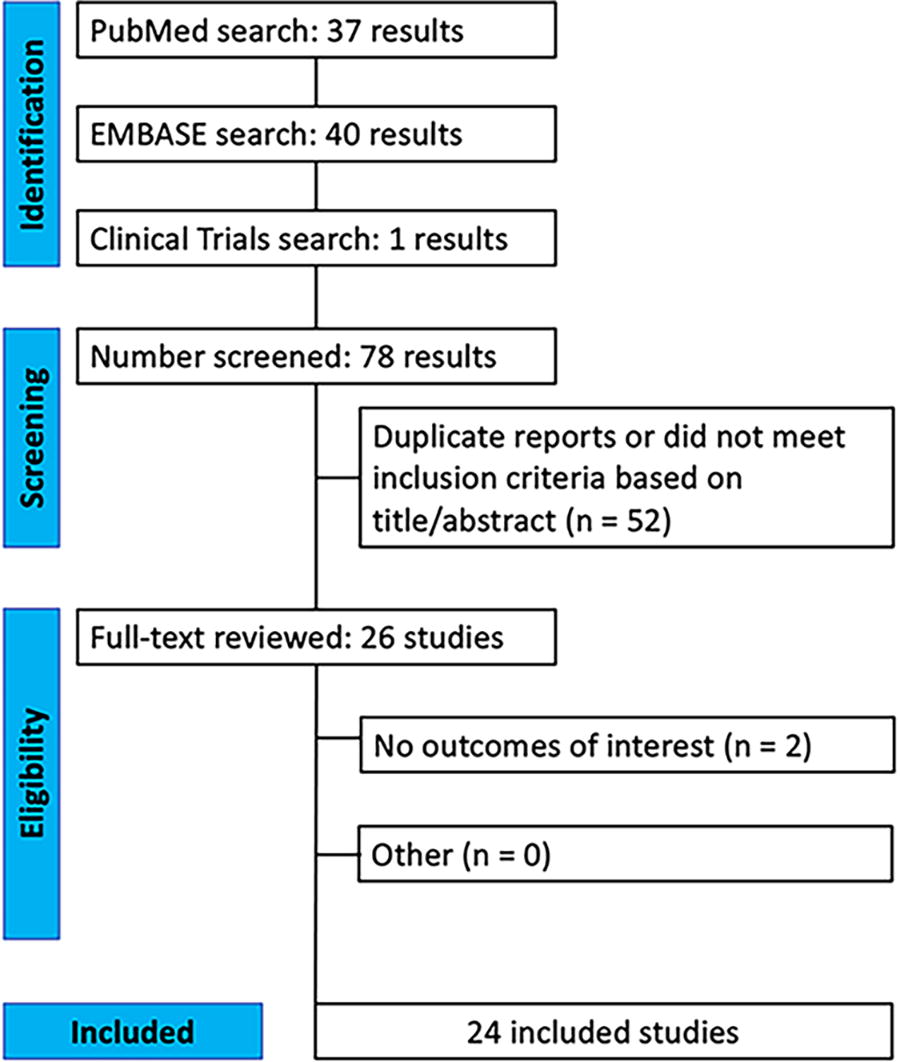
PRISMA flow diagram of study screening and selection.
To ensure a comprehensive review and mitigate bias, the reference lists of included studies were scrutinized for additional relevant articles that may have been missed during the initial search. To safeguard the integrity of the review and avoid potential conflicts of interest, a thorough examination was performed to confirm the absence of financial or other biases among the authors. Furthermore, all content was generated authentically by the review authors, with diligent citation and acknowledgment of any directly quoted or paraphrased sources.
Categorization of benefits and risks of ChatGPT
The benefits and potential applications of ChatGPT were systematically categorized into distinct domains to comprehensively assess its utility within the healthcare landscape. These categories included: Educational benefits in urology education: This encompassed the generation of diverse clinical vignettes, customization of clinical cases tailored to individual student needs with immediate feedback, and improvements in communication skills within healthcare education settings. Benefits in academic/scientific research incorporating text generation, summarization, translation, and literature review capabilities, particularly relevant in facilitating scientific research endeavors. Benefits in urology practice: Contributions toward personalized medicine, diagnosis, treatment strategies, lifestyle recommendations based on personalized traits, and streamlined documentation/report generation within urology practices.
Conversely, the risks and concerns associated with ChatGPT were meticulously categorized to ascertain potential challenges and ethical considerations. These categories encompassed: Ethical issues: Including risks of bias, discrimination based on training data quality, and concerns regarding plagiarism. Hallucination: Referring to the generation of scientifically inaccurate yet plausible content. Content-related concerns: Reflecting issues of over-detailing, redundancy, and excessiveness within the generated content. Legal, interpretability, and referencing issues: Encompassing challenges related to copyright, authorship, interpretability, referencing accuracy, and potential academic fraud. Incorrect content: Focusing on the risks associated with generating inaccurate or misleading content, contributing to the spread of misinformation.
This categorization aimed to thoroughly outline both the potential benefits and inherent risks associated with the utilization of ChatGPT in the context of urology, serving as a comprehensive framework for analysis within this systematic review.
Results
Our review identified and analyzed 24 studies that detailed the advantages and challenges associated with the integration of ChatGPT in urology, using a diverse array of research designs from observational studies to comparative analyses and narrative reviews (Table 1).
Summary of Available Literature on the Role of ChatGPT in Urology
AGI, Artificial generative intelligence; LLM, Large language models; OAB: overactive bladder; PVR, post-void residual; SVM, support vector machine.
Educational and academic insights
The educational utility of ChatGPT was widely recognized. For instance, studies by Okui et al. and Kianian et al. demonstrated its capacity for enhancing data analysis and education in urology, 21,29 whereas Schuppe et al. and Eppler et al. acknowledged its benefits in expediting medical literature review processes. 5,16 Similarly, Adhikari et al. and Talyshinskii et al. shed light on ChatGPT’s role in synthesizing research, aiding in academic writing, and generating literature summaries. 12,23 Notably, these studies collectively suggest that ChatGPT has significant potential in enriching academic discourse and streamlining the research methodology (Table 2).
Current Scenarios to Use chatGPT in Urology, Their Potential Advantages and Shortcomings
Clinical practice applications
Regarding clinical practice, a set of studies, including those by Coskun et al. and Kim et al., indicated that ChatGPT serves as a robust source of information, which can be instrumental in assisting healthcare professionals with patient inquiries and medical education. 9,27 Manolitsis et al. also observed that ChatGPT provides information consistent with EAU guidelines, further supporting its role in enhancing clinical learning practices. 17 These findings suggest that ChatGPT could be a valuable asset in both patient and clinician education, provided the content is verified for accuracy (Table 2).
Potential risks and ethical concerns
However, the integration of ChatGPT in urology is not without its risks. Caglar et al. raised concerns about ethical and privacy issues; ChatGPT might have limitations in understanding ethics, confidentiality, and generating sensitive responses, 25 and Szczesniewski et al. noted the potential for misinformation, highlighting the importance of human oversight. 20 Moreover, Schuppe and colleagues identified challenges related to content verification, such as the accuracy of references. 16 These studies collectively underscore the imperative for rigorous content validation to mitigate the dissemination of misinformation and ensure ethical usage (Table 2).
In summary, the benefits of ChatGPT in urology are multifaceted, enhancing both education and clinical practice. However, these advantages are tempered by potential risks, particularly in the realm of misinformation, which necessitates a cautious and supervised approach to integration. The comparative analysis of the studies reveals a consensus on the utility of ChatGPT, yet also aligns in cautioning against its unverified use.
Discussion
The incorporation of AI, particularly ChatGPT, within urology presents substantial promise and transformative potential. The collective evidence from these studies underscores ChatGPT’s adeptness in furnishing precise information and addressing inquiries arising from patient data analysis, thereby augmenting decision-making processes within the realm of urology. Significantly, it has contributed to the realms of personalized medicine, predictive abilities concerning disease risks and outcomes, the streamlining of clinical workflows, improvements in diagnostics, and advancements in documentation processes. 28 –30 Remarkably, this proficiency spans across various subdomains within urology, particularly in oncology, functional urology, and general urology.
Noteworthy is its demonstrated potential in determining prognoses and guiding decisions related to adjuvant therapy, indicating its applicability in surgical planning, diagnostic methodologies, diverse treatment modalities, and subsequent patient outcomes.
Educational enrichment through AI
ChatGPT’s role in urological education resonates with a call for innovation in medical learning. 5,12,16,21,23,29 The findings from the review advocate for its implementation as a tool that can amplify the quality of medical education. It can act as a bridge, connecting intricate medical concepts to the practical necessities of clinical education, thereby enhancing the comprehension of complex urological diseases for both trainees and seasoned practitioners. The literature presents a consensus on the beneficial use of ChatGPT for educational purposes, yet it also calls for a strategic approach to its integration, ensuring it complements rather than replaces traditional learning methods.
Ethical imperatives in the age of AI
As with any profound technological advancement, the adoption of ChatGPT carries with it ethical imperatives that must be addressed. 5,9,11 –16,20,23,25 –27 Studies underscore the risks associated with potential misinformation and privacy concerns, suggesting that although ChatGPT has the potential to be a powerful supporter in urological practice, it also poses risks that warrant careful consideration. The discussion extends beyond the technical capabilities of ChatGPT to the heart of ethical medical practice. Ensuring the ethical deployment of ChatGPT involves maintaining vigilance over its outputs, safeguarding patient privacy, and consistently validating the veracity of the information provided.
A comparative lens reveals a nuanced understanding of ChatGPT’s applications. Although studies such as those by Whiles et al. and Coskun et al. concur on the utility of ChatGPT’s interface in patient information dissemination, they also caution against a one-size-fits-all approach, given the individual needs of patients. 9,11 Similarly, the concerns of content accuracy and reliability echo across studies, underscoring the need for a standardized framework of oversight to ensure the responsible use of ChatGPT in urological settings.
The future of AI in urology must be navigated with a responsible outlook, balancing the benefits against potential inaccuracies and ethical concerns. The rapidly evolving AI landscape calls for a dynamic approach to research and implementation. As such, ongoing vigilance and adaptation are essential, ensuring that AI tools such as ChatGPT are utilized to their full potential while upholding the highest standards of patient care and safety.
Strengths and limitations
The present review serves as an initial and concise overview of ChatGPT’s applicability within urology education, research, and practice. Nonetheless, it is imperative to consider several limitations when interpreting the findings. First, the variability in the quality of the included records might pose challenges to the generalizability of the outcomes. Second, the exclusion of non-English records could introduce selection bias, potentially limiting the comprehensiveness of the review. These limitations collectively urge careful consideration and temperance in extrapolating the conclusions drawn from this review.
Conclusion
In conclusion, although ChatGPT stands at the frontier of technological advancement in urology, it is imperative that its integration is guided by a commitment to patient safety, data security, and ethical responsibility. Moving forward, the medical community should embrace the benefits of AI with a cautious optimism, ensuring that advancements in AI such as ChatGPT are aligned with the core values of medicine. Continuous evaluation, research, and development are crucial to navigate the evolving interface of AI and healthcare, ensuring that the potential of ChatGPT is fully realized in a manner that is both innovative and conscientious.
Footnotes
Authors’ Contributions
All authors contributed to the study conception and design. Conceptualization and the idea for the article: N.T.; Methodology: C.S. and N.T.; Formal analysis and investigation: C.S., G.P.A., S.R., A.A.M., and V.M.P.; Writing––original draft preparation: C.S.; Writing––review and editing: N.T. and O.T.; Supervision: O.T.
Declarations of Conflicts of Interest
The others authors declare that they have no conflicts of interest. ChatGPT was not used in the production of the article.
Data Availability Statement
Data supporting this comprehensive review are available in the original publications and preprints that were cited in the reference section. In addition, the analyzed data that were used during the current review are available from the author on reasonable request.
Ethics Statement
Not applicable.
Consent to Participate
Not applicable.
Author Disclosure Statement
Prof. O.T. is a consultant for Coloplast, Rocamed, Karl Storz, IPG Medical, AMBU, Quanta System.
Funding Information
This is an independent study and is not funded by any external body.