




Abstract
Introduction and Objective:
One potential advantage of single-port (SP) robotic surgery compared with multiport (MP) robotic surgery is improved cosmesis. The only studies in urology patients to suggest this finding did not assess differences based on incision site. Our study evaluated SP, MP, incision location, age, gender, and prior abdominal surgery as predictors of cosmesis and scar consciousness for reconstructive procedures.
Methods:
This is a cohort study using an institutional review board–approved prospective genitourinary reconstruction database. Patients at least 3 months from surgery were emailed and called to complete the Consciousness subsection of the Patient Scar Assessment Questionnaire. Bothersome was defined as a score of 11 or greater. Overall consciousness was scored with a single item as “not conscious” or “conscious.” Pearson’s chi-squared, Wilcoxon rank sum, Fisher’s exact test, and logistic regression were performed to assess how age, gender, prior surgery, and incision location affect cosmesis.
Results:
There were 111 patients (54 MP, 57 SP), of which 27 were SP umbilical, 14 were SP midline nonumbilical, and 16 were SP lower quadrant. On univariate analysis the periumbilical incision had the lowest consciousness. Age was associated with Bother (p = 0.012) and Consciousness (p = 0.002), whereas gender, prior abdominal surgery, and incision site were not significant. On logistic regression, all SP incisions were less likely to be bothered compared with MP, although only SP umbilical was statistically significant (odds ratio [OR] = 0.08, 95% confidence interval [CI]: 0.01,0.38; p = 0.005). Age was also significant on logistic regression for Bother (OR = 0.96, 95% CI: 0.93,0.99; p = 0.005). Gender and prior abdominal surgery were not associated with Bother or Consciousness.
Conclusions:
SP periumbilical incisions provide the best outcomes for cosmesis compared with other SP incision sites and MP incisions. This finding should be discussed and taken into account when planning surgical approaches for patients undergoing urinary reconstruction, especially in patients younger than 40 years of age.
Introduction
Since its introduction in 2018, the da Vinci single port (SP) has been utilized for a variety of urologic surgeries, including partial nephrectomy, radical/simple prostatectomy, urinary tract reconstructions, and radical cystectomy. 1,2 Several potential advantages of the SP compared with multiport (MP) include shorter length of stay, decreased postoperative opioid use, and improved cosmesis. 3 –6 While cosmesis is a secondary objective compared with primary surgical outcomes of success and postoperative recovery, it has been suggested as a priority for younger patients. 7 Efforts to improve cosmesis have resulted in changed incision placement in patients undergoing urologic reconstructive surgery. 8 Scar appearance and visibility have been shown to influence the preferred surgical approach by patients in urology and other surgical fields. 9,10 Park et al. showed that patients preferred single-incision kidney surgery compared with open or traditional laparoscopic surgery for cosmetic outcomes assuming an equivalent surgical risk. 7
Numerous studies have suggested that SP incisions in urologic surgery have improved cosmesis, but these reports have not directly assessed the cosmesis of different SP incision sites as an outcome. 3,8,11 –14 When cosmesis is measured, there is no uniform and accepted measurement, with reports often not including validated instruments. A prior systematic review comparing minimally invasive and open kidney surgery was unable to conclude about cosmesis because of variable reporting methods, despite identifying eight different studies that included an assessment of cosmesis. 15
Two prior studies have utilized validated patient-reported outcome measures to objectively measure cosmesis outcomes in patients undergoing urologic surgery with SP. Neither of these studies was in patients undergoing reconstructive urologic surgery nor investigated the impact of SP incision location on cosmesis. 5,6 Several different SP incision sites have been reported for patients undergoing urologic surgery, such as the periumbilical, mini-Pfannenstiel, and lower anterior access incision. 3,16 The periumbilical incision is used exclusively with a transperitoneal approach. In contrast, the midline nonumbilical incision can be used with either a transperitoneal or extraperitoneal/transvesical approach. 17 The lower anterior access can be used with a transperitoneal or retroperitoneal approach to the kidney and ureter. 16 It is unclear whether there are differences in cosmetic outcomes with the various SP incision sites that have been introduced. In addition, as these studies were in the context of oncologic procedures, patients may have prioritized cosmetic outcomes less. The assessment of cosmesis of different SP incisions for patients who underwent robotic procedures for benign disease is not reported in the literature despite suggestions that these patients may value cosmesis more than those who underwent surgery for oncologic indications. 7
We report the cosmetic outcomes of SP incisions compared with MP, and whether age, gender, and prior abdominal surgery influence patient scar consciousness. Since cosmesis has been suggested to be a priority for patients with benign disease, the focus of the study was patients who underwent benign reconstructive surgery. This is the first report in the literature to objectively measure cosmetic outcomes between different SP incision sites and MP incisions in adult patients who underwent reconstructive urologic procedures.
Patients and Methods
Study population
We performed a retrospective review of our institutional review board–approved, prospectively maintained database for patients who underwent reconstructive urologic surgery. Inclusion criteria were English-speaking patients, a minimum of 18 years old, undergoing surgery for benign urologic disease with either the da Vinci MP or SP, with a minimum of 3 months from surgery.
A total of 257 patients were initially identified in our database undergoing urologic reconstructive surgery from December 2017 to October 2023, and from this group, 14 patients were excluded for not having English as a primary language, 7 were deceased, and 5 were less than 3 months from surgery. Of the remaining 231 patients, 111 completed the Consciousness subsection of the Patient Scar Assessment Questionnaire for a response rate of 48.05%. Patients were emailed and called up to five times to complete the questionnaire.
Surgical incision classification
Patient incisions were classified as MP, SP umbilical, SP midline nonumbilical, and SP lower quadrant based on a review of the incision in patient records. Midline nonumbilical was used as a category for incisions placed directly above or below, but not at the umbilicus. The decision to utilize an assistant port with an additional incision for SP was recorded. The rate of postoperative hernia requiring surgery for the most commonly used SP incision, periumbilical, was recorded from follow-up. Examples of SP lower quadrant, midline nonumbilical, and SP umbilical are provided in Figure 1, Figure 2, and Figure 3, respectively.
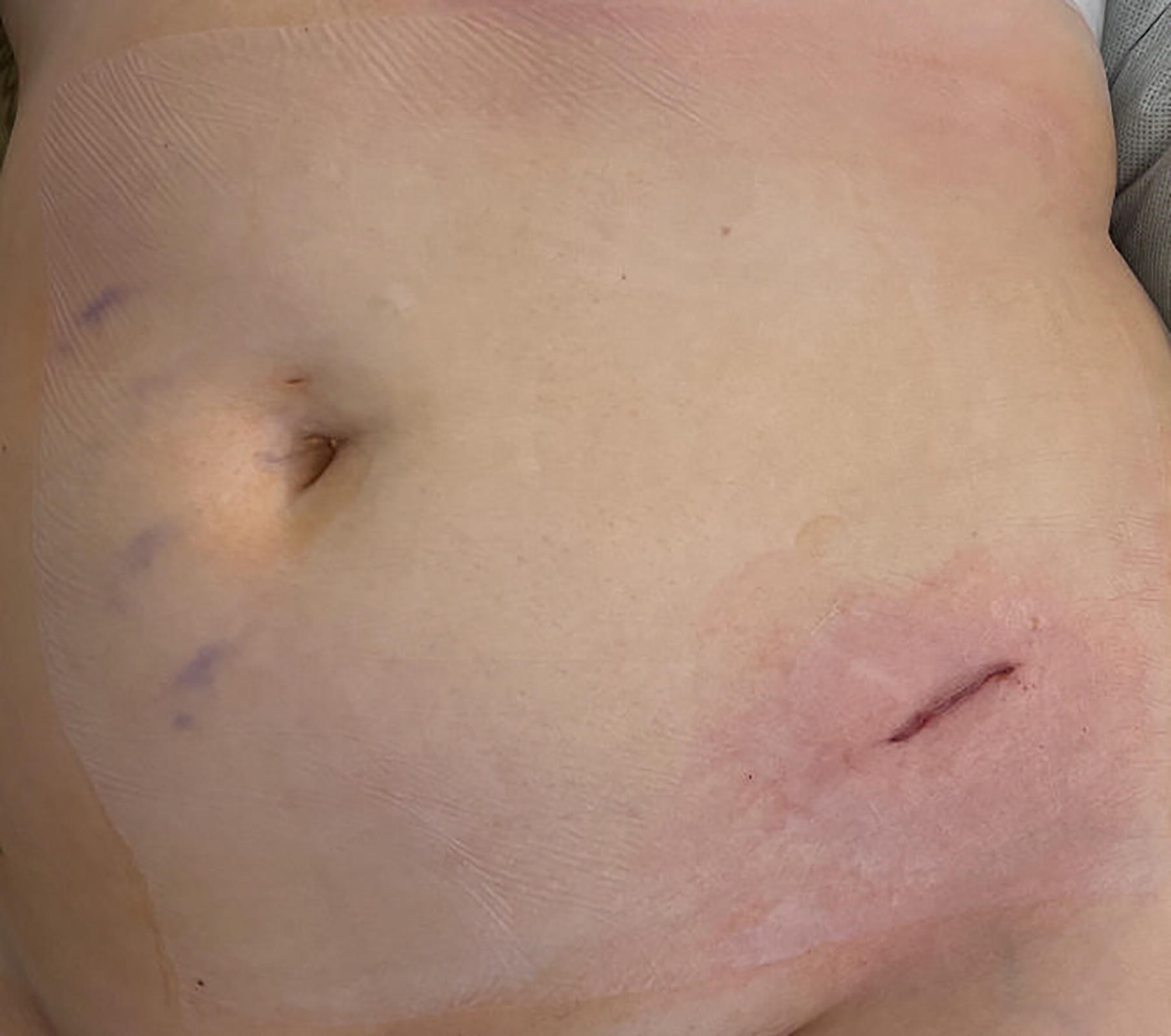
A picture of a lower quadrant incision.

A picture of a midline nonumbilical incision.
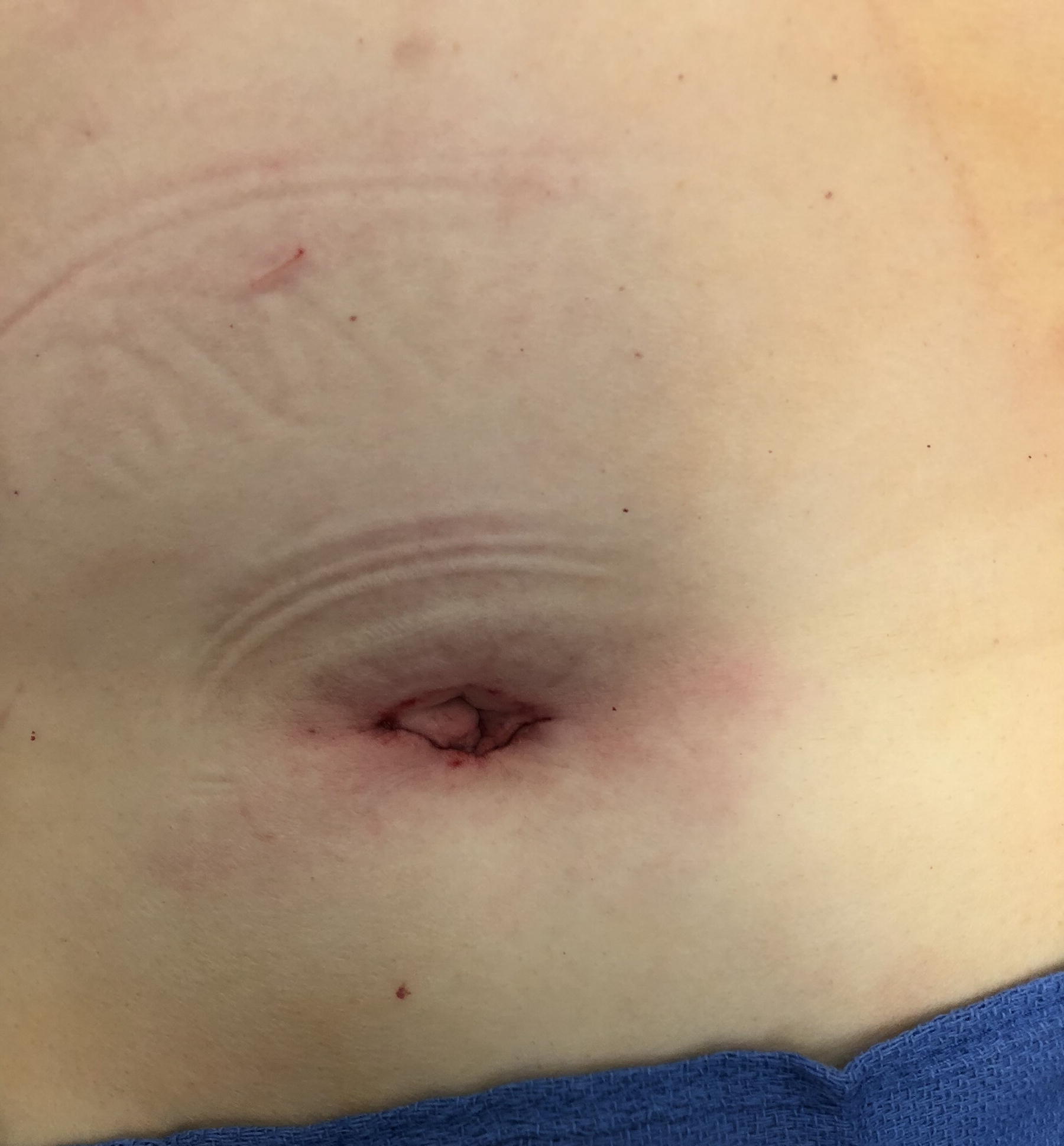
A picture of a periumbilical incision.
Patient Scar Assessment Questionnaire
The Consciousness Domain of the Patient Scar Assessment Questionnaire was utilized to objectively assess cosmesis outcomes. This questionnaire is a validated instrument composed of four separate domains that can be measured separately. 6 To improve the response rate we elected to focus on the consciousness domain, as this domain was found to be significant in a prior study, and the questions assessed the impact of scar location on body image. 6 The questionnaire is composed of six items, each scored from 1 (Never conscious/Not at all noticeable) to 4 (Very noticeable/Always conscious) with higher scores indicating worse consciousness. Scores ranged from a minimum of 6 points to a maximum of 24 points.
Cosmesis scores were defined as “Bothered” or “Not Bothered,” with a summed score of <11 being classified as “Not Bothered” and ≥11 being classified as “Bothered,” to reflect a response indicating a minimum of “Sometimes/Slightly noticeable” on the survey.
Consciousness was measured with the summary question assessing overall consciousness, and responses were categorized as either “Not conscious” or “Conscious.” A response of “Not at all self-conscious” on the survey is classified as “Not conscious.” A response of “Slightly self-conscious,” “Fairly self-conscious,” or “Very self-conscious” is classified as “Conscious.”
Statistical analysis
The items on the questionnaire are included in Table 1. We performed Cronbach’s alpha for the survey. Patient characteristics were compared between incision sites of MP, SP umbilical, SP lower quadrant, and SP midline nonumbilical. Pearson’s chi-squared test was performed to compare gender and prior abdominal operations. Fisher’s exact test was utilized to compare percent bothered and percent conscious between incision groups, and between SP with and without an assistant port. Kruskal–Wallis rank sum test was performed to compare the median age at surgery, median months from surgery to survey completion, and the median sum of cosmesis scores between the incision groups.
Consciousness Domain of Patient Scar Assessment Questionnaire
Multivariate analysis with logistic regression was performed to compare incision site, age, gender, and prior abdominal operations between patients who were Bothered vs Not bothered and Conscious vs Not conscious. Propensity-Score Matched Analysis was performed with a balance of covariates for prior abdominal surgery and time to questionnaire completion.
Results
Survey reliability and univariate analysis of incision sites
Cronbach’s alpha was 0.83 (Feldt 95% confidence interval or CI: 0.77–0.87), indicating reliability of responses. Of the entire cohort, five patients (4.5%) were noted to have postoperative hernias. Of these, three were treated surgically. The rate of postoperative hernia for SP umbilical requiring surgery was 7.4% (2/27), with an overall hernia rate of 11% (3/27), the highest rate compared with MP and other SP incisions. No patients with SP lower quadrant incisions were noted to have postoperative hernia.
Of the cohort, six patients were recorded as having an assistant port, with five of these patients having SP umbilical incision and one with a midline nonumbilical incision.
The results of the comparison of patient characteristics between different incision sites are listed in Table 2. Of the 111 patients, 54 were MP, 27 were SP umbilical, 14 were midline nonumbilical, and 16 were lower quadrant incisions. History of prior abdominal operations was significantly different between MP (38/54, 70%), SP umbilical (8/27, 30%), midline nonumbilical (6/14, 43%), and lower quadrant (5/16, 31%), p = 0.001. Median months to survey completion were also significantly different between groups: MP 30 (20, 53), SP umbilical 27 (18, 35), midline nonumbilical 34 (21, 43), and lower quadrant 13 (6, 20), p < 0.001. On univariate analysis SP umbilical and midline nonumbilical had lower Bother and Consciousness compared with MP, but this difference did not reach statistical significance despite 7.4% of umbilical incisions being bothered as opposed to 30% of MP incisions.
Comparison of Incision Sites on Univariate Analysis
Bolded means statistically significant.
Pearson’s chi-squared test.
Kruskal–Wallis rank sum test.
Fisher’s exact test.
IQR, interquartile range; MP, multiport.
Univariate analysis of Bother
The results of the comparison of patient characteristics and Bother are listed in Table 3. Median age at surgery was significantly associated with Bother with incision. Prior abdominal operations and gender were not associated with Bother with incision.
Comparison of Bother on Univariate Analysis
Bolded means statistically significant.
Pearson’s chi-squared test.
Wilcoxon rank sum test.
Fisher’s exact test.
Univariate analysis of Consciousness
The results of the comparison of patient characteristics and Consciousness are listed in Table 4. Median age at surgery was significantly associated with Consciousness of incision. Prior abdominal operations and gender were not associated with Consciousness of incision.
Comparison of Consciousness on Univariate Analysis
Bolded means statistically significant.
Pearson’s chi-squared test.
Wilcoxon rank sum test.
Fisher’s exact test.
Logistic regression analysis
The results of logistic regression assessing whether Bother depends on incision site, age, gender, prior abdominal operations, and time to survey completion are listed in Table 5. With MP as a reference, SP umbilical incision was significantly associated with decreased Bother with incision (OR = 0.08, 95% CI: 0.01–0.38, p = 0.005), consistent with 7.4% of umbilical incisions being bothered as opposed to 30% of MP incisions. Midline nonumbilical and lower quadrant were also associated with decreased Bother but were not statistically significant. Older age was associated with decreased Bother with incisions (OR = 0.96, 95% CI: 0.93–0.99, p = 0.005). Gender and prior abdominal operations were not statistically significant for Bother with incisions.
Logistic Regression Analysis for Bother
Bolded means statistically significant.Null deviance = 118; Null df = 110; Log-likelihood = −51.1; AIC = 116; BIC = 135; Deviance = 102; Residual df = 104; No. Obs. = 111.
CI, confidence interval; OR, odds ratio.
The results of logistic regression assessing whether Consciousness depends on incision site, age, gender, prior abdominal operations, and time to survey completion are listed in Table 6. Older patients were less likely to be conscious of their incision scar (OR = 0.95, 95% 0.93–0.98, p < 0.001). Periumbilical incision had the lowest consciousness and approached statistical significance (p = 0.051), with location of other incision sites not significant. Prior abdominal operation and gender were also not significant.
Logistic Regression Analysis for Consciousness
Bolded means statistically significant.Null deviance = 125; Null df = 110; Log-likelihood = −54.6; AIC = 123; BIC = 142; Deviance = 109; Residual df = 104; No. Obs. = 111.
Propensity-score matched analysis of Bother and Consciousness
Table 7 includes the results of a propensity-score matched analysis for Bother and Consciousness with a covariate balance of prior abdominal operations and months to questionnaire completion. Increased age at surgery and umbilical incision were associated with decreased Bother and Consciousness with incision, respectively.
Propensity Score-Matched Analysis of Bother and Consciousness
Bolded means statistically significant.
Discussion
This report compares SP and MP cosmesis with various SP incision sites in patients who underwent benign urologic surgery, a patient population for which cosmetic outcomes are a priority. On logistic regression, SP umbilical incisions were less likely to be bothered compared with MP. This confirms prior findings that a single incision placed at the umbilicus provides better cosmesis, likely because of the minimal visibility of these incisions. 5,6 Morgantini et al. compared responses on the validated Patient Scar Assessment Questionnaire between 104 SP and 78 MP patients for urologic oncology procedures, and found SP periumbilical, described as “virtually scarless,” had improved scar cosmesis compared with MP. 6 Huang et al. utilized 234 crowd-sourced survey responses comparing SP periumbilical with and without an assistant port, open surgical, and MP incisions for radical prostatectomy with the psychosocial domain of the ScarQTM, with SP incisions being ranked as more appealing compared with MP or open incisions. 5 However, neither of these studies assessed the cosmesis of different SP incision locations. 5,6
Our results suggest that midline nonumbilical and lower quadrant SP incisions were not associated with improved cosmesis compared with MP on both univariate analysis and logistic regression. A prior study has suggested that incisions that are below the belt line are associated with improved cosmesis in pediatric patients; however, our results did not demonstrate this in adults. 18 Garcia-Roig et al. suggested that incisions covered by undergarments have improved cosmesis based on results from a crowd-sourced online survey. Of note, in this study participants initially did not show a strong preference for lower midline incisions, until being shown an additional picture of hypothetical lower midline incisions being covered by clothing. 9 Our findings provide a real-world experience in cosmetic outcomes of patients who have undergone surgery and do not show significant cosmetic benefits of incisions below the umbilicus.
An umbilical incision limits the surgeon to a transperitoneal approach and may not be ideal in patients with an increased risk of hernia or who have had previous abdominal surgery(ies) where one would benefit from an extraperitoneal approach. 19 In our cohort of patients with a periumbilical incision, we noted a rate of postoperative hernia treated with surgical repair of 7.4% (2/27) and an overall hernia rate of 11% (3/27). In contrast, no patients with lower quadrant incisions were noted to have a postoperative hernia. The rate of postoperative hernia for single-incision surgery at the umbilicus has been previously reported at 8.4%. 20 For patients who would benefit from a retroperitoneal approach, the improvements in postoperative recovery may outweigh cosmetic benefits. Park et al. reported that as surgical risk increased, patients prioritized the ideal surgical approach that minimized the risk of complications over cosmetic outcomes. 7
The role of age and its effect on cosmesis is unclear. Huang et al. reported that age greater or less than 60 years did not affect cosmesis, but this study utilized crowdsourced responses and not patients who underwent surgery, and was in the context of oncologic surgery. 5 In contrast, Park et al. suggested that younger patients undergoing surgery for benign disease prioritize cosmetic outcomes, but did not include a comparison by age. 7 Our results provide a definitive answer that patients undergoing reconstructive urologic surgery value cosmesis differently depending on age, with significantly lower median age for both Bother and Consciousness. Of note, 45% of patients younger than 40 years were conscious, and over a third of patients younger than 40 were bothered. Logistic regression demonstrated that for both cosmesis as measured by Bother, and overall Consciousness, older patients were less likely to have a negative perception of their scar. However, it is unclear if this finding is generalizable to patients undergoing oncologic surgery. Further studies should investigate whether age also influences cosmesis outcomes in patients undergoing surgery for malignancy.
Our study confirms that a history of prior abdominal operations did not influence cosmetic outcomes for new scars. The presence of existing abdominal incisions and satisfaction with these incisions has previously been reported to not influence cosmetic satisfaction for new scars. 5 This study confirms that prior incisions are not associated with cosmetic satisfaction of additional surgical scars, suggesting that patients who already have surgical scars do not care less about cosmesis.
In addition, we found that the use of an assistant port was not associated with Bother or Consciousness, suggesting that an additional small incision did not influence overall cosmesis outcomes, in contrast to the findings of Huang et al. 5 However, this may be caused by a limited sample size of only six patients with assistant port, with almost all of these periumbilical incisions which were noted to have the lowest Bother and Consciousness of all incisions. Given the limited sample size with the assistant port, we cannot conclude its impact on cosmesis.
Gender was not significantly associated with cosmetic outcomes, a finding that has also been reported for patients undergoing laparoscopic or open donor nephrectomy. 21 These findings suggest that the scar consciousness of SP and MP incisions does not differ between male and female patients.
This study has several limitations. While this is the first and largest report to compare cosmesis by SP incision site for patients undergoing benign urologic surgery, our results were limited to a single institution study with a relatively small sample size for each incision site. Future studies should expand upon this study by assessing differences between incision sites with larger cohorts. In addition, this study did not assess whether patient satisfaction with scar appearance would change accounting for changes in the benefits of the surgical approach. Periumbilical incisions may provide superior cosmesis, but the benefits of an alternate incision site that lowers the risk of postoperative complications have been suggested to be a greater priority to patients. 7 A limited sample size of patients with assistant port limits results assessing its impact on cosmesis. The response rate for the questionnaire was also <50%, which may have reflected a selection bias for patients who were most bothered and conscious of their incisions. Lastly, the focus of this study was patients undergoing reconstructive surgery for benign disease. These patients may be more sensitive to cosmetic results as their surgery was performed for benign disease. It has been proposed that patients undergoing surgery for oncologic disease may care less about cosmesis. 7 Future studies should investigate cosmesis for patients undergoing oncologic surgery.
Conclusions
SP periumbilical incisions provide the best outcomes for cosmesis compared with other SP incision sites and MP incisions. This finding should be discussed and taken into account when planning surgical approaches for patients undergoing benign urologic surgery, especially in patients younger than 40 years of age.
Footnotes
Authors’ Contributions
M.R.: Conceived the project and contributed to the design and implementation of research, data collection, analysis of the results, and writing the article. C.I.: Contributed to the design and implementation of research, data collection, analysis of the results, and writing the article. M.H.: Contributed to data collection and analysis. Q.C.: Contributed to data collection and analysis. K.K.: Contributed to data collection and analysis. S.G.: Contributed to data collection and analysis. S. Saxena: Contributed to data collection and analysis. R.S.D.L.R.: Contributed to data collection and analysis. S. Seidman: Contributed to data collection and analysis. G.L.: Contributed to data collection and analysis. R.M.: Contributed to data collection and analysis and editing the article. M.B.: Contributed to data collection and analysis. M.A.: Contributed to data collection and analysis. M.S.: Conceived the project, contributed to the design and implementation of research, data collection, analysis of the results, and writing the article, and supervised the project.
Author Disclosure Statement
M.R., C.I., M.H., Q.C., K.K., S.G., R.S.D.L.R., S. Seidman, G.L., R.M., and M.B.—None. M.A.—Intuitive Surgery, BioTissue, and Ethicon consultant. M.S.—Intuitive Surgery Advisory Board, VTI consultant, and Ethicon lecturer.
Funding Information
No funding was received for this article.
Supplementary Material
Supplementary Table S1
Supplementary Table S2
Abbreviations Used
References
Supplementary Material
Please find the following supplemental material available below.
For Open Access articles published under a Creative Commons License, all supplemental material carries the same license as the article it is associated with.
For non-Open Access articles published, all supplemental material carries a non-exclusive license, and permission requests for re-use of supplemental material or any part of supplemental material shall be sent directly to the copyright owner as specified in the copyright notice associated with the article.
