




Abstract
Abstract
Little research has focused on the use of visual imagery in struggles for environmental justice (EJ). This article contributes to knowledge by gauging respondents' reactions to two images used in a recent conflict surrounding the proposed reopening of a copper smelter owned by the American Smelting and Refining Company (ASARCO) in El Paso, Texas. After viewing the images, respondents voiced concern about environmental injustices and expressed interest in job creation that would be safer and fairer for themselves, their children, and future generations. An analysis of respondents' reactions informed the creation of two alternative images designed to resonate with local values and advocate for environmental justice. When designing protest images, EJ groups should use text to make the point of the image clear, include pertinent information about the hazard, and use imagery that is meaningful to people who are likely to be affected.
Introduction
Little work has focused specifically on groups' use of visual imagery in environmental justice struggles. In one of the only EJ studies to take a visual approach, the researcher conducted an in-depth critical visual discourse analysis of four EJ groups' logos and found that all four represented, in some way, the abilities of lay people to engage with experts and expert knowledge. 4 Despite little academic focus in the EJ literature, visual imagery is arguably a powerful tool. An abstract concept can be made more salient if it is presented in a visual manner. For activists in Woburn, Massachusetts, creating a map plotting clusters of leukemia set the stage for a major epidemiological study of drinking water from suspicious wells. 5 Similarly, NASA satellite pictures of the ozone hole over the Antarctic mobilized action against ozone depletion. 6
This investigation gauges student reactions to two images used in a recent attempt to reopen a copper smelter owned by the American Smelting and Refining Company (ASARCO) in El Paso, Texas. The first image was used by the community group Get The Lead Out Coalition (GTLO) to express their opposition toward reopening the smelter. The second image was used by ASARCO to highlight the jobs that would be available if the smelter were to reopen. Analysis of these reactions then informs a discussion regarding visual imagery in environmental justice and the creation of two alternative images related to the ASARCO case that advocate for environmental justice.
Despite their power, visual images and viewer reactions to them have not been focused on to a great degree in the literature. Only Kurtz 7 examines visual imagery, and she focuses on group logos as a window into how EJ groups symbolically represent themselves as opposed our focus on how the public understands visual images associated with an EJ case. As one of the first of its kind, this study is an exploratory examination into the use of visual images in environmental justice cases. The method of surveying students about environmental justice has been used before, 8 but not in relation to visual images.
This article contributes to existing research by specifically investigating how viewers react to visual images (i.e., photographs) created by opposing groups in an environmental justice debate. The global use of images in advocacy campaigns makes our study pertinent to environmental justice groups around the world. Our recommendations for the creation of new images and findings from this research are practically useful and can also be used to inform a larger-scale study of visual images and environmental justice in the future.
Contextual Background
The ASARCO smelter is located in El Paso, Texas, meters from Ciudad Juárez, Mexico and Sunland Park, New Mexico. The region is home to a population of over 2 million people that are predominately Hispanic and working class. The smelter was originally founded under the Mexican Ore Company in 1887 and that year, the smelter employed 250 people and smelted over 12,000 tons of lead. After a fire in 1901, ASARCO reopened with seven new lead furnaces; an additional copper smelter was added nine years later. 9
By 1969, El Paso had the highest concentration of lead air pollution in Texas. 10 In April 1970, the City of El Paso and the State of Texas filed a lawsuit against ASARCO for violating the 1967 Air Safety Code and Texas Clean Air Act. A settlement was reached and ASARCO was fined for pollution violations and ordered to pay for installation of emission control equipment, monthly soil and air sampling, and medical examinations for children with elevated blood-lead levels, as well as additional money for future pollution. That same year, the Center for Disease Control found that 53 percent of children aged 1 to 9 years living within 1.6 kilometers of ASARCO had blood lead levels that were considered dangerous to their health. 11 By this time, the health effects of lead on children's development were well understood. 12 In December 1971, the El Paso City-County Health Department discovered that ASARCO had emitted 1,012 metric tons of lead into the air since 1969. By the 1980s, the lead smelters had been shut down, yet ASARCO continued operations of the copper smelter. In a 1998 internal memorandum from the Environmental Protection Agency (EPA), it was discussed that ASARCO and subsidiary Encycle illegally burned over 5,000 tons of hazardous waste at the El Paso smelter from 1992–1997. Related to this incident, in February 2008, the TCEQ (Texas Commission on Environmental Quality) denied a request filed for a review of possible criminal conduct by ASARCO.
ASARCO ceased smelter operations in 1999 after the price of copper dropped. The company filed for Chapter 11 bankruptcy in 2005. According to Devra Davis, ASARCO claimed bankruptcy in an effort to avoid paying cleanup costs at dozens of Superfund sites it had produced; the company's failure to take responsibility places the burden on the taxpayers. 13 In 2007, ASARCO began a bid to acquire an air permit to reopen its El Paso smelter due to rising copper prices. Despite organized bi-national protest, on February 13, 2008, the TCEQ voted to renew ASARCO's Air Quality Permit No. 20345. 14
With copper prices plummeting, the new Obama-led EPA announced that ASARCO would have to spend millions to update their equipment. 15 These two factors led ASARCO to announce that it would not reopen its copper plant as of February 6, 2008. In May 2009, the City of El Paso reluctantly accepted $52 million from ASARCO in bankruptcy court to fund clean up at the smelter site, citing that it was not enough money to properly rehabilitate the land. They argued that the figure also did not take into account the clean-up efforts that would also be needed across the border in Ciudad Juárez, where residents have also been affected by the smelter's pollution.
The issue of the smelter reopening had been framed in terms of “jobs versus the environment” by both ASARCO and its opponents. ASARCO led an effective public relations campaign using images to shape local public opinion to their favor. At that time, over 50% of registered voters in El Paso supported the opening of the smelter, 16 presumably because they believed it would create jobs. A pilot survey conducted in four El Paso neighborhoods found that public support for ASARCO relied heavily on the company's promise to stimulate the local economy even though the majority of those residents felt ASARCO's re-opening would be harmful to their health. 17
The Get the Lead Out Coalition (GTLO) is a grassroots organization and one of the main opponents to the re-opening of ASARCO. As an alliance of individuals committed to protecting the health of citizens and promoting sustainable growth in the Southwest border region, the group formed as a response to the discovery of toxic substances (i.e., cadmium, arsenic, and lead) in soil samples from the Sun Bowl Stadium adjacent to the ASARCO smelter. 18 Often in conjunction with ACORN (Association for Community Reform Now), the group hosted several events to raise awareness of the risks imposed by ASARCO. One of these was a march to El Paso's City Hall. GTLO also traveled, along with community members, in busses to the TCEQ hearings for ASARCO's permit renewal in Austin, Texas as a show of opposition against the smelter's re-opening. The group's “Faces Against ASARCO” campaign also used an image to influence public support. The image, created during the culmination of the campaign, is the image used for this study. Following the announcement that ASARCO would not continue to operate in El Paso despite the renewal of their permit, the GTLO Coalition has remained a vocal participant in the remediation process.
Data And Methods
First, we selected the two primary campaign images used in the ASARCO case—one from the GTLO and one from ASARCO. The GTLO image “Faces Against Asarco” (Fig. 1) was selected because it was the apex of the group's anti-ASARCO campaign. A considerable amount of organization took place in order to execute the image. Taken in September 2007 by the GTLO, Figure 1 depicts about 1,500 people coming together to protest the smelter. Black ash is visible around the rim of the stack's opening and the photo captures a portion of the air-shed and mountain range shared by El Paso, Texas; Sunland Park, New Mexico; and Ciudad Juárez, Chihuahua, Mexico.

Get the Lead Out image, “Faces Against Asarco.”
The ASARCO image “I want to work for ASARCO” (Fig. 2) was selected because it reflects the company's basic strategy for generating public support, i.e., highlighting prospective jobs and economic growth to the community, and was used widely in the campaign. Figure 2 depicts about 75 people at the ASARCO plant. The ASARCO image does not encompass natural landmarks or the entirety of the iconic smoke stack. In comparing the images, both focus on crowds of people and appeal to community and family values, but neither image explicitly states its message.
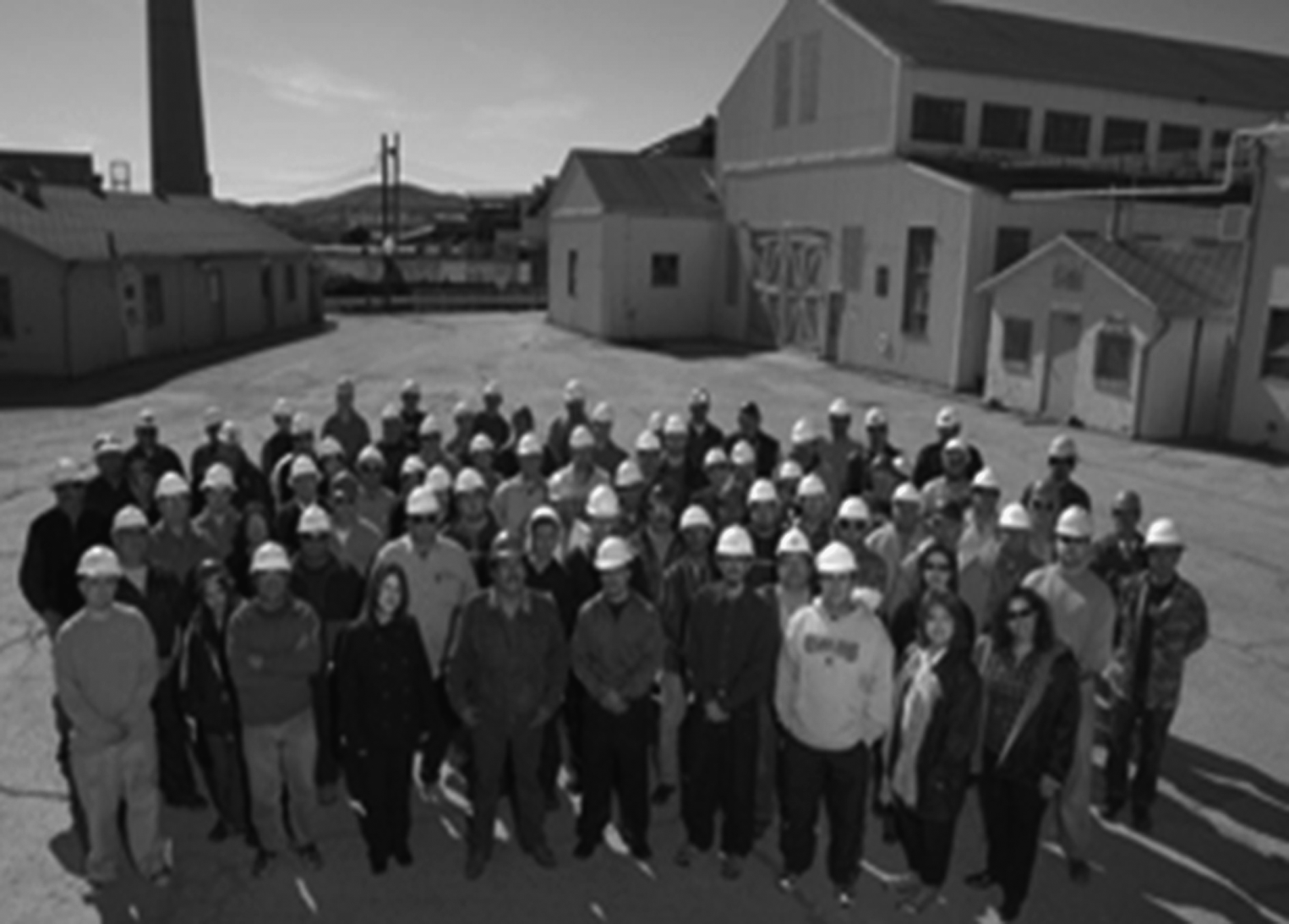
ASARCO image, “I want to work for ASARCO.”
This research consisted of two phases approved by the University of Texas at El Paso Institutional Review Board in February 2008. First, an open-ended questionnaire was administered to an undergraduate sociology course at the University of Texas at El Paso. A total of 34 students filled out the questionnaire, and their responses were imported into QSR International's NVivo 7 software for analysis. The open-ended questionnaire was used to (a) gauge student interpretations of the environmental images and (b) to find out if the images swayed student opinions on ASARCO. We assumed that students would be aware of this issue as it was reported on in the media regularly during this time and the smelter is located less than a mile from campus. This introduces a limitation into the research as it was possible that the students had already made up their minds about ASARCO before completing the questionnaire, or that, because the images used in the study were publicly displayed via the Internet, they may have already seen and been influenced by the images. However, the questionnaire was designed to distinguish the influences of the images by first asking students what their ideas of ASARCO were prior to their viewing the two opposing images. Thereafter, students were asked if and how the images impacted their opinions of ASARCO and its possible re-opening.
Respondents were between the ages of 18 and 50, with over half of the respondents falling between the ages of 18–25. Nineteen of the respondents (56%) were female and fifteen of the respondents (44%) were male. This is an approximate reflection of students at the University of Texas at El Paso (UTEP); in 2006, 55% of undergraduates were female and 45% were male. The total household income for the respondents generally varied, but the median income level was $30,000–$39,000/year. Twenty-nine of the 34 respondents (85%) were of Latino/Hispanic ethnicity, which roughly matches the percentage of Hispanic students enrolled at UTEP (86%). 19
Then, two alternative environmental images were created by the first author, based on knowledge gained during analysis of responses. The photographs were taken in 2007 and edited using Picasa software and InfranView graphic viewer. The purpose of this phase was to create visually effective images that could both educate and persuade people to resist environmental injustices, specifically those created by ASARCO.
Research Results
Results and discussion of survey
Students' general attitudes toward the ASARCO smelter
Students were first asked about their general attitudes toward the ASARCO smelter. More specifically, the students were asked two things: one, do they believe the smelter should open or close and why, and two, what is their overall association with the smelter. Out of the 34 students who filled out the questionnaire, 23 students (67%) felt the smelter should remain closed, three students (9%) stated they wanted the smelter to reopen and eight students (24%) were undecided. Undecided students included those who mentioned the opening/closing of ASARCO “depends” on whether ASARCO abides by regulations or not. Reasons for opposing the smelter were largely due to environment and health concerns. Students against the smelter reopening made comments including:
“ASARCO is responsible for lead contamination.” “ASARCO polluted the air, especially around UTEP.” “ASARCO pollutes and contaminates water and the cities surrounding it.” “ASARCO will continue to contaminate our border environment—we still have leftovers.” “I do not believe that setting a cap on pollution via an Air Quality Permit helps anyone's quality of life. There is still pollution.”
More than half (53%) of the students opposed to ASARCO came from middle and upper income groups (i.e., had household incomes of over $40,000 per year). A student from the middle income group said, “I think ASARCO should remain closed. What I do know is that while it was open it affected the El Paso and the Juárez communities/families.” Interestingly, she unites the word community with the word family, representing closely linked nature of these two terms for her; she also suggests that they span the international border. For her, the smelter should remain closed because of its affects on the bi-national community. These responses taken together are indicative of the dissonance between ASARCO's framing in the local media of their “proud history” in El Paso and the way that these students perceive the corporation as a polluter.
A couple of the students who opposed ASARCO shared personal stories of their experiences with the smelter. One student mentioned, “I think it should be closed! I used to live in the El Dorado Apartments [located 1 km from the plant] as a kid and I would always be sick with coughs, colds, bronchitis, etc. As soon as we moved to the West side, it stopped.” A second student shared a similar story, “I don't agree with ASARCO re-opening because as a kid I attended Mesita Elementary [located 1.6 km from plant] and before then I had no sign of allergies or asthma. During the years I attended (grades 3–5) I began to get shortness of breath and constant congestion.”
Three students in favor of ASARCO reopening cited economic benefits as the reason the smelter should reopen. One student said, “It would create more jobs—therefore lowering the unemployment rate and boosting the local economy.” Another student acknowledged the environmental hazards, but felt that employment opportunities were more important: “I know that it opening may be harmful to the environment but it will also have jobs available.” The fact that some residents are willing to embrace toxic industry for jobs is indicative of El Paso's economic and environmental marginalization. Another student said, “It will create more opportunity and the economy will [improve].” These statements likely reflect the success of ASARCO's media campaign in which they vigorously promoted their employment capabilities. Whether these jobs would have been given to local people is debatable; research has shown that factories rarely employ neighboring residents. 20
Eight of the students surveyed were undecided about the reopening of ASARCO; either they reported that they really did not know much about ASARCO and therefore remained undecided or they felt that El Pasoans will benefit either way from ASARCO closing or reopening. As one student mentioned, “I have no opinion. I could go for both sides. I think it helps and hurts us. If it reopens there are more jobs for the city. If it remains closed they will not harm certain communities anymore.” It is likely that those who are undecided will be most influenced by environmental campaigns. As two students mentioned:
“I do not know enough to make my choice.” “I am confused. I feel there should be more information and explanation on what ASARCO does.”
Household income seemed to have a small effect on the undecided students' responses. Over one-third of students in the lowest income group (i.e., household incomes of less than $40,000 per year) were undecided (in contrast to 13% for middle and upper income students), possibly because their financial situation might made them more susceptible to ASARCO's “well-paying job” rhetoric. For instance, a student from the lowest income group said, “If it remains closed we benefit environmentally, but if it opens, it brings more jobs to a city that desperately needs more jobs.”
Were students influenced by the GTLO image?
Out of the 34 respondents, 33 answered the question “has your opinion on the ASARCO issue changed after viewing this image?” Two students (6%) felt neutral/undecided, twenty (61%) students said they were positively influenced by the image or had positive views of the image reinforced, and eleven (33%) did not feel influenced. One of the students who initially felt neutral about ASARCO stated that, “I still have no opinion. [The image] to me, [looks] like a community got together for some reason. What reason? I can't tell from looking at image.” This statement is indicative of the confusion the GTLO image creates if not viewed carefully.
Students who had their opinions reinforced answered: “I've always been against its reopening to begin with,” and, “I am already sympathetic to their cause.” The large crowd of people shown in the image influenced some students' perspectives. One explained, “Yes [I am influenced]. It shows that a lot of people care and it's a big deal.” Another who felt influenced recognized the power of the image to linger in the mind in a way that textual information might not: “It does make [the smelter] look dark so I am influenced […] this image is now stored in my mind.”
For the students who did not feel influenced, the lack of case-specific information in the image might have contributed to its lack of influence. For example, when asked if he/she was influenced, one student said, “No, I feel that to make a choice I need to find out more of what is going on and not just follow a crowd or maybe see a picture like this.” Another stated that, “Not really, because I don't know for sure what they are trying to achieve.”
Were students influenced by the ASARCO image?
All 34 respondents answered the question “has your opinion on the ASARCO issue changed after viewing this image?” Two students (6%) felt neutral, four students who were originally against ASARCO (12%) did feel influenced by the image, and 28 students (82%) did not feel influenced by the image. One of the previously neutral students remarked: “Now my opinion is that closing ASARCO will help the environment, but it will also affect those who [would] work for the company and their families.” The other students who were influenced by the image also mentioned jobs and workers:
“It's one more image in my mind of what ASARCO can represent so yes, now I will have to think of the workers more.” “It makes me think about the people who could potentially have jobs there.” “It does leave me with a bit of mix emotions because I now have a face to the people that would lose out on jobs.”
Perhaps prior to this image, these students had likely never pictured jobs with the faces of people; the image, in this case, was powerful because the students were influenced by the guilt of seeing real people that could be affected if the plant did not reopen. These quotes reflect the successful framing by ASARCO of the issue as one of “jobs vs. the environment.”
The depiction of an entirely Hispanic group of individuals was also influential and signified a reference to the local community, which like UTEP, is predominantly Hispanic. One student said that “You can tell [the people in the image] are all Hispanic or Mexican.” This is an obvious way of marketing ASARCO in this community, and it is a strategic way of providing a sense of familiarity to people. As one student said when describing the people in the image: “People just like me, my relatives …”
The focus on employment benefits for local people makes sense as ASARCO was well aware that the environment is the main reason for popular opposition. ASARCO could have addressed this issue by including a natural environment in the image. One student mentioned that “they could have taken [the photograph] at a park.” If this was the case, the scenery could divert attention from the business aspect by bringing in warmer, brighter colors and forms. In essence, this would depict ASARCO out in the community acknowledging the environment instead of being inside the plant.
Students who said they were not influenced by the image stated the following:
“You can tell ASARCO is trying too hard to appeal to the community.” “Well, by this [picture] I would not like it to reopen because it all looks false.”
In fact, according to GTLO, ASARCO paid the people to appear in the photo shoot. The staged nature of the photo in this instance made it less influential.
Comparing responses to the GTLO image and ASARCO image
The primary difference between the two images is the emotions they evoke in respondents. The GTLO image uses vibrant colors from the natural landscape to help capture a feeling of excitement from the crowd. The pose (everyone raising arms in air) helps create energy in the image. The GTLO crowd was more often described as “unified” than the crowd in the ASARCO image by respondents. This is possibly due to the GTLO image having more incorporated themes—the use of the color white and people dressed and posed similarly.
It seems, however, that ASARCO makes their message more personal and emotion-eliciting than the GTLO image. Although it features a smaller group of people, the ASARCO message seems designed to induce feelings of individual guilt for refusing to make jobs available. In fact, ten students referenced feelings of guilt related to the image. Furthermore, feeling pride in working hard and providing for family resonates with cultural characteristics of the region, especially because the family is an important social unit for Hispanics. ASARCO seems to assert that it can provide jobs and, by extension, nurture positive sentiments in an individual, their family, and the community.
Family was thus invoked in both images through presentation of healthy, happy families by GTLO and through the image of Hispanic workers needing jobs to provide for their families in the ASARCO image. Family was also important to student respondents. According to the majority of them, the creation of hazardous pollution was not acceptable, given the high importance of protecting and providing for the family unit. While employment might appear to have more direct and immediate effects on the family than the environment, a polluted environment has longer lasting effects. The issue thus becomes one of intergenerational equity, both economically and environmentally. Economically, respondents to the ASARCO image felt that the company was portraying a livelihood for their families. One student said “[The image shows] that by closing ASARCO, they will be hurting families.” Environmentally, respondents to the GTLO image noticed “that there are children there and [the smelter] affects them in the future.” Several respondents noticed the GTLO image included families, while ASARCO's image included mostly men. One student said that the people in the GTLO image “could be parents concerned about fighting for their children's health” who “care for [El Paso's] future.”
Presentation of alternative images
The first author created two additional protest images in order to convey salient findings (i.e., the most common concerns of surveyed students) that emerged during analysis of responses. These findings were: a concern for health and the environment, intergenerational equity, and the importance of having adequate information when making a decision.
Image #1 (see Fig. 3), titled “Be the Voice” is asking parents to protest on behalf of their children. The idea for this image emerged from the importance that students gave to concerns of family and intergenerational equity, i.e., the notion that parents should leave their children with an environment just as healthy as or healthier than the one they inherited. In addition, the focus on children is warranted because they are the first to be affected by environmental toxins, like lead. The image was taken during the Faces Against ASARCO event.
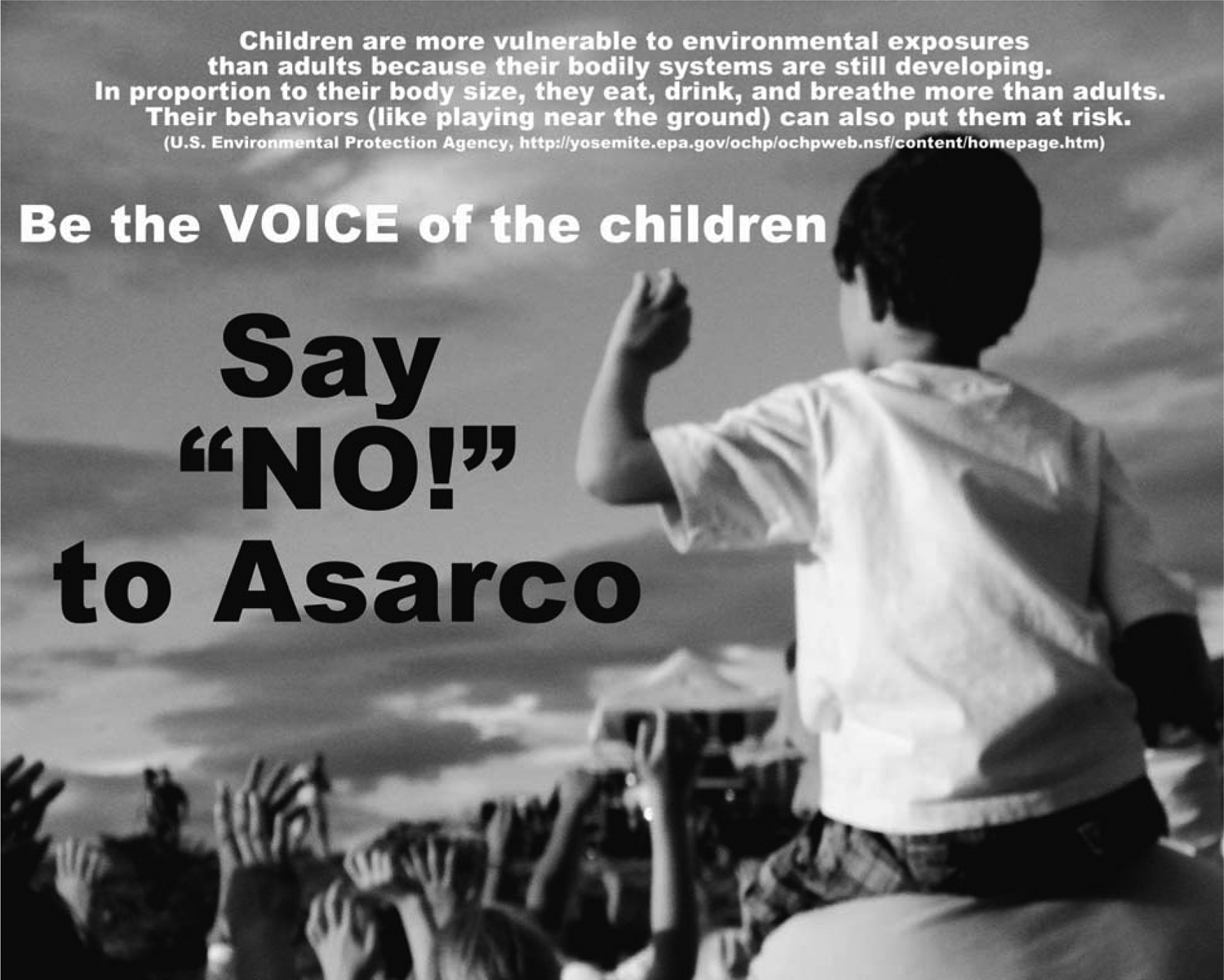
Be the Voice.
Image #2 (see Fig. 4), titled “Think of the Future” is a black and white image depicting the silhouette of the ASARCO smelter. This image contains a caption with factual information, something the students noted was missing from the two images presented earlier. The purpose of this image is to inform viewers that ASARCO not only pollutes but that it has also broken the law and violated community trust by burning illegal materials. It also alludes to the concept of intergenerational equity discussed earlier by urging the viewer to think about the future consequences of reopening ASARCO.
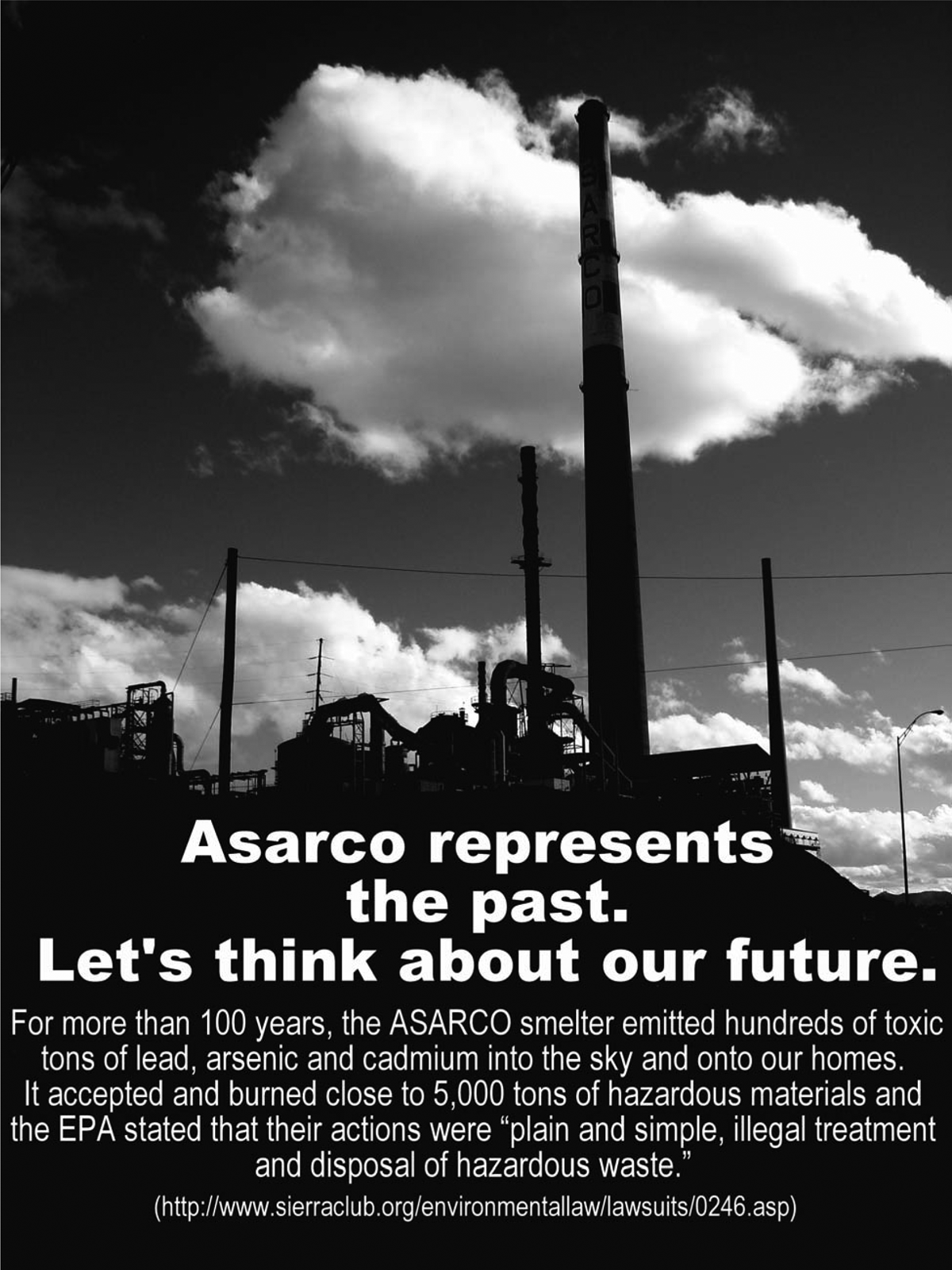
Think of the Future.
Discussion
Over the past forty years, the environmental justice movement has grown and diversified; however, the power of corporate interests and government entities has also grown and fighting them has become increasingly difficult. In order to fight back and protest these inequities, a variety of strategies have been used by those seeking to make a change. Visual methods can be a powerful tool for grassroots organizations, 21 and the selection and/or creation of an appropriate visual image can help further a cause by catalyzing emotional opposition, attracting more people to protest, and thus creating power in numbers.
Our survey data showed that in general, the images did elicit emotional responses from the viewers. In fact, some emotional ambivalence was introduced as the images stimulated feelings that countered previous perceptions of ASARCO. For example, several students felt bad for the workers after viewing the ASARCO image, even though they had not previously thought about the workers and had instead focused on the environmental harm associated with the smelter. Survey data also suggested that appealing to cultural values is important in creating effective images. Both GTLO and ASARCO did this, through the image of families and collective struggle in the GTLO image and through Hispanic workers and material success in the ASARCO image, which resonated with students. In addition, we found that many students felt they needed more information about the case in order to take a stand. The lack of text, especially in the GTLO image, caused confusion in terms of whether the image was pro- or anti-ASARCO.
A concern for intergenerational equity (responsibility to future generations) was also present among students. In another survey-based project examining the importance of environmental justice values in solving environmental conflicts, 22 students felt that responsibility to future generations, species, and the environment were most important. They rated procedural justice (fairness in the process of environmental decision making) and distributive justice (equal distribution of environmental benefits and hazards) as less important. It seems then that using protest images that focus on impacts on children and the earth would be effective in many settings.
In this article, we take a critical or reflexive realist perspective, 23 which identifies the existence of biophysical environmental problems while recognizing that how we understand these problems is the product of framing. We assert that environmental harm has been caused by ASARCO. As compared to other cases, there is little material uncertainty about risks associated with lead contamination. Within this broad realist framework, we take a constructivist perspective in our examination of how the ASARCO case was constructed and framed in images by a community group and the company and how these frames shaped students' understanding of the issue. Thus our assertions that including information about environmental harm in protest images as a way to make the message more powerful is in line with our reflexive realist approach. While the constructivist-realist debate still exists in environmental sociology, scholars integrate them through perspectives such as critical or reflexive realism. Here, we recognize that the framing of this environmental issue has been very central to how the case is understood by local people, but also that environmental harm has been caused.
Limitations
A limitation of this project is that we did not test our images, in a follow-up phase of the research, to see if they were less confusing. By the time we had analyzed the data and designed the new images, the salience of the issue had faded from the public's concern, given that the site was permanently closed. This would make direct comparison of the original and new images fraught with validity issues. Future research could build off this study by designing a series of images (e.g., a set with differing amounts of text) and then test them to see how the public responded to the messages. In addition, we utilized a small sample of respondents. We hope that future EJ scholars follow the lead of Kurtz 24 and this article, and continue to conduct visual EJ research.
Conclusion
This analysis and creation of the new images leads us to the following list of suggestions for environmental groups designing protest images:
Use text to make the point of the image clear Include at least one simple, relevant piece of information from a reliable source Talk to people about the issues first, so you can learn what they care about Use imagery that is meaningful for people
The power of images does not need to be contended, as Douglas Kellner points out, “a media culture has emerged in which images […] help produce the fabric of everyday life.” 25 Local members of the GTLO acknowledged this strong capability and created a campaign that centered around one photograph to combat the smelter's presence in the city. By comparing this image with ASARCO's, this research reveals how images are used within environmental justice struggles and how images influence viewers. The viewer is enticed to see potential employment benefits of resuming operations at a copper smelter. While economic concerns often rank high in working-class communities such as El Paso, student participants in this research voiced concern about environmental injustices, as they have in other projects 26 and expressed interest in job creation that would be safer and fairer for themselves, their children, and future generations.
Acknowledgments
The authors acknowledge Dr. Frank Perez at the University of Texas at El Paso for his help with an earlier iteration of this manuscript.
Footnotes
1
David N. Pellow, “Framing Emerging Environmental Movement Tactics: Mobilizing Consensus, Demobilizing Conflict,” Sociological Forum 14 (Dec 1999): 659–683; Paul Almeida and Linda Brewster Sterns, “Political Opportunities and Local Grassroots Environmental Movements: The Case of Minamata,” Social Problems 45 (Feb 1998): 37–60; Melissa Checker, “Like Nixon Coming to China”: Finding Common Ground in a Multi-Ethnic Coalition for Environmental Justice,” Anthropological Quarterly 74 (July 2001): 135–146.
2
Lois Gibbs, “Citizen Activism for Environmental Health: The Growth of a Powerful New Grassroots Health Movement,” Annals of the American Academy of Political and Social Science 584 (Nov 2002): 98.
3
Ibid.
4
Hilda Kurtz, “Reflections on the Iconography of Environmental Justice Activism,” Area 37 (2005): 79–88.
5
Phil Brown, “Popular Epidemiology: Community Response to Toxic Waste-Induced Disease in Woburn, Massachusetts,” Science, Technology and Human Values 12 (1987): 78–85.
6
John A. Hannigan. Environmental Sociology: A Social Constructionist Perspective, 2nd ed. (Routledge, 2006).
7
Kurtz, “Reflections on the iconography.”
8
Susan Clayton, “Models of Justice in the Environmental Debate,” Journal of Social Issues 56 (2000): 459–474.
9
Eliot Shapleigh, ASARCO in El Paso, (State of Texas, El Paso County, 29th Senatorial District Office, 2007).
10
Ibid.
11
Philip J. Landrigan et al., “Epidemic Lead Absorption Near an Ore Smelter: The Role of Particulate Lead,” New England Journal of Medicine 292 (1975): 123–129.
12
Herbert L. Needleman, John R. Pierce, and Gerhard Stöhrer, “Lead Control,” Science 254 (Oct 1991): 500–501.
13
Devra Davis. Counterpunch.<
14
Timothy Collins, Sara Grineski, and Martha I. Flores, “Environmental Injustices in the Paso del Norte,” Projections: MIT Journal of Planning 8 (2008): 156–171.
15
Sito Negron. Newspaper Tree. <
16
Darren Meritz, “Majority of El Pasoans say ASARCO should be allowed to Reopen.” El Paso Times, October 2007.
17
Collins, Grineski, Flores, “Environmental Injustices.”
18
Get the Lead Out Coalition. <
19
Campus Diversity Facts. (n.d.) Demographics. Retrieved March 25, 2008, from<
20
Steve Lerner. Diamond: The Struggle for Environmental Injustice in Louisiana's Chemical Corridor. (MIT Press, 2006).
21
Kurtz, “Reflections on the Iconography.”
22
Clayton, “Models of Justice.”
23
Hannigan. Environmental Sociology.
24
Kurtz, “Reflections on the Iconography.”
25
Douglas Kellner. Media Culture: Cultural Studies, Identity and Politics between the Modern and Postmodern. (Routledge, 1995).
26
Clayton, “Models of Justice.”