




Abstract
Abstract
Hurricane Katrina has exacerbated problems of environmental injustice and food insecurity in the Lower 9th Ward. Community leaders are attempting to address these issues through environmental restoration and community gardening projects, which could benefit public health by increasing access to healthy food and storm protection. Combining the environmental restoration and food security movements could increase the effectiveness of both by sharing resources, enlarging networks, and addressing multiple health concerns at once. Restoration of the Bayou Bienvenue Wetland Triangle, a local wetland, provides a case study of merging these two movements. The Lower 9th Ward has a history of direct food acquisition from the local environment, and a tradition of community activism. These characteristics have the potential to reconcile the immediate food security needs of the community with the long-term goals of environmental restoration. Using community-based participatory research, this article examines whether food security has a role in promoting community awareness and support for environmental restoration.
Introduction
Community leaders in the Lower 9th Ward have identified sustainability as a guiding principle in the restoration of the neighborhood (Tulane/Xavier Center for Bioenvironmental Research and Louisiana Department of Natural Resources, 2006). Addressing environmental justice issues, specifically the need for environmental restoration to increase natural storm protection, could protect the neighborhood against future storm surges while promoting direct benefits to residents such as food acquisition and recreation opportunities. Yet with only 19 percent of pre-Katrina population at the time of Hurricane Katrina's third anniversary (Greater New Orleans Community Data Center, 2008) and the continued lack of basic services, the immediate needs of residents have taken precedence. However, failure to address wetlands restoration leaves the Lower 9th Ward vulnerable to future flooding (Stokstad, 2005).
This article examines whether food security has a role in promoting community awareness and support for environmental restoration. Through semi-structured interviews and structured surveys of residents, the historical and current access to food and the role of direct food acquisition in the adjacent Bayou Bienvenue Wetland Triangle (BBWT) is examined. This case study demonstrates how environmental degradation and food insecurity result from social injustice and provides an example of how addressing improvements in food security can motivate environmental restoration. This could ultimately improve public health in the Lower 9th Ward through increased storm protection, a healthy diet, and increased environmental awareness.
Environmental Justice And Food Security In The Lower 9th Ward
Interest in environmental justice grew out of the civil rights movement of the 1950s and 1960s when African American activists recognized concerns about environmental hazards (Bullard, 1990). In 1991, the First National People of Color Environmental Leadership Summit expanded the scope to include a range of public health issues that center around physical, social, cultural, and spiritual factors (Lee, 2002) and has become a way for communities to frame social and environmental issues to promote collective action (Taylor, 2000). Hurricane Katrina further broadened the scope of environmental justice by including proximity, likelihood, and vulnerability of natural disasters for low-income and minority populations (Pastor et al., 2006).
The community food security movement focuses on culturally acceptable access to healthy and nutritious food (Gottlieb and Fisher, 1996). Like environmental justice, it has a public health focus; food access and diet affect public health of minority communities. African Americans have the highest prevalence of diabetes and are 40% more likely than Caucasians to die of cardiovascular disease (Webb, 2007). Diet is also important in combating a variety of health stressors (Hennig et al., 2007). The demographic overlap and shared concerns of the environmental justice and community food security movements represent an opportunity to productively unite disparate groups (Allen, 1999; Schlosberg, 2004) to efficiently address these issues (Lee, 2002).
The Lower 9th Ward
The Lower 9th Ward is characterized by both environmental injustice and food insecurity. Before Hurricane Katrina, the Lower 9th Ward had a 96% non-white population and the poverty rate was 35% (Greater New Orleans Community Data Center, cited from U.S. Bureau of the Census, 2000), characteristics that put them at inherent risk for environmental injustice (Bullard, 1990), food insecurity (Whelan, Wrigley, Warm, Cannings, 2002) and health problems (Fiscella, Franks, Gold, Clancy, 2000). For example, the Lower 9th Ward is near locally unwanted land uses (LULUs) located in the adjacent BBWT, a 427-acre wetland directly north of the neighborhood. The BBWT is separated from the Lower 9th Ward by a railroad track and steel floodwall. The BBWT is home to a landfill, a sewage treatment plant, scrap metal recycling facility, and storm water pump stations. The Crescent Acres landfill is located on the northeastern corner of the BBWT, and was in operation between 1983 and 1993 (University of Wisconsin-Water Resource Management Practicum, 2008). At the southeastern corner of the BBWT is the New Orleans Sewerage and Water Board East Bank Treatment Facility. Updated in the 1970s, this plant treats all sewage for the city of New Orleans (University of Wisconsin-Water Resource Management Practicum, 2009). On the northwestern hypotenuse is Southern Scrap Recycling, a 32-acre metal recycling plant in operation since 1957 (University of Wisconsin-Water Resource Management Practicum, 2009). In addition to these industries, the southwest corner of the BBWT houses Pump Station # 5. This station pumps all the storm water run-off from the Lower 9th Ward into the BBWT (University of Wisconsin-Water Resource Management Practicum, 2009).
The series of canals that cut through the Bayou Bienvenue Central Wetland Unit (CWU) allow salt-water intrusion that has placed the neighborhood in a precarious position due to large-scale environmental degradation (University of Wisconsin-Water Resource Management Practicum, 2008) which represents a different form of LULU by reducing the natural storm protection provided by the wetlands. These channels also serve as conduits for storm surges.
The Gulf Intracoastal Waterway, completed in 1949, severed the land bridge north of the Lower 9th Ward, isolating the Lower 9th Ward from New Orleans. This waterway connects to the Mississippi River Gulf Outlet (MR GO), and eventually connects Gulf of Mexico. MR GO, a 76-mile shipping channel, has caused the destruction of thousands of acres of cypress and salt marsh wetlands in the New Orleans area due to salt water intrusion (Day, Ford, Kemp, Lopez, 2006; United States Army Corps of Engineers, 2007). Degradation of wetlands and the corresponding decrease in their storm buffering qualities (Day, Ford, Kemp, Lopez, 2006), as well as canals and channels cut through the BBWT, have been blamed for channeling storm water into the Lower 9th Ward (Stokstad, 2005).
Environmental degradation has also affected the Lower 9th Ward's traditional role as a food producer. “Truck farms” located throughout the neighborhood used to supply the French Quarter restaurants (Greater New Orleans Community Data Center, Holy Cross Snapshot). As the neighborhood developed, it retained its food producing customs such as gardening and fishing, but these practices declined over time. In the 1970s the only grocery store closed down, leaving fast food restaurants and corner stores as the only source of purchased food in the neighborhood.
In a post-Katrina study, Rose et al. (2009) determined that the Lower 9th Ward was a food desert. Lack of access to fresh, healthy food adds to the already difficult situation in the Lower 9th Ward. Given the historical role of BBWT as a source of fresh foods, we investigated the linkages between food insecurity and environmental degradation, particularly assessing whether wetland restoration efforts could improve food access and thereby add food security as another motivation for environmental restoration.
Methods
This case study assessed knowledge and attitudes toward food access, wetland restoration, and community organizing. Three distinct studies have been employed in this research over the period June 2007 through January 2009. Different selection techniques discussed below were used for each of the three studies and there were no cross comparisons made between community residents, community leaders, and survey participants because the questions did not directly overlap, although food and environmental themes were consistent throughout. Unfortunately, detailed response rate data was not collected. The information from the three different studies provides insights into how the BBWT was used, particularly for food access, knowledge about the BBWT, and information on food access. These three different studies are used to assess motivation for restoration of the BBWT and the potential for improving food access. Together, they provide data on the history of food acquisition and the environment in the Lower 9th Ward.
First, a “Food Study” consisting of 16 structured interviews with residents in two different neighborhoods was administered in the summer of 2007 to gauge access to food. The 21-question interviews were conducted and audio recorded with residents in two demographically distinct neighborhoods: the Lower 9th Ward and Fauburg Marigny in the 7th Ward, both of which are in the 70017 zip code (Table 1).These two neighborhoods are divided by the Gulf Intercoastal Waterway. The survey was developed by the authors and administered by the first author. While the answers were closed-ended, respondents frequently commented and added to their answers, providing illustrative quotes used in the analysis below.
Data was collected to compare the shopping patterns and attitudes toward local food, organic food, neighborhood grocery options, and food in the culture. Half of participants in both neighborhoods were chosen based on snowball sampling and half by approaching residents who were outside and willing to be interviewed. The interviews were listened to and key quotes were transcribed. The methods used to analyze the interviews were indentifying main themes and illustrative quotes.
The second method was a Lower 9th Ward neighborhood-wide structured questionnaire administered in the summers of 2007 and 2008 by students in the University of Wisconsin-New Orleans Sustainable Restoration Workshop (UW-NOLA). The 50 (2007) and 51(2008) question surveys concerned the BBWT to gauge resident use of the area north of the neighborhood, knowledge of restoration, and perceived water and soil safety. Table 2 shows detailed survey demographic information. The survey was designed and administered in person by the students in the UW-NOLA workshop researching the BBWT of which the first author was a member.
A stratified area sampling frame was used; the neighborhood was divided into eight sections and survey target goals were based on estimated populations of each section. Due to the isolated nature and patchwork rebuilding patterns of the neighborhood during rebuilding, every resident encountered over the age of 18 was eligible to participate. Sampling of each section stopped when the target number for that section was reached. For both years we had survey teams of two graduate students that collected survey information 3–4 days a week over a 6-week time period.
The population was the entire adult population of the Lower 9th Ward, an estimated 1,375 residents (Greater New Orleans Community Data Center, 2008). Thirty-seven surveys were completed in 2007 and 35 surveys were completed in 2008. The surveys were pretested on three community members, and minor alterations were made that clarified confusing language and local knowledge. Descriptive statistics and chi-squared analysis were used to analyze the results. Findings from this study are denoted with the title “BBWT Study.”
The third study, denoted by the title “Historical Study,” used in-depth, semi-structured interviews of community leaders in 2007 and 2008. This method was useful for gaining a more detailed history of the direct food acquisition practices. Participants were selected through recommendations from community leaders and known community leaders that were involved in either food or environmental issues. There were approximately 20–30 recognized community leaders in the Lower 9th Ward and six were interviewed. Due to time constraints of a 6-week research season and other research duties, we were unable to interview a larger sample. Questions for this study were guided by results from both the food study and the BBWT study. The analytical methods for this study were identifying major themes and illustrative quotes.
Results
Pre-Katrina
All three studies contributed to the socio-environmental story of the neighborhood food culture in the past and to the evolving relationship the residents have with the local environment. These studies revealed the historical importance of direct food acquisition. Residents described the neighborhood as close-knit, with plentiful gardening, hunting, and fishing, the latter in the BBWT. Mr. B recalls, “When I was young … there was a place where you could go and say I want that one, that one, and that one. And they will just take the chicken out of the coop” (Food Study). In fact, respondents reported that they were called the “chicken kids” at the local school because many raised chickens in their yards (Food Study, Historical Study). Residents ate a diet heavy in fresh fish and other food found in the neighboring waterways (Food Study; Historical Study). Crabs, gar, crawfish, turtle, and boar were all available on the boundaries of the neighborhood. The protein was supplemented by fresh vegetables and fruits grown in the neighborhood. Gardens typically had corn, melons, and greens. Another resident, Miss A, whose family kept an abundant vegetable garden, described how families and neighbors helped each other. “We had other relatives that would fish or that would catch rabbits and things like that. They had the turtles, that was another favorite dish, the Cowan they called it. And we exchanged things family to family … they made use of the natural resources that were available for food and they enjoyed it. … They would grow their own vegetables and the fruit” (Historical Study).
The BBWT, also known as “Logger Bayou,” was an important resource for food, timber, additional materials for household goods, and as a source of income for residents. This 427-acre wetland directly north of the Lower 9th Ward, transitioned from a thriving cypress swamp ecosystem 50 years ago to a tidally influenced pond (University of Wisconsin-Water Resource Management Practicum, 2008). The participants in the BBWT study were asked if they used the BBWT in the past and how they used it. Fifty-three percent of survey participants reported using the BBWT in the past; fishing, crabbing, and shrimping accounted for 87% of all previous use (BBWT Study). Mr. J, a resident and local ecology expert, pointed out that, “Whenever we were in the wilderness, we were working. We were trying to survive. We were trying to catch food to put it on the table. … Because we ate wild things, and we still do” (Historical Study).
Before Katrina, Lower 9th Ward residents continued to fish and garden within the neighborhood, but it was mostly elderly residents who engaged in these practices (Historical Study). BBWT surveys and historical interviews indicate that the neighborhood began to rely more heavily on corner stores, fast food, local restaurants, and driving to other neighborhoods for groceries after the only grocery store in the neighborhood closed in the 1970s.
Post-Katrina
The pre-Katrina population of the entire Lower 9th Ward was 19,515 and 95% African American (Greater New Orleans Community Data Center citing US. Bureau of Census, 2000). At the three-year anniversary of Hurricane Katrina the population was 1,375 and 88.9% African American (Greater New Orleans Community Data Center, 2008). Katrina shut down every available food option in the Lower 9th Ward. Respondents in the Lower 9th Ward reported fewer grocery stores, cooking ingredients, and produce than their counterparts in the Faubourg Mariginy (Food Study). For details on food availability in each neighborhood see Figures 1 and 2.
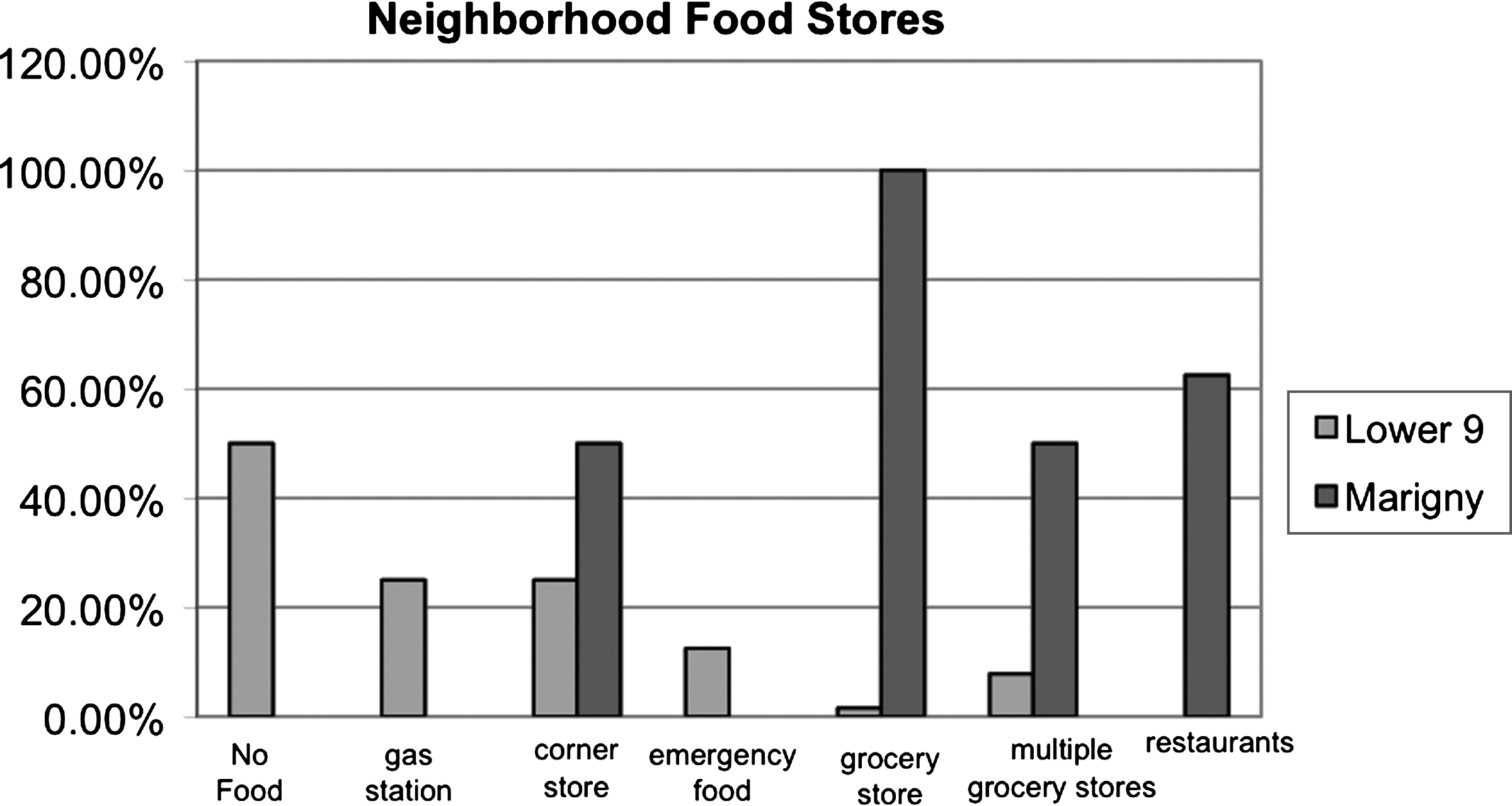
Food Study: Comparison of neighborhood food stores in the Lower 9th Ward and Faubourg Marigny.

Food Study: Comparison of food availability in the Lower 9th Ward and the Faubourg Marigny.
In addition to loss of food stores and restaurants, direct food access declined as well. Fishing and gardening are not as popular as they were before the storm due to the many tasks involved in rebuilding. In addition, gardens and fruit trees were largely wiped out because of Katrina. In the Food and Historical studies, elderly respondents reported that they no longer can start and maintain a garden because of their health and rebuilding needs. Only 5% of survey participants currently use the BBWT, mostly for fishing and relaxing, and some continue to fish in the local waterways and occasionally fish in the Mississippi River (BBWT Study). However, 47% of the BBWT study respondents perceive the fish to be unsafe to eat (BBWT Study). Thus, testing and information about the safety of eating fish and the water quality are a crucial part of wetland restoration efforts.
When asked how access to food has changed in the Lower 9th Ward since Hurricane Katrina, every participant in the Food Study replied that either their distance to groceries increased and/or the prices went up. Miss L summed up that access to food, “was a lot easier to get before the storm, and the prices changed dramatically since the storm … You're gonna to pay a lot more than you did prior to Katrina.” Furthermore, stores in the neighborhood do not offer a full selection of items. Residents are limited to “ … can goods, candy, coffee, potato chips, liquor, and stuff like that. No one in the Lower 9 offers fresh vegetables, so that's out.” To find a selection of fresh vegetables and cooking ingredients, residents reported that they go to Winn Dixie or Wal-Mart, located 4 and 8 miles from the Lower 9th Ward, respectively. Miss Y, a lifelong resident of the Lower 9th Ward described her shopping choices, “I'm trying to survive off $1,100 a month retirement. Prior to Katrina I worked at Charity Hospital for 26 and a half years. The hospital was destroyed. So was my job. I was not ready to retire. So it's not much I can do off $1,100 a month. It's how much gas can I put in the car, what kind of foods I can buy. I have to pay my car insurance, my utilities, my rent, so I have to pace myself at buying food” (Food Study).
Restoring The Environment: Feeding The People
The Lower 9th Ward has a well-documented history of community activism and civic engagement; residents have fought for services, funds, and civil rights (Greater New Orleans Community Data Center, Lower 9th Ward Snapshot), and evolved into a well-organized political powerhouse (Germany, 2007; Landpair, 2007). Community leaders are now engaged in a wetland restoration project that seeks to restore the BBWT to a cypress swamp for improved environmental protection that could consequently improve direct food access. Miss P, a community leader and advocate for sustainable redevelopment, describes wetland restoration as, “something that is very, very close and dear to so many people because that goes straight to the heart of environmental justice, its about protecting the community but it's also about really connecting to a beautiful area that is a huge resource for us aside from the protection aspects.” (Historical Study). Asked if they would use the restored BBWT in the future, 63% of respondents said they would and not just for fishing; 20% reported they would use it for relaxation and 17% for hiking and walking (BBWT Study). These results indicate that the residents in the Lower 9th Ward would like to use the BBWT mostly as a source of food, but also for recreation and exercise. Miss P goes on to discuss the need to connect the neighborhood with its ecosystem services, “The birds are important too, and the fish we eat … it's all interrelated … we began making that connection in peoples' minds, and that is something we've got to continue.”
The restoration of BBWT has created a diverse partnership of community leaders and citizens working with local and national non-profit and environmental organizations on projects aimed at environmental health, community-food security, and preventative health. While community leaders and environmental groups want the BBWT restored for the storm protection benefits, residents are more concerned with rebuilding needs. In 2008, 57% of survey residents reported that wetland restoration was “important” for the long-term survival of New Orleans.
Despite comments in the Historical Study that there were generational differences in the use and perceptions of the BBWT, results from chi-squared analysis of data from the BBWT Study indicate that age has no influence on support for its restoration at the 5% level of significance. Age was split into two categories: 45 and younger and 46 and older. This split was identified by the respondents based on their perception of generational changes in the neighborhood. Responses regarding the importance of restoration were then compared across the two age groups, i.e., those who thought restoration was important vs. those who did not consider it important or did not know (BBWT). As a point of comparison, 60% of the respondents viewed housing as the city's main rebuilding priority. Thus, respondents view restoration as approximately the same level of importance as the immediate need for housing.
Community leaders, such as Mr. M, are worried about how to address these basic needs. “This neighborhood, you talking about between the elderly and the handicap and the disabled, 70% of the neighborhood. And if you don't give them fresh vegetable and produce … they are gonna die … because they are not able to afford it” (Historical Study). Mr. M's solution is to use the land that is currently abandoned to produce food. His plan would call for testing the soil and remediation if necessary. This would accomplish the dual goals of providing healthy food for the elderly while engaging the community in environmental education.
Several of the organizations and individuals who are involved in restoration are also exploring community gardens and urban agriculture projects within the vicinity of the BBWT. Numerous community garden projects are underway in the Lower 9th Ward, such as maintaining the Chartes Street community garden and the newly constructed children's education garden at the home of Miss A. Make it Right and Global Green, two sustainable housing projects involving Brad Pitt, include rain gardens and community gardens in their plans.
Community leaders have expressed an interest in using the low-lying portions of the Lower 9th Ward for community agriculture as part of the BBWT restoration project. These advocates for restoration and food security are linking food and the environment by pointing to the tradition of utilizing the environment for food and the need for environmental education. This direct connection to the environment increases resident awareness of the local ecology. Increasing scientific knowledge about the safety of their surroundings makes residents more effective advocates for the neighborhood.
There was a concern voiced by older respondents in Historical Study that the younger generations did not make the same connection between food and the environment. Gardening among the younger generation was never popular, and residents reported that people 40 and younger preferred to buy their food instead of growing or catching it (Historical Study). Mr. M, a community leader in his mid-fifties, explains the change in food culture, “the difference between me … and the kids today, the kids think a tomato grows in Wal-mart or Winn Dixie. They have no idea it grows on a vine” (Historical Study). This feeling was echoed by other respondents. Miss A explained her decision to start a community garden in her yard as a way to reconnect children with the environment. “You talk about the global warming, and they [children] may hear that. But it doesn't faze them because they are not intimately involved in the process. So it has to be somebody that is close to the environment. … And you have to make them aware of this” (Historical Study). Although age was not a factor for fishing use in the BBWT, these quotes illustrate the connection between food and the environment for the older generation that may be lacking among younger residents, despite similar levels of support for restoration.
An additional public health benefit of restoration comes from the empowerment associated with community action. Mr. M emphasized the way actively participating in the rebuilding has helped him through the challenges facing his community. “I was sitting around waiting for the cavalry to come. And what I've learnt, we have to become the cavalry. And this has been healing for me to embrace this project because I was a very, very bitter person.” Mr. M's experience demonstrates how community involvement can actually improve mental health through a sense of control and collaboration.
Conclusions
Wetland restoration is necessary for the long-term survival of New Orleans to mitigate future storm damage and flooding. Currently, dozens of groups are working on restoration proposals that range from using treated waste-water to supply fresh water and nutrients to carbon sequestration. What is lacking from these proposals is the impact of restoration on the traditional use of BBWT as a food source for residents.
This case study reveals that community leaders realize the power of combining the Lower 9th Ward's tradition of hunting, fishing, and gardening with the historic civic involvement to encourage residents to advocate for environmental restoration. They also believe it will increase residents' access to food. Thus, wetland restoration provides an example of combining the interests and resources to strengthen the environmental justice and community food security movements that could result in an opportunity for a broader and linked community development or “empowerment based discourse” called for by Gottlieb and Fisher (1996).
According to the New Orleans Food and Farm Network (2009), “food justice” means that “[e]very household should have an accessible way to get healthy food onto their table, which suits the family's culture, regardless of race or income.” Using this definition, a healthy natural environmental is necessary for food justice in the Lower 9th Ward because wetland degradation has diminished access to culturally relevant food that was traditionally procured from surrounding wetlands and grown within the neighborhood. Findings indicate that residents see wetland restoration as important, but are focused on immediate needs. Access to traditional food sources has the potential to reconcile these priorities.
The restoration of BBWT offers numerous environmental justice and food security benefits. Restoring the area to a cypress swamp could decrease the neighborhood's vulnerability to future storms. Protecting, monitoring, and encouraging the use of BBWT for direct food acquisition can provide residents with much-needed healthy food. Environmental education and recreation opportunities are additional benefits.
Food is important to the culture of New Orleans. It has both a symbolic and functional role in rebuilding. During tragedies such as Hurricane Katrina, culture provides support and continuity and can help with healing (Ford, 2007). Cuisine, and especially the locally abundant food, is a way to align various rebuilding interests and celebrate New Orleans. When asked about the role of food in New Orleans culture Mr. B exclaimed “Oh, Lord, huge!” and went on to say that food is “like a sign of affection. It's like I love you.”
Footnotes
Acknowledgments
The authors thank Pam Dashiell (1948–2009) for her hard work and dedication to the long-term sustainability of the Lower 9th Ward. They also acknowledge the contribution and friendship of the Lower 9th Ward residents and community leaders for inviting the authors into the community and for participating in this research. Financial assistance for this research has been generously provided by the McKnight Foundation, The Nelson Institute for Environmental Studies, and the Doris Duke Charitable Foundation. Additional assistance and leadership has been provided by Dr. Herb Wang. The students involved in the University of Wisconsin-New Orleans Sustainable Restoration Workshop have contributed to this work through countless hours of research and collaboration.