




Abstract
Abstract
Many communities impacted by environmental injustice, including the disproportionate burden of unhealthy land uses and environmental hazards and lack of access to health-promoting infrastructure, can trace these disparities to inequities in planning, zoning, and community development. These inequities and infrastructure disparities occur in many places because of the way that governance structures, particularly municipal police powers, are applied differentially and how in some cases these legal structures drive segregation and the production of riskscapes. In this article, we will describe how municipal police powers have led to zoning and planning inequities particularly around the use of planning designations (specifically extra-territorial jurisdiction (ETJ) and joint planning agreements) in the state of North Carolina. These planning designations can create patterns of environmental inequality whereby some communities may have infrastructure disparities including a lack of basic amenities (e.g., sewer and water infrastructure, paved roads, good housing stock, and healthy ecosystem services). We will then discuss the work of the West End Revitalization Association (WERA), a community-based environmental justice organization located in Mebane, North Carolina, as an example of a community burdened by ETJ abuses and the lack of basic amenities which impacts community health. We will detail WERA's efforts to increase the participation of its residents in civic engagement through the use of the administrative complaint process and development and implementation of the community-owned and managed (COMR) approach. We will then discuss the deficiencies of the COMR approach and its utility in other community contexts. In addition, we will describe how federal statutes and legal structures have gaps that also lead to underserved communities not having basic amenities and how some federal laws do not adequately protect the health of communities with infrastructure disparities. Finally, we will discuss the utility and integration of WERA's community engagement model and principles into national environmental justice policy.
Introduction
In this article, we will describe how governance structures, particularly municipal police powers, have led to zoning and planning inequities particularly around the use of planning designations (specifically extra-territorial jurisdiction and joint planning agreements) in the state of North Carolina. These planning designations can create patterns of environmental inequality whereby some communities may have infrastructure disparities including a lack of basic amenities (e.g., sewer and water infrastructure, paved roads, good housing stock, and healthy ecosystem services). We will then discuss the work of the West End Revitalization Association (WERA), a community-based environmental justice organizations located in Mebane, North Carolina, as an example of a community burdened by extraterritorial jurisdiction abuses and the lack of basic amenities which impacts community health. We will also detail WERA's efforts to increase the participation of its residents in civic engagement through the development of the community-owned and managed (COMR) approach, examine flaws in this approach, and discuss the utility and integration of this model in national environmental justice recommendations.
Land Use Regulations, Extra-Territorial Jurisdiction, and Annexation in Nc
In North Carolina, Article 6, Sections 153A-121 to 153A-140 and Article 8, Sections 160A-174 to 160A-193 of the North Carolina General Statutes (GS) provide delegation and exercise of the general police power for counties and cities, respectively. Through these statutes, each governmental entity is given general ordinance-making power, territorial jurisdiction of ordinances, the power to enforce ordinances, and the ability to abate public health nuisances. These statutes provide the basic foundation for counties and cities to govern and regulate land uses in North Carolina. In addition, Article 18, Sections 153A-320 to 153A-349 and Article 19, Sections 160A-360 to 160A-392 establish the specific powers of counties and cities to perform and regulate land use planning and community development. Their land use planning powers include: 1) zoning, 2) subdivision regulation, 3) enforcement of the state building code, 4) minimum housing code regulation, 5) historic district regulation, 6) historic properties designation and regulation, 7) community development projects, 8) acquisition of open space, 9) floodway regulation, and 10) soil erosion and sedimentation control regulation. 13
GS 160A-360, the main statute that establishes municipal territorial jurisdiction for land use and development regulations, provides that all land use regulatory powers may be exercised by any municipality within its corporate limits. The 1923 zoning enabling act granted cities the authority to zone within their corporate limits. 14 As zoning and other land use regulations first came into widespread use in North Carolina in the 1920s, counties remained primarily uninvolved in land use planning and regulation. 14 After World War II, irregular development and growth occurred near the outer boundaries of cities and in unregulated areas outside of corporate limits. 14 This resulted in North Carolina authorizing “perimeter zoning,” which is currently known as extraterritorial jurisdiction (ETJ) in NC land use statutes. 14
GS 160A-360 allows municipalities to control zoning, planning, land use regulations, and community development in areas outside their corporate limits. GS 160A-360 states that a city may exercise these powers within the ETJ, a defined area outside of its corporate limits depending upon the town's population size.13–14 In 1971, the current ETJ statute was adopted. 14 GS 160A-360(a) provides that the extraterritorial jurisdiction may extend up to one mile from the city limits for municipalities with populations of less than 10,000.13–14 After county approval is secured, cities with populations between 10,000 and 25,000 and populations greater than 25,000 may extend their ETJ up to two miles and three miles, respectively.13–14 GS 160A-360 also requires that county agreement be secured for the extension of a city's ETJ into any area wherein the county is enforcing three major types of land use and development regulations: 1) zoning, 2) subdivision regulations, and 3) the state building code.13–14 However, when a county is not enforcing the three major types of land use and development regulations in the target area, the city can unilaterally exercise its ETJ authority. 13–14
In addition, a city exercising its ETJ authority must expand membership of both its planning and adjustment boards to include representation from populations who reside in the city's ETJ.13–14 In 1996, a law was passed to require proportional representation from the ETJ population on the two boards. 14 The law states that if there are an insufficient number of “qualified” ETJ residents to sit on the boards, then other county residents may be appointed to the boards.13–14
A city normally exercises its ETJ authority in order to expand its ability to grow and develop and applies public health, city planning, and development regulations in the extraterritorial areas to make the areas more congruent with areas in the corporate limits.13–15 Annexation laws provide legal authority for municipalities to annex unincorporated ETJ areas. As result of annexation, ETJ areas are able to receive basic services including: 1) water supply and distribution, 2) sewage collection and treatment, 3) law enforcement, 4) fire protection, 5) solid waste collection and disposal, and 6) street maintenance and improvement. 15 Only cities are authorized under GS Chapter 160A to provide the full range of basic amenities. Counties can provide some services, but are not authorized to provide street maintenance and improvement. Under GS Chapter 160A, the city can use four methods to annex nearby unincorporated areas: 1) annexation by legislative act, 2) voluntary annexation of areas contiguous to the city boundaries, voluntary annexation of non-contiguous nearby areas (e.g., satellite annexation), and 3) involuntary annexation. 15 The aforementioned planning, development, and land use laws give cities a lot of power and discretion to positively or negatively impact the growth, health, and sustainability of ETJ neighborhoods.
ETJ, Joint Planning Agreements, and Basic Amenities
Residents who live in the ETJ in unincorporated areas do not have the power to vote or control land use decisions which acts to disenfranchise them.16–24 Local officials can use the ETJ as de facto residential segregation to marginalize historical neighborhoods of color and place noxious land uses in the ETJ which can impact the health of affected residents.16–24 Recent literature emphasizes the importance of racial residential segregation in leading to differential exposure of populations of color to health risk factors such as pollution from locally unwanted land uses as well as differential access to resources such as basic amenities, medical services, and good housing stock.25–27 This emerging area of research indicates that segregation acts as a major driver of environmental health disparities.25–29 Joint Planning Agreements (JPAs) are similar to ETJ statutes; however, the agreements give municipalities the power to extend their town planning jurisdictions beyond the boundaries imposed by state law for ETJs. This planning designation exacerbates environmental and public health risks by giving municipalities expanded authority to place unhealthy land uses in JPA neighborhoods that have underlying vulnerabilities due to their lack of basic amenities and other municipal services.
ETJ and JPA neighborhoods across NC often lack basic amenities which has negative consequences for neighborhood health. Basic amenities include public regulated drinking water and sewer services, garbage collection, paved roads, gutters and ditches for stormwater management, accessible roads, street lighting, and sidewalks.16–24 Basic amenities provide the health-promoting infrastructure that act as the building blocks for neighborhoods. Neighborhoods with limited basic amenities may have higher levels of neighborhood stress, lower quality of life, less vitality, lower property values, greater exposure to negative living environments, and worse health outcomes.16–24 For example, literature has shown that living in communities without infrastructure and resources (e.g., sidewalks, parks, grocery stores, good transportation networks) impacts healthy food access, physical activity opportunities, and obesity and diabetes prevalence.30–36 Also, residents without access to regulated drinking water and sewer services who use private septic systems for sewage disposal purposes and well water as their primary drinking water source may have septic system failure.21–23 Fecal wastes can contaminate groundwater supplies leading to human exposure to enteric microbes.19–24
Due to ETJ and JPA zoning practices that exclude “underserved” and “unserved” communities from public, regulated sewer and water services, we believe these populations may not only have increased exposure and health risks from fecal microbes, but these health risks are exacerbated by the presence of noxious land uses (i.e., landfills, wastewater treatment plants, hazardous waste sites) in their neighborhoods.16–23 In the following sections of the article, we will discuss these issues from the perspective of the West End Revitalization Association (WERA).
Use of Administrative Complaint Process to Advance Environmental Justice
The West End Revitalization Association is a community-based environmental justice organization, in Mebane, NC, that organized in 1994 to address environmental justice issues in poor, underserved neighborhoods of color located in Mebane's ETJ. More details about the history of the organization, demographics, and environmental justice research efforts can be found in previously published papers.16–20 The primary issue that residents of the West End, White Level, Buckhorn/Perry Hill communities organized around was the planning of a highway, the 119-bypass for over fifteen years without the input of local stakeholders who would be impacted by the building of the highway. Residents became more civically engaged in the process of planning the highway through the organizing efforts of the West End Revitalization Association. 18 Unlike other environmental justice organizations and non-profit groups who have sued to block the siting of a locally unwanted land use (LULU), WERA submitted a civil rights complaint in 1999 to the Department of Justice (DOJ) and the Environmental Protection Agency (EPA).
This civil rights complaint was developed to document environmental injustice associated with the lack of basic amenities and services for low-income black residents in Mebane, NC and discriminatory planning of a large highway without input from impacted African-American residents. In the process of doing background research on the use of local police powers associated with zoning and planning, WERA found that there were gaps in the laws and few protections for unincorporated neighborhoods, neighborhoods found in the ETJ of North Carolina towns and cities, zoning and planning inequities, and a lack of oversight and accountability from state and federal agencies. WERA discovered that when federal funds were being used for projects such as the building of a highway, that federal entities such as the Department of Commerce, Department of Transportation (DOT), Department of Agriculture, Housing and Urban Development, Department of Interior and others have to officially sign off on the project depending on its location (i.e., built in an urban area, rural area, near a national park, etc.) and go through a particular checklist to ensure that there isn't discrimination or a disproportionate impact of the project on a racial/ethnic population as denoted by Title VI of the Civil Rights Act. In the case of the 119-bypass, the rules of this legal process known as transactional law were not followed. The local municipality, state and federal DOT, and other agencies were not in compliance with Title VI.
In addition, the power of the complaint focused on the lack of basic amenities in the underserved African-American enclaves located primarily in Mebane's ETJ. Residents were asked to submit information on the state of their sewer and water infrastructure. Many residents described not having access to city regulated sewer and water services and having primarily private septic systems and well water as their drinking water source. Information was also included that detailed the poor state of these systems and the inability of residents to connect to city sewer and water lines. In the case of West End households, some residents were across the street from the sewage treatment plant, but were unable to connect to sewer lines due to ETJ redlining and costs. WERA used the fact that residents didn't have proper access to sewer and water infrastructure and the possible contamination of well water supplies as threats to public health. These threats to public health were violations of the Safe Drinking Water Act. Therefore, the power of the complaint extended beyond the transactional law issues and to the lack of basic amenities as an environmental justice issue. WERA was able to leverage a secondary issue (lack of basic amenities) to block the building of the highway (the primary issue) by stating that the building of the highway would disproportionately impact communities of color that were already burdened by infrastructure disparities specifically the lack of basic amenities.
Due to these violations, the building of the highway was put under a moratorium in 1999. In addition, because the City of Mebane had not been complying with civil rights laws or federal requirements when it obtained community development block grants (i.e., applied for grants that they stated would be used in low-income communities of color, but used the funding for other purposes), the town was blocked from receiving funding for police cars and other services until it addressed the previous inequities. WERA also discovered that some households that did have municipal or county sewer and water infrastructure had pipes that were not up to code (e.g., proper width, material, depth in the ground) as described in NC Administrative Code 15A.18A.1900. In addition, residents lived on dirt roads that were not paved, but should have been paved because of their location in the city's jurisdiction and many roads did not have the proper ingress or egress as specified by transportation codes. WERA's process of examining the intersection of environmental statutes, building codes, the EJ Executive Order, and Title VI of the Civil Rights Act in the context of the exposure-disease paradigm has been framed as legal or legal-based epidemiology. 20
We found that WERA's administrative complaint leveraged the synergy of the new levels of community engagement around planning inequities and interest in environmental justice and environmental racism which led to the organization's ability to receive a high level of participation in and support for the complaint. This level of engagement in community-driven efforts was solidified and expanded through the development and implementation of the community-owned and managed research (COMR) approach which will be discussed in the next section of the article.
Use of the COMR Approach to Increase Community Engagement
WERA developed the COMR approach as an alternative to traditional research approaches 16–19,24 in order to increase community engagement of local residents in research activities that could lead to solutions to the lack of basic amenities and infrastructure disparities in their neighborhoods. WERA's approach emphasizes principles of community ownership and management at each research stage to address locally relevant EJ and public health issues.16–19,24 We suggest that the COMR model is an appropriate model to address EJ issues because it emphasizes the credibility and capacity of the community to lead, develop, manage, and sustain a research agenda following a public health justice perspective.16–19,24 The COMR model is founded on the belief that the EJ community should be the center of knowledge production, learning, action, and social change instead of academia in order to sustain long-term reduction and removal of environmental health hazards.16–19,24
The COMR model stresses: 1) the identification of community-based organizations (CBOs) with the demonstrated ability to build capacity and organize around local EJ issues; 2) funding the CBO directly as principal investigator (PI) and project manager; 3) a shift to a process where CBOs prioritize research objectives; 4) the CBO's selection of university “experts” whom they identify as open to working on the EJ-related health issue and sign a Memorandum of Agreement (MOA); and 5) community management of the research process to foster sustainability of EJ solutions.16–19,24 These five principles are the foundation for a research framework that we believe takes traditional community-engagement research one step farther—to a paradigm in which the community has true control, ownership, and power in the research process.16–19,24 More information on the COMR approach can be found in previously published literature.16–19
There are potentially a few minor problems with the COMR approach. It assumes that community-based organizations that work on environmental justice issues have the capacity to own and manage the research process. Due to organizational capacity issues, many community groups do not have the training or fiscal capacity to manage large federal or foundation grants or adhere to the reporting requirements of federal grants particularly EPA grants. In addition, COMR assumes that community-based organizations desire the responsibility of acting as PI or project manager. In some cases, community groups may be comfortable with sharing responsibility with their academic partners and this may be a more appropriate arrangement due to burden of the project activities or manpower available to community-based organizations. In WERA's case, COMR has been operationalized in several ways: 1) WERA has acted as PI/project manager on several EPA grants including an EJ small grant and collaborative problem-solving model grant; 2) WERA has acted as a co-PI on a NIEHS Partners in Research grant—it may be more appropriate for the groups to share the responsibility with their academic partners; and 3) WERA has acted as a co-investigator on other grants. Even though COMR emphasizes the importance of the community group acting as PI or project manager, it is as important for the contextual expertise of impacted residents to be respected during all phases of the research process and implementation of solutions. This will help organizations participating in community-engaged research including COMR to feel empowered and go through the process of training necessary to develop their organizational capacity and skill sets needed to act as PI or project manager, if they so desire.
An additional problem with the COMR approach is the focus on community data ownership. WERA developed the approach in reaction to negative relationships it had with academic and legal experts who desired to extract data from the community which they plan to leverage to obtain resources to benefit their institutions and careers (see previously published papers on this issue for more information). At the core of COMR, is a focus on data ownership that follows a corporate model of intellectual property rights. This approach to data ownership and management has been very helpful to WERA in helping it to protect the confidentiality of impacted residents, increase the security of the data for research purposes, and enhance the utility of the data for translation into interventions and solutions. To outside parties, the language of data ownership by a community group following the model of corporate entities may be seen as not very inclusive, open, or democratic which may negatively impact a community group's ability to develop relationships with partners who see the ownership issue as a barrier to collaboration and bidirectional decision making about the research process. We acknowledge that the scientific racism and colonialism experienced by WERA may not be experienced by every community group who participates in a community-university partnership. Therefore, since COMR is a flexible, context-specific model, these groups should be able to adapt and operationalize the COMR approach to the context of their particular community-university partnership experience to make their research process more inclusive, open, and democratic.
Furthermore, COMR assumes to a certain extent that academia may not be properly suited to lead research endeavors in communities impacted by environmental injustice, infrastructure disparities, and environmental health disparities because of underlying privilege and power imbalances between academic institutions and community groups. Many academic institutions receive a large amount of federal funding with very little going directly to their community partners due to the commodification of science and knowledge production in the U.S. This funding disparity and the tenure and promotion system that emphasizes publishing research that may have little direct impact on solving social issues including environmental justice and health problems creates distrust and tension between community and academic partners. However, this tension may be present in other types of community-engaged research such as community-based participatory research (CBPR). In all forms of community-engaged research partnerships including COMR, both community and academic partners must acknowledge and address the privilege and power imbalances up front, maintenance of relationships must occur on a continuous basis, and a renewal of commitment to use collected information to solve problems must occur on a continuous basis as well. Even with its minor deficiencies, WERA's use of the COMR approach has been effective in helping many WERA residents receive basic amenities. The involvement of community members in COMR has also led to more grassroots activism and leadership. The level of knowledge of WERA residents on EJ issues, basic amenities, and environmental laws and public health statutes has increased based on the increased level of participation of affected residents in WERA's organizational meetings, local town council meetings, and other research efforts.
Further Discussion of Research Results in Relation to Laws and Statutes
During its research on the history of local neighborhoods, WERA leaders heard stories about discrimination, the lack of community development and healthy planning by local and county governments in WERA neighborhoods, racial covenants, and the inability of WERA residents to get connected to sewer and water mains present in their neighborhoods or to get the local government to extend that infrastructure into their neighborhoods. As previously mentioned, WERA surveyed residents and found that many were low-income. Thus, most residents do not have the money to connect to sewer and water mains because of the high fees charged by the local government. 20
We argue that these infrastructure disparities cannot be addressed equitably or justly through current federal and state laws and regulations. The Safe Drinking Water Act (SDWA) regulates the level of contaminants such as microbial pathogens (e.g., Total Coliform Rule, viruses), turbidity, and chemicals that pose a public health risk. The groundwater rule was added to the SDWA to establish a risk-targeted approach to target ground water systems that are susceptible to fecal contamination, instead of requiring disinfection for all ground water systems (GWSs). This is because the SDWA's Total Coliform Rule (TCR) (54 FR 27544), a major component of the SDWA established to preserve drinking water quality and protect public health, does not adequately address fecal contamination at the ground water source. Moreover, no federal regulation exists that requires either monitoring of ground water sources or corrective action upon finding fecal contamination. This is a major problem for WERA residents because most use a private individual well as their potable water source and septic tanks as their sewage treatment system.
WERA found that the SDWA only applies to public water systems which cater to more than 25 people or have at least 15 connections. None of the public health protections present in the SDWA apply to WERA residents or other populations on well water. In addition, drinking water rules found in G.S. 130A-315 and rules related to wells (i.e., Well Construction Act of 1967) have done little to protect ground water sources or public health. Only recently with the passage of House Bill 2873 will there be rules for new private wells to be inspected and have monitoring for 17 contaminants including microbial pathogens and turbidity. Unfortunately, this bill only covers new wells, it does not protect the two million NC residents with older wells, and it does not address the equity and justice issues associated with historical planning disparities in underserved communities.
In addition, North Carolina has regulations on septic tanks in NC Administrative Code 15A.18A.1900. These regulations state that septic tanks which “create or have created a public health hazard or nuisance by surfacing of effluent or discharge directly into groundwater or surface waters, or that are partially or totally destroyed must be repaired” within a certain time period. Non-compliance may lead to an injunction against homeowners that have septic tanks that are not working properly or possible condemnation of residential properties whose septic wastes are posing a threat to public health. Therefore, for WERA neighborhoods, these regulations are problematic. Through its research efforts, WERA found that a large number of households (∼500) had septic tanks that were not working properly. Under the current regulations, homeowners could be forced to fix or replace their tanks which could be very expensive, connect to nearby sewer lines which could also be expensive, or have their property potentially condemned. The lack of flexibility in the regulations and provisions for state financial resources to defray the costs of fixing or replacing septic tanks or connecting to nearby sewer lines, made WERA residents less likely to seek assistance from local public health officials. These reasons are also part of WERA's rationale for keeping all of the household survey and surveillance data private and de-identified to ensure that the confidentiality of residents is protected.
Community Facilitated Strategies in Federal EJ Recommendations
Omega Wilson, President of the West End Revitalization Association, joined the National Environmental Justice Advisory Council (NEJAC) in 2007 due to his effective participation in community engagement activities with federal agencies, researchers, legal experts, and local government. Mr. Wilson's primary focus during his tenure on NEJAC (2007 to 2010) was to advocate for the inclusion of community-driven collaboration recommendations such as community-owned and managed research approach and principles into environmental justice policies. During his tenure on NEJAC, Mr. Wilson primarily worked as a part of the goods movement workgroup. 37 The EPA defines goods movement as the distribution of freight (including raw materials, parts, and finished consumer products) by all modes of transportation, including marine, air, rail, and truck. Goods movement or freight facilities include seaports, airports, and land entry ports (e.g., border crossings), rail yards/ rail lines, highways and highly-trafficked roads used by cargo trucks, and warehouse and distribution centers. 37 In June 2007, EPA requested that NEJAC “provide advice and recommendations about how the Agency can most effectively promote strategies, in partnership with federal, state, tribal, and local government agencies, and other stakeholders, to identify, mitigate, and/or prevent the disproportionate burden on communities of air pollution resulting from goods movement” due to major public health concerns associated with exposure to diesel exhaust and related air pollution. This pollution contributes to negative respiratory conditions including asthma, cardiovascular disease (CVD), cancer, and premature mortality. 37
Mr. Wilson helped to introduce new principles, language, and policies on how community engagement should occur in reducing the impacts of goods movement activities. Mr. Omega Wilson brought the experience of impacted African-American stakeholders not being involved in the decision-making process associated with the planning of the 119-bypass in Mebane, NC and related environmental decision making on basic amenities and infrastructure issues as explained earlier in the article to the workgroup. Mr. Wilson developed the language on community-facilitated strategies (CFS) found in Section 3.1.2. of the 2009 report entitled: Reducing Air Emissions Associated With Goods Movement: Working Towards Environmental Justice. 37 This report is under review by Lisa Jackson, EPA administrator, for approval as new EPA policy.
CFS include a variety of approaches such as community-owned and managed research and the CPS model that actively involve the public, especially disadvantaged communities, in the decision-making process in order to achieve environmental justice for the communities and tribal territories likely to be impacted by proposed and existing goods movement related activities. 37 This decision making includes, but is not limited to, agreements, development of incentive programs, and other interactions and policy activities. The goods movement report notes that CFS should: 1) support robust empowerment and capacity building of the “community voice” necessary to reach across cultural, language, socio-economic, and technological barriers and 2) follow well established moral and ethical principles that ensure transparency and accountability in addressing prioritized goods movement activities. 37 Figure 1 displays the community-facilitated strategies paradigm.
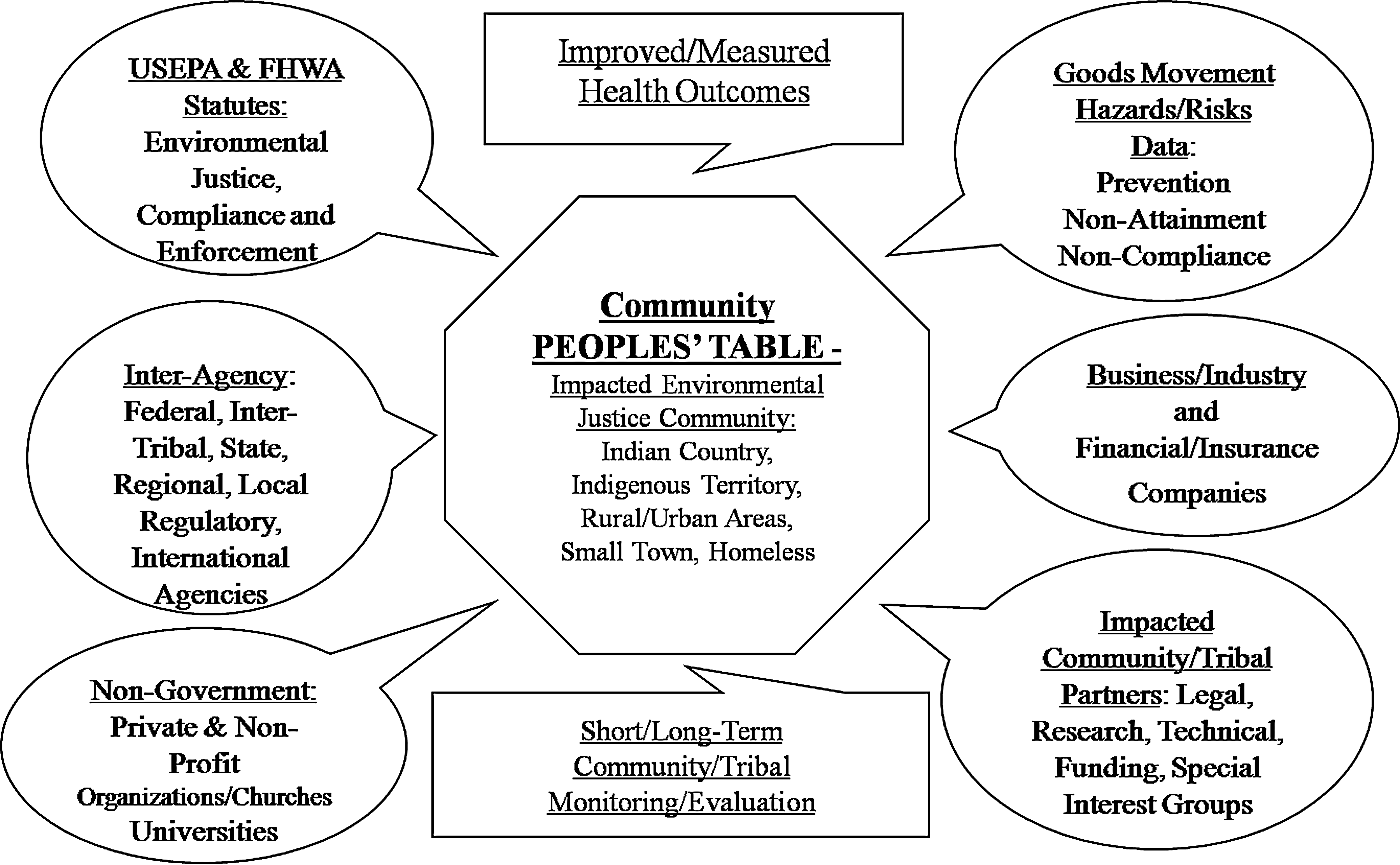
Community facilitated strategies paradigm.
Principles and framework
Residents have a right to voice their opinions and exercise their rights when a decision is going to impact them or their community. The “Community Peoples' Table” represents steps for building credibility and trust, for impacted areas, in a goods movement process that should foster transparency and accountability in policy and decision making. Robust collaborative partnerships with impacted residents can help enlighten the decision-making process with community-based knowledge. The goal is to capitalize on existing community and tribal resources by building positive and effective working relationships between decision-making agencies and those communities and stakeholders adversely impacted by goods movement activities. Key principles guiding action in this area are: 1) affected communities should be fully engaged at the local, regional, and national level, during the planning, development, and implementation stages of goods movement-related decisions and 2) funding must be provided to plan, strategize, and implement actions at the community and tribal levels to mitigate health and environmental impacts from goods movement. Equity in funding and parity in the management of collaborative problem-solving initiatives at the community and tribal level will ensure short and long-term measurable outcomes and sustainability. 37 For more information on specific recommendations to the EPA on integrated CFSs into goods movement decision-making processes, please see the Goods Movement report. 37
We believe that the inclusion of the COMR approach and principles in community facilitated strategies paradigm and language in NEJAC EJ recommendations for goods movement and other EPA priorities has the potential to benefit communities impacted by environmental injustice. These recommendations can lead to the development of policies that helped impacted communities be more engaged in local environmental decision making and be empowered to have more control over land use planning and infrastructure development.
Conclusions
The efforts of the West End Revitalization Association to combat environmental injustice in North Carolina have shined light on how governance structures including the use of police powers by municipalities and planning designations such as ETJ and JPAs can lead to infrastructure disparities, a lack of basic amenities, and environmental injustice in underserved communities. Our discussion of basic amenities disparities, specifically access to public, regulated drinking water and sewer services, paving of dirt roads, and installation of gutters for stormwater management, has expanded the environmental justice lexicon. ETJ zoning and the lack of basic amenities have received little coverage in the EJ movement. This oversight has been detrimental to the health and sustainability of poor, underserved African-American communities in North Carolina and throughout the South. Through the use of an administrative complaint and development and implementation of the community-owned and managed research (COMR) approach, the West End Revitalization Association was able to increase community engagement on environmental justice issues that impacted low-income residents of color in Mebane, NC. Even though COMR has some underlying assumptions that may undermine its effectiveness for some community groups, it's use led to positive change for WERA neighborhoods and may have positive benefits for other communities impacted by environmental injustice as seen by its inclusion in national environmental justice recommendations from NEJAC to the U.S. Environmental Protection Agency.
Footnotes
Author Disclosure Statement
Drs. Wilson and Heaney and Mr. Wilson have no conflicts of interest or financial ties to disclose.