




Abstract
Abstract
The social, environmental, and economic benefits of urban trees can mitigate many negative aspects of the built environment. As such, disparities in the benefits of tree cover as a result of class or racial segregation represent an environmental injustice. Quantifying the ecosystem services of urban tree cover is increasingly being used to advocate urban greening and sustainability programs. Although some cities have instituted programs promoting tree planting on public property, these programs most often take place in the context of promoting sustainability rather than addressing structural inequities in the built environment. Using field and U.S. Census data, computer modeling, and online resources, this study analyzed variables such as urban forest cover, diversity of trees, and tree condition among White, African American, and Hispanic areas in Miami-Dade County. We then use these results to quantify two key ecosystem services from urban trees and discuss how their provision can be inequitable. This might be due to a failure to first address structural inequities that have been recognized by the environmental justice movement.
Introduction
Environmental justice in urban built environments
Over time, activists and authors recognized that environmental quality in built environments is also a component of environmental justice and scholarship on this topic increased in prevalence and scope, reflecting inequities from the local to global levels. 4 Amenities in the urban built environment include natural settings such as green spaces, parks, community gardens, and remnant natural areas. This urban greening has tangible benefits beyond recreational aspects. 5 Yet, in some urban communities of color or low income, these green spaces have been sacrificed for other uses or sold to private interests for development. 6
Tree cover distribution and its benefits
Urban forests are influenced by human values, urban morphology, and climate. 7 Tree cover, an easily measured indicator of urban forest amount and diversity can vary according to land tenure patterns, socioeconomic status, and land use. 8 Tropical wind storms can also affect the structure and composition of coastal urban forests. 9 This distribution in urban tree cover can, in turn, affect the amount and type of ecosystem services—the ecological functions of urban tree cover that are directly enjoyed, consumed, or used to produce specific, measurable human benefits. Thus, if the amount, type, condition, and distribution of urban forests vary across an urban landscape, so will ecological function and the subsequent provision of ecosystems services by urban trees.
The ecosystem services provided by urban tree cover can generally be classified as social, environmental, and economic. Exposure to even a minimal amount of nature can produce a range of social and health benefits. For example, researchers have demonstrated the following specific outcomes when particular populations have access to natural elements: confined people, such as inmates and hospital patients, experience better health outcomes; 10 adults and children demonstrate better cognitive abilities; 11 and public housing tenants report having more ability to cope with major life stressors such as poverty, the threat of violence, and raising children in impoverished conditions. 12 Furthermore, analyses of crime records and aerial photographs of vegetation cover show that property and violent crimes are lower where the amount of vegetation is higher. 13
Several communities have quantified their urban tree cover and the ecosystem services it provides. Recently available urban forest functional models use site-specific tree, weather, pollution, and built environment data to estimate several ecosystem services and environmental benefits. Urban forests can moderate temperature and microclimate, reduce storm water runoff, and minimize soil erosion. 14 Economically, tree cover can reduce building energy use and increase property values. 15 Ecosystem services by definition are human-centered, so different perceptions and attitudes of humans determine the type and level of benefits they receive from trees. Since urban areas have high densities of humans with different interests, cultures, and attitudes; measuring the social ecosystem services such as psychological and recreation benefits can be complex. Similarly, measuring economic and some environmental functions such as urban heat island (UHI) effects is complex because of regional-scale climate issues common to coastal areas. 16 Various elements of the urban built environment, such as buildings, roadways, and decreased vegetation contribute to warmer temperatures in the urban environment. 17 Epidemiological studies on urban climate and health have assessed individual or neighborhood attributes that are markers of susceptibility. 18 Other research using existing models has documented the ability of urban tree cover to improve air quality and influence human health and well-being. 19 For example, a recent study found that carbon dioxide emission offsets by urban forests in Miami-Dade are comparable to other carbon dioxide emission reduction policies. 20 Research has also shown that in some cities, there have been disparities in the distribution of urban tree cover and this has been linked to structural characteristics inherent to urban political economy, such as social class and housing tenure. 21
The current research explores what can occur when urban tree cover, a component of a sustainable urban built environment, is equitably distributed yet divorced from consideration of social, physical, and economic inequities that have been recognized as components of environmental justice. 22 In the case of Miami-Dade County, Florida, we posit that the result has been inequities in the ecosystem services provided from urban tree cover.
The objectives of this article are to analyze tree cover in urban areas of Miami-Dade County using random field plots, an available urban forest ecosystem service model, Geographical Information Systems, and World Wide Web resources to specifically assess if: 1) there are inequities in the distribution of tree cover, and 2) there are statistical differences in the amount and condition of urban forests in White, Hispanic, and African American communities. Through this analysis the article will examine disparities in ecosystem services provided by tree cover in the three areas. The article concludes with a discussion of the possible connection between environmental justice factors such as housing tenure, housing condition, and initial levels of pollution with disparate provision of ecosystem services.
Methods
From January through May 2008, a random sampling design was used to establish 229, 0.04 ha plots in a 1,273 km2 study area in urban Miami-Dade County, Florida, to capture tree cover, amount, and distribution. Plots represented a range of land uses such as: residential, industrial, commercial, agricultural, green areas/parks, and transportation. Data were collected on these plots for each tree and palm with a minimum diameter at 1.3 meters above ground surface (DBH) of 2.54 cm. 23 Tree and palm data measured included: species, number of stems, DBH, total height, crown diameter and exposure, crown dieback (a surrogate for tree condition), and indication if the tree or palm was located on a street right-of-way and managed by the municipality or other public entity. Tree, shrub, and ground surface covers were also estimated on site. Direction and distance of trees relative to residential buildings of less than two stories high and within 50 meters was also measured.
The field data were used in the Urban Forest Effects (UFORE) model to estimate: urban forest structure characteristics (e.g., number of trees, tree density, tree condition, etc) and Leaf Area Index (LAI), leaf area—and their Standard Error of the estimate (SE)—as well as a tree diversity index. The urban forest structure data was also used in the UFORE model to quantify two commonly measured ecosystem services: air pollution removal by tree cover and energy savings due to tree shade. 24 Since urban forest amount, condition, and diversity determine these ecosystem services, we statistically analyzed for differences in: leaf area, leaf area index, number of tree species, and number of street trees with the Kruskal-Wallis statistical test and a p < 0.10 using the Statistical Application Software (SAS) procedure NPAR1WAY; while the number of street trees and tree condition were tested using a Chi-square test and the FREQ procedure in SAS.
Community stratification
Using a Geographical Information System, plots were post-stratified using U.S. Census block group data, 25 and spatial interpolation using Kriging, 26 a geostatistical tool. First, zonal statistics were used to generate areas of predominantly (e.g., greater than 50% of the population) White, Hispanic, and African American populations. Secondly, ordinary Kriging was used to interpolate the percentage of total population data and create a prediction surface by weighting the spatial relationship among the sample data location and prediction location. 27 Plots located on agricultural land uses and areas outside the central urbanized core of the County were not analyzed leaving a total of 157 plots for subsequent analysis.
Air pollution removal
Plot field data, hourly weather, and air pollution (e.g., particulate matter less than 10 microns, sulfur dioxide, carbon monoxide, nitrogen dioxide, and ozone) in the UFORE model were used to quantify air pollutant removal by tree cover. Leaf on and off season, percent evergreen composition of the city's vegetation, and periods of precipitation in which dry deposition is set to zero, were also considered in estimating air pollution removal. Average hourly pollutant removal per square meter of tree cover was then multiplied by total tree cover (m2) to estimate pollutant removal by vegetation across the three areas. The monetary benefits of air pollution removal by trees in the UFORE model are the reduced negative externalities to health care associated with air pollution. Specific methods and assumptions for estimating air pollution removal by tree cover and health benefits are described in Nowak et al. 28
Energy effects
The UFORE model also estimated the effects of urban trees on building energy use. Tree effects on building energy usage in Miami-Dade County were estimated using information from McPherson and Simpson. 29 The amount of energy use savings due to tree cover was calculated using the cardinal direction of a tree relative to a building, climate characteristics, leaf type (e.g., deciduous or evergreen), and percent cover of buildings and trees on a sample plot. Default values established by McPherson and Simpson for the Gulf Coast region of the United States were used for climate and building characteristics, shading, and climate energy effects. Shading effect values, or the effects of tree shading on building energy usage, were adjusted according to building vintage types as set by McPherson and Simpson. The effects of an individual tree on cooling energy use (TE) were adjusted based on actual tree canopy condition. Total tree cover effects on local climate estimations were based on an actual sample plot's building and tree cover, tree condition, and procedures from McPherson and Simpson's Gulf Coast United States region values and their interpolation of formulas relating tree cover effects on climate. Total energy effects were calculated by summing the individual trees effects for the energy use for cooling and building characteristics. Effects were adjusted for building, climate effects, and electrical cooling emission factors. 30
Results
Urban forest structure characteristics for predominantly White, African American, and Hispanic areas in Miami-Dade County were quantified. Table 1 indicates that White areas had greater tree species diversity, more trees per hectare, and greater leaf area. Hispanic areas had more trees per hectare and greater LAI than African American areas; while African American areas had lower tree diversity than Hispanic and White areas. However, leaf area (p > 0.19) and the number of tree species (e.g., 25, 55, and 34 for African American, Hispanic, and White areas, respectively) were not statistically different (p > 0.34) among the three areas but LAI was statistically different (p < 0.04) (Table 1). A greater LAI indicates a denser tree canopy and can be used to infer increased air pollution removal and shading potential. Conversely, African American and Hispanic areas had more street trees than did White areas (Fig. 1), however the number was not statistically different (Chi-square of 0.2).

Percent of total street trees in predominantly White, Hispanic, and African American areas in Miami-Dade County, Florida.
SE, Standard Error; *Statistically different p < 0.10; **Not statistically different p < 0.10.
Tree cover distribution
Studies often use percent tree cover as a basis for quantifying the amount of green space in a city. Figure 2 displays the variability of tree, shrub, grass, impervious, and potential plantable space among the three areas. White areas had more tree (17.8%) and shrub (7.8%) cover than Hispanic and African American areas and Hispanic areas had slightly more impervious surfaces. African Americans areas, however, had more potential planting space for trees (27.1%; SE 5.1%) versus Hispanic and White areas (21.8%; SE 3.1% and 16.3%; SE 5.4%, respectively). These results are in line with other studies that have indicated that African American areas in general have less tree cover than White areas, despite impervious cover being similar in all three areas. 31
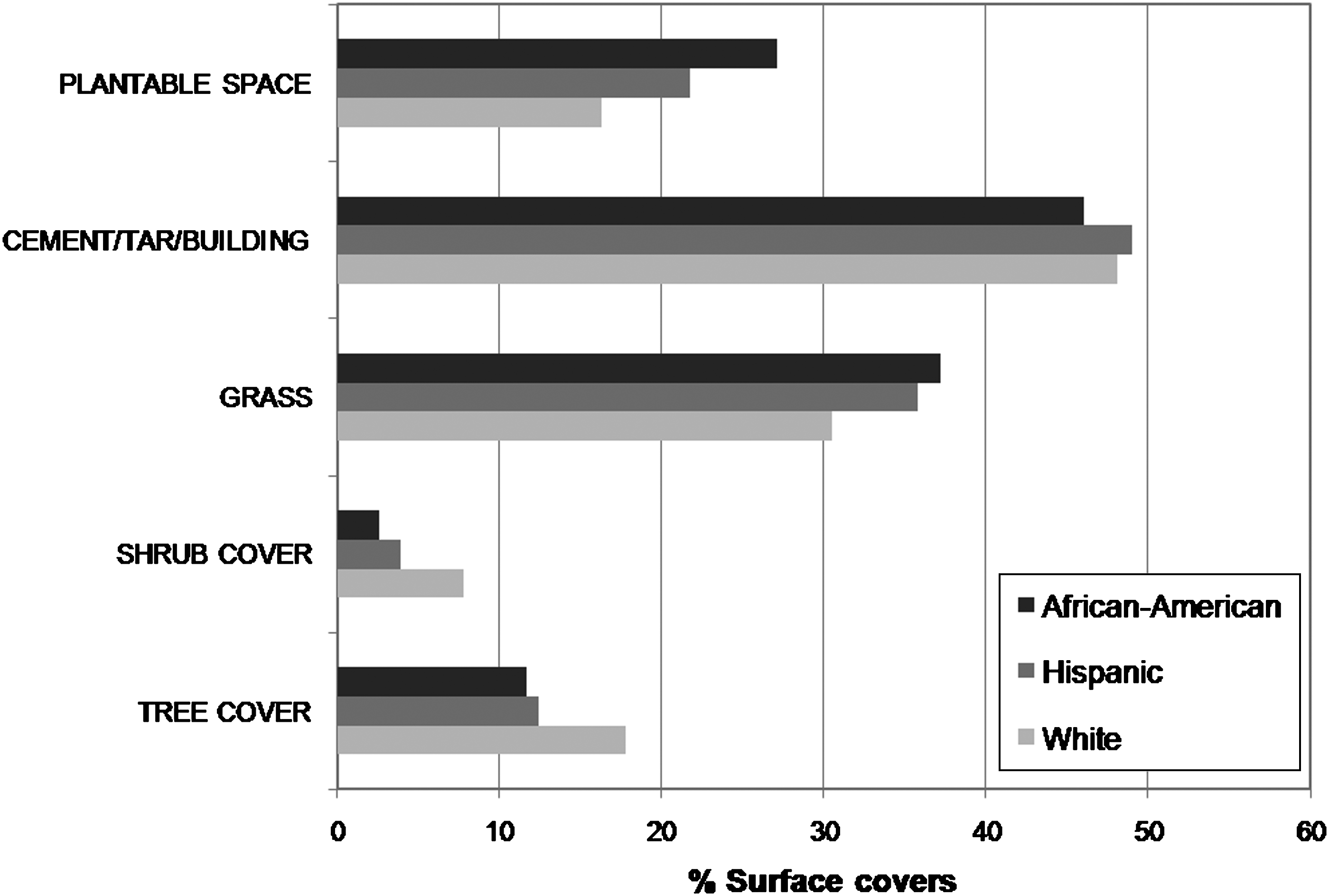
Percent tree, shrub, grass, impervious, and plantable space in White, Hispanic, and African American areas in Miami-Dade County.
Tree diversity and condition
Tree species composition is another indicator that can be used to assess the quality of a community's urban forest. Tree composition, or diversity, is the number of tree species for a given area, but in general a greater number of tree species indicates more resilience against pests and diseases, resistance to hurricane impacts, and provides a wider suite of ecosystem services. 32 The number of tree species was not statistically different among areas (p > 0.34) but we used the Simpson Diversity Index to better measure tree composition, or the total number of tree species and the proportion of each species in the three areas. Based on the Simpson index for tree diversity, White areas and Hispanic areas had an index of 11.1(Table 1). Therefore, these two areas were more diverse in terms of tree species than African American areas which had an index of 8.8.
Tree condition is one of the most important indicators of urban forest quality, which is influenced by tree management and investment of resources towards their care. In all, tree condition was consistent among the three areas, however, the number of trees in good to excellent condition was statistically greater in Hispanic areas (Chi-square of 0.047) (Fig. 3). The low number of poor condition trees is likely due to the 2004–2005 hurricanes that removed dead and dying trees and branches consistently across the entire county.

Tree condition in White, Hispanic, and African American areas in Miami-Dade County.
Tree benefits: Air pollution removal and energy use
The higher the concentrations of pollutants, and/or greater the leaf area, the more pollutants can be removed by trees. This relationship can therefore be used to determine the pollution removal effects of increasing vegetation cover in any part of, or the entire County. Pollution removal by trees was quantified in the UFORE model for the three areas and then used to estimate the economic benefits to human health. Hispanic areas received the most air pollution removal and benefits while African American areas receive the least (Fig. 4). African American areas also receive substantially less energy savings in residential buildings that are two stories or less. This is a result of tree placement, relative to buildings and subsequent shading since the UFORE model does not account for non-residential and buildings more than two stories high (Fig. 5).
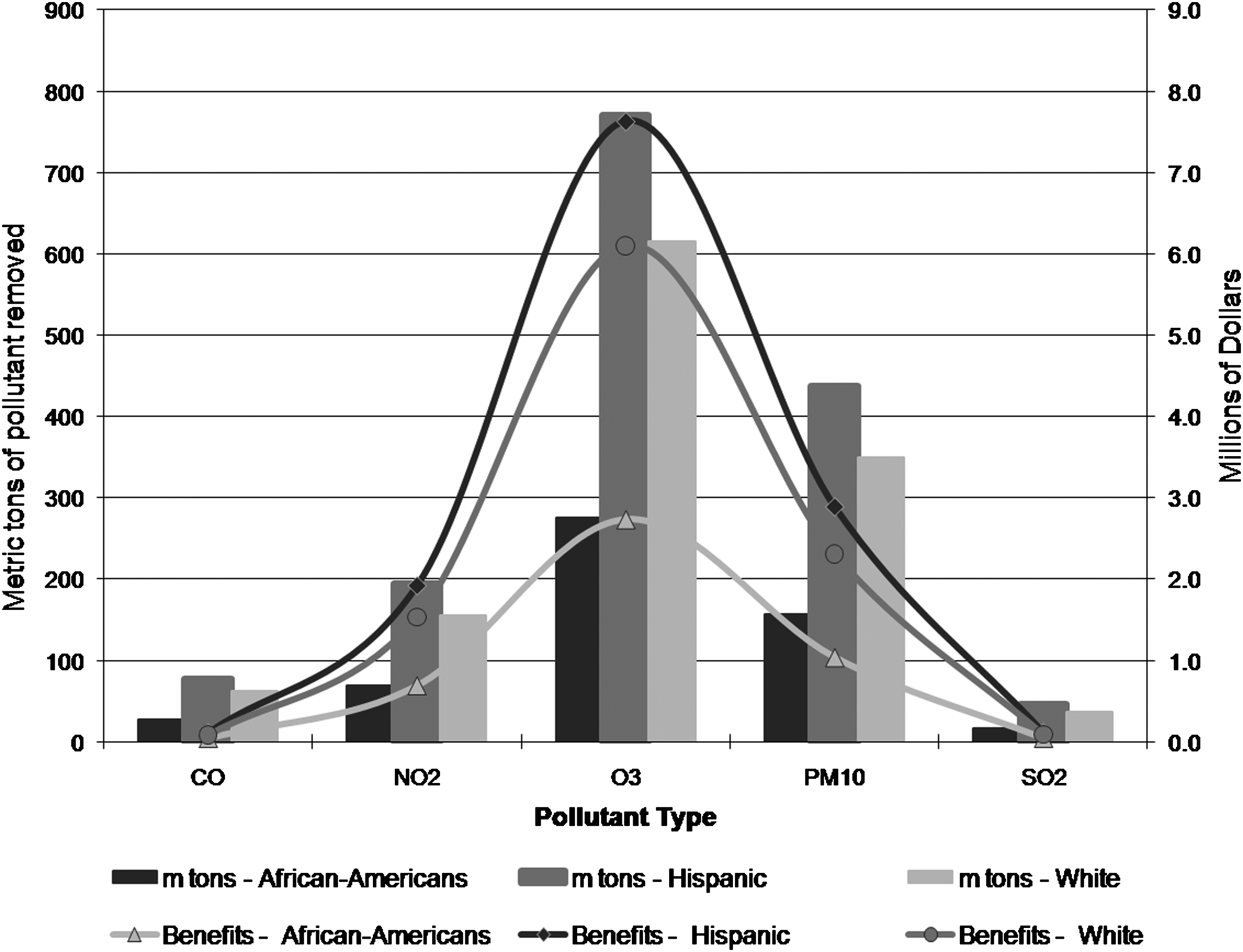
Air pollution removal by trees and related economic health benefits in White, Hispanic, and African American areas of Miami-Dade County.

Residential energy saving from trees in buildings less than two stories high in White, Hispanic, and African American areas in Miami-Dade County.
Discussion And Conclusion
Management decisions by officials in public areas and preferences of private home-owners have contributed to current urban forest structure and composition, 33 which then provides ecosystem services such as air pollution removal and energy savings. In general, results show that White areas in Miami-Dade County have greater tree density, greater tree and shrub cover, more tree diversity, and the greatest amount of energy savings due to trees. Hispanics however, had greater individual tree LAI, more trees in excellent condition, more impervious surfaces, and more air pollution removal than the other two groups. African Americans had the lowest tree density and LAI, lowest tree and shrub cover and diversity, and received the least amount of ecosystem services in terms of air pollution removal and energy savings than did the other two groups. However, African Americans had the greatest amount of potential planting space for trees and the greatest percentage of street trees. Clearly, more research is needed to determine the exact reasons for these disparities. But the environmental justice implications of both the potential contributing factors and the significance of the outcomes are worth examining.
Given our results, a potential cause of the uneven distribution of urban tree cover might be the differing levels of control over the physical environment due to housing tenure. 34 A 2007 housing study showed that of all housing occupied by Blacks in the Miami-Fort Lauderdale metropolitan area, 42% were renters and 58% were homeowners; of all housing occupied by Hispanics of any race, 38% were renters and 61% were homeowners; and of all housing occupied by Whites, 29% were renters and 71% were homeowners. 35 The differing amounts of urban forests and disparities in ecosystem services may occur if tenants are less able or likely to plant and maintain trees than homeowners. Tenants do not own and control the property on which they reside and often have higher rates of mobility than homeowners. They may be less able to take on the long-term maintenance that trees require and less likely to benefit from doing so. Thus, an area heavily populated by tenants may lack tree cover and may not benefit the same from the ecosystem services that urban trees provide. 36
Even if residents have the ability to control and improve the physical environment, they may be constrained by income. People without the financial means to purchase and maintain trees are limited in their ability to maintain tree cover. 37 The 2007 housing study showed that 19% of Black-occupied households and 16% of Hispanic- (of any race) occupied households in the Miami-Ft. Lauderdale metropolitan area, were reported to be below the poverty level. 38 Low-income communities are more dependent on public investment in urban forests (e.g., street trees), but the cost of planting and maintaining trees on private property may be outside municipal budgets or priorities and these communities must then rely on nonprofit investment. 39
The results of this study show that even when some urban forest structure indicators (i.e., leaf area) are not strikingly different among areas, the ecosystem services provided by trees can be limited and inequitable. Although not directly measured or analyzed here, one potential contributing cause is that if housing is substandard it may be also be less energy efficient. 40 Substandard housing in poor and minority neighborhoods has been considered an environmental injustice, as it can result from inequitable social processes, such as a landlord's disinvestment in a rental property or a low-income homeowner's having to make decisions between making home repairs and paying bills. 41 The 2007 study showed that 6% of Black-occupied housing, 5% of Hispanic- (of any race) occupied housing, and 3.5% of White-occupied housing reported moderate or severe physical housing problems such as missing roofing material, holes in the roof, boarded up windows, and broken windows. 42
Another potential reason for the inequitable distribution of ecosystem services from trees may be higher initial levels of pollution in minority neighborhoods. Although initial levels of pollution in this study were not measured directly, the disproportionate distribution of environmental hazards, including industrial facilities and criteria air pollutants, in minority and low-income neighborhoods has been well documented elsewhere. 43
In summary, housing tenure, low income, substandard housing, and higher initial levels of pollution are examples of inequities in the built environment that have been recognized by environmental justice activists and scholars as problematic for communities of low-income and color. These inequities not only directly affect the abilities of these communities to improve their environment, but can also mediate the benefits communities receive from urban tree cover. Furthermore, they merit attention as constituent of historical disenfranchisement, even when policies are facially neutral, as they have disproportionate impacts on minority and low-income populations. 44
Some cities have recognized the social, environmental, and economic benefits of trees toward urban sustainability and have implemented programs and policies encouraging tree planting and maintenance on public and private property. 45 But merely planting trees is not enough and without consideration of structural inequities a disconnect between sustainability and environmental justice can occur. 46 Efforts towards urban sustainability must incorporate principles of environmental justice, such as striving to achieve equity in the urban built environment. Failing to do so risks maintaining the biases reflected in this study—an inequitable distribution of environmental benefits. With a projected 2050 world population of more than nine billion, and with well over half of that population living in urban areas, how we create and manage our built environments should incorporate matters of social, economic, and environmental justice to achieve true sustainability.
Footnotes
Author Disclosure Statement
The authors have no conflict or interest or financial ties to disclose.
1
Charles Lee, “Environment: Where We Live, Work, Play and Learn,” Race, Poverty & the Environment 6 (1996), 6; David H. Getches and David N. Pellow, “Beyond ‘Traditional’ Environmental Justice,” in Justice and Natural Resources: Concepts, Strategies, and Applications, eds. Kathryn M. Mutz, Gary C. Bryner, and Douglas S. Kenney (Washington, DC: Island Press, 2002), 3–6.
2
Lisa Schweitzer and Max Stephenson Jr., “Right Answers, Wrong Questions: Environmental Justice as Urban Research,” Urban Studies 44 (2007), 319–337; Robert Gottlieb, Forcing the Spring: The Transformation of the American Environmental Movement. (Washington, DC: Island Press, 2005), 6–10.
3
Robert Bullard, “Residential Segregation and Urban Quality of Life,” in Environmental Justice—Issues, Policies, and Solutions, ed. Bunyan Bryant (Washington, DC: Island Press, 1995), 76; Robert Bullard, “Anatomy of Environmental Racism and the Environmental Justice Movement,” in The Environment and Society Reader, ed. R. Scott Frey (Boston: Allyn & Bacon, 2000), 98; Sacoby M. Wilson, Christopher D. Heaney, John Cooper, and Omega Wilson, “Built Environment Issues in Unserved and Underserved African American Neighborhoods in North Carolina,” Environmental Justice 1 (2008), 64. From a legal perspective, one of the rare environmental justice cases to be successfully brought on an equal protection basis was Dowdell v. City of Apopka, in which the plaintiffs, African American residents in a low-income and underserved area of Apopka, Florida, sued the city, its mayor, and four council members for disparate provision of basic municipal services including water hookup, street paving, and storm water drainage. The court found that there was “ample evidence in this case of the correlation between municipal service disparities and racially tainted purposiveness to mandate a finding of discriminatory intent.” Dowdell v. City of Apopka, 698 F.2d 1181, (11th Cir. 1983).
4
Samara Swanston, “Environmental Justice and Environmental Quality Benefits: The Oldest, Most Pernicious Struggle and Hope for Burdened Communities,” Vermont Law Review 23 (1999), 545–555; Julian Agyeman, Robert D. Bullard, and Bob Evans, “Exploring the Nexus: Bringing Together Sustainability, Environmental Justice and Equity,” Space and Polity 6 (2002), 83–84; Sacoby Wilson, Malo Hutson, and Mahasin Mujahid, “How Planning and Zoning Contribute to Inequitable Development, Neighborhood Health, and Environmental Injustice,” Environmental Justice 1 (2008), 213.
5
For example, recent studies have considered environmental qualities in the built environment that encourage physical activity and that lead to differences in health between racial groups. B. Giles-corti, M. H. Bromhall, M. Knuiman, C. Collins, K. Douglas, K. Ng, A. Lange, and R.J. Donovan, “Increasing Walking—How Important is Distance To, Attractiveness, and Size of Public Open Space?” American Journal of Preventive Medicine 28 (2005), 169–176; Bethany B. Cutts, Kate J. Darby, Christopher G. Boone, and Alexandra Brewis, “City Structure, Obesity, and Environmental Justice: An Integrated Analysis of Physical and Social Barriers to Walkable Streets and Park Access,” Social Science and Medicine 69 (2009), 1314–1322.
6
In one New York case, residents brought a civil rights lawsuit against the city after their community gardens were auctioned, arguing that the action disparately impacted a community of color by depriving it of ecological space and social and economic resources. Residents testified about the environmental benefits of the garden, including open space, environmental education, intergenerational and intercultural exchange, trees and flowers, and reduced crime and urban decay. In a survey of what youth would be doing instead of tending to these New York community gardens, a respondent stated “some would be in jail, most wouldn't know what to do in our neighborhood.” Another woman from Brooklyn stated that the green space “changed our mischievous teenagers to a positive junior block association, learning parliamentary procedure and conducting their own meetings instead of destroying the block.” The city countered the residents' protest by categorizing the lands as “vacant” and stating that building housing developments in the place of the hundreds of gardens would yield significant benefits. The city had the additional advantage that the development of housing was in accordance with the zoning of the neighborhood as residential/commercial. Despite the fact that the residents could not assert a legally cognizable right to the gardens, scholarship in this area identifies the tangible benefits of trees on leisure, property values, and pollution reduction as well as positive impacts on human health. Sheila Foster, “The City as Ecological Space: Social Capital and Urban Land Use,” Notre Dame Law Review 82 (2006), 535–536.
7
D.J. Nowak, “Understanding the Structure of an Urban Forest,” Journal of Forestry 92 (1994), 42.
8
D.J. Nowak, “Understanding the Structure of an Urban Forest,” 43; L.R. Iverson and E.A. Cook, “Urban Forest Cover of the Chicago Region and its Relation to Household Density and Income,” Urban Ecosystems 4 (2000), 118–121; M.A. Pedlowski, V.A. Carneiro Da Silva, J.J. Corabi Adell, and N.C. Heynen, “Urban Forest and Environmental Inequality in Campos Dos Goytacazes, Rio de Janeiro, Brazil,” Urban Ecosystems 6 (2002), 15; M. Zhao, F. Escobedo, and C. Staudhammer, “Spatial Patterns of a Subtropical Urban Forest: Implication for Land Tenure and Invasives,” Urban Forestry and Urban Greening, 9 (2010), 206–207.
9
M.L. Duryea, E. Kampf, R.C. Littell, and C.D. Rodríguez-Pedraza, “Hurricanes and the Urban Forest: II. Effects on Tropical and Subtropical Tree Species,” Arboriculture and Urban Forestry, 33 (2007), 83–84, 94; F. Escobedo, C.J. Luley, J. Bond, C. Staudammer, and C. Bartel, “Hurricane Debris and Damage Assessment for Florida Urban Forests,” Arboriculture and Urban Forestry, 35 (2009), 103–104.
10
E.O. Moore, “A Prison Environment's Effect on Health Care Service Demands,” Journal of Environmental Systems 11 (1981), 17–34; R. Ulrich, “View through a Window May Influence Recovery from Surgery,” Science 224 (1984), 420–421; S. Verderber and D. Reuman, “Windows, Views, and Health Status in Hospital Therapeutic Environments,” The Journal of Architectural and Planning Research 4 (1987), 120–133.
11
Carolyn M. Tennessen and Bernadine Cimprich, “Views to Nature: Effects on Attention,” Journal of Environmental Psychology 15 (1995), 77–85; Nancy Wells, “At Home with Nature: Effects of ‘Greenness' on Children's Cognitive Functioning,” Environment and Behavior 23 (2000), 775–795.
12
Frances Kuo, “Coping with Poverty: Impacts of Environment and Attention in the Inner City,” Environment and Behavior 33 (2001), 5–33.
13
Frances Kuo and William Sullivan, “Environment and Crime in the Inner City: Does Vegetation Reduce Crime?” Environment and Behavior 33 (2001), 343–367.
14
E.G. McPherson, J.R. Simpson, P.J. Peper, and Q. Xiao, “Benefit-Cost Analysis of Modesto's Municipal Urban Forest,” Journal of Arboriculture 25 (1999), 243–244; D.J. Nowak and J.F. Dwyer, “Understanding the Benefits and Costs of Urban Forest Ecosystems,” in Handbook of Urban and Community Forestry in the Northeast, ed. J.E. Kuser (New York: Kluwer Academic/ Plenum Publishers, 2000), 27–38.
15
E.G. McPherson et al., “Benefit-Cost Analysis of Modesto's Municipal Urban Forest,” 235; L.Tyrvainen and A. Miettinen, “Property Prices and Urban Forest Amenities,” Journal of Environmental Economics and Management, 39 (2000), 205; D.J. Nowak and J.F. Dwyer, “Understanding the Benefits and Costs of Urban Forest Ecosystems,” 27–34. Conversely, tree cover can have detrimental effects on air quality, human health, and city finances through allergenic effects of pollen, the emission of volatile organic compounds (VOCs) that can eventually form ozone, and the costs of removing fruit and tree debris from property and repairing any damage caused by trees.
16
The UHI effects pertain to air temperatures that are 3.5 to 4.5 degrees higher than in nearby rural areas. An early awareness of the warmth of cities was observed by lexicographer Noah Webster, who noted that when the temperature in the coldest areas of New York were at 40 degrees Fahrenheit, the temperature a mile outside the city would be below freezing and thick ice would appear on the ponds. William B. Meyer, “Urban Heat Island and Urban Health: Early American Perspectives,” The Professional Geographer 43 (1991), 38–48. The UHI effect is thought to increase by roughly one degree per decade from the additive effects of global warming. A. Voogt, “Urban Heat Island,” in Encyclopedia of Global Environmental Change, ed I. Douglas (New York: John Wiley & Sons, 2002), 660–666.
17
Buildings and roadways absorb sunlight and reflect heat. Vegetation supplies shade and holds cooling moisture. Increased urban temperatures can lead to potentially calamitous heat events. Morbidity and Mortality Weekly Report, “Heat-Related Deaths—United States, 1999–2003,” MMWR 55 (2006), 796–798. Jason Coburn, “Cities, Climate Change and Urban Heat Island Mitigation: Localising Global Environmental Science,” Urban Studies 46 (2009), 416–417.
18
Frank C. Curriero, Karlyn S. Heiner, Jonathan M. Samet, Scott L. Zeger, Lisa Strug, and Jonathan A. Patz, “Temperature and Mortality in 11 Cities of the Eastern United States,” American Journal of Epidemiology 155 (2002), 80–87; Sharon L. Harlan, Anthony J. Brazel, Lela Prashad, William L. Stefanov, and Larissa Larsen, “Neighborhood Microclimates and Vulnerability to Heat Stress,” Social Science & Medicine 63 (2006), 2847–2850. The highest morbidity and mortality appear to take place in cities and to have a disparate impact on marginal communities: the poor, people of color, and the elderly. Congressional Black Caucus Foundation, African Americans and Climate Change: An Unequal Burden (Washington, D.C: Redefining Progress, 2004).
19
D.J. Nowak, “Understanding the Structure of an Urban Forest,” 43; E.G. McPherson et al. “Benefits-Cost Analysis of Modesto's Municipal Urban Forest,” 235; D.J. Nowak and J.F. Dwyer, “Understanding the Benefits and Costs of Urban Forest Ecosystems,” 27–32.
20
E.G. McPherson et al., “Benefit-Cost Analysis of Modesto's Municipal Urban Forest,” 235; D.J. Nowak and J.F. Dwyer, “Understanding the Benefits and Costs of Urban Forest Ecosystems,” 26; G. McPherson and J.R. Simpson, “Potential Energy Savings in Buildings by an Urban Tree Planting Programme in California,” Urban Forestry & Urban Greening 2 (2003), 73–86; F. Escobedo, S. Varela, M. Zhao, J.E. Wagner, and W. Zipperer, “Analyzing the Efficacy of Subtropical Urban Forests in Offsetting Carbon Emissions from Cities,” Environmental Science and Policy 13 (2010), 366.
21
Nikolas Heynen, “The Scalar Production of Injustice within the Urban Forest,” Antipode 35 (2003), 991. Harold A. Perkins, Nik Heynen, and Joe Wilson, “Inequitable Access to Urban Reforestation: the Impact of Urban Political Economy on Housing Tenure and Urban Forests,” Cities 21 (2004), 291–292.
22
Robert R. Keuhn, “A Taxonomy of Environmental Justice,” Environmental Law Reporter 30 (2000), 10681–10682. Nikolas Heynen, “The Scalar Production of Injustice with the Urban Forest,” 990–991.
23
M. Zhao et al., “Spatial Patterns of a Subtropical Urban Forest: Implication for Land Tenure and Invasives,” 208.
24
D.J. Nowak, D.E. Crane, J.C. Stevens, and M. Ibarra, “Brooklyn's Urban Forest,” in: USDA Forest Service General Technical Report (Newtown Square, PA, 2001), 6–22. The Urban Forest Effects (UFORE) model was developed by the USDA Forest Service to assist communities in quantifying the structure and services of their urban forests. The model is currently being utilized in several cities across the United States.
25
United States Census Bureau, “Density Using Land Area, For States, Counties, Metropolitan Areas, and Places,” United States Census Bureau,
26
J. Maantay, “Mapping Environmental Injustices: Pitfalls and Potential of Geographic Information Systems in Assessing Environmental Health and Equity,” Environmental Health Perspectives 110 (2002), 165; F. Escobedo et al., “Analyzing the Efficacy of Subtropical Urban Forests in Offsetting Carbon Emissions from Cities,” 5.
27
K. Johnston, J.M.V. Hoef, K. Krivoruchko, and N. Lucas, Using ArcGISTM Geostatistical Analyst (Redlands, CA: ESRI Press, 2001).
28
D.J. Nowak et al., “Brooklyn's Urban Forest,” 6–15. During periods of precipitation, pollution is removed via wet deposition, therefore dry deposition is not occurring and pollution removal by vegetation is set to zero in the model. Pollution removal by tree cover is modeled as a function of tree cover and tree leaf area.
29
E.G. McPherson et al.,“Benefit-Cost Analysis of Modesto's Municipal Urban Forest,” 237.
30
E.G. McPherson et al., “Benefit-Cost Analysis of Modesto's Municipal Urban Forest,” 237; F. Escobedo et al., “Analyzing the Efficacy of Subtropical Urban Forests in Offsetting Carbon Emissions from Cities,” 366.
31
Nikolas Heynen, “The Scalar Production of Injustice within the Urban Forest,” 991.
32
M. Zhao et al., “Spatial Patterns of a Subtropical Urban Forest: Implication for Land Tenure and Invasives,” 206.
33
M. Zhao et al., “Spatial Patterns of a Subtropical Urban Forest: Implication for Land Tenure and Invasives,” 206; D.J. Nowak, “Understanding the Structure of an Urban Forest,”42–43.
34
A legacy of discrimination in housing practices and the continuation of discriminatory lending practices has led to ethnic and racial disparities in housing tenure, segregated neighborhoods, and declining urban infrastructure—all of which have been described as components of environmental justice. Robert Bullard, “Residential Segregation and Urban Quality of Life,” 76–81; Douglass S. Massey and Garvey Lundy, “Use of Black English and Racial Discrimination in Urban Housing Markets,” Urban Affairs Review 36 (2001), 452–455.
35
U.S. Census Bureau, Current Housing Reports, Series H170/07-28, American Housing Survey for the Miami Metropolitan Area: 2007.
36
Harold A. Perkins and Nik Heynen, “Inequitable Access to Urban Reforestation: The Impact of Urban Political Economy on Housing Tenure and Urban Forests,” Cities 21 (2004), 293–294; Nik Heynen et al. “The Political Ecology of Uneven Urban Green Space: The Impact of Political Economy on Race and Ethnicity in Producing Environmental Inequality in Milwaukee,” Urban Affairs Review 42 (2006), 14–15. In order to obtain maximum benefits, such as tree shade and energy use reduction from tree cover, residents must consider factors like appropriate species, sizes, and location from homes.
37
Nik Heynen et al., “The Political Ecology of Uneven Urban Green Space: The Impact of Political Economy on Race and Ethnicity in Producing Environmental Inequality in Milwaukee,” 12–13.
38
U.S. Census Bureau, Current Housing Reports, Series H170/07-28, American Housing Survey for the Miami Metropolitan Area: 2007.
39
Nik Heynen, Harold A. Perkins, and Parama Roy, “The Political Ecology of Uneven Urban Green Space: The Impact of Political Economy on Race and Ethnicity in Producing Environmental Inequality in Milwaukee,” 5. Opportunities do exist in Miami-Dade through several organizations that focus on improving the urban environment through projects such as tree-planting. Online research reveals details about these organizations. TREEmendous Miami is a non-profit community-based organization that provides public education about community trees and opportunities for volunteer planting and maintenance of trees. Citizens for a Better South Florida, a non-profit environmental education organization, hosts the Urban Greening and Community Forestry Program that includes projects to increase the numbers of trees planted in public and private spaces and to maintain and protect existing trees, particularly in neighborhoods with the lowest tree canopy. Programs such as Roots in the City and Operation Green Leaves promote beautification projects in specific minority neighborhoods. The Grove Tree Man Trust, in Coconut Grove, provides assistance to the City of Miami, Miami-Dade County, and the State of Florida by monitoring the planning and development process to ensure environmental resources are considered; assisting with the development and implementation of existing legislation on public and private trees; and purchasing and distributing local trees to homeowners. TREEmendous Miami.
40
James Krieger and Donna L. Higgins, “Housing and Health: Time Again for Public Health Action,” American Journal of Public Health 92 (2002), 758–760; Rick Nevin and David E. Jacobs, “Windows of Opportunity: Lead Poisoning Prevention, Housing Affordability, and Energy Conservation,” Housing Policy Debate 17 (2006), 185–186.
41
Sara E. Grineski and Alma Angelica Hernández, “Landlords, Fear, and Children's Respiratory Health: An Untold Story of Environmental Injustice in the Central City,” Local Environment 15 (2010), 199–216.
42
U.S. Census Bureau, Current Housing Reports, Series H170/07-28, American Housing Survey for the Miami Metropolitan Area: 2007, 12–13.
43
Phil Brown, “Race, Class and Environmental Health: A Review and Systematization of the Literature,” Environmental Research 69 (1995) 15–30; Andrew Szasz and Michael Meuser, “Environmental Inequalities: Literature Review and Proposals for New Directions in Research and Theory,” Current Sociology 5 (1997), 99–120; Manuel Pastor, Jr., Rachel Morello-Frosch, and James L. Sadd, “The Air is Always Cleaner on the Other Side: Race, Space, and Ambient Air Toxics Exposures in California,” Journal of Urban Affairs 27 (2005), 143; Sara E. Grineski, B. Bolin, and C.G. Boone, “Criteria Air Pollution and Marginalized Populations,” Social Science Quarterly 88 (2007), 535–554.
44
Regina Austin, “Not Just for the Fun of It! Governmental Restraints on Black Leisure, Social Inequality, and the Privatization of Public Space,” Southern California Law Review 71 (1998), 673–674.
45
For example, a public-private partnership of organizations including the Los Angeles Department of Recreation and Parks, TreePeople, and the USDA Forest Service Pacific Southwest has instituted the Million Trees Initiative to plant trees on over 16,000 acres of land in and around Los Angeles. Tree canopy cover (TCC) targets were established per council district with the objective of filling 50% of the available canopy sites. This goal for TCC recognizes each council district's unique attributes such as variations in land use and existing and potential TCC reflecting historic patterns of development and tree stewardship. Thus, the council districts with the least amounts of TCC will exhibit the greatest increases; the council districts with the greatest amount of cover will have the least enrichment. There is potential to add 2.5 million additional trees. A realistic target of filling half of the sites would be satisfied with the planting of 1 million trees. MillionTrees LA.
46
Sheila R. Foster, “From Harlem to Havana: Sustainable Urban Development,” Tulane Environmental Law Journal 16 (2003), 804. Foster describes this as occurring when the “feet” of sustainable development goals do not touch the ground. If the goals of urban sustainability include pollution reduction and energy conservation, and tree planting programs are a part of a strategy to attain these goals, the programs may fail if certain structural inequities, recognized by the environmental justice movement, are not also considered. In recent decades, attempts to implement the concept of sustainability have tended to emphasize environmental and economic factors at the expense of concerns for social equity. A 2002 analysis of sustainability programs in 77 U.S. cities with populations exceeding 200,000 revealed that although more than 40% had Internet accessible information on their programs, only five also included discussion of environmental justice issues and only one program had indicated a consideration of environmental justice concerns. Kee Warner, “Linking Local Sustainability Initiatives with Environmental Justice,” Local Environment 7 (2002), 37. Another study of the 20 largest metropolitan areas indicated that even when local governments made sustainability a priority, there was little evidence that connections between sustainability and environmental justice were made. David Hess and Langdon Winner, “Enhancing Justice and Sustainability at the Local Level,” Local Environment 12 (2007), 380. Fortunately, scholars and activists have already recognized this disconnect and started the process of developing mutual frameworks. Gary C. Bryner, “Assessing Claims of Environmental Justice, Conceptual Frameworks,” in Justice and Natural Resources: Concepts, Strategies, and Applications, eds. Kathryn M. Mutz, Gary C. Bryner, and Douglas S. Kenney (Washington, DC: Island Press, 2002), 50–53. Bryner states, “Sustainability is intertwined with social justice,” and describes how “The same forces that exploit natural resources also exploit people,” and that the goals of sustainability include decreasing poverty, increasing access to goods and services, decreasing pollution, decreasing nonrenewable resource consumption, and encouraging and citizen participation in decision making; all these are also goals of the environmental justice movement.