




Abstract
Abstract
In collaboration with the Woonasquatucket River Watershed Council and the Department of Environmental Management, the Brown University Superfund Research Program's Community Engagement Core piloted an environmental health justice program with middle school students in Rhode Island. Our curriculum introduces students to environmental justice and the nearby Superfund site, with the goal of building environmental health justice literacy and encouraging civic engagement in local environmental remediation. Although little research has been done on teaching middle school students about environmental justice, popular education approaches rooted in community-based participatory research methods are regularly used in community outreach activities to organize and engage local residents in community issues. With this particular program, we present a place-based, student-centered, standards-aligned model for teaching environmental health justice.
Introduction
Teaching environmental justice
The environmental justice lens for education combines understanding the local environment with understanding how social dynamics, including politics and policies, affect local places.1 Despite living in a world replete with health and environmental justice concerns, basic environmental literacy is low. Environmental literacy entails an understanding of environmental systems and issues and how to act to maintain and ameliorate the health of these environments.2 A nationwide survey of 6th and 8th grade students found a mean environmental literacy composite score of 59%.3 Furthermore, environmental health literacy is low.4 Environmental justice literacy is rarely achieved but recognized as important to teach to youth.5,6
In particular, youth and low-income residents—who are traditionally excluded from governmental decision-making processes7 and tend to have low levels of environmental and environmental justice literacy8—are likely at higher risk of exposure through recreational activities and subsistence fishing.9 In order to build environmental literacy, environmental educators must increase public understanding of environmental issues and teach students skills to make informed decisions and take action on environmental issues.10 Interest in developing engaging environmental health literacy curricula that use local and recent environmental health examples is growing.11 However, few environmental justice curricula have been evaluated, and those that have been published12 consider college-level courses. Given the limited research on environmental justice education, we root our work in the benefits of environmental education more broadly, while recognizing that environmental justice education could lead to additional beneficial outcomes, including increased environmental justice awareness, civic engagement, and social responsibility.
Advantages of environmental education
Environmental education improves academic, behavioral, and civic outcomes. Environmental education, especially applied activities, helps students build critical thinking and problem-solving skills through hands-on learning experiences and teamwork.13 Applying core subject skills such as reading, writing, mathematical calculations, and scientific inquiry to relevant topics like one's immediate surroundings secures those skills and their usefulness in a student's mind far more than traditional, passive methods of learning do.14 Such skills can be later applied to both tests and real-world problems. As a result, schools using hands-on environmental curricula have higher standardized test scores in reading, writing, math, and science than schools without an environmental education component.15,16
Environmental education programs also consistently improve behavior, attitude, and cognitive functioning of students, including increasing student self-discipline and enthusiasm for learning and mitigating a variety of behavior and health problems, including attention deficit disorders, obesity, and depression.17,18,19,20 Locally-oriented environmental education also leads to increased student participation in community issues21 and improved environmental quality outcomes.22
Curriculum context: environmental justice along the Woonasquatucket River
The Woonasquatucket River had a long history of heavy industrial use, and now runs through a densely populated metropolitan area in Rhode Island, which has been identified as the birthplace of the American industrial revolution.23 Nineteeth-century Rhode Island saw a vast increase in textile production due to Samuel Slater's innovative use of water to power industrial processes, releasing toxicants into the very waterways that served mills and adjacent lands.24 Many of these sites are still contaminated, including the Centredale Manor site, which the Environmental Protection Agency (EPA) recognized as a Superfund site in 2000 due to high soil levels of dioxin.25
A chemical product of waste incineration, paper bleaching, and industrial mill operation, dioxin is a highly carcinogenic, persistent, bioaccumulative reproductive toxicant and endocrine disruptor.26,27 Due to high levels of dioxin in the Woonasquatucket River's soil sediment, regulators recommend against eating local fish and swimming in the river to avoid potential dioxin exposure.
The Centredale Manor site has received substantial attention from the federal government and the short-term cleanup process is already underway. However, local community members know little about the site, potential exposures, and potential health effects. Educational initiatives must be undertaken to increase awareness.
Partnerships for community outreach
The Brown University Superfund Research Program CEC facilitates professional-to-community collaboration,28 builds community capacity, and works towards environmental justice in Rhode Island. Our outreach and advocacy activities are guided by adherence to community-based participatory research principles, including active collaboration and co-learning between academic and community partners, community-driven and culturally appropriate work, and providing tangible benefits to affect social change.29,30,31 In accordance with these principles, the CEC has formal partnerships with a number of other institutions, including three community-based, environmental-justice-oriented organizations in Rhode Island. These partnerships receive funding through the National Institute for Environmental Health Sciences Superfund Research Program grant, which began in 2005, and our community-based participatory approach includes yearly planning meetings with each of our partners to determine what will be most useful for them to work together on in the year ahead.
The non-profit Woonasquatucket River Watershed Council (WRWC) was one of our funded community partners under the Superfund Research Program grant and our closest collaborator in SEEDS (Superfund and Environmental Education Discovery Seminar). Before this project, we had engaged with the WRWC on a number of other activities, including other pedagogical programming, community outreach, technical assistance, and participation in government meetings. Having already collaborated with the WRWC in a number of other capacities helped build rapport and sustain open lines of communication for this particular project. Based on their interest in education and working with youth and our prior experience in education (Author 1 had prior experience developing an environmental justice curriculum and teaching), coupled with our collective concern about limited community literacy regarding the remediation process for the Superfund site within the primarily urban and suburban Woonasquatucket River watershed, we chose to develop and pilot an environmental health justice curriculum, which was a programmatic strategy that combined partnership assets and partnership needs. In pursuing this strategy, we reached out to engage the Rhode Island Department of Environmental Management (RIDEM), with whom the Community Engagement Core has been working for years on environmental justice issues concerning siting of minority schools on contaminated land and on general environmental equity regulation for brownfields remediation projects.32,33 In our curriculum, the CEC worked with WRWC to achieve overlapping educational and outreach goals; a RIDEM representative consulted on curriculum content and visited classes as a guest speaker. We put a high priority on nurturing our multiple partnerships, including maintaining strong lines of communication. We met in person and communicated over e-mail with WRWC staff on a weekly basis, we were in e-mail communication with our contact at RIDEM as necessary, and we checked in with school administrators before and after each class in person, in addition to being in touch by phone or e-mail weekly. Our extensive planning efforts included compiling local and expert knowledge through our pre-existing relationships with community-based organizations, academics, and government officials to inform our development of the curriculum; identifying schools that could be potential partners, and setting the groundwork for working with the schools through meeting with administrators and teachers, and inviting people to visit our classes and conduct guest lectures.
The goal for our primary audience, middle school students, was to increase awareness about local environmental contamination and encourage community participation in regulatory decisions. We also had a secondary audience of the larger community—in particular, students' families and school staff. We hoped our curriculum would have spillover effects, including increasing awareness and future advocacy potential of school staff, which has been observed in other environmental education initiatives.34
Community members have a right to know about local environmental health hazards, which regulators have insufficiently communicated thus far, as evidenced by our participant-observation in a stakeholders group centered around the Superfund clean-up planning and our communication with community partners (through SEEDS and other activities). Community residents also have the environmental justice right to participate meaningfully in regulatory decisions; however, those residing within the Woonasquatucket River watershed have historically not mobilized in response to contamination.35 Thus, when the federally mandated, EPA-facilitated, 60-day public comment period opens, it will be a particularly opportune time for local residents to voice their opinions, concerns, and ask questions, which EPA will consider before making a remedy decision.36 First, however, residents must achieve comprehension and command of the concepts involved. For these reasons, our curriculum is an important tool in a larger effort to optimize the well-being and safety of residents living in the Woonasquatucket River Watershed and near the local Superfund site.
Discussion
Our curriculum
Overview of content
WRWC had expressed interest in working with youth to teach them about Rhode Island's Woonasquatucket River and the Centredale Manor Superfund site. In response, CEC researchers with experience in curriculum development and teaching environmental justice wrote lesson plans in consultation with WRWC, RIDEM, and EPA staff. We used environmental justice as a guiding framework for our curriculum because the Woonasquatucket River's toxic contamination is an environmental public health concern that disproportionately affects low-income communities of color and has been inadequately addressed by regulators. By teaching middle school students, we intended to reach students at a key time in their moral and civic development, capitalizing on strong peer influence dynamics among adolescents within and outside of the classroom37 to extend our curriculum's reach beyond the classroom.
The eight-lesson curriculum covers the following topics with the corresponding objectives:
• Introduction to local environment: Students will be able to define their environment and explain the term; explain the lifecycle of waste (utilizing Leonard's “The Story of Stuff”38). • Environmental justice: Students will be able to define and apply the concept of environmental justice. • Rhode Island industrial history and Superfund sites: Students will be able to explain how industrial activity in Rhode Island created hazardous waste sites, how Superfund sites are selected, and how a Superfund cleanup plan is implemented, including attribution of responsibility to various parties involved. • Centredale Manor site history: Students will be able to explain the history of the Centredale Manor Superfund site and apply definitions of the environment to the Centredale Manor and the Woonasquatucket River Watershed. • Centredale Manor stakeholders and potential remediation strategies: Students will be able to explain the various remediation strategies under consideration for Centredale Manor and compare benefits and drawbacks of each strategy; apply their understanding of the major Centredale Manor stakeholders to determine what they would want in remediation; and persuasively communicate their groups' opinions. • Government processes and legislative advocacy through effective oral communication: Students will be able to identify examples of other environmental issues in Rhode Island and understand how Rhode Island's legislative system addresses environmental issues. • Preventive solutions: precautionary principle and green chemistry: Students will be able to define the precautionary principle and identify examples of its application, define green chemistry, and explain how it applies the precautionary principle to the lifecycle of waste. • Effective written communication: Rhode Island Department of Education includes effective written communication as a state educational standard; we operationalized this standard as: students will be able to describe qualities of a newspaper article that make it effective; write a short news article conveying basic content knowledge related to the Woonasquatucket River and Centredale Manor Superfund site (e.g., contaminants present, remediation options); write an editorial that persuades the reader; state their opinions concisely (with a letter to the editor); and convey concepts graphically (with a print ad).
Our discussion of the curriculum throughout the article is rooted in our mixed methods of evaluating and reflecting upon the curriculum; these methods included quantitative and qualitative surveys completed by students in one of the classes, participant-observation and ethnography, conversations with our partners (community, school, and government), and in-classroom formal and informal assessments.
Curricular principles
Place-based
Curricular content was based in the local environment to ensure relevance and to accomplish shared CEC and WRWC goals of increasing awareness of the Woonasquatucket River Watershed and the Centredale Manor Superfund site. In developing the curriculum, the two partners worked closely to ensure content accuracy and relevance, by including Rhode Island's industrial history, specific remediation strategies proposed for the Centredale Manor Superfund site, and Rhode Island state legislative processes. The local, place-specific focus increased student interest—from our participant observation, they were intrigued and sometimes shocked to learn about environmental issues so close to their schools and homes. It also increased their potential for future local civic action, with many students suggesting “volunteering,” “talking to people to spread knowledge,” and “publishing articles in the newspaper” as ways that they could help address environmental problems in a survey they completed at the end of the program.
Student-centered
Our guiding teaching philosophy was an emphasis on project-based, student-centered learning, or activities where the teachers support students learning individually and in small groups with minimal lecturing. Student-centered learning improves motivation, knowledge retention, understanding, enthusiasm, and appreciation of material among participating students.39,40 Each lesson involved activities designed to engage middle-schoolers, ranging from class-wide and small group discussions and journal-writing to town hall meeting debates, a play, and writing a newspaper. The two lessons the students most enjoyed, as evidenced by student and teacher feedback, were a town hall debate between stakeholders and the creation of a short environmental health and justice local newspaper. Although the activities themselves were very different, the two lessons were alike in their student-oriented qualities: each student/group of students compiled and organized their knowledge and opinions into a cohesive statement to be presented to others, either through speech or writing. Another student-centered lesson that was particularly well-received, per student and teacher feedback, was the play about the industrial history and contamination of the Woonasquatucket River and subsequent cleanup of the Centredale Manor site in which students assumed roles of various stakeholders and actors (human and non-human) in the story, including dioxin-contaminated fish and dirt, one of the mills that polluted the river, DEM and EPA officials planning the cleanup, and local residents dealing with restricted use of the river.
Standards-aligned
The curriculum was aligned with Rhode Island grade-span expectations, which are state standards used to guide in-class curricula content and content assessed in standardized tests. We pursued this alignment in response to interest from partnering school leaders; Authors 1 and 2 aligned the curriculum using the grade-span expectations, which are publicly available online. Our curriculum integrates standards from science, social studies, engineering, and writing. For example, our lessons simultaneously allow students to: learn how humans are affected by environmental factors (life science standard); write extensively (written and oral communication standard); demonstrate the impact of technology on society (engineering and technology standard); and demonstrate their political participation by expressing and defending an informed opinion (civics standard). An example that demonstrates how one of our lessons, which taught about the history of the Centredale Manor Superfund site, was aligned with state standards in multiple disciplines can be found in table 1.
Sites of implementation
In our effort to develop a particularly effective model for environmental health and justice education, we taught iterations of the curriculum in three different school sites within the program's first year, based on the interests and needs of each partnering school. We contacted, via e-mail and phone calls, all schools in the surrounding area to invite them to participate; CEC and WRWC then followed up with schools that expressed interest. The three Rhode Island schools where our curriculum has been taught so far are: Johnston's N.A. Ferri middle school (located less than five miles away from the Centredale Manor Superfund site, in a middle-class, primarily white suburb);41 Providence's Paul Cuffee School (located downstream of Centredale Manor in a low-income, predominantly minority community); and Providence's Oliver Hazard Perry Middle School (also located downstream of Centredale Manor in a low-income, predominantly minority community).42,43 (See figure 1.)
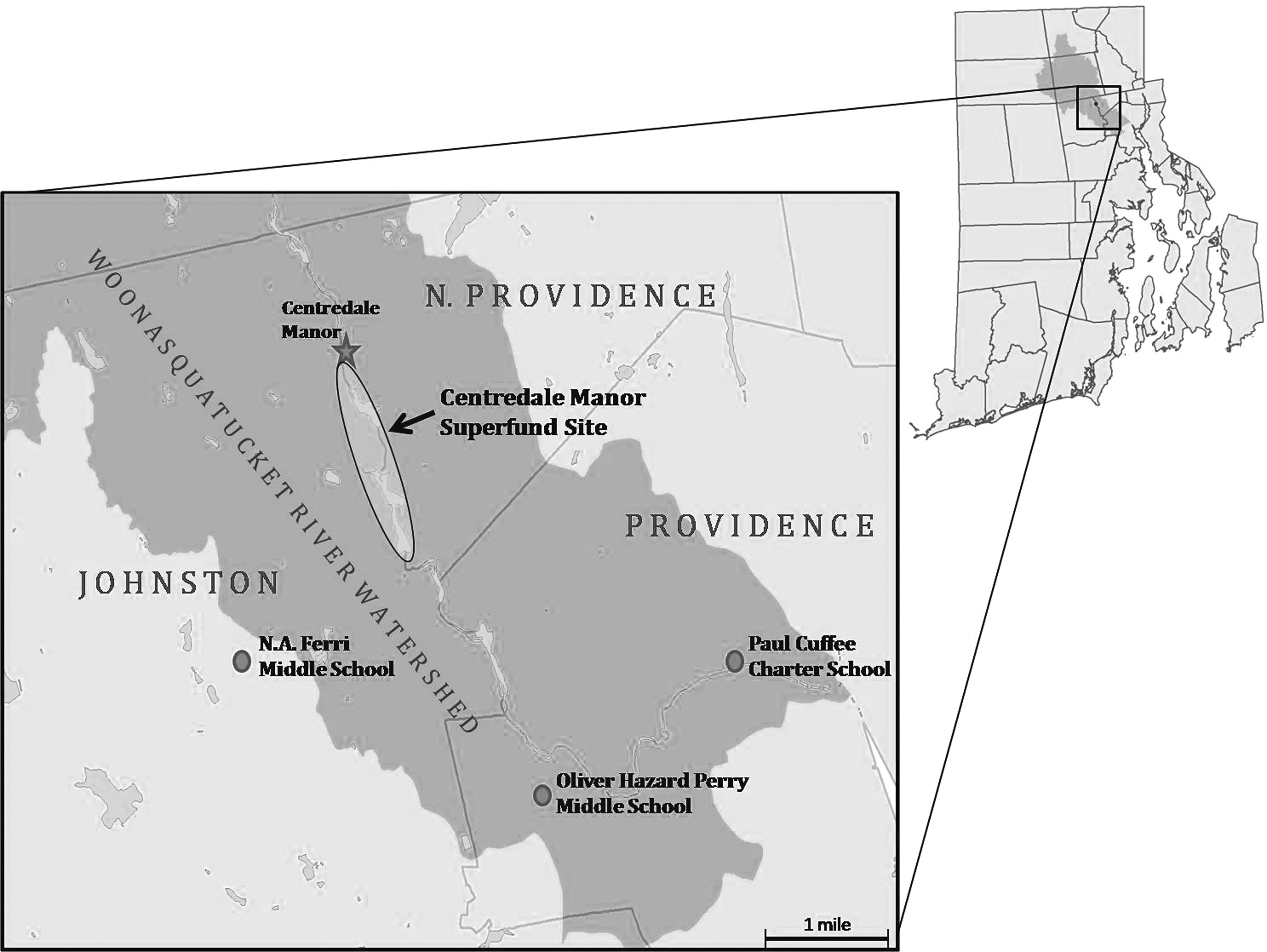
The Woonasquatucket River Watershed, the Centredale Manor Superfund site, and our participating schools.
The in-school enrichment model: N.A. Ferri Middle School (Johnston, RI)
At Ferri, an eight-lesson curriculum was taught over four weeks to the 8th grade class of gifted and talented students during their in-school enrichment period. Two CEC staff (Authors 1 and 2) facilitated each lesson, and at least one school administrator was present for each lesson. Students reported that this was an opportunity afforded to them only because they were top performers and academically inquisitive, a statement validated by school administrators, and so student participation continued to be of high quality and high frequency in our lessons. Additionally, students reported (to Authors 1 and 2, who co-taught the class) that this curriculum was more interesting and exciting than other activities they had participated in during their enrichment period historically, another sentiment that was also expressed by our school administrator partners.
The after-school enrichment model: Paul Cuffee Middle School (Providence, RI)
At Cuffee, a K–8 charter school with a maritime theme, administrators wanted to use our curriculum to increase and diversify their after-school offerings throughout the week. As a result, our curriculum was offered weekly, on Friday afternoons. Enrollment was voluntary, but became the default activity for students who were not enrolled in any other after-school activity on Fridays. Two to three CEC staff facilitated each lesson, and school administrators were intermittently present. The program, which was initially planned to run for eight weeks, was curtailed after three weeks due to student attrition explained in large part to the Friday afternoon timing (which was historically the day of the week with lowest participation in after-school activities) and in part to the unsuitability of the curriculum as an after-school activity on par in popularity with basketball or yearbook.
The standards-reinforcing engaging activity model: Oliver Hazard Perry Middle School (Providence, RI)
Perry administrators organized a camp during spring break for students who were preparing for the upcoming standardized science test. In particular, these students were on the threshold of passing the test, but the school wanted to ensure that their students did in fact pass. As a result, they offered a camp that did test preparation in the morning and engaging activities in the afternoon that reinforced content knowledge to be tested on the upcoming state science test. Because administrators were aware of our work in Rhode Island middle schools and our commitment to aligning our curriculum with state standards, we were invited to participate in facilitating lessons at the camp. This demonstrates the importance of spreading knowledge about curriculum offerings among school leaders. Two lessons were selected from the full curriculum; these lessons were taught by two CEC lesson facilitators and four AmeriCorps members affiliated with Perry. Administrators and students alike positively reviewed our component of the program.
Lessons learned from implementation iterations
Although some participants in the Ferri iteration of the curriculum failed to gain full understanding of the material, program reviews were positive from conversations with school staff. The lessons taught at Perry were also well-received, as evidenced by observed student enthusiasm for “SEEDS days,” and successful in conveying information to students. In contrast, teaching the curriculum at Cuffee was more challenging and less successful in communicating information. We attribute the differences in student participation and enthusiasm as well as effectiveness of lessons between iterations to the circumstances in which each was taught: in a classroom setting during school hours or mandatory enrichment camp, versus in a gymnasium where the lesson was in competition with other recreational activities after school.
Impact on student environmental health justice literacy
Methods
We used a suite of different methods for reflective practice and evaluation to further develop and refine this pilot curriculum for future expansion. Our assessment methods varied. At each school, we were in communication at least twice each week with on-site school liaisons to get constant feedback, curricular revisions, and summative review, through in-person meetings, e-mails, and phone calls. We also refined the curriculum and the program through meetings with our WRWC and DEM partners. In addition, science notebooking methods, which encourage students to constantly document observations and reflections,44 were incorporated into the curriculum for teaching and evaluation (formative and summative) purposes. Learning objectives were assessed through students' explanations of concepts in class discussions and written work, including science notebooking and writing the newspaper. At Ferri, we had a team member dedicated to evaluation, allowing for more thorough surveys and ethnographic observations. Ferri students completed surveys at the first (n=17) and last sessions (n=22) which assessed students' understanding of the concepts and their feelings about the ideas and information presented. Survey data was analyzed in Excel. Our evaluation methods allowed for iterative curriculum improvement during the curriculum unit and in preparing for future sites. Although only Ferri students completed surveys, our meetings with school, community, and government partners helped us work to better meet our stated programmatic objectives, and our review of student notebooks and ethnographic observations at all three schools allowed us to triangulate information to understand student learning outcomes in general. Themes observed from students' written work and classroom participations and illustrative examples are provided in this article.
Understanding of the local environment
Students demonstrated increased content knowledge through conversing, writing, and thinking critically about environmental health and justice concepts. Our pre-surveys (n=17) offer important baseline information: when asked to briefly define “environment,” 64% of students' definitions of the environment were superficial and based on physical observation (i.e., “trees”). At the conclusion of the curriculum, 50% of respondents (n=22) provided more conceptual definitions of their environment (i.e., “everything around me”). Only one student (6%) in the pre-survey (n=17) provided a correct definition of environmental justice (i.e., included the idea of justice, equity, or universality, e.g., “The environment needs to be equal. All must be protected and taken care of.”). In the post-survey, 22% of students (n=22) correctly defined environmental justice, raising concepts of justice and universal rights. Locally, at the beginning of the program, 12% of students (n=17) reported pre-existing knowledge of the Centredale Manor Superfund site, and only 35% of students reported knowledge about the Woonasquatucket River, despite its proximity to their school. At the end of the curriculum, all (100%) students (n=22) reported knowledge of the Centredale Manor Superfund site and/or the Woonasquatucket River.
Understanding government
Through role-playing in a town hall meeting, students' understanding of the interaction between local community members and government actors increased. In the town hall meeting staged, students were divided into four groups to represent four major stakeholders: the government, the non-profit sector, the potentially responsible parties (the companies who were identified as “potentially responsible” for polluting), and current homeowners and residents. Students synthesized their knowledge of the Centredale Manor Superfund site with their analysis of what these different stakeholder groups wanted to determine which remediation strategy they supported (cap, excavate, or dredge) and develop a persuasive argument accordingly. Then, all stakeholders shared their perspectives within a town hall meeting setting, where students spoke impassionedly about, for example, the engineering limitations of dredging and the justice implications of excavating. Equipped with knowledge of subject matter and the local government process, students were more prepared to be active citizens in the local government process after participating in our curriculum than before, as measured by vocalized and enthusiastic interest in contacting local government officials and the fluency with which they discussed the highly technical remediation alternatives proposed. While this is based only on classroom observation and serves as a proxy measure, having classroom civic learning experiences is associated with a greater commitment to civic engagement,45 and so we have reason to hypothesize that positive modeled civic experiences in classroom settings like our town hall meeting help prepare and encourage students to be active citizens.
Identifying solutions
Students gained a deeper understanding of possible solutions, as evidenced by their ability to explain to others the advantages and disadvantages of various options and suggest applications of green chemistry. In the pre-survey, students understood and could name several environmental issues (particularly pollution), but had a less thorough understanding of feasible solutions. For example, common responses included “reducing pollution,” a general recommendation but difficult to specifically address. The top two actions students said they would be willing to do to take care of the environment were picking up litter and recycling (59% of students (n=17) said they would do each of these actions). In comparison, in the post-survey, students identified specific behavioral changes and social movement activities, including “proper waste disposal,” “using less electricity,” and “spreading knowledge about environmental issues.” The action that the most (82%) students (n=22) said they would be willing to do was proper waste disposal, followed by volunteering (27%) and using alternative fuels/green chemistry (27%). These results indicate that students gained a firmer understanding of the sources of environmental issues and concrete solutions and the ability to demonstrate a means by which individuals can strive to reach societal environmental goals.
Conclusions
We learned several lessons regarding how to teach environmental health and justice.
Planning and partnership is critical for successful curriculum implementation. A tenet that our CEC espouses is that “serendipity favors the prepared.”46 We built from and deepened pre-existing partnerships to plan for and develop this new initiative. When developing a curriculum, we recommend our approach: partnering with local community and government experts with local content and context knowledge to ensure relevance for students' lives and working with people with teaching experience to ensure grade-level appropriateness and strong pedagogical methods. It is also important to establish rapport, credibility, and authority with administrators, teachers, and students in the school before beginning to teach the curriculum. Understanding the local school's context and what type of program they are interested in (e.g., academic enrichment, after-school, reinforcing standards, as discussed) can inform the adaptation of the curriculum to the particular setting. Additionally, having a school staff or faculty member present in the classroom as a resource can help prevent any potential behavioral issues. Our curriculum was most effective when taught during school hours in a setting with few distractions, and as the most exciting (while still scholarly) option for students. We recommend choosing a suitable time and place to facilitate lessons, so that the curriculum is an alternative to other educational, rather than recreational, activities.
Similarly, the interests of multiple implementation partners must be considered. A place-based, student-centered, standards-aligned curriculum, like the SEEDS curriculum we present, addresses the interests of diverse partners effectively. When presenting the curriculum to students, it is important to emphasize the place-based and student-centered aspects of the curriculum, and describe it as a new and exciting way to learn about their local community. When presenting the curriculum to educators, however, it is important to emphasize the student-centered and standards-aligned nature of the curriculum, describing it as an effective way to reinforce educational standards. The place-based nature of the curriculum is also important for working with local community-based organizations and government agencies, as well as when seeking press coverage to help increase awareness about content covered in the curriculum within the greater community.
We recommend a student-centered, collaborative teaching philosophy. This includes designing interactive lessons where students actively participate in learning, seeking regular feedback on the lessons and adapting lesson plans as appropriate to better fit students' learning styles. For example, due to student enthusiasm for interactive activities, we converted what had been a lecture about the industrial history of the Woonasquatucket River and Centredale Manor site in our first iteration of the curriculum into a play in subsequent iterations, actively encouraging student participation. Additionally, we recommend facilitating peer collaboration to increase engagement in lessons by channeling peer influence, which is particularly strong for adolescents.
Always consider the curriculum's multiple target populations. For example, we hoped that, by educating a small group of middle school students, we would spread information and momentum for activism to their peers, parents, and community members, particularly with the short, student-written newspaper comprised of community-relevant articles. With this in mind, we have since designed, with another community organization as lead partner, the Community Environmental College, which serves primarily high school students to further expand environmental justice in Rhode Island. In all of these initiatives, though, future systematic research to gauge the extent to which information and activism spreads beyond the class itself should be done.
We posit that targeting middle school students for environmental health and justice education programs reaches individuals during particularly formative years for the development of one's sense of civic and environmental responsibility, thereby instilling principles and practices in them that will affect academic and civic performance beyond the duration of the curriculum. Participating students experienced knowledge, attitude, and behavior change regarding their local environment. We encourage researchers and practitioners to study and evaluate their programs to help build the literature on environmental health education so that the field can begin to identify best practices.
In sum, we emphasize the promise and potential of place-based, student-centered, and standards-aligned curricula as a particularly effective and engaging way of introducing students to environmental health justice, based on our pilot work with SEEDS.
Footnotes
Acknowledgments
The authors thank Elizabeth Hoover (Brown University), Lisa Aurecchia of and Jenny Pereira formerly of the Woonasquatucket River Watershed Council, Lou Maccarone of RIDEM, and the schools who have hosted this curriculum (N.A. Ferri Middle School, Paul Cuffee Middle School, and Oliver Hazard Perry Middle School), for supporting the formation and implementation of this curriculum. Alissa Cordner, Dave Ciplet, and Ellie Leonardsmith provided helpful feedback on this article.
Author Disclosure Statement
This publication was made possible by grant number 5 P42 ES013660-02 from the Superfund Research Program of the National Institute of Environmental Health Sciences, National Institute of Health. Additionally, Cohen and Waters received partial support from Brown University Undergraduate Teaching and Research Awards. The authors have no conflicts of interest or financial ties to disclose.
1
Anna Gahl Cole, “Expanding the Field: Revisiting Environmental Education Principles Through Multidisciplinary Frameworks,” The Journal of Environmental Education 38 (2007): 35–44.
2
Charles E. Roth, “Environmental Literacy: Its Roots, Evolution and Directions in the 1990s,” (paper for ERIC Clearinghouse for Science, Mathematics, and Environmental Education, Columbus, OH; 1992).
3
William McBeth and Trudi L. Volk, “The National Environmental Literacy Project: A Baseline Study of Middle Grade Students in the United States,” The Journal of Environmental Education 41 (2010): 55–67.
4
Ron Chepesuik, “Environmental Literacy: Knowledge for a Healthier Public,” Environmental Health Perspectives 115 (2007): A494–A499.
5
Jeanne Peloso, “Environmental Justice Education: Empowering Students to Become Environmental Citizens,” Penn GSE Perspectives on Urban Education 5 (2007).
6
Running Grass and Julian Agyeman, “Reorienting Environmental Education for Environmental Justice,” (Second National People of Color Environmental Leadership Summit Resource Paper Series; 2002).
7
Meira Levinson, “The Civic Achievement Gap,” (Center for Information and Research on Civic Learning and Engagement (CIRCLE) working paper 51; January 2007).
8
McBeth and Volk, 2010.
9
Jason Corburn, “Combining Community-Based Research and Local Knowledge to Confront Asthma and Subsistence-Fishing Hazards in Greenpoint/Williamsburg, Brooklyn, New York,” Environmental Health Perspectives 110 (2002): 241–248.
10
Environmental Protection Agency, Federal Register. “Definition of environmental education.” October 16, 1992.
11
Mark Floyd, “Welcome to Hydroville!,” Environmental Health Perspectives 112 (2004): A166.
12
Giovanna Di Chiro, “Teaching Urban Ecology: Environmental Studies and the Pedagogy of Intersectionality,” Feminist Teacher 16 (2006): 98–109.
13
Gerald A. Lieberman and Linda L. Hoody, “Closing the Achievement Gap: Using the Environment as an Integrating Context,” (report presented for the State Education and Environment Roundtable, Poway, CA; 1998).
14
Lieberman and Hoody, 1998.
15
Oksana Bartosh, Lynne Ferguson, Margaret Tudor, Catherine Taylor, “Impact of Environment-Based Teaching on Student Achievement: A Study of Washington State Middle Schools,” Middle Grades Research Journal 4 (2009): 1–16.
16
Lieberman and Hoody, 1998.
17
Lieberman and Hoody, 1998.
18
Richard Louv. Last Child in the Woods: Saving Our Children from Nature-Deficit Disorder. (Algonquin Books of Chapel Hill, 2005).
19
Frances E. Kuo and Andrea Faber Taylor, “A Potential Natural Treatment for Attention-Deficit/Hyperactivity Disorder: Evidence From a National Study,” American Journal of Public Health 94 (2004): 1580–1586.
20
V Cleland, D Crawford, LA Baur, C Hume C, A Timperio A, J Salmon, “A prospective examination of children's time spent outdoors, objectively measured physical activity and overweight,” International Journal of Obesity 32 (2008): 1685–1693.
21
Udan Kusmawan, John Mitchell O'Toole, Ruth Reynolds, Sid Bourke, “Beliefs, attitudes, intentions and locality: the impact of different teaching approaches on the ecological affinity of Indonesian secondary school students,” International Research in Geographical and Environmental Education 18 (2009): 157–169.
22
Michael Duffin, Michael Murphy, Brian Johnson. Quantifying a relationship between place-based learning and environmental quality: final report. Woodstock, VT: NPS Conservation Study Institute in cooperation with the Environmental Protection Agency and Shelburne Farms, 2008. <
23
Evelyn Savidge Sterne, “Bringing Religion into Working-Class History: Parish, Public, and Politics in Providence, 1890-1930,” Social Science History 24 (2000): 149–182.
24
“Town of Smithfield History.” <
25
BNET Business Network. “EPA Approves Centredale Manor/Woonasquatucket River for Superfund Listing.” <
26
Maaike Bilau, Christophe Matthys, Willy Baeyens, Liesbeth Bruckers, Guy De Backer, Elly Den Hond, Hans Keune, Gudrun Koppen, Vera Nelen, Greet Schoeters, Nicolas Van Larebeke, Jan L. Willems, Stefaan De Henauw, Flemish Center of Expertise for Environment and Health, “Dietary exposure to dioxin-like compounds in three age groups: results from the Flemish environment and health study,” Chemosphere 70 (2008): 584–592.
27
Sally S. White, Linda S. Birnbaum, “An overview of the effects of dioxins and dioxin-like compounds on vertebrates, as documented in human and ecological epidemiology,” J Environ Sci Health C Environ Carcinog Ecotoxicol Rev 27 (2009): 197–211.
28
Laura Senier, Ben Hudson, Sarah Fort, Elizabeth Hoover, Rebecca Tillson, Phil Brown, “Brown Superfund Basic Research Program: A Multistakeholder Partnership Addresses Real-World Problems in Contaminated Communities,” Environmental Science and Technology 42 (2008): 4655–4662.
29
Liam O'Fallon, and Alan Dearry, ”Community-Based Participatory Research as a Tool to Advance Environmental Health Sciences,” Environmental Health Perspectives 110 (2002): 155–159.
30
James Krieger, Tim K. Takaro, Carol Allen, Lin Song, Marcia Weaver, Sanders Chai, Philip Dickey. “The Seattle-King County Healthy Homes Project: Implementation of a Comprehensive Approach to Improving Indoor Environmental Quality for Low-Income Children with Asthma” in Community Research in Environmental Health: Studies in Science, Advocacy and Ethics, Doug Brugge and H. Patricia Hynes (eds). (Ashgate Publishing Limited, 2005).
31
Barbara A. Israel, Amy J. Schulz, Edith A. Parker, and Aaron B. Becker, “Review of Community-Based Research: Assessing Partnership Approaches to Improve Public Health,” Annual Review of Public Health 19 (1998): 173–202.
32
Alison Cohen, “Achieving Healthy School Siting and Planning Policies: Understanding Shared Concerns of Environmental Planners, Public Health Professionals, and Educators,” New Solutions: A Journal of Environmental and Occupational Health Policy 20 (2010): 49–72.
33
Laura Senier, “Public Schools and Contaminated Land in Rhode Island: Using Superfund Basic Research Program Research Translation and Community Outreach to Foster Research and Advocacy,” presentation for Superfund Basic Research Program Wetterhan Award, Asilomar, CA; December 2008.
34
Steven Locke, “Environmental education for democracy and social justice in Costa Rica,” International Research in Geographical and Environmental Education 18 (2009): 97–110.
35
Stephen Zavestoski, Frank Mignano, Kate Agnello, Francine Darroch, Katy Abrams, “Toxicity and Complicity: Explaining Consensual Community Response to a Chronic Technological Disaster,” The Sociological Quarterly 43 (2002): 385–406.
36
Lou Maccarone, written communication with author, 12 March, 2010, Providence, RI (e-mail communication in possession of the author).
37
Alejandro Gaviria and Steven Raphael, “School-Based Peer Effects and Juvenile Behavior,” The Review of Economics and Statistics 83 (May 2001): 257–268.
38
Annie Leonard. “The Story of Stuff.” <
39
Richard M. Felder, Rebecca Brent, “Navigating the Bumpy Road to Student-Centered Instruction,” College Teaching 44 (1996): 43–47.
40
Erin E. Peters, “Shifting to a Student-Centered Science Classroom: An Exploration of Teacher and Student Changes in Perceptions and Practices,” Journal of Science Teacher Education 21 (2010): 329–349.
41
United States Census Bureau. “Profile of General Demographic Characteristics: 2000, Geographic Area: Johnston town, Providence County, RI.” <
42
United States Census Bureau. “Profile of General Demographic Characteristics: 2000, Geographic Area: Providence County, RI.” <
43
United States Census Bureau. “Profile of General Demographic Characteristics: 2000, Geographic Area: United States.” <
44
Maria A. Ruiz-Primo, Min Li, Carlos Ayala, Richard J. Shavelson, “Evaluating students' science notebooks as an assessment tool,” International Journal of Science Education 26 (2004): 1477–1506.
45
Joseph E. Kahne and Susan E. Sporte, Developing Citizens: The Impact of Civic Learning Opportunities on Students' Commitment to Civic Participation, American Educational Research Journal 45 (2008): 738–766.
46
Laura Senier, Rebecca Gasior Altman, Rachel Morello-Frosch, and Phil Brown, “Contested Illnesses Research Group: Nuts and Bolts and Lessons Learned,” in Contested Illlnesses: Ethnographic Explorations (eds. Phil Brown, Rachel Morello-Frosch, Stephen Zavestoski), in press.