




Abstract
Abstract
This article examines the relationship between brownfields redevelopment and urban gentrification processes. Examples from both the national environmental justice literature as well as a short case study from Spokane, Washington illustrate that the redevelopment of contaminated brownfields is central to gentrification processes and that justice advocates need to be aware of gentrification processes in brownfields communities. Brownfields—or contaminated postindustrial property—environmental justice scholars have found, are overwhelmingly found in low-income and minority communities. Federal brownfields redevelopment initiatives emerging in the mid 1990s have aimed to remedy these issues by remediating and redeveloping tainted sites, thus creating an urban landscape that poses fewer risks to environmental health and has improved the economic viability of brownfields communities. While brownfields redevelopment can “fix” many environmental justice problems, it also can create different issues, including gentrification, that threaten low-income communities. The article contends that since gentrification processes often have both social and environmental dimensions that are closely intermingled, environmental justice scholars should more closely examine socio-environmental issues such as gentrification in their research and advocacy.
By almost any estimation (i.e., public, economic, and ecosystem health, etc.), a remediated brownfields site is preferable to a contaminated site. Through brownfields redevelopment and urban infill, cities can work simultaneously on many pieces of the urban sustainability puzzle: the environment is cleaned, the economy is bolstered, and social justice is restored.3 The benefits of a remediated and redeveloped brownfield extend beyond the boundaries of the tainted site and into the surrounding neighborhood. The EPA observes that a “ripple effect can occur that brings community benefits for health, the environment, the local economy, a community's civic capacity, neighborhood identity, and neighborhood infrastructure.”4 Brownfields redevelopment theory contends that decades of environmental injustice, poverty, and disinvestment can be overcome as these ripple effects move through the community. Given all of these benefits, it is difficult to find many critics of brownfields redevelopment policies.
While the beneficial externalities of brownfields remediation may seem to “fix” many of the environmental, economic, and social issues that threaten low-income communities, upon closer examination, the outcomes of brownfields remediation and redevelopment are more complex. When considered from a social justice perspective, many of the ripple effects of brownfields redevelopment, such as site cleanup, removal of blight, and increased property values, can perpetuate gentrification processes in brownfields communities.
Gentrification, as geographer Neil Smith summarizes the complex term, is “the reinvestment of capital at the urban centre, which is designed to produce space for a more affluent class of people than currently occupies that space.”5 Gentrification processes threaten effected communities as property values rise and low-income and minority residents are priced out of their neighborhoods and forced to leave.6 While no low-income residents are directly displaced by brownfields remediation, the insertion of upscale redevelopment projects can serve as a catalyst for gentrification in the surrounding neighborhood. This can lead to indirect displacement wherein lower income groups are no longer able to afford housing in an area where they once could have, due to rising property values. Many of the negative ripple effects of brownfields redevelopment, such as increased property values and taxes, low-income housing removal, and indirect residential displacement, are the hallmarks of contemporary urban gentrification processes.
Researchers refer to environmentally informed gentrification processes similar to brownfields gentrification as green, ecological, or environmental gentrification.7 For example, Sieg et al. argue that site cleanup tends to make a neighborhood more attractive, which leads to increasing real estate prices, which precedes the displacement of renters and low income residents. Thus, existing residents that placed a higher priority on affordable housing, for instance, may actually be harmed by the site cleanup. The critical point, these researchers argue, is that existing residents may not value the removal of the disamenity as much as the potential newcomers.8 As long as brownfields remediation and redevelopment are linked by policy and practice, the gentrification processes in effected communities should be seen not only as a social justice issue, but also as an environmental justice issue.
In 2006, the National Environmental Justice Advisory Council (NEJAC) published a report on brownfields justice issues and identified gentrification as one of the troubling “unintended consequences” of brownfields redevelopment initiatives. The committee found that, “citizens living in urban, poor, and people-of-color communities are currently threatened by gentrification, displacement and equity loss on a scale unprecedented since the Urban Renewal movement of the 1960s.”9 The council further argued that through brownfields programs, the “EPA may have unintentionally exacerbated historical gentrification and displacement…[since] EPA funds have sometimes been used to support development at the expense of low-income residents.”10 These gentrification processes, the report continues, are “spurred by local government attempts to reclaim underutilized and derelict properties for productive uses.”11 Further, they found that the “environmental cleanup of these formerly industrialized, now residential, communities can be a powerful displacing force” and urged responsible communities to reject the premise that the “unavoidable cost for the revitalization of poor and decaying brownfields communities is the displacement of poor populations.”12 “It is not fair to suggest that federal redevelopment and revitalization programs are purposefully causing unintended impacts such as gentrification, displacement, and equity loss in environmental justice communities,” the council concedes, but the “otherwise beneficial programs [are] having that net effect.”13
Still, as the following case study shows, policymakers, planners, and developers in places like Spokane, Washington tend to celebrate the positive ripple effects while ignoring the negative externalities, such as gentrification, that proceed from brownfields redevelopment projects. During the course of the remediation and ongoing redevelopment of Kendall Yards in downtown Spokane, the competing discourses of residents, civic leaders, city planners, and developers illustrate the interplay between the social and environmental tensions that can occur during the redevelopment of a contaminated site. Moreover, this brief case study highlights how brownfields gentrification is not only a social justice issue, but is a process that can further entrench environmental injustice in brownfields communities.
Brownfields Gentrification in Spokane
The city of Spokane in eastern Washington sits where the Spokane River dives through a cascade of falls. This dramatic downtown riverfront has always been Spokane's most distinctive feature and its most important industrial center. In the 1970s, the riverfront, which had been a tangle of bridges, rail trestles, and rail yards throughout most of twentieth century, was transformed by an urban renewal project. This project rerouted the railroads away from the downtown riverfront, leaving behind the 78-acre Kendall Yards site, which had been the Union Pacific's locomotive repair facility (Figure 1). The site was abandoned and much of the waste and contaminated soils were simply buried in place.14

Kendall Yards near downtown Spokane, ca. 1930. Source: Northwest Room, Spokane Public Library.
For a decade, the abandoned and contaminated Kendall Yards site existed as a large vacant parcel sitting conspicuously in a prominent downtown location with some of the best river views in the city. Metropolitan Mortgage and Securities Company purchased the property in 1982, and in the mid 1990s proposed a mixed-use development on the site. The company completed only minimal site cleanup, though, before abandoning the project. Black Rock Development purchased the property and in 2006, presented its plan for a mixed use development with 2,600 housing units and one million square feet of retail and commercial space. In addition to the upscale housing and retail, the development proposed a host of restaurants, entertainment venues, and landmark public plazas (Figure 2).
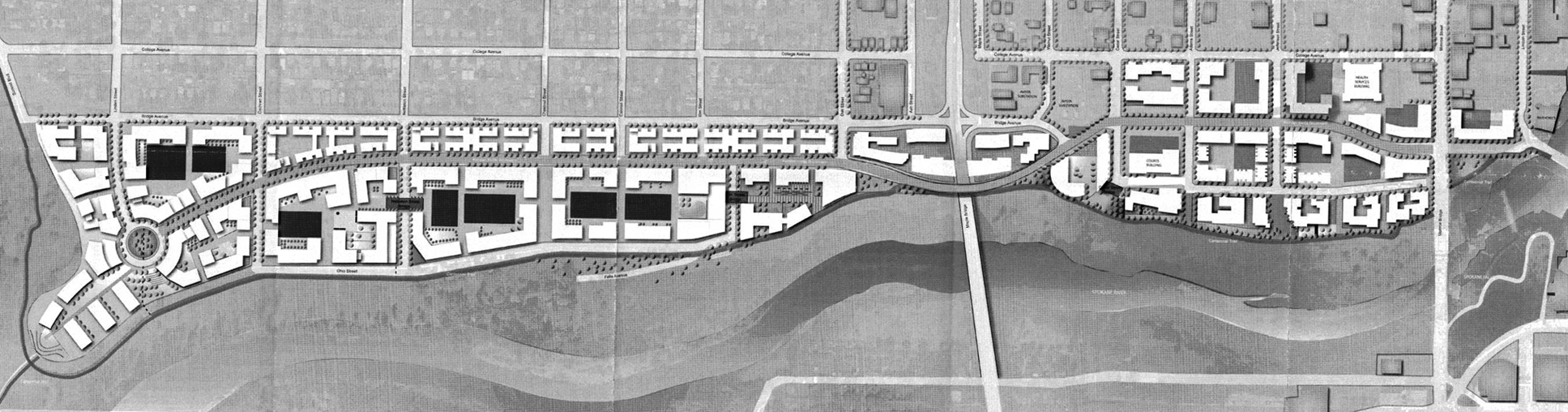
Black Rock developers' site plan for Kendall Yards in Spokane, 2007. Source: Spokane Planning Department.
Before the proposed redevelopment could begin, though, the Kendall Yards site needed to be cleaned of an assortment of buried foundations, railroad timbers, asphalt, arsenic, cadmium, lead, and asbestos. Noxious black ash permeated the top two feet of soil, and oil spills had penetrated as deep as 30 feet. The ambitious cleanup project, which removed over 220,000 tons of contaminated material, received a $2.4 million EPA-backed loan from Washington State, the largest Brownfields Revolving Loan Fund amount ever awarded. The site cleanup was broadly heralded as a success.15 The redevelopment reality, though, has been much more complex.
The Kendall Yards site abuts Spokane's low-income West Central neighborhood (Figure 3). For decades, the abandoned brownfield anchored the neighborhood, acting as an eyesore, lowering housing values, and attracting crime. With a per capita income that is less than two-thirds of the city's average income, and a poverty rate that nearly doubles the city's rate, West Central is one of the poorest neighborhoods in Spokane. Home values are likewise low—approximately 20 percent lower than the Spokane average—and there are more renters than home owners in the neighborhood. Although the 2000 Census found that only 15 percent of West Central's residents are non-white, the community is still somewhat more diverse than the rest of the city.16 In many ways, the neighborhood fits all of the requirements of an urban neighborhood that is ripe for gentrification, and Black Rock's plans for Kendall Yards—which promised to insert 4,000 new “upper income…professionals who want to own a home with an urban feel” into a community that consisted of 8,000 primarily low-income residents—would initiate an instant gentrification process.17
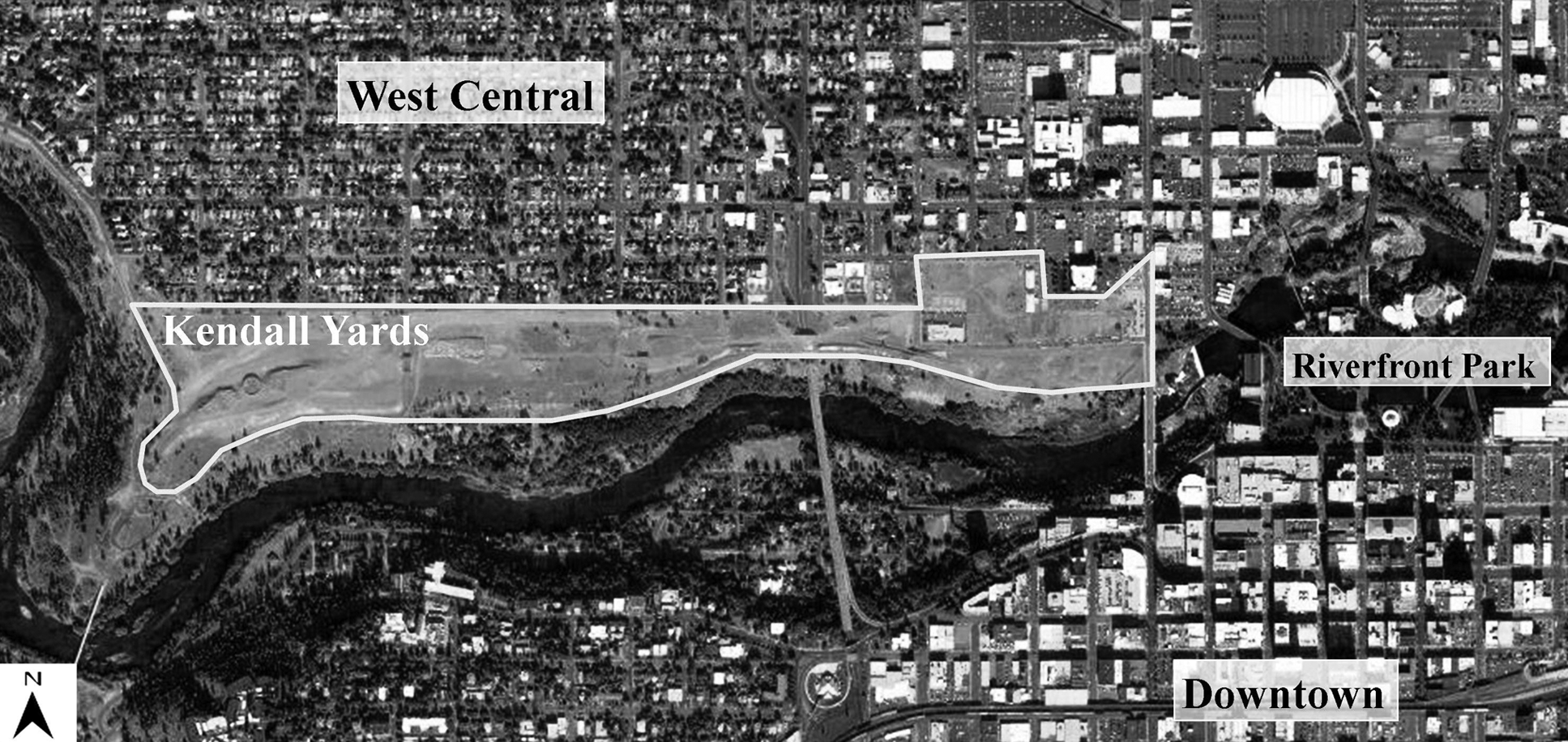
Kendall Yards brownfield site, Spokane, 2009. Source: Google Maps aerial photograph, map by author.
While city leaders like the mayor championed the way the Kendall Yards redevelopment would “catalyze additional private investment in low income neighborhoods and underutilized areas surrounding the site,”18 this kind of redevelopment discourse was disconcerting for many West Central residents. The threat of real estate speculation, rising property values, rising property taxes, residential displacement, and the loss of affordable housing, some West Central residents feared, would transform their neighborhood.
Indeed, real estate speculation in the West Central neighborhood began almost immediately after the Kendall Yards cleanup began. A city planner involved remembers that as soon as site remediation began, the “investment properties” on the northern border of the site “started shooting up in price, and people started being forced out.”19 Within a year after the project was announced, average home prices in the neighborhood increased by almost a quarter of their value, and real estate was beginning to move quickly as investors purchased single-family homes and multi-family rental properties. A realtor reported selling several properties within hours of listing them and bragged that he had a client with a standing order to purchase any West Central property in the $90,000 range that came on the market. “Right now,” the realtor said, the West Central neighborhood is “the hottest little area in town.”20 “Anecdotally,” the Kendall Yards environmental impact statement agreed, “housing speculation is taking place in the neighborhood, especially in proximity to the proposed project site.”21
In the midst of this booming real estate market, West Central residents were left with very little reassurance about the probable loss of affordable housing in their community. In a 2005 meeting where Kendall Yards planners introduced their concept to the West Central neighborhood, one resident asked if there would be any affordable housing as part of the project. “That's not envisioned,” the developer replied. At the same meeting, another resident asked about the threat of rapidly rising property values. The project manager responded by listing all of the reasons that rising property values were positive.22 Another long-time West Central resident wrote to the city: “Those, particularly among seniors, who do not wish to become speculators and simply want to stay in their home, are going to be hit with sizable increase in property taxes.”23 As many West Central residents mentioned in other public forum, there was relief that the Kendall Yards site had been remediated, and many residents looked forward to the possibility of lower crime and an increase of community amenities,24 but these concerns over rising home values, property taxes, affordable housing, and potential displacement illustrate that some residents feared that they would not be able to afford to enjoy their remediated and redeveloped neighborhood.
The Summit-Bridge Alliance, a group of West Central residents that lead the Kendall Yards opposition, filed a complaint with the city planning office, arguing that the “speculative housing market and [rising] prices and property taxes” that were accompanying the Kendall Yards project were threatening “the low to middle-income character of the West Central neighborhood.”25 This group specifically challenged the project's Environmental Impact Statement for its failure to address affordable housing and displacement issues. Ultimately, though, the Spokane City Hearing Examiner's decision explained that the “the obligation to address housing displacement in an EIS relates to actual displacement from the project site as when housing is removed or torn down. No housing will be removed from this site.”26 Essentially, the hearing examiner said, because no residents would be directly displaced on the development site itself, no provisions were needed for indirect displacement either. Additionally, the hearing examiner found that the environmental impact statement did not have to address affordable housing at all “because it is a socioeconomic issue. Socioeconomic impacts are not ‘environmental’ impacts.”27 While issues such as low income housing may not be environmental issues per se, environmental issues such as the cleanup and redevelopment of a contaminated brownfields site do often create very real social impacts.
Yet, in spite of West Central residents' concerns of gentrification, civic leaders were very eager to ensure that the Kendall Yards site was developed. An editorialist for the Spokesman Review observed: “Some property owners in the West Central neighborhood are concerned that Kendall Yards is going to drive up the property value in the area so much that they can't afford to live there. That's a valid concern…No development anywhere should be built on the backs of the weakest among us, just because they don't have a lot of political clout.” But after expressing her sympathy, and recounting the various committees that the city had organized to observe the gentrification process, the columnist continues by chastising West Central residents for “continu[ing] to whine about how their property is going to increase in value, and they'll have to pay more taxes.”28 Within the discourses of the civic elite, there was some recognition that the Kendall Yards redevelopment was going to drastically alter the West Central neighborhood. A planner for the city described a “very tiny voice” in the city's regulatory process that said, “‘Wait a minute, we are spending an awful lot of money cleaning this up…Should it be luxury homes only?’” She continues her critique, “Are there problems with affordable housing? Are there environmental justice issues? Those issues, I would say, didn't get addressed.”29 Among city leaders and decision makers, gentrification may have been an unintended, but not unforeseen, consequence of this brownfields project.
Conclusion
In the end, the recent economic downturn forced Black Rock Development into bankruptcy and the company abandoned the Kendall Yards project in early 2010. However, a new developer has already revived the project. Greenstone, the new development company, plans to maintain many of the previous plans while adding more park space to a less dense and slightly more affordable development. The new plan looks promising, but it is impossible to tell how the project will change over the next few years. Although the gentrification issues in Spokane's West Central neighborhood have stalled somewhat, there are still important lessons that environmental justices scholars and advocates can learn from the Kendall Yards remediation and redevelopment.
In contemporary urban society, it is increasingly difficult to tease apart environmental and social issues. While the Spokane Hearing Examiner tried to do this when he ruled that “socioeconomic impacts are not ‘environmental’ impacts,”30 environmental justice advocates should not make the same mistake. Gentrification processes, which are not conventionally thought of as an environmental justice issues, often have both social and environmental dimensions that are closely intermingled. Environmental justice scholars should not repeat the mistakes of the Spokane Hearing Examiner, but should instead more closely examine socio-environmental issues such as gentrification in their research and advocacy.
Without a deliberate approach to mitigating the negative ripple effects of contemporary urban environmental management strategies, such as the brownfields redevelopment initiatives addressed in this article, social and environmental equity both tend to decrease as middle-class quality of life increases. Environmental justice advocates have made important statements about the disproportionate number of brownfields in low income communities, yet in the absence of ongoing critique the gentrification around brownfields redevelopment projects will add another environmental injustice to communities that have already shouldered too much environmental injustice.
Footnotes
Author Disclosure Statement
The author has no conflicts of interest or financial ties to disclose.
1
For important examples from the environmental justice literature, see: Robert Bullard. 2000. Dumping in Dixie: Race, Class and Environmental Quality. Third ed., Boulder, CO: Westview Press; United Church of Christ Commission for Racial Justice. 1987. Toxic Waste Sites and Race in the United States: A National Report on the Racial and Socio-Economic Characteristics of Communities with Hazardous Waste Sites. New York: United Church of Christ; Michael K. Hieman, “Race, Waste, and Class: New Perspectives on Environmental Justice,” Antipode 28 (1996): 111–121; Pellow DN, Brulle RJ, 2005. Power, Justice, and the Environment: A Critical Appraisal of the Environmental Justice Movement. Cambridge, MA: MIT Press; Andrew Hurley. 1995. Environmental Inequalities: Class, Race and Industrial Pollution in Gary, Indiana, 1945–1980. Chapel Hill: University of North Carolina Press. For excellent examples of environmental justice literature about brownfields specifically, see: Rowan, GT and Fridgen, C., “Brownfields and Environmental Justice: The Threats and Challenges of Contamination,” Environmental Practice 5 (March 2003): 58–61; Christopher G. Boone and Ali Modarres, “Neighborhood in Los Angeles County: A Historical Examination of Environmental Inequity,” Urban Affairs Review 35 (1999): 163–87.
2
U.S. Environmental Protection Agency. 2009. Building vibrant communities: Community benefits of land revitalization. U.S. EPA document EP-W-07-023. Available from <
3
De Sousa, C. 2008. Brownfields redevelopment and the quest for sustainability. London: Elsevier; Lerner, S., and W. Poole. 1999. The economic benefits of parks and open space. San Francisco: Trust for Public Land; De Sousa, C., “Measuring the public costs and benefits of brownfields versus greenfield development in the greater Toronto area,” Environment and Planning B 29 (2002): 251–280; Dorsey, J. W., “Brownfields and Greenfields: The Intersection of Sustainable Development and Environmental Stewardship,” Environmental Practice 5 (March 2003): 69–75; Campbell, S. 1996. “Green cities, growing cities, just cities? Urban planning and the contradictions of sustainable development,” Journal of the American Planning Association 62 (3): 296–312; U.S. Conference of Mayors. 2008. Recycling America's land: A national report on brownfields redevelopment (Vol. 7). Washington, DC: U.S. Conference of Mayors.
4
U.S. Environmental Protection Agency. 2009. Building vibrant communities: Community benefits of land revitalization. U.S. EPA document EP-W-07-023. Available from <
5
Smith, N. 2000. Gentrification. In The Dictionary of Human Geography, eds. R. Johnston, D. Gregory, G. Pratt, and M. Watts, 294–296. Malden: Blackwell Publishing.
6
Lees, L. T. Slater and E. Wyly. 2008. Gentrification. New York: Routledge; Shaw, K., “Gentrification: What it is, why it is, and what can be done about it,” Geography Compass 2 (2008): 1697–1728; Marcuse, P., “Gentrification, abandonment and displacement: Connections, causes and policy responses in New York City,” Journal of Urban and Contemporary Law 28 (1985): 195–240.
7
Dooling, S., “Ecological gentrification: A research agenda exploring justice in the city,” International Journal of Urban and Regional Research 33 (2009): 621–639; Banzhaf, S. 2008. Environmental justice: Opportunities through markets. PERC Policy Series no. 42. Available from <
8
Sieg, H., K. Smith, and S. Banzhaf, S., “Estimating the general equilibrium benefits of large changes in spatially delineated public goods,” International Economic Review 45 (2004): 1047–77.
9
National Environmental Justice Advisory Council. 2006. Unintended impacts of redevelopment and revitalization efforts in five environmental justice communities. Draft report presented to EPA. Available from <
10
Ibid., 2.
11
Ibid., 2.
12
Ibid.,3 and 19.
13
Ibid., 1.
14
Washington State Department of Ecology. 2009. Linking toxics cleanup and redevelopment across the states: Lessons for Washington State. Prepared for the Department of Ecology Toxics Cleanup Program by the University of Washington. February 2009 Publication no. 09-09-043. Available from <
15
Ibid.
16
City of Spokane Planning Services Department. West Central Neighborhood Assessment Report, March 28, 2005. Available from <
17
Kendall Yards Development, Inc. 2006. The Kendall Yards PUD master plan, January 2006. Copy held by City of Spokane planning department, 26.
18
Howell, P., “Progress slow at Kendall Yards: Project faces delays, cutbacks,” Spokesman-Review 21 Aug. 2008.
19
Spokane Planner. 2010. Interview by author. Spokane Jan. 14, 2010.
20
Little, M., “Affordable no longer: Once-inexpensive West Central Area sees rising housing costs,” Spokesman-Review 5 July 2006.
21
Spokane Planning Department. Kendall Yards planned unit development supplement draft environmental impact statement, supplement to the Final EIS for Summit Properties 21 July 1993, January 2006. Copy held by City of Spokane planning department, 59.
22
Boggs, A., “Meeting draws crowd, questions,” Spokesman-Review 26 Oct. 2005.
23
Vial, M., Letter from Maurice Vial to Leroy Eadie, City of Spokane Planning Department, dated 6 April 2006. Copy held by Spokane Planning department, PUD Kendall Yards folder 1 of 7.
24
For example, see City of Spokane Planning Services Department. West Central Neighborhood Assessment Report, March 28, 2005. Available from <
25
Summit-Bridge Alliance. 2006. Letter from Summit-Bridge Alliance to Leroy Eadie, City of Spokane Planning Department, dated July 19, 2006. Copy held by Spokane Planning department, PUD Kendall Yards folder 3 of 7.
26
City of Spokane Hearing Examiner. 2006. Preliminary plat and planned unit develop application by Riverfront Properties LLC for a 78 acre preliminary plat to be known as Kendall Yards. Copy held by Spokane Planning department, PUD Kendall Yards folder 3 of 7.
27
Ibid., 10–11.
28
Hansen, P., “Kendall Yards project appear sound,” Spokesman-Review 26 May 2007.
29
Spokane Planner. 2010. Interview by author. Spokane Jan. 14, 2010.
30
City of Spokane Hearing Examiner. 2006. Preliminary plat and planned unit develop application by Riverfront Properties LLC for a 78 acre preliminary plat to be known as Kendall Yards. Copy held by Spokane Planning department, PUD Kendall Yards folder 3 of 7, 10–11.