




Abstract
Abstract
Amid rising global temperatures and a changing physical environment, climate change has led to the development of a new social group called “Climate Migrants or Climate Refugees.” In 1995 approximately 25 million people worldwide were considered to be environment or climate refugees; it is anticipated that this number will increase to 200 million by 2050. Over the last decade rising sea levels, tropical cyclones, flash floods, soil salinity, and river erosion have emerged as the environmental or climatic push factors that have forced highly exposed and vulnerable coastal communities to migrate. In most cases people abandoned their settlements in rural and coastal areas and moved to towns and cities. Such push factors lead to chaotic and overwhelming levels of urbanization with attendant congestion, poor housing, and pollution choking urban areas. Planning systems in developing countries like Bangladesh have found it difficult to accommodate climate change-related migration and uncontrolled urbanization. Climate change is a major challenge for most coastal countries and this issue has to be addressed at various levels of planning including national, regional, and urban contexts. Consequently planning policy and practice need to evolve a vertically integrated decision-making framework linking national, regional, and local planning to address climate migration.
Introduction
Traditional migration theories as well as the United Nations (UN) (Refugee Convention) do not adequately identify displaced communities. It could also be argued that we are witnessing a new kind of migration that has not been seen in the past. Nevertheless displaced migrants need sustenance when they move to new locations. Their demands are increasingly challenging the orderliness of towns and cities that attract a large share of displaced migrants. Climate migrant issues are now documented in various international research and organizations but very few of them focus on how the migration destination planning system can address this challenge within their system; how to address this new type of migrant and provide housing, services, and economic opportunities is proving to be a major challenge. This research aims to address and integrate climate migration and the associated challenges with the urban planning system, specifically focusing on Bangladesh which is a developing nation. When prevailing urban planning processes in poor and developing countries like Bangladesh are vulnerable to climate change, they do not foresee the consequences of climate migrants and as such are unprepared to deal with unplanned or unpredicted urbanization.
Defining Climate Migrants
The links between climate change and migration are not well defined and classified in traditional migration theory; although current global statistics show that forced migration is increasingly being induced by climate change. Currently the concern is how migration theory and international legal frameworks will define those victims who are forced to migrate due to climate change events; will they be categorized as “climate migrants,” “environmental refugees,” or “climate refugees.” 3
Classical migration theories, in general ignore environment or climate as drivers of migration. Bridging the gap between traditional migration theories and climate change is a pressing priority. The Intergovernmental Panel on Climate Change (IPCC) argued in the Working Group II report to extend the definition of refugee in the 1951 UN Refugee Convention in order to include environment or climate migrants because they are seeking refuge from the government of that particular country where they migrate. 4 Migration theories generally contend that the decision to migrate depends on a number factors and personal circumstances. On the other hand climate migration infers a mono-causality type. Population forecasting models have to develop a distinction between traditional migration and climate migration. Forecasting models are rare in migration research. In some context climate change is linked to human migration but there are some contradictory factors as well. 5 Climate migration or displacement is not only the calculation or counting the number of people migrating from one place to another or seeking refuge. Climate migration is also a mechanism that interlinks demographic change with natural or environmental stress. It is not merely an economic or political issue; it is associated with environmental and social issues.
Despite debates concerning definitions of climate refugee, migrants, or displaced communities, the International Organization of Migration (IOM) developed a working definition of climate change-related migration: 6
persons or groups of persons who, for compelling reasons of sudden or progressive changes in the environment that adversely affect their lives or living conditions, are obliged to leave their habitual homes, or choose to do so, either temporarily or permanently, and who move either within their country or abroad.
Since there is currently a theoretical debate between traditional migration processes and environmental migration, it is stated that migration due to climate change may be considered a subset of migration and it could be defined as:
persons or groups of persons who, for compelling reasons of sudden or progressive changes in the environment as a result of climate change that adversely affect their lives or living conditions, are obliged to leave their habitual homes, or choose to do so, either temporarily or permanently, and who move either within their country or abroad. 7
While a detailed definition of climate migrants or environment migrants is lacking, a number of studies have documented historical evidence linking climate change and migration. In Bangladesh, cyclones and floods are the two main drivers that influence environment migration or displacement, whereas other climate change actions are considered to be indirect drivers of human displacement. 8
Climate Migration And Urbanization In Bangladesh
Bangladesh is the world's seventh largest populated nation with 157 million people within 143,998 km2; out of that 157 million 30% are living in urban areas. 9 Internal migration is one of the key drivers of rapid urbanization in Bangladesh. Figure 1 below highlights the historical and estimated urbanization rate in Bangladesh from 1950 to 2030. 10
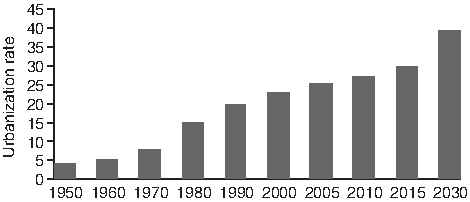
Urbanization in Bangladesh.
The urban population growth rate in Bangladesh is approximately 3.5% where 1.3% is the natural urban growth rate and the remainder (2.2%) is influenced by internal migration. During the last decade climate change has emerged as an environmental push factor and has been credited with amplifying the migration rate. 11
At present the total hardcore poor in urban areas is about 14.6 million, according to the World Bank, “who are earning less than US$1 per day.” Furthermore about 25% of this hardcore poor have migrated from rural areas and they have done so because of natural calamities and changes in the local physical environment, for example loss of farm land, loss of houses, and income opportunities. 12 This rapid migration is more prominent in Dhaka, capital of Bangladesh, according to the Department of International Development (DFID). 13 The DFID annual report estimates that about 55% and 32% of this city's population are absolute and hardcore poor respectively. Whereas only 2% (the elites) of the urbanites enjoy 15–20% of its residential areas, 50% of the poor and middle class people occupy only 6% of residential areas. Since the 1990s the country's GDP has increased due to foreign investment and international trade, but at the same time the poverty gap between rich and poor has widened considerably. This poverty gap is more distinct in urban than rural areas. Figure 2 illustrates the growth of GDP and the increase of the poverty gap in Bangladesh. 14
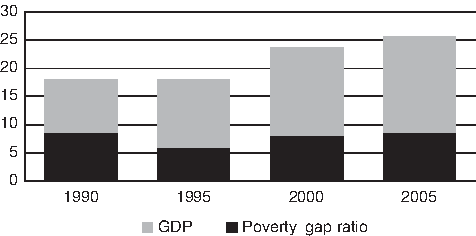
GDP and poverty gap in Bangladesh.
In 1991–92 the incidence of poverty in urban areas was 46.7% compared to 47.8% in rural areas. This situation was reversed in 1995–96 when rural poverty was 47.1% and urban poverty was 49.7%. By the year 2000 urban poverty had risen to 52.5% when the urban population was just half of the total rural population. 15
Within the last 30 years Bangladesh has been hit by more than 100 cyclones and about 60 flash floods along with other natural disasters including epidemics, drought, and heat waves. The coastal areas of Bangladesh are the home of almost 50 million people (1/3 of the total population) who are highly exposed to these natural disasters. For example about 9.2 million people, all from the south coast region of Bangladesh, were affected by storm surge and tropical cyclones in 2007–2009. 19.3 million people were affected by floods over the whole of Bangladesh during 1984 to 2007. Victims of natural disasters may be displaced from the security of their homes; some are displaced for a short time eventually returning and restart lives at the point of origin while others permanently migrate. Figure 3 shows the natural disasters in Bangladesh between 1980 and 2010. 16 Floods and cyclones are the most frequent and destructive natural forces.

Natural disasters trend in Bangladesh from 1980–2010.
At the same time the rural-urban population distribution has also changed at an alarming very rapid rate. According to the projected population census of 2001, by 2010 the rural-urban population will be roughly equal and by the end of 2020 the urban population will be double that of rural areas. Natural growth and traditional rural-urban migration cannot be the sole reasons for such a dramatic urban influx. Rather it could be argued that external forces are influencing the population distribution and challenging the urban system in Bangladesh. Between 1980 and 2010 natural disasters have acted as direct push factors for internal migration to the extent that it has altered the urbanization pattern and become a challenge for the urban planning system. Figure 4 shows the rural and urban population distribution in Bangladesh and it clearly demonstrates how the ratio has changed since 2010, right after cyclone SIDR 2007 and AILA 2009. 17
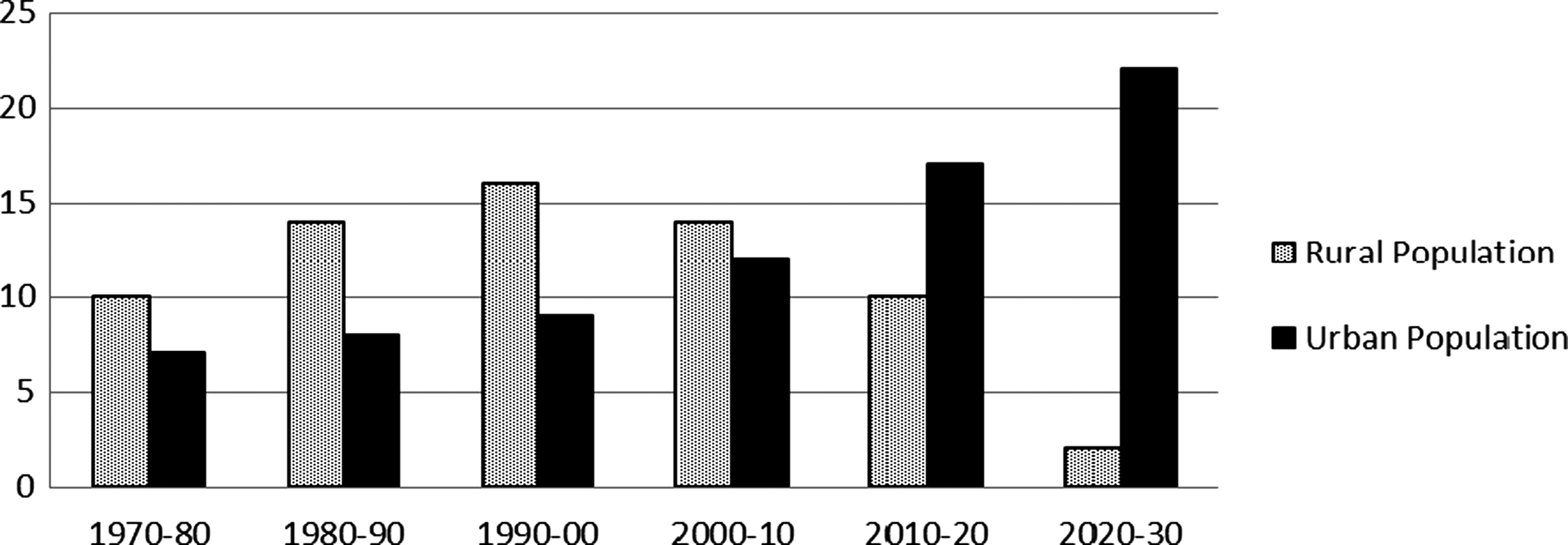
Rural-urban population distribution in Bangladesh 1970–2030.
The above two figures (3 and 4) clearly reveal that over the last decade the intensity and frequency of natural disasters, especially cyclones and floods, have increased while the distribution of population between rural and urban areas has also changed. This evidence raises the question “do climate events influence forced migration and changes urbanization pattern that need to be addressed in urban planning systems?”
Research Method
The south coast of Bangladesh is home to 35 million inhabitants at a density of 738 persons/km2. This density is projected to increase to between 40 and 50 million by 2050. 18 These coastal communities mainly depend on subsistence agriculture and fishing on the fertile plains along rivers and the coast. To understand forced migration and rapid urbanization in Bangladesh, this study involved a field survey in one of that country's south coastal cities—Khulna—which is the third largest city and coastal divisional headquarters on the south coast with 4394.46 km2. The total population in Khulna city is 2.5 million with a 3.8% population growth rate per annum. About 5.7% of the total urban population in Bangladesh is living in Khulna city, because of its industrial economy. Climate migrants coming from the poor communities along the coast areas have located themselves in the urban fringe and slums where they have cheap accommodation and access to low paid employment. With the help of local and national NGOs (non-government organizations) named “Pothik Krreith” and “Sheba,” a mass scale dialogue program was conducted with the local residents (around 700 people) to inform them of the research aim and to identify targeted people who had migrated due to varying climatic hazards. From that mass scale dialogue and participant list about 200 respondents were chosen as the targeted community. The targeted people had all migrated or been displaced from their original homes due to cyclones, flash floods, river erosion, or drought. The selected stratum was chosen from different Thanas (a Thana is a local government administrative boundary, mainly the area under a police station jurisdiction) so that diversity could be reflected in the sample. Out of the 200 selected people, 100 respondents were chosen through systematic random sampling, every alternate person being chosen to provide answers for the questionnaire survey. Figure 5 illustrates how the targeted community was selected in regard to the questionnaire survey.
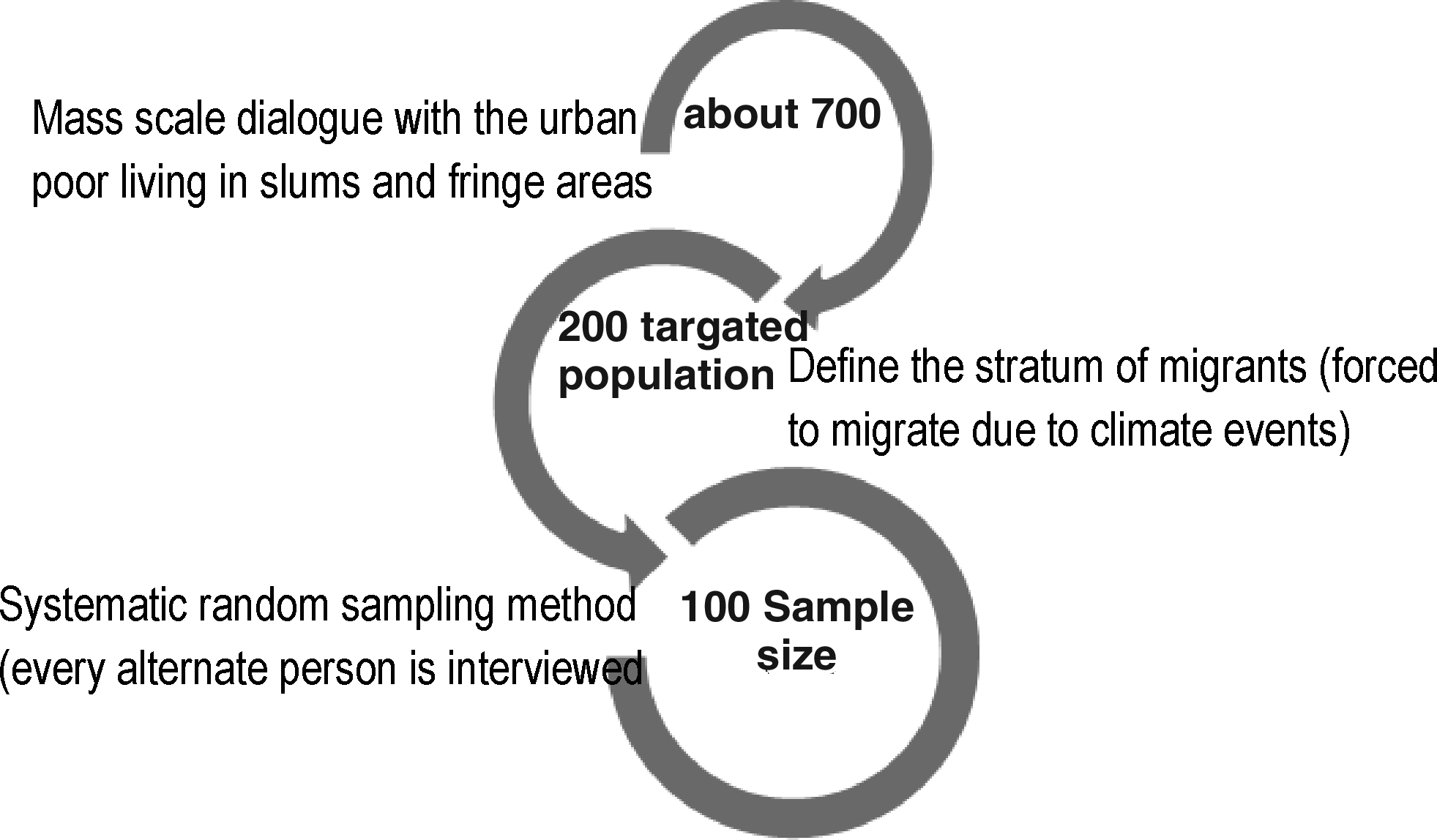
Systematic approach of selecting the questionnaire survey sample.
Over the last two decades frequent disasters, increases in soil salinity, river erosion, floods, tropical cyclones, and storm surges have forced the marginal coastal communities to migrate to other destinations in search of alternative livelihoods. Bangladesh has lost hundreds of thousands of lives due to catastrophic cyclones in recent history, one of the latest being Cyclone SIDR in November 2007, which causing almost 4,000 deaths. Moreover the frequency of cyclones in Bangladesh has increased more than five times compared to the last three decades. 19 Following SIDR, Cyclone AILA attacked on May 25, 2009. About half a million people were forced to leave their homes. More than 300 people died, about 1,120 people went missing and more than 200,000 were trapped in water. 20 In many such cases productive farmland is rendered useless as a result of inundation and subsequent salinity and in others it is permanently flooded, forcing residents to migrate. Such migration has taken place mostly into the southern coastal cities in Bangladesh. 21 In their search for alternative livelihoods displaced communities generally opt for urban destinations where employment opportunities and livelihoods are perceived to be available; hence they can be labeled climate migrants. Figure 6 draws the survey results and depicts the experiences of people who migrated to cities due to disasters caused by climate change. 22

Reasons for forced migration.
Migration resulting from climate change has increased since 2006 due to frequent disasters in the coastal region. This followed a spike of forced migration due to climatic hazards began in 1988 after a coastal flash flood. The highest level of migrations occurred in 2007 and 2009 immediately after Cyclones SIDR and AILA, which resulted in millions of people in coastal marginal communities becoming homeless and helpless. The fact that these migrants almost all sought refuge in a limited number of urban centers led to an unforeseen impact on the capacity of these towns and cities to accommodate the climate migrants. The urban planning system was badly compromised, as were land use dynamics and more importantly the livelihoods of migrants. Figure 7 23 shows the volume climate induced migration to Khulna since 1988. 24
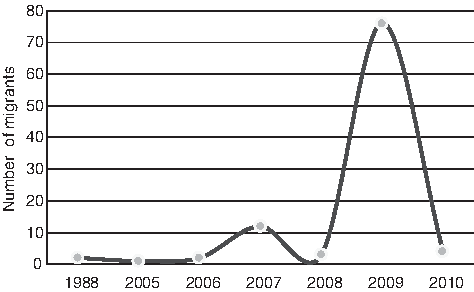
Change volume of climate induced migration since 1988.
Climate-driven environmental changes and subsequent migration on the scale reported here have huge potential to impact on many aspects of life in the receiving towns and cities, adversely affecting urban land use, increasing urban poverty, and generating high demands for housing, sanitation, water supply, healthcare, and other services. High demand coupled with limited, undeveloped, or nonexistent infrastructure and facilities in cities tend to push the migrant communities below the poverty line, and this represents a difficult problem for the already stretched city planning system. Forced migrants quickly accommodate themselves in urban fringe areas and sometimes squat on undeveloped government land. Unforeseen levels of climate migrants affect orderly development of cities, urban land use, and urban economy. The challenge for the urban planning system is how to address the consequences of migration induced by climate change.
Integrating Climate Change Induced Migration And Urbanization In The Urban Planning System
Planning strategies and policy in Bangladesh are developed and implemented at the national, regional, and local levels, 25 and they roughly correspond to other countries' federal, state, and local levels or central, provincial, and local levels. According to current planning practice in Bangladesh the “national level plan” is a mainly strategic plan while the financial plan covers economic and development issues. The national level planning process also addresses emerging issues and incorporates policy guidelines that address those challenges both at the regional and local levels. National level planning has a long-term vision and it is generally funded by government revenue and foreign government aid. The regional level planning system is responsible for preparing planning policy and guidelines for the individual region and supporting the local level planning authorities to develop and implement plans at the local level based on the national and regional planning policies. 26
Both the regional and local level planning systems are responsible for ensuring quality of life through a better urban planning approach that considers all urban planning challenges associated with the planning components, such has housing, sanitation, and land-use urban utilities. Therefore urban planning policy and strategies are directly connected to the planning challenges and actions to ensure quality of life. While climate change induced migration is being added it is a new planning challenge which is not clearly understood in the current planning practice both in national, regional, and local levels. Climate change not only threatens environmental quality but also threatens human lives, property, and future prosperity; communities are becoming more vulnerable. Floods, landslides, cyclones, and other natural phenomena are having a long-term impact on physical infrastructures like water supply, drainage, sanitation, waste management, and land use. The large-scale influx of climate refugees is putting immense strain on housing supply, increasing rates of squatting on both private and government land and creating economic and social stress. Whilst many new jobs have been created as result of climate migrants being prepared to work for low wages or simply in exchange for space to live, the capacity of the economy to expand in the short to medium term is finite. Social stress is also apparent from the survey findings with many households dependent on NGO support and charity and many individuals traumatized as result of their experiences. Successfully incorporating climate change impacts into regional and local level plan and development processes will largely depend on relevant institutions, planners, and agencies being well coordinated, recognizing the range and scale of the challenges facing them, and being sufficient resourced to prepare policy and undertake projects efficiently and effectively.
Bangladesh government published Bangladesh Climate Change Strategy and Action Plan 2008 with a 10 year (2009–2018) vision to build the capacity of the country to face the climate change challenges throughout the nations. For first five-year session (2009–2013) the plan is targeted to achieve six major pillars: (i) food security and health, (ii) comprehensive disaster management, (iii) infrastructure, (iv) research and knowledge management, (v) mitigation and low carbon management trajectory, and (vi) capacity building. 27 The plan was designed with guideline policies at the national level while there were no clear directions for the local and regional levels to develop and implement climate change action plans. Though the national plan addresses capacity building strategy to face the climate change challenges, there was no focus on who, when, and how to build climate resilience capacity. Therefore it is necessary to include local development plans into regional level sectoral plans and into national level development plans to ensure coordination among various planning hierarchies. Local government authorities are also responsible for local development plan implementation, the aim of such a plan being to develop a bridge between the government and the public so that they can work together on climate change risks within the ambit of urban planning. 28 Active hierarchical coordination, local plan preparation, community participation, and involvement of development organizations both at local and national levels are the key ingredients for a planning system to address uncontrolled urbanization. Therefore a decision-making framework is necessary to integrate climate migration and urbanization within the current policy and planning system.
The major problem in the planning system is lack of coordination in the decision-making framework. In order to overcome this issue it is important to involve the key planning and development authorities in the development of effective adaptation strategies. At the same time local level planning authorities need to be aware of the relevant outcomes of impacts when a new action plan is to be implemented. Figure 8 depicts a model decision-making framework, which incorporates new challenges in the planning policy and system. It includes hierarchical links that can assist in evaluating climate risks and enabling development of alternative policy options. 29
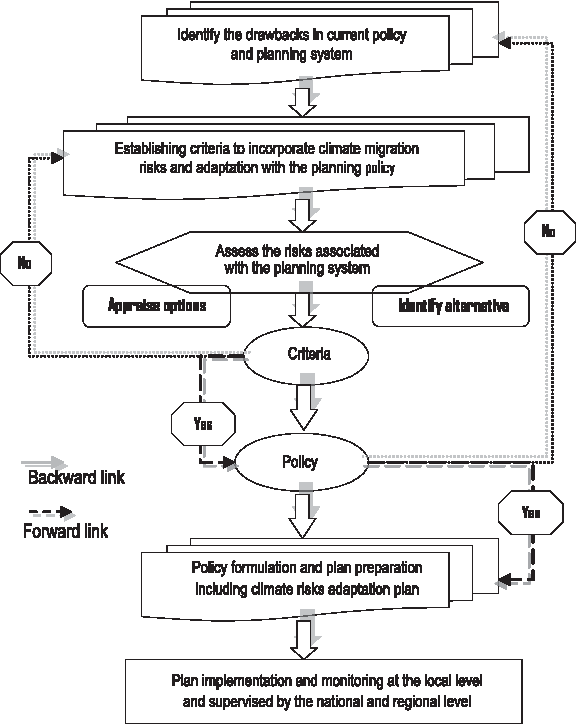
Decision-making framework that integrates climate change into the traditional planning process.
There are many avenues that can be pursued for integrating climate migration and planning policy. It is important to understand that climate migration is not a direct impact but instead a cumulative set of indirect impacts leading to changes that affect the whole development and planning system. Its impacts are physical, social, and economic as well as emotionally problematic and extend beyond the migrants themselves in that the population, physical environment, and infrastructure of the receiving communities are also significantly affected. Therefore coordination takes on an important role in the development of the planning response. Top-down recognition of the policy challenge is required as are bottom-up links between local and national level planning when climate change adaptation plans are designed and implemented. Climate migration and urbanization is more a local issue while climate change is a national issue but the two levels of government and planning need to recognize their relative contributions to the solutions.
Conclusion
Incorporating climate migration into the traditional planning approach is an important development strategy to ensure sustainable development with a long-term vision. Climate change impacts are not a steady or isolated process; rather they are events that are interlinked. Tropical cyclones in coastal zones cause land degradation and have been proven to increase urban poverty when environment or climate migrants have little or no infrastructure at their disposal. Indeed changes due to climate change can offset the effects in other sectors, namely, agricultural production, health, employment, and housing. Those cumulative impacts are increasing challenges for the existing planning system to address. Meanwhile the frequency of climate induced disasters and subsequent migration pressures increase and the entire urban system becomes more vulnerable as a result. Addressing climate migration in strategic planning is a vital step that developing countries' governments must take. Even though adaptation plans and strategies do exist they fail to deliver due to lack of coordination within the system. Addressing climate migration through planning options needs to be matched by a realistic recognition of priority needs in local, national, and sectoral planning. In effect it means understanding and working to create an urban disaster risk reduction strategy. A combination of top-down and bottom-up planning is required to address climate change and forced migration so that sustainable development and efficient use of resources is made possible.
Footnotes
Author Disclosure Statement
The authors have no conflicts of interest or financial ties to disclose.
1
Piguet, Etienne, “Climate change and forced migrating,” UN Refugee Agency Research Paper No. 153 (Jan. 2008).
2
Mayer, Norman and J Kent, “Food and Hunger in Sub-Saharan Africa,” The Environmentalist 21 (2001): 41–69.
3
Dun, Olivia and François Gemenne, “Defining environmental migration,” Refugee Study Centre Review Paper (Oxford Department of International, Development, University of Oxford, Oct. 2008).
4
Intergovernmental Panel on Climate Change (IPCC), “Assessment of observed changes and responses in natural and managed system,” Working Group II, Fourth assessment report for Intergovernmnetal Panel on Climate Change, Cambridge University (2007).
5
Raleigh, C, Jordan, L, and Salehyan, I, “Assessing Impact of Climate Change on Migration and Conflict, Social dimension of climate change,” Middle East and North Africa, Sustainable Development concept note, for World Bank (2008), <
6
International Organizations of Migration (IOM), “Migration and Climate Change,” International Organization of Migration Research Series 33 (May 2008) 31.
7
Sward, Jon, “Migration and climate change: how will climate shift affect migration trend,” Briefing on Migration, Sussex Centre for Migration Research, Sussex University (Sept. 2008).
8
Akter Thahera, “Climate change and flow of environmental displacement in Bangladesh,” Research paper, Environment Unit of Unnayan Onneshan, National development NGO, Dhaka (Jul. 2009).
9
Bangladesh Government, Bangladesh Bureau of Statistics (BBS), Population Census Report, 5th revised report (2010).
10
United Nations, “Urban Population Report for Global Population Estimation,” Population Report 2010, United Nations Population Database (2010).
11
Bangladesh Government, BBS, Population Census Report, 5th revised report (2010).
12
Shafi, A. “Poverty Alleviation and Urbanization in Bangladesh,” Research Paper for Urban Management Program, Asian Development Bank, Bangkok (1994).
13
Department of International Development (DFID), Rural and Urban Development Case Study—Bangladesh, DFID, Rural Development Report for Bangladesh, Dhaka (2004).
14
UNEP (United Nations Environment Program), Global Virtual University E-learning program, United Nations University (UNU), Tokyo, 2009. <
15
Bangladesh Government, BBS, Preliminary report on household income and expenditure, Ministry of Planning, Dhaka (2001).
16
Université catholique de Louvain, EM-DAT: The OFDA/CRED International Disaster Database, Brussels (2009). <
17
Bangladesh Government, BBS, Population Census Report, 5th revised report (2010).
18
Hossain, Rakibul, “Climate change environmental forced migrants and Rural-Urban migration: are big cities prepared in Bangladesh” (Conference paper, BRAC University, 2009). Paper presented at Urban Poverty and Climate Change—Infrastructures of Development Conference, BRAC University, BRAC centre, Dhaka; June 2009.
19
World Bank, “Bangladesh: Climate Change and Sustainable Development Report,” South Asian Regional Report 2000 (prepared for presenting country assessment report by World Bank Rural Development Unit, Dhaka, 2000).
20
Graham, L, “Bangladesh: 100 thousand still stranded from cyclone Aila,” Green fudge, UNDP, Dhaka (2009),<
21
Bangladesh Government, Ministry of Environment and Forestry, Dealing with disaster and climate change in Bangladesh (2008), Climate Change Cell report.
22
Ahsan Reazul, Karuppannan, S and Kellett, J., “Climate migration and Change of urban land uses in Bangladesh” (Proceeding paper, University Science, Malaysia, 2010); Ahsan, Reazul, Karuppannan, S and Kellett, J, “Climate migration and Change of urban land uses in Bangladesh” (Paper presented in 4th International conference on Built Environment in Developing Countries, School of Housing, Building and Planning, University Science Malaysia, Penang; Dec. 2010).
23
Ibid.
24
Ibid.
25
Rahman, G. Components of urban planning: Town Planning and the Political Culture of Planning in Bangladesh. (A H Development Publishing House, 2008), 113–161.
26
Ibid.
27
Bangladesh Government, Ministry of Environment and Forests, Bangladesh Climate Change Strategy and Action Plan 2008, Ministry of Environment and Forests, Government of the People's Republic of Bangladesh, Dhaka.
28
Bangladesh Government, Ministry of Environment and Forests, Characterizing Country Settings: Development of a Base Document for Bangladesh (2009), Climate Change Cell report.
29
Ahsan, Reazul, “Climate change; changing urban planning policy and system” (University of South Australia, 2010) (paper presented at postgraduate research colloquium, University of South Australia, Adelaide, Nov. 2010).