




Abstract
Abstract
Large-scale, intensive, industrial, corporate livestock production has increased steadily in all livestock sectors in the last half-century. Many humans suffer from various physical, social, and mental health problems resulting from corporate food animal rearing practices—namely through their environmental pollutants. The global poor, workers, and marginalized rural communities are the most susceptible to the environmental and general public health consequences of livestock agribusiness. The health consequences of livestock agribusiness require attention from public health researchers, policymakers, and social and environmental justice advocates.
Introduction
In addition to the barbarous treatment experienced by animals, contemporary livestock rearing practices have been shown to lead to various physical, social, and mental human health problems. Many of the health consequences are an outcome of CAFO and abattoir environmental pollutants. However, the global poor, workers, and marginalized rural communities disproportionately endure the environmental and general public health consequences of livestock agribusiness. This article demonstrates that the public health consequences of livestock agribusiness span environmental and social justice concerns. The movement for a sustainable and just food system necessitates communication and teamwork between environmental and social justice advocates.
Grain and the Global Poor
With the rise of corporate livestock production, global meat consumption has also steadily risen in developed and developing regions. 3 However, the rise in consumption is uneven across regions and classes. As meat consumption increased in the United States it became “identified with ‘the American way of life,’” resulting in a “dietary modernization” for the wealthy of developing countries (i.e., a shift from grain-based diets to meat-based diets) (74). 4 The global poor are dependent on cereal grains for sustenance. Thus, the global redistribution of cropland use from human food to the animal feed needed to support intensive, grain-based feedlots reallocates food from the poor to the rich. Walker et al. have illustrated the most glaring health contradiction of this global shift in diet: one billion people are overweight or obese largely due to increased meat consumption (as animal products are the primary source of saturated fats) while one billion people are malnourished due to reduced crop availability to sustain increased meat consumption for the wealthy. 5
The general, though unequally distributed, global increase in meat consumption has had dramatic effects on global human health for both the global poor (decreased food crop availability) and the more prosperous (increased saturated fat consumption). Further, increased meat production perpetuates corporate livestock production as it “provides artificially cheap meat for the consumer, and the consumer demand in turn fuels the IAP [industrial animal production] system” (354). 5 This association preserves and deepens the environmentally unsustainable practices of corporate livestock production 2 and, in turn, generates further consequences for human health (see Figure 1).
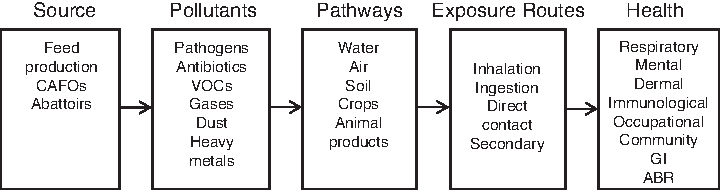
Livestock production's environmental health impact. Adapted from Walker PP, Rhubart-Berg P, McKenzie S, Kelling K, and Lawrence RS. Public health implications of meat production and consumption. Public Health Nutrition. 2005; 8(4): 348–356. VOCs: volatile organic compounds. GI: gastrointestinal disorder. ABR: antibiotic-resistant organisms.
Feed Production, Nitrogen, and Pesticides
The amount of nitrogen needed to grow feedstuffs has increased dramatically with intensive corporate farming practices; for instance, half of the grain produced in the United States is fed to livestock. 6 These demands are supplied largely by synthetic chemical fertilizer production. Much of the synthetic nitrogen created is inefficiently absorbed by feed crops and animals and ends up in the air and water through leaching, misapplication of manure to the land, runoff, and manure lagoon overflows and leaks. 7 Concentrations of nitrogen oxides in the air are linked to reactive airways disease, coughs, asthma, reductions in lung function, chronic respiratory disease, and respiratory tract inflammation.8–9 The nitrate that ends up in groundwater down the “nitrogen cascade” 10 can lead to reproductive problems, methemoglobinemia (especially in infants [“blue-baby” syndrome]), and various cancers. 9 Further, more pesticides are needed for increased feed production. 2 Pesticides harm human health by increasing the risks of poisoning, cancer, and immune, reproductive, and nervous system damage through direct contact or through food and water contamination. 5
Water, Food, and Feces
Nitrate is only one of the many hazards found in the 133 million tons of livestock manure excreted every year in the U.S. (13 times more than that produced by humans). 11 Animal manure contains various zoonotic bacterial and viral pathogens that can be ingested by humans via animal products and contaminated drinking water. Zoonotic pathogens are highly correlated with the cramped and unsanitary conditions in CAFOs and abattoirs that operate at very high, deregulated speeds. 12
Because Escherichia coli O157:H7 (E. coli) infections are so deadly, E. coli is one of the more well-known pathogens related to livestock production, though it is not common (62,000 U.S. illnesses a year). 13 E. coli can cause bloody diarrhea, irritable bowel syndrome, seizures, comas, high blood pressure, severe kidney damage, and death. Usually originating from cattle manure, E. coli can contaminate drinking water via runoff or end up in food. Collecting over 1,000 food samples from various retail markets, Minnesota medical researchers found that almost seventy percent of the pork and beef samples and over ninety percent of the poultry samples were contaminated with fecal matter. 14 More worryingly, E. coli bacteria was found in almost half of the poultry samples. Cargill Meat Solutions (one of the largest beef cattle firms) was recently forced to recall thousands of pounds of beef. 15
Salmonella and Campylobacter illnesses are much more common than E. coli, with 3 million U.S. foodborne illnesses a year. 13 Salmonella and Campylobacter, originating from chickens, can contaminate food through feces, leading to diarrhea, stomach pains, and, less commonly, death. Just recently, Wright County Egg (a huge firm with multiple CAFO units) was forced to recall millions of eggs due to Salmonella contamination. 16
Bovine spongiform encephalopathy (BSE) (“mad cow disease”) (Creutzfeldt-Jakob disease in human form) and H1N1 (“swine flu”) recently infected thousands and scared millions. BSE was created by making cattle into cannibals via meat and bone meal—a practice originating from intensive operations to cut costs. 17 Schmidt has speculated that the H1N1 outbreak evolved due to factory farming and may have originated from a Mexican factory farm, but there is still not enough conclusive evidence showing where the strain developed. 18
Heavy metals, phosphorus, hormones, and pharmaceuticals have all been found in drinking and recreational water due to CAFOs.2, 19–21 Heavy metals are used as growth promoters in feedstuffs and are not absorbed well by livestock. Copper, zinc, arsenic, cobalt, iron, manganese, cadmium, and selenium are commonly added to livestock feed, accumulate in their waste, and can cause various dermal, nervous, and immune disorders when ingested and accumulated by humans. 2 Next to pathogens and nitrate, the mass amounts of veterinary pharmaceuticals used for animals in intensive operations are one of the leading concerns of livestock production-related public health issues.
The (MIS)Use of Pharmaceuticals
It is estimated that over seventy percent of all antibiotics manufactured in the United States are used for producing livestock. 22 The massive amount of veterinary pharmaceuticals used in intensive livestock production is to keep food animals “healthy” in the extremely crowded and filthy conditions where they grow (therapeutic) and to promote rapid tissue growth (nontherapeutic). 23 The great majority of antibiotics used in livestock production are for nontherapeutic purposes. 22 Because many of the antibiotics used for livestock are related to antibiotics used to treat humans, scientists and the United Nations are growing increasingly concerned about more quickly developing and more diverse antibiotic-resistant strains of bacteria;22, 24–25 however, more research is needed to determine the long-term impacts of exposure. 7
Workers and the Surrounding Community
Livestock agribusiness has consistently shown to negatively affect rural community well-being: firms avoid local taxes, reduce housing market prices, and shut down operations when markets are bad, leaving contract farmers with overhead costs. 26 Further, CAFOs are usually unwanted by rural communities and are disproportionately placed in low-income areas with less political influence. 27 Thus, poor communities penetrated by CAFOs further suffer economically through lessened property values and the “proletarianization” of small farmers through unbalanced and unjust contractual agreements. 28 These communities have been shown to be at greater risk for various physical, mental, and social health problems due to neighboring CAFOs. 27 In North Carolina, physical health problems associated with high-density livestock production include respiratory problems due to increased exposure to air pollution.29–30 Increased rates of posttraumatic stress disorder, anxiety, and depression have been linked to the economic stressors and declining quality of life caused by neighboring CAFOs.31–32 The leading social health impact associated with high-density livestock production areas is the impact on quality of life due to the foul and far-ranging odors emitted by CAFOs. 27 Communities that once depended on outdoor activities for identity formation and networking must now take cover indoors due to the overwhelming smell. As Donham et al. stated, “[h]omes are no longer an extension of or a means for enjoying the outdoors. Rather, homes become a barrier against the outdoors that must be escaped” (318). 27
CAFO workers, most without adequate or any health care, experience a vile work environment of manure gases (including ammonia), odors, bacteria, and dust. 33 Due to these unsanitary conditions, up to thirty percent of CAFO workers suffer from respiratory diseases. 12 The conditions for slaughterhouse workers have not fundamentally improved since Upton Sinclair's century-old critique. 34 To increase profits, slaughterhouses operate at dangerously quick tempos without suitable protective equipment and workers experience high rates of injury and repetitive motion syndrome. 35
Toward a Healthy Food and Social System
As this essay has shown, the environmental health problems created by livestock production are unequally distributed due to, and perpetuated by, social stratification. Thus, to achieve the goal of a sustainable agriculture—sustainable for the environment, humans, and animals—would also mean confronting the unjust social formation that preserves these environmental health impacts. A growing body of literature shows that a genuinely sustainable food system may need to eliminate the production of meat altogether.36–38 In opposition to the growing global thirst for meat, these scholars have claimed that a healthy and ecologically-sound agriculture would include universal vegetarianism as a consumptive counterpart. Indeed, a recent United Nations report has concluded that the production and consumption of meat is simply unsustainable and advices a shift from animal-based diets to plant-based diets. 39
Social and environmental justice advocates must struggle to remove corporate livestock production from the food system. This potential may be outside the limits of a socioeconomic system that values profit-maximization more than health. Thus, the push for a healthy, plant-based, and sustainable food system is fastened to the push for a healthy and just social system. As the critical theorist Max Horkheimer declared over sixty years ago, “[t]he subjugation of nature will revert to the subjugation of man, and vice versa, as long as man does not understand his own reason and the basic process by which he has created and is maintaining the antagonism that is about to destroy him” (177). 40
Conclusions
The public health consequences of corporate livestock production are substantial. Increased meat consumption increases saturated fat consumption, which is linked to heart problems, diabetes, stroke, and cancer. The mass amount of feed grain demanded by intensive livestock production not only further contributes to the health risks associated with nitrate and pesticide leaching and contamination, but also robs food grain from the poorest people in world. The filthy conditions at CAFO sites due to the concentration of animal manure are related to various water borne and foodborne zoonotic pathogens. The massive use of veterinary pharmaceuticals, utilized mostly for growth promotion, is associated with antibiotic-resistant pathogens. The rural communities with CAFOs are at increased risk for various physical, social, and mental health problems. CAFO and livestock processing workers are subjected to filthy and unsafe working conditions with low pay and few health benefits.
The health consequences of factory farming require attention from public health researchers, policymakers, and social and environmental justice advocates. The negative health consequences associated with corporate livestock production extend across environmental and social justice concerns. As the public health consequences are experienced disproportionately by marginalized communities, social justice advocates must collaborate with environmental justice advocates in promoting and creating a more just and sustainable food system founded around meeting the needs of both humans and the rest of the biosphere.
Footnotes
Acknowledgments
I would like to thank Dr. David Ashley, Dr. Richard Machalek, Dr. Angela Jaime, Dr. Anna Zajacova, and Lindsey Grubbs for helpful comments on an earlier draft of this paper. I owe special thanks to the University of Wyoming's Sociology Department for the 2011 Chet Meeks Scholarship Award.
Author Disclosure Statement
Mr. Gunderson has no conflicts of interest or financial ties to disclose.