




Abstract
Abstract
Differing attitudes towards development and relationships with nature constitute some of the most significant causes of conflict among peasant and indigenous communities involved in large-scale mining projects. Both the state and the mining companies try to impose a fetishized interpretation of mining, envisioning it as fate, as the only way to bring economic growth to the high Andean regions, a view to which all community expectations and ways of life must be subject. It is a fetishism that shows the world upside down: “it is mining that accounts for society and not society that accounts for mining.” With this logic, other forms of development are denied, and the legitimate territorial defense on the part of the peoples is undermined. However, community mobilization in defense of shared rights is effectively unmasking this point of view. The peoples' actions bring light to a central issue: the right to self-determined development.
Introduction
Challapata, for its part, has become an example of the extent to which a people can keep and defend their right to freely determined development—in this case, agricultural, livestock, and dairy production—through shared perseverance. Their fight was the result of a difficult decision made 16 years ago that has since been strengthened by successful agricultural production.
The two cases share the same problems: they are facing not only specific mining projects, but also a fetishized interpretation of mining and national development.
The purpose of this article is to highlight the contribution of these two cases to the fight against development mining fetishism. Towards this goal, the first section deals with a brief explanation of what we mean when we talk about mining fetishism. The two following sections describe the main events of both conflicts. Finally, we conclude by underlining the outcomes of both cases.
Fetishized View of Mining
Intensive mining has been ongoing in Bolivia since the country gained independence. However, contrary to the promises made in each of the mining boom periods, the results have not been the much-anticipated socio-economic development; poverty has not been reduced and quality of life has been negatively affected by severe environmental degradation in mining regions.1
The consistency of mining activity throughout national history has led many to say that Bolivia is “a country with a mining vocation.” In the high Andean regions, such as the Department of Oruro, the saying has become a chorus: “Oruro was, is, and will be a mining region.”2 In this way, a fetishized view of mining is revealed, where it is seen as an inescapable fate, taking place above society, instead of as an activity performed by social actors. As Magnet3 says, there is an upside-down perception of reality, in that mining determines society's development rather than society defining the conditions of mining.
Mining fetishism has also been used as ideological armor. Instead of a proper evaluation of risks and potentials, instead of incorporating mining into other economic sectors, and instead of respecting environmental standards, the fetishized view of mining demands that the country and its legal, institutional, economic, and social structures, as well as its environmental conditions, adjust their standards in order to facilitate mining. From this viewpoint, defense of collective rights over ancestral territories, concern for ecological impact, and regulation of pollution are all considered obstacles to mining and, therefore, to development.
It is within this context that conflicts arising in rural and indigenous communities against the risks and impacts of mining in their territories provide a radical critique to the fetishized view. These conflicts defend the right of peoples to a freely determined development.4
The Coro Coro Conflict: The Right to Prior Consultation When Activities Affect Ancestral Territory
The Coro Coro region is located about 60 km southwest of La Paz City. It has historically been part of the Jach'a Suyu Pakajaqi ancestral territory.5
In June 2008, the Bolivian government, the state Corporación Minera de Bolivia (COMIBOL), and the South Korean company Korea Resources Corporation (KORES), signed the Risk Contract for the exploitation of the Coro Coro copper deposit. The project was to be carried out in two stages. The first phase would consist of regional prospecting by KORES and installation of a hydrometallurgical plant by COMIBOL. The second phase, of which KORES would be in charge, assisted by an investment of USD 210 million, would end regional prospecting and begin open-pit activities in order to process 10 to 15 thousand tons of copper daily and produce 30 to 50 thousand fine metric tons (FMT)/year of copper.6
The hydrometallurgical plant, in the first stage, had a treatment capacity of 300 tons/day of mining leftovers and waste from old operations, with the aim of recovering cathode copper at a pace of 390 FMT/month. The plant started operations on October 27, 2009. During its installation, COMIBOL occupied, without consent, nearly 15 hectares (ha) belonging to ayllu Huacasayaña in order to build the residues dam. It also expanded water conveyance works in the Pontezuelo River, ayllu Sikuypata. The effects of the subsequent decrease in water flow on the local population and the river ecosystem were not evaluated, nor were they discussed with affected individuals. Those actions undermined the right to prior consultation and consent, as stated in the International Labour Organization (ILO) Agreement No. 169, the United Nations Declaration on the Rights of Indigenous Peoples, and in the State Political Constitution passed in February 2009.7
Before these abuses, the peoples' authorities of Jach'a Suyu Pakajaqi had, as of December 2008, repeatedly asked for information about the mining project and their right to prior consultation from the Ministry of Mining, COMIBOL, the Legislative Assembly, and even President Evo Morales, all without any success.
On November 22, 2009, the community members of ayllu Sikuypata, tired of being ignored, restored the Pontezuelo River's natural channel, cutting the water supply to the hydrometallurgical plant. The government reacted to this incident through the Minister of Mining, who publicly called it “an act of terrorism.”8 However, the measures taken by the peoples obliged the government to sign a covenant with the representatives of Jach'a Suyu Pakajaqi, agreeing upon the enforcement of prior consultation and compensation for possible damages.
The promised consultation timetable was not adhered to, however, due to aggressions on the part of hydrometallurgical plant staff, who did not want such a process to work. Since then, the government, despite acknowledging its duty to consult the ayllus and respond to environmental concern, has been evading responsibility, hiding behind the opposition of miners and the lack of legal and institutional mechanisms.
Due to the government's unwillingness to solve the claims of the ayllus of Jacha Suyu Pakajaqi, the peoples' authorities have decided to present the case before the Inter American Human Rights Commission (IAHRC) in a hearing during the 140th Period of Sessions, hoping that taking this step will force the Bolivian government to comply with the right to consultation.
Challapata: The Right to Self-Determined Development
The Municipality of Challapata, located 120 km from the City of Oruro, is known as the “Farming, Livestock and Dairy Region of Western Bolivia,”9 a title that acknowledges the importance of these activities to the region since the installation of the Tacagua Dam and irrigation system in 1961.
Livestock in the area is estimated at about 11,108 cattle, with an average of 13.8 cows per family, and 60,000 sheep, with an average of 70 sheep per family. Milk production (only cattle) yields 36,000 L/day in summer and 19,000 L/day during winter.10
Due to this significant production, the Irrigators' Association successfully convinced the government to install a dairy processing plant with a capacity of 18,000 L/day, which was officially opened by Evo Morales on February 9, 2011.
It is estimated that farming, livestock, and dairy production in the region generates an economic revenue of about 5 million dollars per year, with the likelihood of future increases due to the operation of the dairy processing plant and the projects that are now being carried out to dredge the dam. The increase in employment due to these activities is estimated at 1,200 direct jobs, corresponding to the number of people affiliated with the irrigation system, and nearly 2,500 indirect jobs connected to the processes of trade, transport, services, and others.
The mining threat
In 1993, the Bolivian Canadian Consortium EMUSA-ORVANA started mining prospecting work in the Achachucani Hill, located about one thousand meters from the Tacagua Dam in Challapata. Preliminary reports showed the existence of a mineral deposit estimated at nearly 51.6 million tons, containing 2.3 million ounces of gold.11 Based on this data, the company announced its goal to begin a large open-pit operation using cyanide-leaching methods.
This announcement was immediately concerning to the communities that relied on the irrigation system, given that the mining project was to be located very near the Tacagua Dam (see Figure 1), and they feared severe impacts. During the last quarter of 1993, representatives of communities requested information from both the company and the government about the mining project, but they could get no answer to their claim.
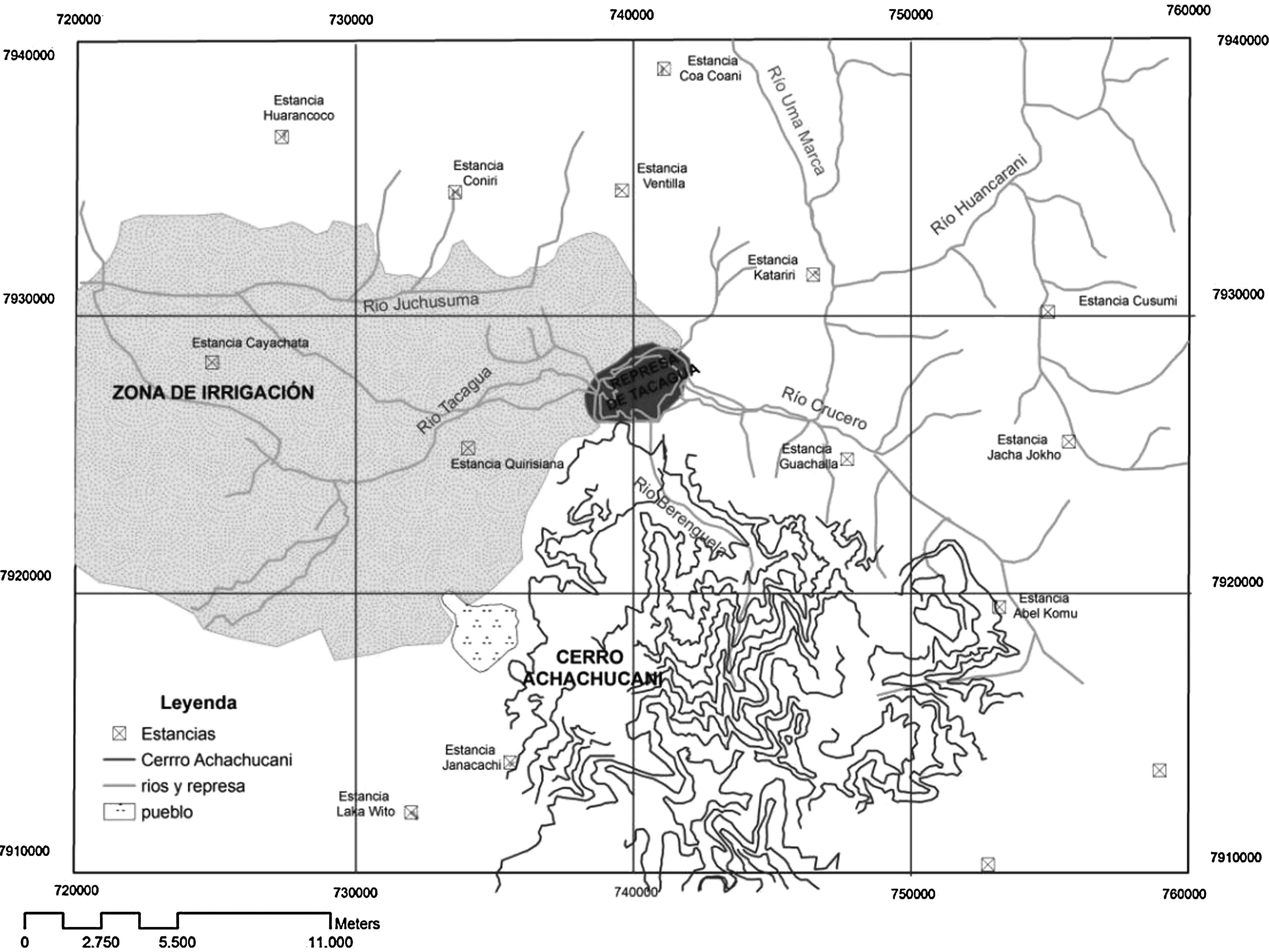
Map of the mining project and Tacagua Dam. Source: Silvana Lafuente, based on cartographic information taken from the Military Geographic Institute.
Given the silence of the company and authorities, in January and February of 199412 the communities of Challapata mobilized. They blocked the road between Oruro and Potosí, which goes through their territory and constitutes the main artery flowing towards the south of the country. This decisive action obliged the company to stop its prospecting activities and evict its staff from the area, thus adjourning the mining project indefinitely.
In 2007, during a period of high international gold prices, the Achachucani extraction project was resumed, this time by another Canadian company, Castillian Resources, which installed equipment and staff in the area to start prospecting work again.
In May, the communities responded again, blocking the road from Oruro to Potosí for nearly a week, evicting the company from the area, and forcing the department government to pass Administrative Resolution No. 205/2007, which included the following provisions:
Article 1 “Any mining company, including Castillian Resources Bolivia S.A., shall abandon the intention to carry out mining activities in the Achachucani region, as said company complies neither with the corresponding social license nor with the environmental licence, both of which are essential for any mining activity that respects the integrity of the productive areas of the Department of Oruro.”
However, international gold prices soon reached record levels,13 providing enough of an incentive for Castillian Resources to violate the majority will of the Challapata communities. This company is currently deploying a strong advertising campaign in local media, extolling the supposed benefits of mining, with the clear aim of dividing opinions within the communities. At the same time, the company is lobbying both the national and departmental government authorities, with the aim of garnering their support for and authorization of the project, as the following media notes indicate:
“Our country is rich in different mineral deposits,” the governmental authority said (Deputy Minister for Mining Metallurgical Development), while simultaneously confirming that a Canadian company was exploring a potential gold mine adjacent to the Challapata population.14 “The Achachucani exploitation project was presented yesterday to the Communication Unit of the Government of Oruro, before the Mining Commission members of the Department Assembly, the Secretary of Mining, and the Secretary of Mother Earth and Environment.”15
In response to the harassment in the form of company advertising, the communities, together with the political and administrative authorities and Challapata social organizations, held a general assembly on February 4, 2011. They issued a resolution in which they declared their united rejection of mining exploitation. The resolution was personally delivered to President Evo Morales when he opened the dairy processing plant. The main points state the following:
Despite their determination to defend their agriculture, livestock, and dairy production, Castillian Resources has not stopped its media campaign and continues to influence the government. The communities feel justifiable fear regarding, above all, the authorities' behavior, given that in recent times the government has defended large-scale extraction projects, such as in the case of San Cristóbal mine and the Japanese company Sumitomo.
Conclusion
By way of conclusion: there are lessons from both cases.
The Bolivian State has tended to assume a rigid attitude towards mining, which remains unchanging regardless of turnovers in government and administrative variation. As far as the State is concerned, mining is synonymous with national development. In adopting this attitude, the State assumes the role of guarantor and promoter of this activity's prerogatives. This attitude is transformed into a legal and institutional reality when, for example, it is revealed that current legislation names the mining industry as a “public utility,” indicating its priority for the State and guaranteeing its access to and use of natural resources such as water and soil.
One is therefore faced with a fetishized vision of mining, which is rooted in the State by laws that privilege it over and above the interests of civil society.
As discussed in this article and despite their differences, the conflicts in Coro Coro and Challapata are both challenging the fetishized view of mining that is expressed by State policies.
In the first case, the actions of the State and the miners demonstrate fetishization. Here, it was considered normal and legal for the mining company to occupy other people's land and to alter the course of the river that runs through the communities in order to store water, as if this region existed for no purpose other than the mine. On the other hand, when the residents of the communities decided to reclaim their lands and to restore the natural course of the river, their actions were considered an “act of terrorism.”
In the case of the communities of Challapata, successful resistance to the open pit mine, which has characterized the region from 1994 to now, proves that there are other visions of development, and that it is possible to see the mine in a different light. Their consistent defense a development based in agriculture, livestock, and dairy production suggests that for these communities large-scale mining is not a productive activity, but is rather predatory and high-risk.
Currently, Bolivia is facing the challenge of putting into practice the ideas laid out in its New Political Constitution, which notably includes the consolidation of a plurinational state, understood to imply the full participation of all indigenous groups in public decision making. One of the lessons learned in the previous cases is that until Bolivia is able to overcome the fetishization of development mining, the creation of a “plurinational” state will face serious obstacles. One can hardly produce plurinationality when the State identifies with only one form of socio-economic development, denying other possibilities and opinions that vary from that of mining.
These are also challenges for the local communities: to unmask the fetishism of development through their struggles and to remove the veil that until now has obscured the knowledge that mining is an activity that should be at the service of society, and not the other way around.
Footnotes
Acknowledgments
The Guest Editors gratefully acknowledge translation support provided by Ana Maccioni, National University of Cordoba.
1
United Nations Development Program: Report on Human Development in Bolivia, 2007.
2
Advertising agency's message for mining companies' campaigns in the City of Oruro.
3
Jordi Magnet Colmer, “Fetichización Jurídica del Derecho,” Nómadas: Revista Crítica de Ciencias Sociales y Jurídicas 20 (Barcelona: Universidad de Barcelona, 2008).
4
Raquel Yrigoyen, “De la tutela indígena a la libre determinación del desarrollo, la participación, la consulta y el consentimiento,” (Lima: Instituto Internacional de Derecho y Sociedad-IIDS, 2009).
5
Suyu: pre-colonial territorial political organization. Jach'a Suyu Pakajaqi (in Aymara Jach'a=great, Suyu=region, equivalent to “Great Region”) is now the Province of Pacajes (Spanish version of Pakajaqi), subdivided into 10 markas (minor territorial political organizations), which at the same time are subdivided into Ayllus (territorial unity equivalent to a community).
6
Gustavo Soto, “Neodesarrollismo y Derechos Indígenas en Bolivia,” (CEADESC, December 2010).
7
See Article 32 of the United Nations Declaration on the Rights of Indigenous Peoples, and Article 30, II, 15 of the Plurinational State Political Constitution of Bolivia.
8
“Comunarios cortan el agua a la planta Coro Coro.” Minería de Bolivia. November 26, 2009. <
9
See Leyes de la República N° 2516 dated October 24, 2003 and N° 2632 dated on March 5, 2004.
10
Angela Sempertegui Cuenca, “Reporte sobre el municipio de Challapata,” (Oruro: Documento de trabajo colectivo CASA, February 2011).
11
Emilio Madrid Lara, Nilda Guzmán et al. “Historia de la Minería de Oro en Bolivia—La Lucha de Challapata (Oruro),” Ecología Política 28 (Barcelona: Icaria, 2005).
12
Ibid.
13
In November 2010 gold quotation was US$1325 per troy ounce. On February 25, 2011 a troy ounce was quoted as US$1409.
14
La Patria (Newspaper), July 31, 2010.
15
La Patria, November 28, 2010.