




Abstract
Abstract
In this article, heavy metal concentrations of lead (Pb), cadmium (Cd), and zinc (Zn) in industrial, agricultural, and highway soils in the north of Iran (Amol-Babol) have been investigated. The soil samples were collected randomly from the identified areas and after transfer to the laboratory, they were dried in an oven and then ground by mill and passed through a 2 mm polyethylene sieve. A mixture of HNO3 and HCL was used to extract the metals existing in samples. The measurement of Zn, Cd, and Pb was done by Perkin-Elmer Atomic Absorption Spectrometer (AAS), model 603, after filtration by number 42 Whatman paper. Mean concentrations of the metals were calculated in mg/kg in industrial, agricultural, and highway soils, respectively as follows: Pb 213±132, 19.70±9.5, 84±38; Cd 4.90±3.80, 1.9±1.2, 0.95±0.40; and Zn 214±111.50, 112±47, and 107±39.50. The highest concentration of these metals was observed in industrial area soils. According to the obtained results, the mean concentration of Pb and Cd in the industrial areas of Amol and Babol was more than the permissible limit of Iran's environment conservation organization and Zn concentration in all of the studied regions was less than the permissible limit (400 mg/kg). A significant statistical difference has also been observed between the mean concentration of Pb, Cd, and Zn in the industrial, agricultural, and highway soils and their background concentration.
Introduction
Lead is systemic poison that causes diverse effects in the human body such as hematic, neurotic, digestive, and osteoid diseases. Lead typically enters the environment through gasoline fuels containing lead. In recent years, because of the removal of lead from gasoline, its entrance to urban environments has been decreased significantly, but its previous accumulation remains in the environment and soil (Morton-Bermea et al., 2003; Ebbs et al., 2003).
Cadmium is a potential heavy toxic metal that can accumulate in the human body and remain there more than 10 years. The main acute effects of human exposure with cadmium include functional deficiencies of nephrogenic, respiratory and osteoid systems (Pichtel et al., 2004). This substance is also used in electroplating, pottery, tile, plastic, dye, pigment production, chemical fertilizers, and pesticides. An important area of cadmium contamination is the soil surrounding agricultural land where phosphorous chemical fertilizer or sewage sludge have been used to fertilize the soil. This metal also exists in industrial waste landfills, especially used cadmium batteries (Iskandar and Kirkham, 2005; Lasat, 2004; Morton-Bermea et al., 2003; Liu et al., 2003). According to present research, the amount of phosphorous fertilizer applied in the world will be duplicated over the next 25 years, and so increase the cadmium concentration in the agricultural soils (Pichtel et al., 2004).
Although zinc as a micronutrient for plants is very effective for proper growth and development, in high concentrations in the soil it is toxic to plants, animals, and humans (Chaney, 1998). The most important industrial resources of this substance are electroplating and metal melting industries, industrial waste landfills, etc. (Liu et al., 2003).
In other research done by Delijani et al. on the economical and industrial region of South Pars, the concentration of the heavy metals, Pb, Cd, and cobalt, in soil was measured, and it was determined that the concentration of these substances in the soil surrounding industry and factory sites was significantly higher than in other areas (Delidjani et al., 2009).
In the study performed by Aydinalp and Marinova (2003), the concentration of Pb, Cd, nickel, and Zn was investigated in agricultural soils of Bursa city in Turkey. In this research, the mean concentrations of Pb, Cd, nickel, chromium, and Zn obtained were 80.9, 2, 157.8, 124.5, and 476.7 mg/kg, respectively (Aydinalp and Marinova, 2003). In other research, the relation of traffic factors with the concentration of Pb and Cd in the surrounding soils of Isfahan streets was investigated. In this study, the mean concentration of these metals on 50 m distance from street sides was more than their background concentration (Samani et al., 2008).
Because of the existence of valuable natural resources, Mazandaran Province has been considered as the agricultural and tourism core of the country. On the other hand, the exploitation and operation of natural resources in agricultural, tourism, and industrial sectors has caused serious damage to the environment and human health of this region of the country. It is recommended that supervision of the environmental health condition of these regions will be necessary. In the present research, the concentrations of Pb, Cd, and Zn in the industrial and agricultural areas of northern Iran (two cities of Amol and Babol) and also the highway between these towns was studied.
Materials and Methods
This is a descriptive-analytic and cross-sectional research study, which was performed on agricultural and industrial areas of Amol and Babol and also the highway between these towns in 2009–2010. In this study, the required samples (192 samples) were taken from the different intended areas (Figure 1) at a 10 to 15 cm soil depth, gathered in one kilogram plastic bags, and transferred to the water and wastewater chemistry laboratory in the School of Environmental Health, Babol University of Medical Sciences. After drying and grinding, these samples were passed through a 2 mm polyethylene sieve. The extraction and separation of heavy metals (Pb, Cd, Zn) from the soil was performed by an acidic digestion method, and its features are presented in Table 1. These metal concentrations were measured by atomic absorption spectrometer on wave lengths of 283.5, 228, and 213.9 nm, respectively, in order to measure the concentration of Pb, Cd, and Zn in soil. The other methods for determination of soil assessment parameters such as cation exchange capacity (CEC), granulating, organic carbon, and PH are presented in Table 1.
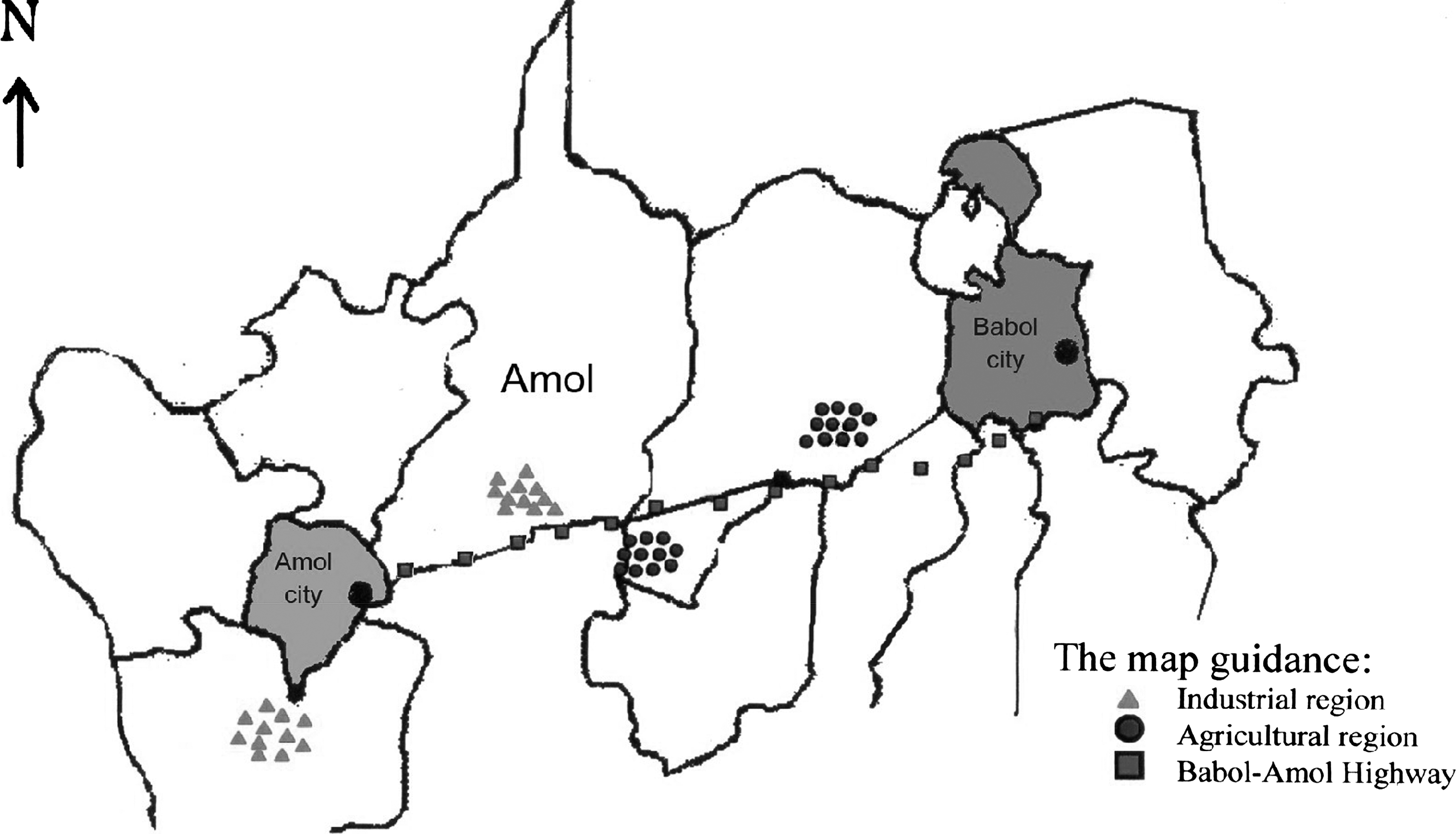
The sampling points of the studied areas.
Results
The highest concentration of Pb (432 mg/kg) was found in the soil surrounding the industrial areas and the factories in the west side of Babol. The lowest concentration of this metal (10.25 mg/kg) was found in agricultural areas of Babol. Mean and standard deviation of Pb, Cd, Zn concentration in soil as mg/kg are presented in Table 2. The statistical analysis by Tukey test on variance analysis has also shown a significant difference between the mean concentration of Pb in industrial, agricultural, and highway soils and also in the agricultural soils and the surrounding soils of the Amol-Babol Highway (p<0.05).
Standard of Environment Protection Organization of Iran (IECO, 2003).
In this study, the mean concentration of Pb in the surrounding soils of industrial regions of Amol and Babol was 213 mg/kg. The statistical analysis by SPSS software has also shown a significant statistical difference between the mean concentration of Pb in the industrial regions and Amol-Babol Highway, and unpolluted soils (background concentration) (p<0.05). The minimum and maximum concentrations of Pb in industrial regions obtained were 41 and 432 mg/kg, respectively. The highest and lowest concentrations of Pb in the surrounding soil of Babol-Amol Highway were reported as 15 and 185 mg/kg, respectively.
The mean concentration of Cd in industrial, agricultural, and highway regions was more than the background concentration of this metal, such that statistically there is a significant difference between the concentration of this metal in the studied soils and its background concentration (p<0.05). The highest concentration of Cd is related to the surrounding soils of industrial centers (11.7 mg/kg) and its lowest amount is found in Amol-Babol Highway (0.55 mg/kg).
The maximum concentration of Zn was found in the soil surrounding the industrial regions (325.65 mg/kg). While this metal concentration in the soil surrounding Amol-Babol Highway was lower than the other studied areas (Table 2), the statistical analysis by ANOVA has also shown a significant difference between the mean concentration of this metal in industrial regions and agricultural and surrounding soils of the highway (p<0.05). There was no significant difference between the mean concentration of Zn in agricultural regions and the surrounding lands of Amol-Babol Highway (p>0.05). The maximum concentration of Zn was found in industrial regions and the minimum was found in Amol-Babol Highway soil (67.5 mg/kg). Statistical analysis by ANOVA has also shown a significant statistical difference between the mean concentration of Zn in industrial regions and the soils of the other regions (p<0.05). There was a significant difference between the mean concentration of Zn in agricultural areas and Amol-Babol Highway with its background concentration (p<0.05). Although in the present research, several differences have been observed between the mean concentration of Pb in agricultural regions and Amol-Babol Highway, these differences are not statistically significant (p>0.05).
Discussion
By the comparison of these kinds of soils with natural and unpolluted soils of the studied regions, it can be concluded that the industrial regions and the surrounding soil of Amol-Babol Highway are among the relatively polluted soils with Pb, such that the concentration of this metal in some of the studied samples is higher than the permissible limit. According to the results of the other scientists' researches in this regard, the soils of the studied industrial regions have a lower pollution. In a study on industrial region of Rajestan State, India, the concentrations of Pb, Cr, Cu, and Zn were reported as 293, 240, 298, and 1364 mg/kg, respectively (Krishina and Grovil, 2004). In the research performed by Shallari et al., the maximum concentration of heavy metals (Pb, Cd, Zn, Ni, Co) in one of the industrial regions of Albania were obtained as 172, 14, 2495, 3579, and 476 mg/kg, respectively (Shallari et al., 2008). In other research by Krishina et al. on the industrial regions of Gojerat State, West India, the concentrations of Cr, Ni, Co, and Zn were reported as 305.2, 79.1, 51.3, and 139 mg/kg, respectively (Krishina and Grovil, 2007). In research done on industrial regions of the United States, the concentration of Pb was reported between 1700–140,500 mg/kg (Pichtel et al., 2004). The results of these studies show similar or higher concentration than in the present study.
In research done on the centric areas of Tirana in Albania, the concentrations of Pb, Cd, and Zn were reported as 95.5±26.3, 0.6±0.3, and 174.2±63.7 mg/kg respectively (Gjoka et al., 2011). In other research in Palermo, Italy, the mean concentrations of Pb, Zn, Cu, mercury, and Cd in the soils of urban areas were reported as 202, 138, 63, 0.68, and 0.8 mg/kg respectively (Salvagio et al., 2002). In the research by Ghashlaghi et al., in the agricultural soils of dried river side in Shiraz, the mean concentrations of Pb, Cd, Zn, Ni, Cr, and Cu were 254.6, 5.2, 117, 171.4, 124.5, and 96.9 mg/kg respectively (Qishlaqi and Moore, 2007). In research done on the soils of seaside agricultural areas of the Mediterranean in Spain, the concentration of Zn was 121.3 mg/kg (Terres et al., 2003). These results are also close to the present research.
In the research by Rahmani, the range of Pb concentration in the Highways of Bandar Anzali, Ramsar, Karaj, and Delijan was 17–187, 10–105, 27–800, and 22–227 mg/kg, respectively (Rahmani, 2002). In other research in Istanbul, Turkey, the maximum concentrations of Pb, Zn, and Cu in the surface soils of the city main highway sides was 1573, 522, and 136 mg/kg, and on the branch roads was 99.3, 156, and 38.1 mg/kg, respectively (Guney et al., 2010). In a study in Cincinnati, Ohio, the maximum concentration of Pb and Zn at 10–15 cm soil depth of the soil surrounding high traffic highway of this city was reported as 1,980 and 1,430 mg/kg, respectively (Turer et al., 2001). The concentration of Pb in surface soils of the low and high traffic roadsides in Mexico City was 345.10 and 1,188.90 mg/kg, respectively (Morton-Bermea et al., 2003).
In general, several factors affect the concentration of heavy metals in industrial regions, including the kind and amount of industrial activity in the studied centers, physical and chemical characteristics of soil, and weather conditions in the region (Pichtel et al., 2004). The soil of Mazandaran Province neutral pH and to some extent alkaline soils, and in alkaline soils usually heavy metals precipitate at the surface (0–15 cm). Also according to the previous studies, the soils of the studied regions have a relative high cation exchange capacity. The concentration of organic carbon and clay particle percentage in the texture tests of these kinds of soils are relatively high. These features increase the adsorption rate and the stabilization of heavy metals like Pb in soil. From the comparison of the Pb concentration in the surrounding soil of Amol-Babol Highway with other studied highways in the country, it can be concluded that the surrounding soils of these regions have a considerable concentration of Pb. The main causes of the Pb concentration increase in this highway (Amol-Babol) include high traffic, the soil alkalinity, the increase of cation exchange capacity, and the high amount of organic carbon and clay particles percentages of the soil. According to the obtained results, the mean concentration of Pb in the soil of industrial regions of Amol and Babol was higher than the permissible limit of the Environmental Protection Organization of Iran (100 mg/kg), while in other studied regions; the concentration of this metal was lower than the permissible limit.
The mean concentration of Cd is also higher than the permissible limit (3 mg/kg) just in the industrial regions and the Zn concentration in all of the studied regions was lower than the permissible limit (400 mg/kg). The concentration of Pb in the surrounding soils of agricultural areas and Amol-Babol Highway was also higher than the background concentration. In the present study, the concentration of Cd and Zn in different regions are higher than their natural and background concentration in soil.
According to the results of this research, it is necessary to regulate the manner of discharge and disposal of all contaminants containing Pb and Cd, such as industrial wastewater or wastes and its sludge, the exhaust particles and fumes of toxic metals from electroplating industries, metal melting, and tile and stone industries, and also to regulate the application of chemical fertilizers and pesticides containing Pb and Cd, by producers, industry managers, farmers.
Footnotes
Acknowledgment
The authors acknowledge Mr. Seyyed Ali Miri, and Mr. Hossein Ali Asgharnia Imeni who cooperated in the preparation of the studied areas maps and also the cooperation of Mr.Yousef Yahyapour in the editing of this article.