




Abstract
Abstract
This article focuses on the way Taiwanese activists used environmental justice (EJ) as a rhetorical tool to promote their campaigns and to fight against each other. In order to highlight the arguments from both sides, the anti-national-park movement is examined in depth. In this specific case, the concept of EJ has been advanced along two paths: for indigenous rights advocates, EJ is about protecting indigenous peoples' traditions and livelihoods; environmentalists however insist that EJ refers to protecting the environment for future generations or for its own sake. Since making compromises is seen as accommodating injustice/evils, the Taiwanese EJ movement ends in stalemate. It argues that unless activists break the present deadlock, the government may gradually take the initiative and redefine EJ to meet its own ends. For the further development of the Taiwanese EJ movement, that is undoubtedly something we should avoid.
1. Introduction: An Upside-Down EJ Case
This article adopts a stance of social constructionism, meaning that it pays special attention to the way EJ is constructed, contested, and then reshaped in Taiwan. I argue that we can only understand EJ by building up an understanding of complicated and dynamic relationships or processes in context. To reach such a comprehensive understanding, the multi-faceted meanings of EJ revolving around the Taiwanese anti-national park movement are explored in depth. After a succinct demographic and historical profile on Taiwan's aborigines and national parks, I then turn to discuss a series of subsequent debates surrounding this stalemate where EJ is pitted against EJ. Finally, I conclude with some comments regarding the importance of setting achievable targets for delivering EJ.
2. A Profile in Relation to Taiwanese Indigenous Peoples and National Parks
2.1. Taiwanese indigenous peoples
Taiwanese aborigines refer to those who have been living on the islands for approximately 12,000–15,000 years, long before the immigration of Han/Chinese in the seventeenth century. Culturally and linguistically, Taiwanese aborigines are closely tied to the Austronesian (Malayo-Polynesian) ethnic groups. Located at the northernmost point where the Austronesian are distributed, indigenous peoples in Taiwan are much closer, ethnographically speaking, to peoples in Madagascar, Polynesia, or New Zealand. Currently, there are 14 officially recognized indigenous groups (or tribes). Most of them still live in the mountainous areas or the thinly populated east coast. Their collective population stands at approximately half a million, comprising nearly two percent of Taiwan's total population (Government Information Office (Taiwan), 2011) (Figure 1).

General distribution of indigenous peoples in Taiwan. Source: Wikipedia, 2010.
With their distinct cultures and lifestyles, Taiwanese aborigines have long faced social exclusion and economic deprivation. For centuries, they have been the target of assimilation policies and subsequently much of their tradition is in danger of disappearing. In order to seek a higher degree of autonomy and recognition, activists have made a concerted effort to revive their cultural practices and preserve their languages. After the world's longest period of martial law (1947–1987) finally ended, the civil/indigenous rights movement has risen and flourished (Table 1). Their efforts paid off, in 1996 the cabinet-level Council of Indigenous Peoples (CIP) was established to take charge of the welfare of aborigines. One year later, the Tenth Amendment reaffirmed that the state must “actively preserve and foster the development of aboriginal languages and cultures.”1
2.2. National parks in Taiwan
The establishment of Taiwan's national parks was strongly influenced by the U.S. At the end of WWII, a bitter fight between the Communist and Nationalist (Kuomintang; KMT) Parties flared up, and in the year of 1949, with American military and economic aid, the defeated KMT-led government was able to retreat to Taiwan. Thanks to ongoing U.S. aid, over the following three decades, Taiwan's economy developed rapidly, making it one of the four Asian Tigers. However, there is a less bright side to Taiwan's economic success.
Due to exceptionally high growth rates and rapid industrialization, Taiwan's environment deteriorated quickly. Thus, in 1965 the American Committee for International Wild Life Protection published its Advisory Report on National Parks and Reserves for Taiwan.2 This 1965 report later became the backbone of the preservation initiatives for Taiwan's natural beauties. In the 1970s, the KMT government were under increasing pressure from the U.S. and international societies to protect the island's natural environment from over-exploitation. In order to mitigate international pressure and to increase Foreign Currency Reserve through tourism, Taiwan eventually passed the National Park Law in 1972; in the years following, its first national park was established (W.-C. Huang, 1994; Yuen-Wen Huang, 1999).
At first, this law was very effective at preserving the otherwise deteriorating environment from further exploitation. However, the government soon noticed that this law had not really taken root in Taiwanese society. As a unique hybrid of the Japanese colonial zoning model3 and, more importantly, the U.S. conservation model, this law adopted a conservational standard far beyond its time in the local context. Before long, its transplanted “peopleless park” model, i.e., treating wilderness as a space devoid of people, caused much conflict between national park authorities and the locals. Local, especially indigenous peoples,4 resent the imposition of national parks and treat these parks as LULUs (locally unwanted land uses) (Sung, et al., 1995; Sung and Wang, 2002). Due to strong opposition, the government dropped the proposal for a national park in Lanyu in the mid-1980s and recently reconsidered its policy on Magau Park (Yuen-Wen Huang, 1997; Taipei Times, 2000). As a result of these controversies, the term “national park” in Taiwan has almost become synonymous with (environmental) racism.
3. Anti-National Park Movement and EJ
In the anti-national park movement, one key element is EJ. Aboriginal activists describe these parks and the National Park Law as an evil institution that deliberately targets and stigmatizes indigenous peoples. For this reason the language of EJ5 has been widely used in anti-national park campaigns (Chi, 2001; Hsueh, Lee, Kao, and Lin, 2002; Yuen-Wen Huang, 1999; Sung and Wang, 2002; H.-P. Tseng, 2002). The reasoning behind the EJ argument can be categorized as both substantive and procedural. Procedurally, most arguments focus on issues of public engagement. It is considered a violation of EJ principles because locals were not consulted when the national parks were built:
Although “nature reserves” and “national parks” are created for the reason of protecting the environment, they still relate to the issue of “Environmental [in]justice”…[T]he current [Taiwanese] National Park Law has not involved local voices in the siting process and it does not protect the interests of the locals. All of this violates the principle of fairness that environmental justice pursues. (Sun, 2009; originally in Chinese, translated by the author)
For this reason, EJ scholars and activists severely criticize the National Park Law and consider it an instrument of racially motivated injustice (Yuen-Wen Huang, 1999; Yang and Huang, 2009). Some single out specific articles of the law as particularly symbolic of discrimination. For instance, in Article 6, the law provides three criteria for the selection of parks; it stipulates that the government should protect the “natural” heritage, pre-historical/historical sites, and recreational resources (National Parks of Taiwan, 2006). “People(s)” however are left out of the criteria. Many argue that indigenous “peoples” are treated as of secondary importance, or entirely unimportant; thus their voices go unheard in the process of establishing parks.
Notably, on the side that is opposing the parks, two dimensions are central: the distribution of these parks and the burdens that parks impose on local residents. Generally, it is argued that the environmental “bads”—including the costs of conservation—are unfairly imposed on the weakest social groups, i.e., indigenous peoples. According to Article 13, some activities, including fishing, hunting, and controlled burns for the cultivation of land, are banned without exception (National Parks of Taiwan, 2006). Under the current law, indigenous peoples are even prevented from performing their sacred tribal rituals in the parks. It is implied, as in Article 6, that the urban middle class need for leisure areas is considered more important than the livelihoods and traditions of aboriginals. For this reason, it is a common criticism that while the urban rich are free to enjoy the parks as leisure facilities, it is the poor and the most vulnerable who shoulder the costs.
It is worth noting that Taiwanese anti-national park campaigns are highly influenced by the U.S. thesis and its measures of EJ. On the one hand, indigenous peoples are considered to be “deliberately” targeted by the government through the procedures demarcating the parks. Briefly, it is argued that when drawing the boundaries of these parks, the government deliberately, partially motivated by racial considerations, demarcated hunting grounds and homelands as parklands. This racially biased demarcating activity is sometimes depicted as a way of “bullying” indigenous peoples (Chi, 2001; Chi and Wang, 1998; Yang and Huang, 2009).
On the other hand, the thesis of distributive justice, distribution of environmental “risks,” was introduced into most parks-versus-indigenous-rights literature:
From the standpoint of nature and heritage protection, the establishment of national parks has made some very positive contributions. However, nowadays, Yushan, Taroko, and Sheipa national parks—that is, three of six [currently there are eight] national parks in Taiwan—are located in areas traditionally claimed by indigenous peoples. Because no consensus was reached when these parks were founded, conflicts between indigenous peoples and national parks have continued over the past ten years (Chi and Wang, 1998: translated by the author).6
Currently, there are 6 national parks [there are eight now] established in Taiwan; with another 2 subject to further discussion, and a final one (Makau National Park) now under planning. Amongst these nine related national parks, more than half of them are concerned with the living space of aboriginal tribes. (Yueh-Wen Huang and Chang, 2001:1; originally in English)
Although these quotes did not use convoluted mathematical models to calculate the spatial distribution of these parks; nonetheless, their purport was evident and very similar to that of American EJ advocates. They attempted to “prove” that most of the national parks, three out of six, are located on the land of indigenous peoples. Since indigenous peoples make up only two percent of Taiwan's population, anti-national park campaigners feel it is “unjust” they are compelled to shoulder the “burdens” of national parks.
4. Counter Arguments: Old Numbers, New Interpretations
Almost all national park related EJ literature (Chi and Wang, 1998; Lin, 2001; M.-H. Tseng, 2007; Yang and Huang, 2009) used the above-mentioned argument to “prove” that national parks are more likely to be located in the lands of indigenous peoples and therefore the parks themselves are also instances of injustice. As the literature continues to grow, two critical shortcomings have recently been addressed. The first deals with specific methodological weaknesses in the ways in which national parks are “assigned” to indigenous peoples. The second blind spot concerns the evidence of unequal distribution.
Regarding the methodological problems, one could easily notice that in the case of national parks, EJ was closely following America's lead. As we can see, by categorizing EJ into procedural and substantive justices, the definition of EJ was purely American. Procedurally, a national park is considered unjust if it was built despite a lack of communication and consensus; substantively, a park is unjust if the burdens it imposes are disproportionately distributed.
This over-simplified argument soon invites opposition from all sides. First, using the aforesaid argument, i.e., the thesis of distributive justice, the government can easily bypass this so-called unequal distribution. In effect, the number of national parks has been increasing over the past decades. Thus, the ratio of unequal distribution is gradually dropping from 3/5 to the recent 3/8. Although still high, these figures show a significant decrease. Since the government can easily exclude indigenous homelands (see the Sheipa case below) when creating new parks, the percentage is likely to continue decreasing in future.
This argument also opens up a debate over how to define an aboriginal community and the boundaries of their “homelands.” From the above quote, people may get an impression that aboriginal communities largely overlap with the parks. After all, it is argued that 50% of the parks are located in indigenous communities. In the literature, most activists used two terms, historical homelands and hunting grounds, to describe how national parks overlap with aboriginal lands. However, they do not provide a clear definition on where these lands are and the purposes for which they are used.
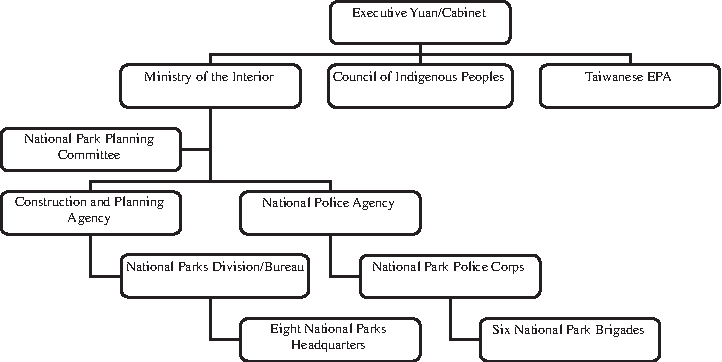
An outline of the Taiwanese governmental structure: Indigenous peoples, national parks, Taiwanese Environmental Protection Agency (TEPA) related. It is noteworthy that being a cabinet-level institution, CIP is in a much higher position than National Park Bureau. Even so, regarding the issues of national parks, CIP somehow only plays a secondary role. Two reasons result in its powerless position: first, National Park Law unequivocally bans fishing, hunting, and controlled burns (see above); second, the enforcement of the law is delegated to the National Park Bureau/Police. That is, although CIP generally supports loosening hunting restrictions, little could be done before the amendment of the National Park Law. Source: by the author.
The debate continues. In order to create a “New Partnership” (a “quasi-nation to nation relationship”) with aboriginals, the previous Democratic Progressive Party (DPP) government had promised to give back more land and more autonomous powers to aborigines. In the future, every tribe is to enjoy “tribal sovereignty” over their lands (Simon, 2006). Unfortunately, in January 2012 the draft of “Indigenous Peoples Autonomy Law” was once again blocked in the Legislative Yuan/Taiwanese Congress. Unless the long-promised autonomous regions are established, it is still uncertain how extensive the lands are and how many autonomous powers the aborigines will be given. The lack of a clear definition invites serious confusion because, historically speaking, as some indigenous activists insist, the “whole” of Taiwan belongs to indigenous peoples:
Indigenous peoples came to this land [Taiwan] thousands of years before the Han people who were from mainland China [about 400 years ago], let alone these 30-year-old national parks? (Hsiao and Hsiao, 2003; originally in Chinese; translated by the author)
One means of looking at this issue, perhaps the most common way, is to use the legal concept of Aboriginal Reserves. Consulting a map (see Figure 3), we can then visualize the amount of land devoted to national parks and aboriginal reserves (see Table 2).
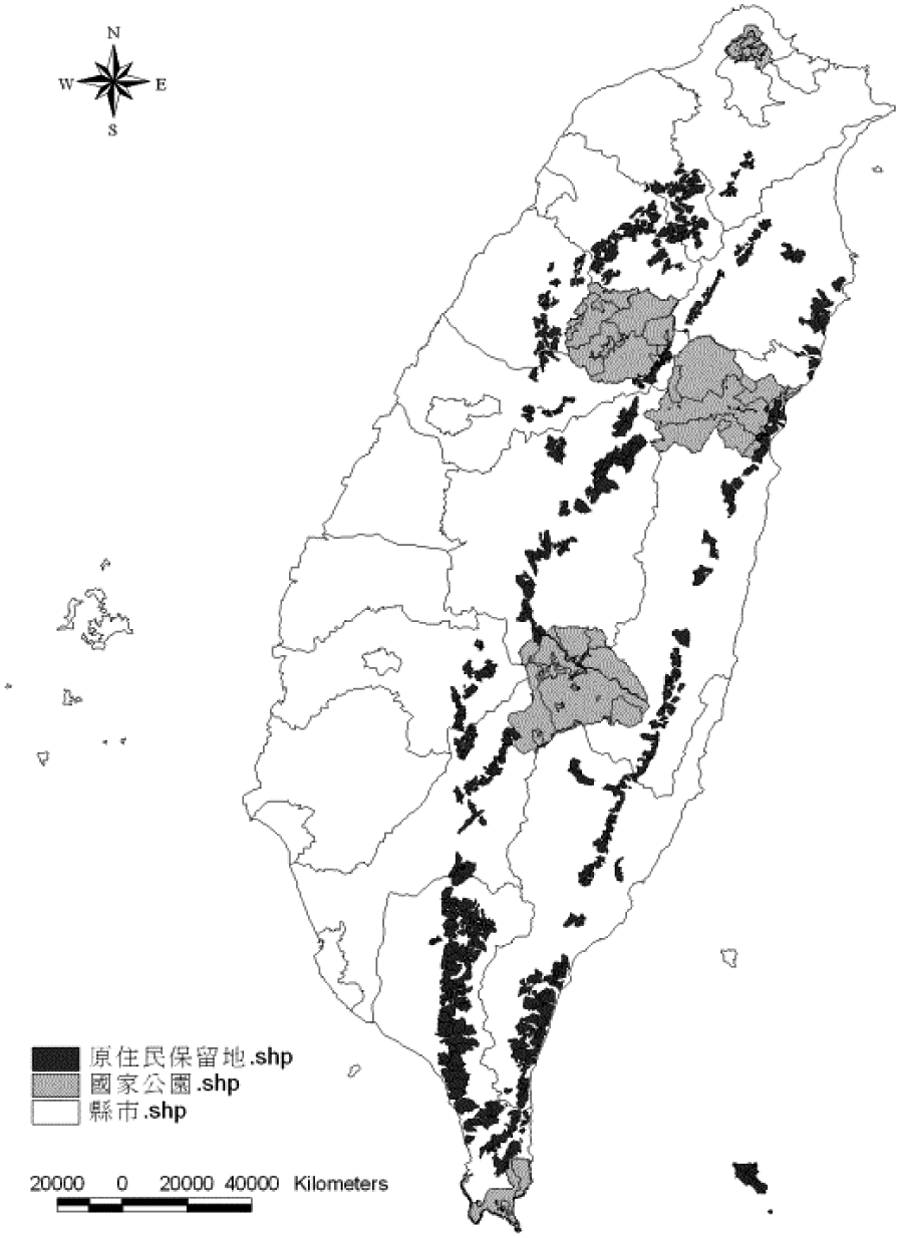
A map of national parks and aboriginal reserves. The darker areas represent Aboriginal Reserves; the grey areas represent the onshore national parts; the grey lines indicate county boundaries. Source: Lin, 2002.
Source: Yang and Huang, 2009.
The map and numbers tell us a completely different story, and one may feel slightly tentative in assessing whether or not the three high-altitude parks are, as some argue, “on” indigenous homelands. The answer to this question is largely dependent on how one interprets these numbers and which threshold one chooses. Arguably, it is true that there is some overlap, but it seems harder to say whether or not these parks are “on” the indigenous homelands/Aboriginal Reserves based on the 0.01 or 2.42 overlap.
5. The Sheipa Debate: Excluding Aboriginal Homelands from the Park of Sheipa
In the case of Sheipa, it is especially hard to make such distinctions regarding aboriginal homelands, not least because indigenous communities constitute only 0.01% of the area of the park, but also because of the history behind this number. Having dealt with opposition from indigenous peoples, when setting up Sheipa National Park the government deliberately excluded, not included, the Tayals' land from the park (Chi and Wang, 1998; Yuen-Wen Huang, 1997; Yueh-Wen Huang and Chang, 2001). As a result, at least in the Sheipa case, one could hardly argue that the placement of this park “deliberately” targeted indigenous peoples.
It is argued, by one of my interviewees, that even when the park is not sited on “your head,” you will still be affected. He relates the following story: in 2001, the government intended to build an incinerator to tackle garbage produced by visitors to Sheipa National Park. According to the National Park Law and other regulations, such facilities cannot be sited within the borders of a national park, thus the proposed incinerator was to be sited adjacent to the park.
The residents living near the site argued that it was not the responsibility of locals to deal with the garbage, particularly given that they produce much less garbage than the tourists. Again, EJ was deployed in the rhetoric, as in this news release:
It [the siting behavior] violates the principles of environmental justice if local Aboriginal tribes have to be responsible for managing waste generated by visitors to Shei-Pa National Park…(Taipei Times, 2001)
In this case, the tribe is affected by the park and associated regulations even though neither the tribe nor the incinerator is within the park. However, again, it is difficult to argue that authorities were “targeting” the aboriginals. In the argument about deliberate targeting, the issue of national parks may fall into a “Which came first?” debate (the indigenous peoples or the parks?). Some of my aboriginal interviewees stated that instead of forcing them to give up eating wild hog (a traditional dish), the latecomer, i.e., national parks, should respect their cultures. After all, they (indigenous peoples) were there first.
6. A Deadlock: EJ vs. EJ
Unlike the U.S. version of the “which came first?” debate (here, blacks or facilities) (Pastor Jr., Sadd, and Hipp, 2001), in Taiwan's cases the indigenous peoples nearly always came first. At first sight it seems a winning argument. Nonetheless, environmentalists are strongly opposed to the argument that prior habitation entitles residents to bend the law and continue hunting. One of the most famous figures to strongly oppose opening the door to hunting in national parks is Chang, Lung-Cheng (2001). Chang, who later served as the director of the Taiwanese Environmental Protection Agency (TEPA), is also known as the “Father of [Taiwanese] National Parks.” He argues that it is important to protect tribal traditions, however it is equally, if not more, important to protect the environment for the generations to come. For him, it is impractical for indigenous peoples to continue to think of using traditional means to protect their cultures. As a result, regardless of whether hunting is a traditional activity, he stresses, it should not be allowed in a national park. Other environmentalists share Chang's standpoint:
[T]he government has the responsibility for protecting vulnerable aborigines' cultures and livelihoods. Nevertheless, indigenous peoples' traditions should also conform to the contemporary new environmental paradigm. Only in so doing, we are able to achieve the final goal of protecting inter-generational EJ. (H.-P. Tseng, 2001:i; originally in Chinese, translated by the author)
One can easily notice that in the national park debate, an EJ vs. EJ dilemma arises. Should we protect the most vulnerable sector of the current population or protect the environment for future generations? With both sides imagining themselves as being on the side of “justice” and invoking the principles of EJ, making compromises is often seen as a betrayal of one's principles and an accommodation of injustice.
As a result, the two sides have been deadlocked in what seems like a losing game for both. For those who believe indigenous rights come first, it is harder for them to logically assert that these parks were deliberately sited where aboriginals live. It seems more justifiable that these parks were sited as they were because the lands are closer to “nature,” not because of the presence of indigenous peoples. It is difficult for one to suggest otherwise. For the latter, i.e., those who suggest that future generations are more important, it seems equally strange for them to argue that it is acceptable to force indigenous peoples to change their traditions in the service of environmental protection. At this stage, the deadlock seems likely to continue.
7. Conclusion
In Taiwan, the EJ movement has successfully opened up possibilities to effectively align environmentalism with the civil/aboriginal rights paradigm. By recognizing a broader range of injustice, the marginalized have been included in the EJ frame. Nevertheless, using the language of justice can easily slip into a stalemate of EJ against EJ. Once different types of EJ are used against each other, the movement becomes stuck in this semantic war. As seen in the case of Taiwanese national parks, both sides insist their interpretation of EJ is correct. This sense of superiority causes a standoff. Failing to reach a compromise, neither side delivers a practical alternative.
The only one who benefits from this deadlock seems to be the government. Without an achievable goal, EJ was either too narrowly or too broadly defined to suit the convenience of the government. A more serious danger is that, the public may believe that justice/EJ is being done, when in fact these government definitions may have helped disguise the status quo. Moreover, no matter what the government does, activists still accuse them of racism and injustice. As a result, the Taiwanese government treats EJ less and less seriously. As I have discussed elsewhere, although EJ was a top priority in the recent 2012 Taiwanese presidential election, it was merely words not policies (C. T. Huang, 2011).
If the goal of EJ is to make a shift from rhetoric into deliverable targets and actions, the current debate needs to move forward by setting up an achievable framework. As demonstrated above, insisting on an implausible framework can lead to a further rift between environmentalists and aboriginal activists. Setting out to heal the rift, activists and scholars should prepare a set of effective policies, rather than insisting on a narrow dogmatism of EJ, to realize their intentions. Likewise, having been made aware of the multifaceted nature of EJ, policymakers should also prepare an approach that would be able to highlight, and hopefully alleviate, issues where different policy frameworks might clash. There is, of course, no easy solution and no single correct path to follow. One thing is for certain however: EJ activists in Taiwan must not overlook the importance of amending U.S. precedents to their own priorities, rather than seeing these precedents as a model to reproduce in Taiwan.
Footnotes
1
About the Tenth Amendment (Tenth Additional Article of the Constitution of the Republic of China (Taiwan)), see <
2
This report can be found in National Taiwan University Digital Taiwan-Related Archives Project at <
3
The Japanese colonial government created a modern zoning system in Taiwan, including aboriginal reserves, natural reserves, and some of its earliest national parks. This system remains ever since without many changes. In 1936, the Japanese demarcated three areas as proposed national parks. Unfortunately, with the break-out of World War II, none of them had materialized before the end of the colonial period. Nonetheless, all these proposed areas are designated as national parks now.
4
To a large extent the history between parks and indigenous peoples parallels that of indigenous North Americans or Africans (Jacoby, 2001; O'Neill, 2003; Ranger, 1999; Westra,  ). In the period of martial law (1947–1987), the Taiwanese government sometimes relocated entire tribal communities in order to make room for these parks.
5
It should be clarified that the exact term huan-jing-zheng-yi, which is the equivalent of EJ in Chinese, was used in most cases. In fact, as EJ is relatively new in the Chinese language, it is not uncommon for people to insert the English term “environmental justice” into their texts to highlight their arguments.
6
A similar argument from Chi can be found in some English pieces as well: “Since the 1980s, the government has established six parks on Taiwan, of which three high-altitude parks are located in the historic homelands and hunting grounds of the indigenous Taroko, Tayal, and Bunun tribes.” (Chi, :147; originally in English).