




Abstract
Abstract
In the last few decades, community-based participatory research (CBPR) has emerged as an important approach that links environmental health and justice advocates with research institutions to understand and address environmental health problems. CBPR has generally been evaluated for its impact on policy, regulation, and its support of community science. However, there has been less emphasis on assessing the ways in which CBPR (re)shapes and potentially improves the scientific enterprise itself. This commentary focuses on this under-emphasized aspect of CBPR—how it can strengthen science. Using two case studies of environmental health CBPR research—the Northern California Household Exposure Study, and the San Joaquin Valley Drinking Water Study—we posit that CBPR helps improve the “3 Rs” of science—rigor, relevance and reach—and in so doing benefits the scientific enterprise itself.
Introduction
Both thinking and facts are changeable. If only because changes in thinking manifest themselves in changed facts. Conversely, fundamentally new facts can be discovered only through new thinking.
Scholars have taken different approaches to CBPR in terms of the level of community engagement in the research process. Figure 1 illustrates this continuum of community engagement. On the left side, traditional scientific endeavors may collect community information or data, but treat community members as passive study participants. Towards the right of Figure 1, community engagement increases, as community members move from being mere study participants to being active research partners. Even on this end of the continuum, however, the extent of community participation varies.
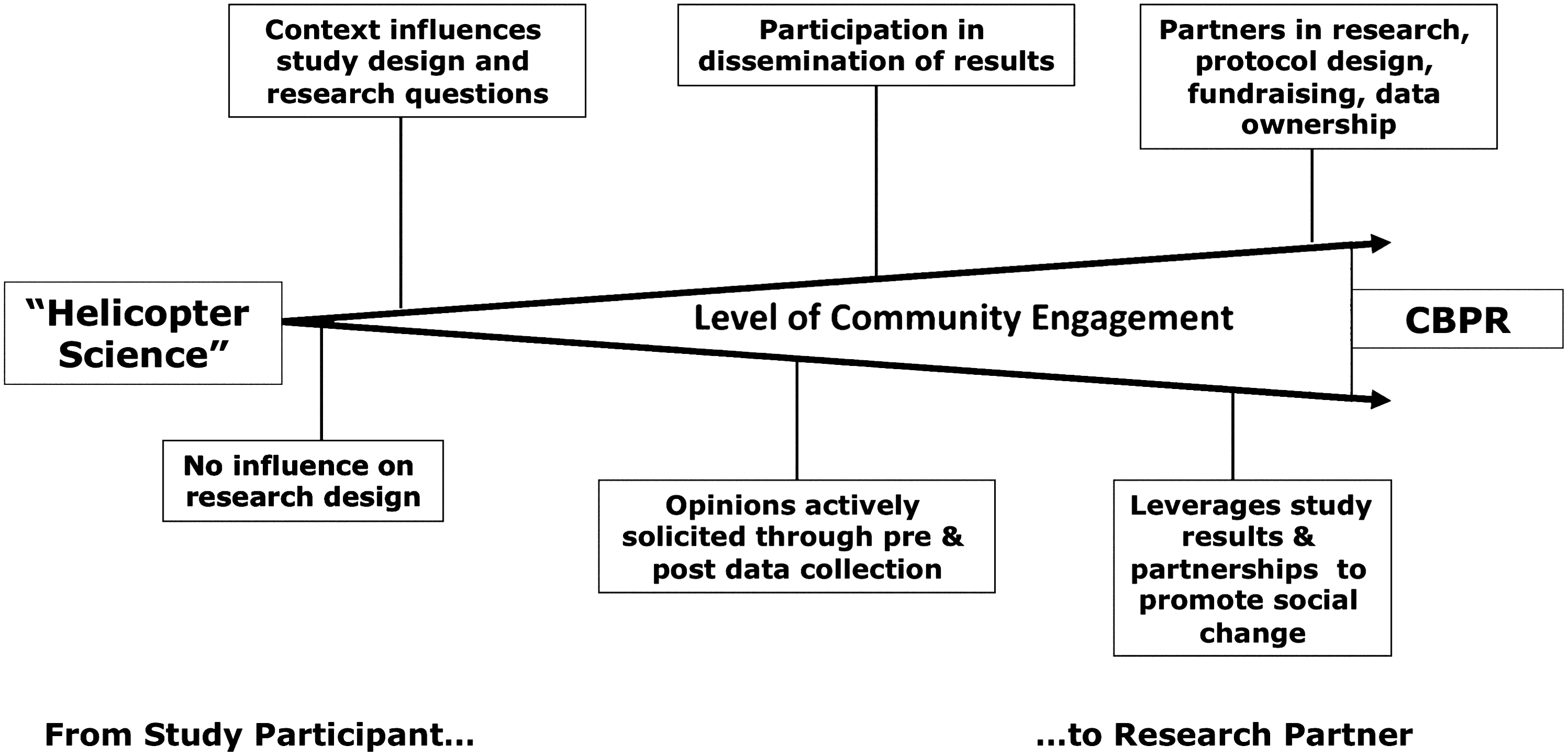
Schematic of community based participatory research as a continuum of efforts, with varying degrees of community engagement. Levels of engagement increase as community members are transformed from study participants to research partners.
The benefits that CBPR generates for community partners have been well documented and include enhanced community empowerment, co-learning between community members and scientists, informing community organizing efforts, and linking research to policy action.8,9,10,11 Less, however, has been written on how CBPR potentially (re)shapes the scientific enterprise itself. This issue has become more salient as federal and private grants supporting CBPR have increased dramatically since 1996, when the National Institute of Environmental Health Science (NIEHS) started funding such research.12
We argue that communities engaged in environmental health CBPR have helped improve the rigor, relevance, and reach of science, or what we call the “three Rs.”13 Rigor refers to the practice and promotion of good science—in the study design, data collection, and interpretation phases of research. Relevance refers to whether science is asking the right questions. For environmental health, relevant research emphasizes appropriate causes of exposure and elucidates opportunities for action or change. Reach encapsulates the degree to which knowledge is disseminated to diverse audiences and translated into useful tools for the scientific, regulatory, policy, and lay arenas. The framework in Figure 2 demonstrates how CBPR shapes the relevance, rigor, and reach of the scientific enterprise, and the feedback loops that occur between the policy impact of a project and science itself.

The 3 Rs (rigor, relevance, and reach) in relation to generalized steps of a community based participatory research approach, where traditional researchers and community members are jointly involved at each step, though levels of participation may vary.
CBPR and community engagement in environmental health science has promoted changes in theories of disease causation and new lines of scientific inquiry and helped shape scientific fact-making.14,15,16,17 This is exemplified in the cumulative impacts arena. Here, environmental justice advocates have long asserted that chemical-by-chemical and source-specific assessments of the health risks of environmental hazards are scientifically problematic because they do not reflect the cumulative impacts of multiple environmental and social stressors faced by vulnerable communities, which may act additively or synergistically to harm health.18,19,20 CBPR has helped advance the science of “cumulative impacts” by elevating the role of structural determinants and their associated social stressors in creating vulnerabilities among certain populations to the adverse health effects of environmental hazards.21,22 Ultimately, this focus on cumulative impacts or the “double jeopardy” of environmental and social stressors is transforming how scientists study environmental health problems.23,24,25 At the same time, advocates have demanded that emerging scientific evidence on cumulative impacts be translated into valid and transparent tools for decision-making in environmental regulation and policy even as the science evolves.26,27
This article uses two successful cases of CBPR environmental health research to explore CBPR's role in strengthening the three Rs of the scientific process. We examine how community input in CBPR embodied a strategic focus that led to improved science and more direct assessments of policy- and regulatory-relevant questions.
Description and rationale of case studies
Our two cases consist of the Northern California Household Exposure Study (HES) and the San Joaquin Valley Drinking Water Study (DWS). The HES involved a research collaboration between an independent research institute (Silent Spring Institute), a regional environmental justice advocacy organization (Communities for a Better Environment, CBE), and two academic institutions (Brown University and the University of California, Berkeley) to characterize indoor and outdoor levels of chemicals in a community bordering a major oil refinery in Richmond, CA and in a rural community in Bolinas, CA.28 The San Joaquin Valley DWS consisted of a collaboration between the Community Water Center (CWC), a community-based organization (CBO) based in the Valley, and researchers from the University of California, Berkeley. Motivated by CWC's desire to understand which residents are most vulnerable to drinking water contamination in the Valley, the DWS examined the association between community-level demographics and water quality in communities across the Valley.
The two cases were selected on the basis of their similarities and differences. Both projects are located in California, which has been an epicenter of environmental justice and environmental health advocacy. Both cases involved CBOs that recognize the links between research, organizing and advocacy as strategies for improving community environmental health. As such, the CBOs involved motivated the research, and the projects can be placed towards the far right of the CBPR community engagement continuum shown in Figure 1, though each project varied in its form of community engagement. In both cases, the participatory approaches employed drew from the notion of collaboratively doing, interpreting, and acting on science, a knowledge-production structure that is not linear, but rather cyclical, in that the collective process of acting on science leads to the further doing of science.29
The two cases provide an opportunity for comparison as well. Richmond is located in Northern California's urban San Francisco Bay Area region, whereas the DWS was conducted in a predominantly rural and agricultural region of the State. The HES collected primary data, while the DWS relied on secondary data. Finally, while both projects were exposure studies, each looked at a different environmental medium (i.e., air vs. water).
Case study 1: Northern California Household Exposure Study
The Household Exposure Study (HES) entailed a household exposure assessment of air and dust for pollutants from industrial emissions, transportation sources, and consumer products. Recruitment and sampling were conducted in an urban community bordering the Chevron oil refinery in Richmond and a rural community in Bolinas that served as a regional comparison area. The Chevron oil refinery is one of the nation's largest, covering 2900 acres, employing approximately 1,000 workers, and processing more than 240,000 barrels of crude oil daily into gasoline, jet fuel diesel and lubricants (
In addition to the scientific goal of characterizing cumulative pollutant exposures in an environmental justice community and understanding their potential sources, the HES aimed to inform local regulatory decisions regarding oil refinery operations, state chemicals policies, and national decisions about endocrine disrupting compounds (EDCs) in consumer products.31
All aspects of the HES were designed and implemented collaboratively—from the development of specific study hypotheses to the design of protocols for reporting study results back to community members and other stakeholders. CBE has a demonstrated history of doing its own scientific work and leveraging the data it collects to push for policy and regulatory change.32 For example, in the San Francisco Bay Area and Los Angeles, CBE has tracked and analyzed flaring activity and emissions from large oil refineries.33 Thus, for CBE, the HES was as much about producing good science as it was about leveraging the scientific enterprise to conduct community outreach and inform policy.
CBE organizing staff was trained by Silent Spring Institute and university scientists to conduct the indoor and outdoor air monitoring, dust collection, and interviews, thereby enhancing the organizations' in-house scientific capacity and ensuring their co-ownership of the research process. Most importantly, CBE's partnership helped the organization demystify science for their constituents by enabling staff to move their data-gathering efforts into the realm of people's homes. For example, as CBE interviewers went through the preliminary exposure questionnaire and set up sampling equipment, the experience encouraged community members to think in new ways about indoor air quality and how contaminants from outdoor pollution sources can penetrate inside the home. These discussions enabled CBE to connect their organizing work with technical and scientific aspects, both of which are central to advancing environmental justice.
CBE helped advance the scientific innovation and rigor of the HES in various ways. The scientific rigor of the study was ensured through collective discussion and negotiation of study design issues such as choosing relevant sampling sites, methods for recruiting study participants, establishing the list of chemicals for analysis, and developing sound protocols for reporting individual study results to study participants and to broader audiences. For example, CBE along with the project's advisory council encouraged the study team to collect a subset of air and dust samples from a community that did not have significant outdoor industrial and transportation emission sources so that these results could be compared to what was found in Richmond. This led to the decision to sample homes in Bolinas. Similarly, CBE encouraged the study team to expand its panel of analytes to include pollutants with sources that are primarily due to oil combustion activities. This led to the inclusion of target compounds such as vanadium, nickel, and sulfates. As a result of CBE's input, the HES was able to demonstrate indoor penetration of chemicals from heavy oil combustion activities in Richmond. The study also showed that levels of multiple pollutants tended to be higher inside homes than outdoors.34 In particular, the HES found some of the world's highest home dust levels of brominated flame retardants35 in Richmond and Bolinas.36
The relevance of the HES was bolstered by CBE's critical input in the development of innovative, transparent and scientifically valid communication materials to report back individual sampling results to all participants who wanted them.37,38 As environmental justice CBPR projects study the sources and pathways of chemical exposures, they are also faced with the paucity of health effects data for many of the pollutants studied. This situation raises ethical and scientific challenges for whether and how to report results to study participants.39 In the context of CBPR, this means ensuring that exposure data are reported in ways that are meaningful and that elucidate potential paths for individual or collective action to protect health. In general, participants tend to want their exposure results, which they often use as a tool for public health advocacy.40 As a result of CBE's input on this issue, the project created bilingual materials (Spanish/English) including graphic displays for communicating aggregate and individual-level results, scientific uncertainties, and potential strategies for exposure reduction. Ultimately, the project found that communication strategy of results contributed to environmental health education and stimulated behavioral change and collective efforts to reduce exposures.41
Finally, CBE's engagement in the HES extended the reach of the HES to broad audiences in order to leverage results to improve regulation and land-use decision making. With the support of scientific partners, CBE, along with some study participants, used data from the HES in their testimony before Richmond's Planning Commission to protest a conditional-use permit application by the nearby Chevron Refinery that would have expanded the facility's capacity to refine lower-grade crude oil and significantly increased pollutant emissions. The presentation of the HES results received significant media attention, as well as inquiries from the California Attorney General's Office, both of which compelled the Richmond Planning Commission to allow for more public input on the environmental impact statement of the proposed refinery expansion. Ultimately, the City of Richmond approved the permit and the struggle went into litigation. But a State Appeals Court decision on the case upheld a lower court's ruling that the environmental impact review for Chevron's conditional-use permit to expand its operations violated state environmental laws for being inadequate and vague about the scope and community health impact of the proposed project.
Ultimately, although CBE's initial focus was on community exposures to pollutants from the Richmond oil refinery, it became clear that demonstrating cumulative impacts of multiple pollutant exposures was also relevant to the organization's mission. CBE, with help from Silent Spring and university partners, received additional funding from the Avon Foundation to conduct a health survey in Richmond with a larger sample (198 respondents provided health data on 722 individuals) than the HES. This project yielded additional data to show disproportionate health challenges in Richmond,42 which were disseminated at multiple meetings for community residents, as well as public health and environmental agencies. In addition to those presentations and a peer-reviewed publication,43 a lay report was released from CBE's website.44
Case study 2: San Joaquin Valley Drinking Water Study
The San Joaquin Valley Drinking Water Study (DWS) was a CBPR collaboration between two partners: the Community Water Center (CWC) and the University of California, Berkeley. CWC is one of the only environmental justice organizations based in the San Joaquin Valley that focuses exclusively on addressing drinking water. Comprised of a team of lawyers, policy analysts and community organizers, CWC works primarily on drinking water advocacy at the local, regional and state level. Over the years, CWC has partnered with various research institutions to conduct research projects that address the problems and costs of drinking water contamination.
The DWS sought to answer two main questions: 1) do community water systems45 that serve greater percentages of low-income or minority communities have higher levels of nitrate and arsenic in their drinking water, 2) and do these systems also face greater difficulties complying with federal drinking water standards? These questions were motivated by a growing concern regarding drinking water contamination in the Valley and its impact on residents. With its intensive irrigated agriculture, the Valley has two of the most contaminated aquifers in the nation and some of the highest nitrate levels in the country.46 Because nearly 95 percent of the Valley's population relies on groundwater for drinking,47 exposure to contaminated groundwater is a particular health risk. This risk is compounded by the fact that with high costs of mitigation, few systems actually treat for drinking water contaminants.
In 2005, one of the authors (Balazs) began partnering with CWC to study patterns of drinking water contamination and test whether there were social disparities in exposure across the region. In essence, CWC wanted a scientifically rigorous study to assess whether contamination impacts were inequitable and widespread, or limited to just a few communities, or one county alone as policymakers often noted.
The CBPR components of the DWS included vetting and developing the study questions and design with CWC. While community members did not take part in data collection or statistical analysis, at each step of the process, CWC staff gave feedback on study design, definition of key variables, study barriers and preliminary findings. To answer the study questions, the research team used existing water quality datasets maintained by the California Department of Public Health (CDPH) to estimate exposure and compliance. This represented an alternative way of estimating exposure with existing data, without needing to collect water quality samples at the tap (an effort which would have been beyond the study's budget, given the study area's large geographic scope). In addition, the UC Berkeley and CWC team jointly sought funding from a California foundation to delineate water system boundaries in a geographic information system (GIS) so as to estimate customer demographics of water systems, a critical, yet missing set of data. Using both datasets, the researchers then developed a series of approaches to estimate drinking water quality served by different water systems, and used statistical modeling techniques to examine the association between water quality and customer demographics across the Valley.
The DWS found that communities with higher percentages of Latinos had higher nitrate levels in their drinking water systems, and that those with lower rates of homeownership had higher arsenic levels and greater chances of exceeding federal safety standards.48,49 In sum, the researchers found that water quality was worse in smaller, disadvantaged communities. This was a significant finding as it highlighted a dual burden—not only that small systems face unequal exposure and compliance burdens, but that the people served by these water systems are socially and economically vulnerable, and may be the least able to afford mitigation to reduce exposures.
The CBPR approach enhanced the rigor of the study in several ways. First, it enhanced the study design. Originally, the study was going to examine demographic disparities in safe drinking water access in Tulare County, one of the counties with the highest nitrate levels in the state. But, due to data limitations, the sample size was not large enough to implement a robust statistical analysis. At first, the researchers were uncertain about how best to address this methodological challenge, but community partners viewed this challenge as an opportunity to expand the study to the entire Valley. Not only would this ensure an adequate sample size and wider variability in drinking water quality for assessing potential environmental inequalities, but the implications of this broader scope would likely be more informative for policymakers and the water regulatory community. By advocating for this enhanced study design, the community partners were, in essence, encouraging researchers to look beyond the known drinking water “hotspots” and analyze drinking water quality issues more broadly for the entire region. This approach, they argued, could elucidate more “upstream” approaches to addressing contamination and remediation issues for a broader and more diverse population of Valley residents.
Secondly, the CBPR partnership enhanced the rigor of the study by spurring the labor-intensive process of estimating community-level demographics in community water systems. While the CDPH maintains water quality data, no Valley-wide demographic information on the water system customer base had ever been estimated. By encouraging researchers to secure the recourses necessary to fund this extra analytical work, CWC facilitated the development of new analytical methods and data which have since been shared with and built on by researchers at other universities and research institutes. For example, researchers at the University of California, Davis integrated some of the results of the water analysis in their most recent report documenting the cumulative impacts of environmental hazards in the San Joaquin Valley.50
Community involvement assured the study questions were relevant to pressing policy issues in the region. Valley communities and advocates had lived experiences of high drinking water contaminant levels in unincorporated, highly Latino, farm working communities. Residents and CWC staff intuited an environmental injustice, hypothesizing that a disproportionate share of this drinking water contamination burden was falling disproportionately on Latinos and lower-income communities. But their early efforts to convince policy makers and regulatory agencies about the need to address this systemic environmental equity problem were met with skepticism and assertions that these issues were isolated incidents and limited to a small number of places. The CBPR partnership was able to break through this impasse by providing the sophisticated analytical work that demonstrated a regional pattern of systemic environmental inequities in drinking water quality.
With solid scientific results in hand, CWC ensured that the research had a wide reach in two main ways. First, CWC leveraged its connections with decision-makers to ensure that the research was presented at key venues. For example, one author (Balazs) was asked to present study results to policy officials, including the United Nations Special Rapporteur for the Human Right to Water and Sanitation and policymakers in Sacramento, and at community-oriented academic conferences. These venues went beyond the traditional academic conferences at which the research team would have otherwise presented (e.g., American Public Health Association, International Groundwater Conference, etc). In extending the policy reach of the science, findings from the DWS entered policy debates on environmental justice and drinking water via more streamlined paths. In August of 2011, for example, the U.N. Rapporteur cited preliminary findings of the drinking water study to the U.S. government and the United Nations,51 well before peer-reviewed findings had been published.
A second, unexpected impact on the reach of the study was that CWC also ensured a broader reach of the research within the research community. Because CWC is a center of expertise and community knowledge on drinking water, throughout the study the Center encouraged different research institutes and universities to approach the UC Berkeley team with research questions and collaboration opportunities. This led to formal and informal collaborations on research, data sharing, and methods discussions. It is our belief, that without this facilitating role of our community partner, these efforts may not have developed, or would have developed on a much slower basis, only after a peer-reviewed publication had been released. In this sense, CWC served as a catalyst for developing additional research questions and collaborations, helping to break down some of the barriers that exist between research institutes.
Discussion
This article traced the impact of CBPR on improving the 3 Rs—the rigor, relevance, and reach—of research and the scientific enterprise. Academic-community collaboratives are complex endeavors that require significant investment in building relationships to ensure that the goals, objectives, and needs of each partner are clearly addressed. In particular, the willingness of community-based groups to invest significant resources in the scientific enterprise depends on whether this work will advance their short- and long-term interests without straying from their primary organizational mission. The two environmental health cases presented in this commentary highlight the strategic, relevant and rigorous science that can result from CBPR partnerships. In both cases, it was through the process of democratizing knowledge production that the science was strengthened, its application made relevant, and the reach of its results increased. What's more, the scientific questions and strategic needs of both CBOs were reflected in the design of study protocols, the scope of the analytical work and the study links to policy and regulation.
Ultimately, both efforts have highlighted new paths for intervention and possibilities for both individual and collective action to reduce exposures to pollutants that are harmful to health. In the HES, CBE's role in the collaborative helped ensure that sampling protocols included chemical analytes that documented for the first time the effects of oil combustion activities on the indoor air quality of the households of fenceline residents. It also highlighted the cumulative impacts of chemicals from consumer products in homes, including various endocrine disrupting compounds. The strategy for communicating results to study participants and other diverse audiences helped to elucidate individual and collective strategies for reducing exposures. What began as a focus on disparities in exposure in the DWS has evolved into developing new research directions that address the composite drinking water burden that Valley residents face, including coping costs, compliance burdens, and regulatory failures.52 Ultimately, these new lines of research will promote multi-level points of intervention to improve drinking water quality at the regional, the community and the household levels. In this way, CBPR has helped elucidate innovative lines of scientific inquiry, by linking future research directions with policy interventions. CBPR encourages scientists to specify the implications of their results for regulatory decision making and results communication in ways that promote action. It pushes through the gridlock of regulatory paralysis through (over)analysis to elucidate strategies for exposure reduction and precautionary approaches for better protecting community environmental health.
Conclusions
In order to continue exploring the beneficial impacts of CBPR on the scientific enterprise, future research will need to more systematically and precisely document and evaluate the ways in which CBPR improves the rigor, relevance and reach of science. In addition, this research will need to address how varying degrees of community involvement impact these outcomes.
Footnotes
Acknowledgments
We thank Laurel Firestone, Susana de Anda, and Maria Herrera at CWC. We thank Dr. Christopher Bacon and Tony LoPresti for feedback on the article. We thank Dr. Isha Ray and Dr. Alan Hubbard for collaboration on the DWS.
Author Disclosure Statement
The HES research was supported by the National Institute of Environmental Health Sciences (R25 ES013258) and the National Science Foundation (SES 0450837). The DWS research was supported by the NSF Graduate Research Fellowship, the California Endowment (through a collaborative grant between Community Water Center and UC Berkeley), the California Environmental Protection Agency (#07-020), and the Switzer Environmental Fellowship. The authors have no conflicts of interest or financial ties to disclose.
1
Fleck, L. Genesis and Development of a Scientific Fact. Chicago, IL: University of Chicago Press, 1979 (1935); 50–51.
2
Cornwall A, Jewkes R: “The Use of Qualitative Methods: What is Participatory Research?” Social Science and Medicine 1995, 41(12):667–1676.
3
Israel B, Schulz A, Parker E, Becker A: “Review of Community-based Research: Assessing Partnership Approraches to Improve Public Health.” Annual Review of Public Health 1998, 19: 173–202.
4
Minkler M, Wallerstein N: Community-based Participatory Research for Health. San Francisco, CA: Jossey-Bass, 2003.
5
Brown P, Brody J, Morello-Frosch R, Tovar J, Zota A, Rudel R: “Measuring the Success of Community Science: The Northern California Household Exposure Study.” Environmental Health Perspectives 2011, 120(3): 326–331.
6
Morello-Frosch R, Brown P, Brody J, Altman R, Rudel R, Zota A, C P: “Experts, Ethics, and Environmental Justice: Communicating and Contesting Results from Personal Exposure Science.” In: Environmental Justice and the Transformation of Science and Engineering. Edited by Gwen Ottinger BC. Boston, MA: MIT Press, 2011: 93–119.
7
Corburn J: Street Science: Community Knowledge and Environmental Health Justice. Cambridge, MA: MIT Press, 2005.
8
Israel et al. 173–202.
9
Minkler and Wallerstein 2003.
10
Minkler M, Vasquez V, Tajik M, Peterson D: “Promoting Environmental Justice Through Community-Based Participatory Research: The Role of Community and Partnership Capacity.” Health Education and Behavior 2006, 35(1):119–137.
11
Brown et al. 326–331.
12
Wolfson M, Parries M: “The Institutionalization of Community Action in Public Health.” In: Social Movements and the Development of Health Institutions. Edited by Mayer Zald JB-H, and Sandra Levitsky. New York, NY: Oxford University Press, 2010: 117–127.
13
Morello-Frosch et al. 93–119.
14
Morello-Frosch R, Zavestoski S, Brown P, McCormick S, Mayer B, Gasior R:
15
Brown et al. 326–331.
16
Morello-Frosch et al. 93–119.
17
Morello-Frosch R, Zuk M, Jerrett M, Shamasunder B, Kyle A: “Synthesizing the Science on Cumulative Impacts and Environmental Health Inequalities: Implications for Research and Policy-making.” Health Affairs 2011, 30(5): 879–887.
18
CalEPA: Environmental Justice Action Plan. Sacramento, CA, 2004.
19
Morello-Frosch et al. 879–887.
20
Sadd J, Pastor M, Morello-Frosch R, Scoggins J, Jesdale B: “Playing it Safe: Assessing Cumulative Impact and Vulnerability Through an Environmental Justice Screen Method in the South Coast Air Basin, California.” International Journal of Environmental Research and Public Health 2011, 8: 1441–1459.
21
Gee GC, Payne-Sturges DC: “Environmental Health Disparities: A Framework Integrating Psychosocial and Environmental Concepts.” Environ Health Perspect 2004, 112(17):1645–1653.
22
Wilson S: “An Ecological Framework to Study and Address Environmental Justice and Community Health Issues.” Environmental Justice 2009, 2(1): 15–23.
23
Morello-Frosch R, Lopez R: “The Riskscape and the Color Line: Examining the Role of Segregation in Environmental Health Disparities.” Environ Res 2006, 102(2):181–196.
24
Clougherty J, Kubzansky L: “A Framework for Examining Social Stress and Susceptibility in Air Pollution and Respiratory Health.” Environ Health Perspect 2009, 117(9).
25
NAS: “Implementing Cumulative Risk Assessment.” In: Science and Decisions: Advancing Risk Assessment. Atlanta, GA: The National Academies Press, 2009: 213–239.
26
Morello-Frosch et al. 879–887.
27
Sadd et al. 1441–1459.
28
The Northern California HES was primarily funded through the Environmental Justice Program of the National Institute of Environmental Health Sciences, and by a grant from the National Science Foundation. One academic collaborator had a long-standing relationship with the Silent Spring Institute and another had a long-standing relationship with Communities for a Better Environment.
29
Brown P, McCormick S, Mayer B, Zavestoski S, Morello-Frosch R, Altman R, et al.: “A Lab of Our Own: Environmental Causation of Breast Cancer and Challenges to the Dominant Epidemiological Paradigm.” Sci Technol Human Values 2006, 31: 499–536.
30
Brody JG, Morello-Frosch R, Zota A, Brown P, Pérez C, Rudel RA: “Linking Exposure Assessment Science with Policy Objectives for Environmental Justice and Breast Cancer Advocacy: The Northern California Household Exposure Study.” American Journal of Public Health 2009, 99: S600–S609.
31
Brown et al. 326–331.
32
For example, the organization is well known for pioneering the “Bucket Brigades” for low-cost air sampling, now used widely in California, nationally and internationally by fenceline communities living near large industrial facilities with hazardous emissions. See: Lerner, S. Diamond: A Struggle for Environmental Justice in Louisiana's Chemical Corridor. Cambridge, MA: MIT Press, 2005. Ottinger, G. “Buckets of Resistance: Standards and the Effectiveness of Citizen Science.” Sci Technol Human Values 35(2): 244–270.
33
This scientific work led to the promulgation of a groundbreaking flare control rule that became a front-page story in the New York Times. Marshall, C: “New Emission Rule for Bay Area Refineries.” New York Times. New York: July 21, 2005.
34
Brody et al. S600–S609.
35
Flame retardants are commonly used in furniture foam and electronic components and are used in particularly high amounts in California, due to the state's unique and strict flammability standard for furniture foam. State of California. Requirements, Test Procedure, and Apparatus for Testing the Flame Retardance of Resilient Filling Materials Used in Upholstered Furniture. Department of Consumer Affairs, CA, 2000.
36
Zota AR, Rudel R, Morello-Frosch R, Brody JG: “Elevated House Dust and Serum Concentrations of PBDEs in California: Unintended Consequences of Furniture Flammability Standards?” Environmental Science and Technology 2008, 42: 8158–8164.
37
Brody JG, Morello-Frosch R, Brown P, Rudel RA, Altman RG, Frye M, Osimo CA, Pérez C, Seryak LM: “Improving Disclosure and Consent: Is it Safe? New Ethics for Reporting Personal Exposures to Environmental Chemicals.” American Journal of Public Health 2007, 97(9): 1547–1554.
38
Morello-Frosch R, Brown P, Brody J, Altman R, Rudel R, Zota A, C P: “Experts, Ethics, and Environmental Justice: Communicating and Contesting Results from Personal Exposure Science.” In: Environmental Justice and the Transformation of Science and Engineering. Edited by Gwen Ottinger BC. Boston, MA: MIT Press, 2011: 93–119.
39
Morello-Frosch R, Brody JG, Brown P, Rebecca Gasior Altman, Rudel R: “Toxic Ignorance and Right-to-Know in Biomonitoring Results Communication: A Survey of Scientists and Study Participants.” Environmental Health 2009, 8(6).
40
Ibid.
41
Adams C, Brown P, Morello-Frosch R, Brody J, Rudel R, Zota A, Dunagan S, Tovar J, Patton S:
42
Cohen A, López A, Malloy N, Morello-Frosch R: “Our Environment, Our Health: A Community-Based Participatory Environmental Health Survey in Richmond, CA.” Health Education and Behavior 2012, 39(2): 198–209.
43
Ibid.
44
Richmond Health Survey Report (available at: <
45
Community water systems (CWSs) are public water systems that serve at least twenty five customers or fifteen service connections year-round U.S. EPA. Public Drinking Water Systems: Facts and Figures. 2010. Retrieved December 15, 2010 from <
46
Dubrovsky N, Burow K, et al. The Quality of Our Nation's Waters: Nutrients in the Nation's Streams and Groundwater, 1992–2004, U.S. Geological Survey, 2010.
47
PICME: Permits Inspections Compliance Monitoring and Enforcement database. California Department of Public Health, Sacramento, 2008.
48
Balazs C, Morello-Frosch R, Hubbard A, Ray I: “Social Disparities in Nitrate Contaminated Drinking Water in the San Joaquin Valley.” Environmental Health Perspectives 2011, 119(9): 1272–1278.
49
Balazs CL, Morello-Frosch R, Hubbard AE, Ray I: “Environmental justice implications of arsenic contamination in California's San Joaquin Valley: A cross-sectional, cluster-design examining exposure and compliance in community drinking water systems.” Environmental Health 2012, 11:84.
50
London J, Huang G, Zagofsky T: Land of Risk, Land of Opportunity. Davis, CA: University of California, Davis, 2011. Available at: <
51
United Nations General Assembly: Report of the Special Rapporteur on the Human Right to Safe Drinking Water and Sanitation. Doc. no. A/HRC/18/33/Add.4. UN Human Rights Council, 2011.
52
Balazs et al. In preparation 2012.