




Abstract
Abstract
An accurate characterization of contaminant exposure at the community level is a critical component of community-based exposure and risk assessments, particularly where they are used for community-based decision making. We conducted a probabilistic, community-level exposure assessment, in conjunction with community members and representatives, to assess exposure to zinc via consumption of caribou, a component of the Selawik, AK traditional diet. The analysis was conducted with publically available software, and implemented in a way that built tribal capacity to assess an array of contaminants in unique traditional diets. The analysis conducted with the software provided information on zinc intake among community members from consumption of caribou and indicated that average lifetime and upper percentile zinc exposure levels did not threaten the health of community members. We present the results of the study and observations associated with conducting the study in conjunction with community members. The study demonstrates the utility of the software to support decisions to address contaminant exposure and risk, and provides critical information to risk managers charged with communicating and implementing actions to address environmental contaminants.
Introduction
National exposure databases tend to focus on commercially available foods and are not designed to be relevant to subpopulations or specific communities with unique dietary characteristics such as local populations of fish consumers.1 Recognizing these limitations, the U.S. Environmental Protection Agency (EPA) Office of Prevention, Pesticides, and Toxic Substances (OPPTS) initiated the development of new software to assess community-based exposure patterns within a health risk assessment framework. The LifeLine Group (LLG) worked with OPPTS to develop and implement a probabilistic-based exposure and assessment model, the LifeLine Community Based Assessment Software (C-BAS).2 We assessed the use of the software within the context of a community-based participatory research model, and demonstrated how the exposure and risk assessment software could incorporate unique dietary and lifestyle patterns to assess potential exposure to environmental contaminants and attendant health risks. The project was also designed to train and empower scientists trusted by the community in the use of the software and, ultimately, to conduct exposure and risk assessments for contaminants in tribal foods and the living environment.
In this article, we report the characteristics of the Customized Dietary Assessment Software (CDAS) and C-BAS that enable their use in a community-based exposure and risk assessment. We also discuss community interactions associated with use of the software, including training, and interpretation and use of analytical results.
Background
The utility of the software was assessed in Selawik, an Inupiaq community of approximately 850 individuals in northwest Alaska. Selawik community members rely heavily on non-commercial, seasonally dependent subsistence foods, and individuals participate in food harvesting activities unique to the culture of the tribe. Caribou is the most significant component of the Selawik traditional diet, and the Selawik community was concerned with potential zinc contamination of the caribou herd as it grazed on lichens in the vicinity of the Red Dog Mine, the world's largest zinc mining operation.
Zinc is an essential human nutrient and the Recommended Daily Allowance (RDA) is 0.16 mg/kg/day (mg zinc/kg body weight/day) for males age>14 years, 0.13 mg/kg/day for females age>14 years, and 0.2–0.3 mg/kg/day for children age<14 years.3 However, community members were not concerned with the essentiality of zinc; rather, they were concerned with the potential adverse health effects of elevated exposure that may result from consuming zinc-contaminated caribou. Exposure to high levels of zinc (at levels well above the RDA) is associated with stomach cramps, nausea, and vomiting. Ingesting very high levels of zinc for several months may cause anemia, damage the pancreas and kidneys, and decrease levels of high-density lipoprotein (HDL) cholesterol. Highly elevated exposures have also been associated with adverse reproductive effects in laboratory animals. The U.S. EPA4 has established a Reference Dose (RfD) of 0.3 mg/kg/day, which is generally considered a “safe” level of exposure to zinc over a prolonged period.5 We used the RfD (the safe exposure level) to evaluate the potential for adverse effects of dietary zinc exposure among Selawik community members who consumed caribou.
An accurate characterization of the diet of community members is essential for community-based exposure and risk assessments. Since there was no formal dietary survey of caribou consumption in Selawik, dietary profiles had to be constructed via other processes. Some community members were highly knowledgeable about eating habits, food preparation and storage, age related and seasonally dependent factors governing accessibility, menu choices, serving sizes, and other important dietary exposure elements among Selawik community members. The dietary profiles used in the assessment were, therefore, derived with significant input from Selawik community members.
Caribou herds are migratory over a large range; thus, selection of zinc concentrations in caribou tissues to be used in the analysis posed a significant challenge. The age of data on available zinc tissue concentrations was also an important consideration as levels may vary over periods of years. The tribal advisor, working with community members, local data sources,6 and other individuals throughout the region, identified the data that were appropriate for use for the Selawik community dietary assessment conducted with the software. Caribou consumption patterns were constructed by customizing diets described in the Alaska Compendium of Traditional and Subsistence Dietary Files7 with Selawik specific information.
Building tribal capacity to conduct an exposure assessment and, ultimately, to assess environmental threats from toxic chemicals through application of the software requires some technological capability within the tribal community. In Selawik, we worked directly with the Selawik Tribal Council and the community environmental officer. We also worked with a tribal advisor who, although not a tribal member, was an individual with significant technical expertise who had worked with, and was trusted by, the community. The role of the tribal advisor was to serve as the liaison between The LifeLine Group and the community, to work directly with the community to explain the use of the software, assist LLG, to produce a dietary exposure assessment, and to work with the community to interpret and use the results of the analysis. With advice and guidance from the community environmental officer and the tribal advisor, the community chose to have the dietary exposure assessment focus on zinc in caribou. The tribal advisor and the community environmental officer worked closely together and involved the Tribal Council and the community throughout the analysis.
We worked with community members to determine whether caribou, upon which they rely for food and for physical, cultural, and economic well-being, pose potential health risks to community members, and to ensure that our efforts supported the tribe as they develop and operate their environmental programs and manage their natural resources. The specific goal of the effort was to assess the utility of the software in providing information that would assist and empower community members to make decisions about toxicant exposure that occurs via the diet.
Methods
The software is designed to characterize a population's dietary and environmental exposures to specific chemicals. In this case zinc, the compound of concern to, and chosen for analysis by, the Selawik community, was used to demonstrate the utility of the software. The approach used in the software is to describe the dietary, activity, and environmental characteristics of individuals within a community and combine this information with chemical residue data (in food and in various environmental compartments, i.e., caribou) and hazard (toxicity) information to produce a community-based probabilistic analysis of exposure and risk. The software is intended for use by trained individuals within a community as well as scientists with expertise in exposure and risk analysis. User-friendly, multimedia tutorials, available in English and Spanish, instruct users in both the scientific and operational aspects of the software. These training tools are designed to assist users at the community level, thus building capacity for informed decision making.
The software can be applied to and used to assess virtually any sub-population in a community (e.g., Native American tribes, farm workers, sport anglers, ethnic-based communities, among many others), and especially those with unique dietary and activity profiles. The software provides community-specific exposure and risk profiles, which can be used to address issues such as:
• distribution of exposure and risk in the overall community • variability of exposure among subgroups of individuals, including susceptible individuals, within the community • evaluating the potential impacts of mitigation strategies on exposure and risk • helping community decision makers understand and communicate consequences of remediation or other mitigation strategies • illuminating areas needing more research or monitoring data.
The software tools that were used in this analysis included the Dietary Record Generator (DRG) and the CDAS (described at <
After discussions with Selawik Environmental Department's Community Environmental Officer and others to explain the purpose of the study and our proposed approach, we met with representatives from the Selawik Tribal Council, the Selawik Elders, the City Councils, U.S. Fish and Wildlife Service representatives, and the school science teacher to explain the project and plan for community meetings to discuss the study and its results. Meeting dates were selected convenient to Selawik's residents and Council. All presentations were designed to avoid science jargon and complex technical graphics while emphasizing health benefits as well as health risks of zinc exposure provided by diets of dried and cooked caribou meat, liver, bone marrow, fat, and heart. Presentations included a comparison of caribou with domestic meats (containing the same zinc levels), emphasis on the importance of caribou for sources of many essential nutrients, including zinc, and comparison of dietary exposures to doses from cold remedies containing zinc.
Results
Exposure analysis
The probabilistic exposure analysis conducted with the software provided information on zinc intake among community members via their consumption of caribou. The analysis indicated that average lifetime zinc exposure never exceeded 0.25 mg/kg/day (Figure 1), which is below the safe exposure level as defined by the reference dose (0.3 mg/kg/day). Average zinc exposure for all ages was highest during the fall when harvested caribou are consumed more frequently and lowest during the summer—when caribou makes up a smaller portion of the diet. Average zinc exposure is relatively constant once individuals reach adulthood (approximately age 20). There is some age-associated variability in zinc exposure among younger individuals (Figure 1).

Average lifetime zinc exposure for Selawik community members.
Detailed, probabilistic examination of zinc exposure was conducted for three subpopulations: individuals age 1–10 years; individuals 11–20 years; and individuals 21–30 years (Figure 2). The median (50th percentile) zinc exposure for those consuming caribou is near or below 0.2 mg/kg/day for individuals within each of the three subgroups. However, there is divergence at the 95th percentile with some individuals (21–30 years) reaching exposure levels as high as 1.0 mg/kg/day in the fall, which is the high caribou consumption season. The 95th percentile zinc exposure was lowest (approximately 0.4 mg/kg/day) in the youngest age group.
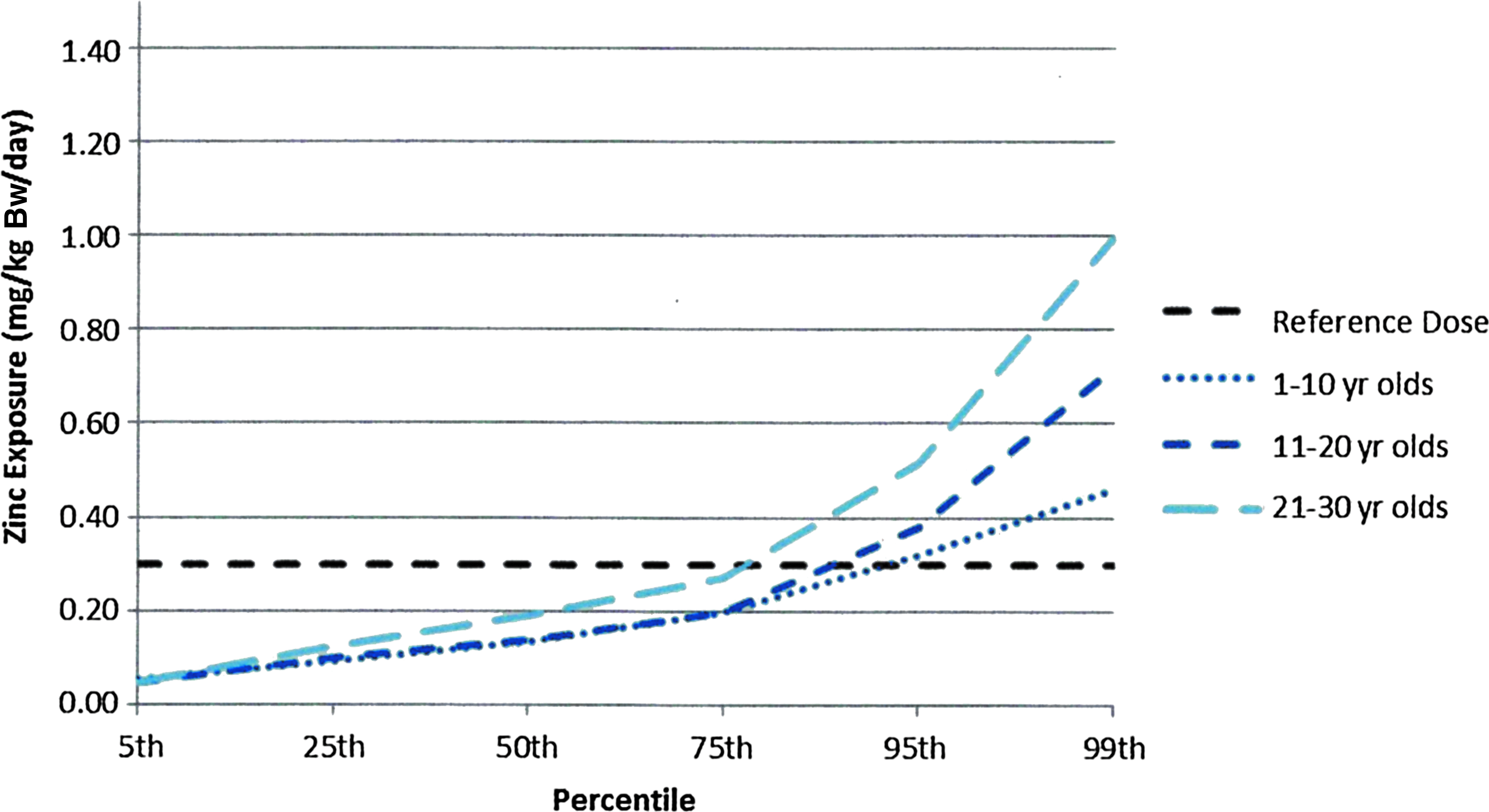
Zinc exposure for three subpopulations: individuals age 1–10 years; individuals 11–20 years; and individuals 21–30 years.
To consider their relevance, dietary exposure levels were related to those with known biological significance. For Selawik community members, average daily zinc exposure is in the same range as the average daily level recommended for health promotion. The highest (99th percentile) potential daily exposure for individuals within any age group is near 1 mg/kg/day. While this exposure level is above the reference dose for zinc, it is not so elevated as to pose a potential health hazard.
Childhood exposure to some environmental contaminants is of special concern.8 In Selawik, there is relatively little exposure among individuals younger than age 6 years since their consumption of caribou, as reported by community experts, is minimal. Therefore, we focused on the subgroup of children age 6–10 years who eat caribou (Figure 3). Median (50th percentile) zinc exposure is approximately 0.2 mg/kg/day, while the 5th and 99th percentile exposures range from less than 0.1 to approximately 0.5 mg/kg/day, with slightly more seasonal variability in exposure at the highest levels (95th and 99th percentiles). As indicated previously, exposure among this age group reflects seasonal variability in caribou consumption, but none of the children experienced daily dietary zinc exposure at levels that threaten health.
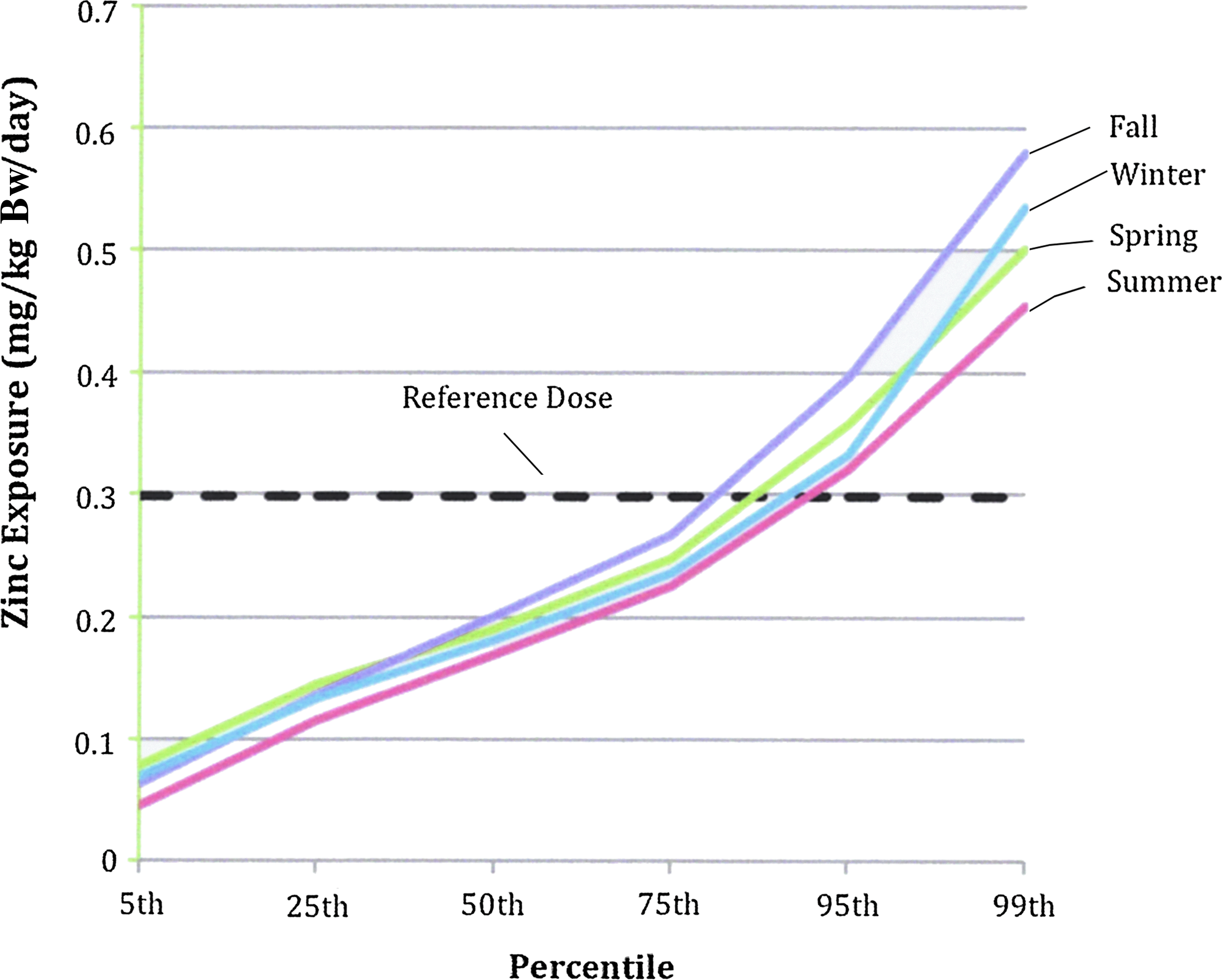
Zinc exposure in the subgroup of children age 6–10 years who eat caribou.
Examination of the percentage of a population or subpopulation that has been exposed to a toxicant can provide additional information to inform decision making. In Selawik, only 25% of the children ages 6–10 years were exposed to zinc from caribou consumption during the summer, while 95% were exposed during spring and fall (Figure 4). This is consistent with community consumption patterns where most caribou is consumed during the fall and spring concurrent with the semi-annual harvest. Elucidation of these consumption and exposure patterns facilitates decision making that can be fine-tuned by age and season as well as other variables that may influence exposure, which would not be available if only annual exposure information were examined. Seasonally dependent food sources often feature diverse dietary patterns and preparation methods. Our analysis underscores the necessity for seasonal exposure assessment capability to accurately assess potential health impacts on a community dependent upon non-commercial subsistence foods.
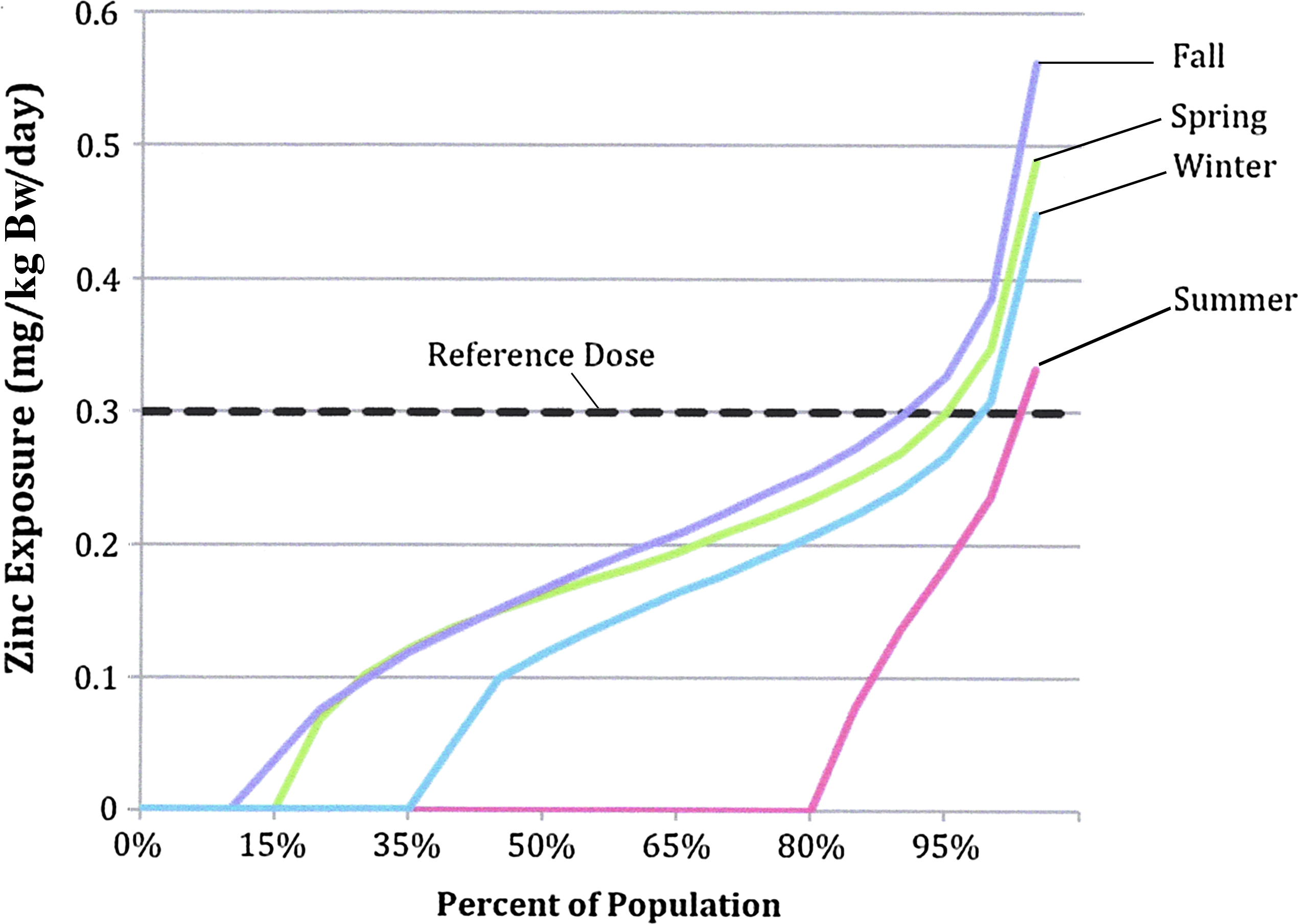
Community caribou consumption patterns by season for children ages 6–10 years.
This type of assessment can be very informative for public health decision makers. It provides distinction between fear of hazard versus confidence in safety of important food sources. It also highlights potential hazard for population subgroups or can display the consequences of previous risk mitigation efforts. It has been demonstrated in another community9 that an analysis of this type allows managers and community decision makers to evaluate, focus, and fine-tune initiatives to protect the health of community members in ways that result in exposure and risk reduction, where appropriate, for sensitive populations while maintaining important community cultural practices such as harvesting and consuming subsistence foods. It also supports decisions for refocused actions based on findings of low exposure and risk, and supports risk managers charged with communicating and implementing these decisions.
Discussion
We noted at the outset of the project that there was a perception that a problem existed (zinc exposure at unhealthy levels) from a mining activity in an area where the caribou herd grazed. We emphasized that our assessment was not being conducted because there was information indicating a problem but, rather, because of the community's concern with potential zinc exposure. We also assured community members that we would provide information on the extent and magnitude of a problem, if one was identified via our analysis, and options available to address it. Through community leaders and a trusted advisor, the community employed its knowledge about caribou in its seasonal diets to enhance interpretation and understanding of zinc monitoring results in terms of the potential impact on health. The LifeLine exposure software facilitated community understanding and receptivity by incorporating food sources and dietary behaviors relevant to the Selawik community. Also key to community confidence in the message was trust—in the communicator and in the relevance of the information used in the analysis. An important consideration for the use of the software is that it does not require agency funding or support. Since it is freely available online, trained users (e.g., from communities, supporting organizations, or trusted advisors) can access and use the software to develop information relevant to the community, thereby avoiding potential contractor or agency-associated tensions and accountability.
The software used in this analysis is unique as it can be used to develop assessments from data on specific, community-based dietary habits for age groups, seasonal sources of food types, food portion sizes, and other dietary information. Information sources can include traditional databases as well as community-based food surveys, and even individual narratives. The software also can align seasonal-specific chemical residue distributions with seasonal-specific dietary patterns and, ultimately, with toxicity information. No other software provides this level of analytical detail and flexibility, is relatively user friendly, and is freely available online.
The limitations associated with the software are associated primarily with the quality of the information provided by the assessor (the community, a trusted advisor, etc.). The assessor must decide what information is to be used and applied within the software. For example, determinations of the foods to be considered, the probabilities for eating those foods (by season or age), and portion sizes (also by age) all must be considered. These issues can be informed from multiple sources and the software provides an internal reference field for each value to help document an assessor's decisions. As is true with all analyses, resultant dietary and exposure profiles should be peer reviewed to ensure their accuracy. Peers in this case can and should include not only external experts but also individuals (e.g., from the community) who have intimate knowledge of individual dietary patterns. In Selawik, these individuals included village elders who distributed food and women who prepared food at the village school and community center. Seasonality profiles were reviewed by community leaders familiar with subsistence food sources such as when caribou were hunted and when other competing food sources are abundant. Where the model generated profiles inconsistent with the knowledge of the experts, appropriate corrections were made.
Conclusion
The Selawik experience confirmed that state-of-the-art exposure assessment software can operate with atypically formatted, community-specific information to yield exposure and risk estimates that can inform health issues and decisions of concern to community members. Communities can describe their dietary habits and food sources, which can then be developed into dietary profiles suitable for exposure and risk assessment. Technical elements are important, but so too is the process that employs trusted community advisors and collaboration with key community “experts” on food availability, dietary habits, and related issues.
The software and our use of it in Selawik can be applied to virtually any community or subpopulation for any food or groups of foods. Information about dietary profiles may not exist in typical study format but can be gleaned from many atypical sources, especially when guided by individuals in the community who are familiar with food sources, availability, storage and preparation, and factors that introduce variability into the consumption patterns.
Footnotes
Acknowledgments
This work was funded under a contract with the U.S. EPA Office of Prevention, Pesticides, and Toxic Substances entitled: Implementation of the LifeLine Software for Tribes and Other Unique Focused Populations (Contract #556282). We appreciate the collaboration and generosity of Dr. J. Dau, Alaska Department of Fish and Game, the people of Selawik, AK and the astute guidance of Elizabeth Resek, U.S. EPA throughout the project.
Author Disclosure Statement
The authors have no conflicts of interest or financial ties to disclose.
1
K. Morland, M. Wolff, R. Bopp, J. Godbold, and P. Landrigan. “Fish consumption and body burden of organochlorines among lower Hudson urban anglers.” Am J Ind Med 51 (2008): 587–94.
2
The LifeLine Group, Washington, DC holds the copyright for The LifeLine™ software (Customized Dietary Assessment Software—CDAS, and the Community Based Assessment Software—C-BAS). The software, related dietary compendia, and training materials are available for free download and use at <
3
National Academy of Sciences. Available at <
4
U.S. Environmental Protection Agency (EPA). Available at <
5
D.G. Barnes and M. Dourson. “Reference Dose (RfD)—Description and use in health risk assessments.” Reg Toxicol Pharmacol. 8 (1988): 471–486.
6
Alaska Department of Fish and Game. Community Subsistence Information System. Community Profile Database Technical Documentation. AK Division of Public Health, Anchorage, AK. Available at <
7
C.F. Chaisson and A.M. Chaisson. The Compendium of Alaska Traditional and Subsistence Dietary Files. Available at <
8
A.N. DeWeese, N. Kmiecik, E.R. Madsen, E.J. Chiriboga, and J.A. Foran. “Risk- and cultural-based fish consumption advice for Anishinaabe in the 1837 and 1842 ceded territories of Michigan, Minnesota, and Wisconsin.” Risk Analysis 29 (2009): 729–742.
9
J.A. Foran, A.N. DeWeese, N. Kmiecik, and M. Hudson. “Probabilistic estimates of exposure and risk reduction associated with targeted fish consumption advice for Anishinaabe tribal members.” J. Environ. Public Health, article # 802584 (2010). Available at <