




Abstract
Abstract
In 2008, Toronto's City Council agreed to support the Tower Renewal Project, an ambitious proposal to renew over 1,000 aging concrete high-rise apartment buildings constructed largely between the 1960s and 1980s in socially and economically marginalized areas across Toronto, Canada. Over 500,000 residents live in these comparatively affordable high-rise buildings. These structures now require significant environmental upgrades to conserve energy and reduce carbon emissions. In addition to proposing structural retrofits, the Tower Renewal Project is concerned with addressing environmental justice issues in high-rise neighborhoods such as the spatial organization of inequalities, transportation concerns, health inequalities, problems with existing zoning bylaws, and public participation. Despite the challenges to naming, framing, and applying the concept of environmental justice in Canada, this article argues that the Tower Renewal Project addresses environmental justice concerns and politics unique to the Canadian urban context, and more specifically, to Toronto.
Introduction
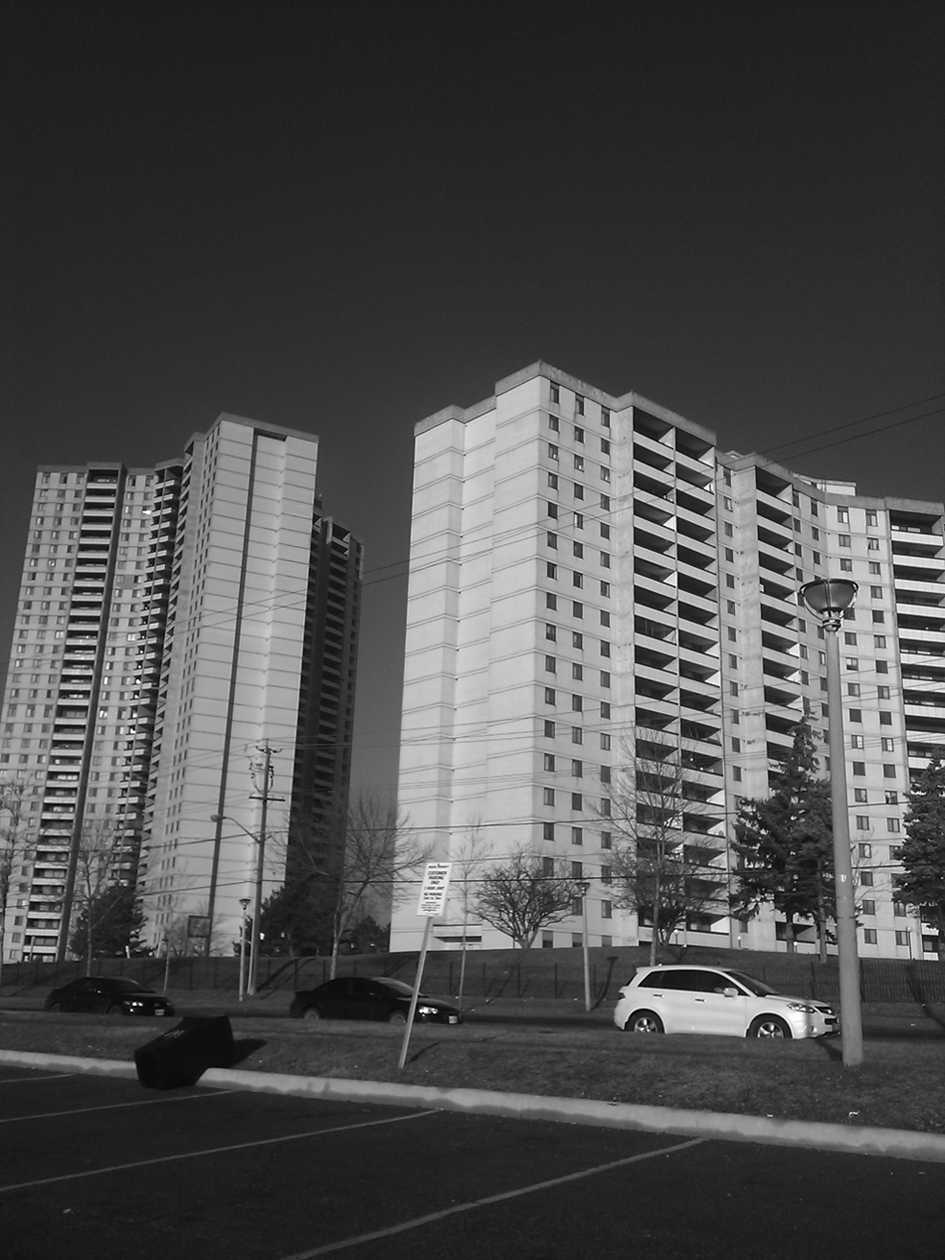
An example of high-rise apartment towers in Toronto.
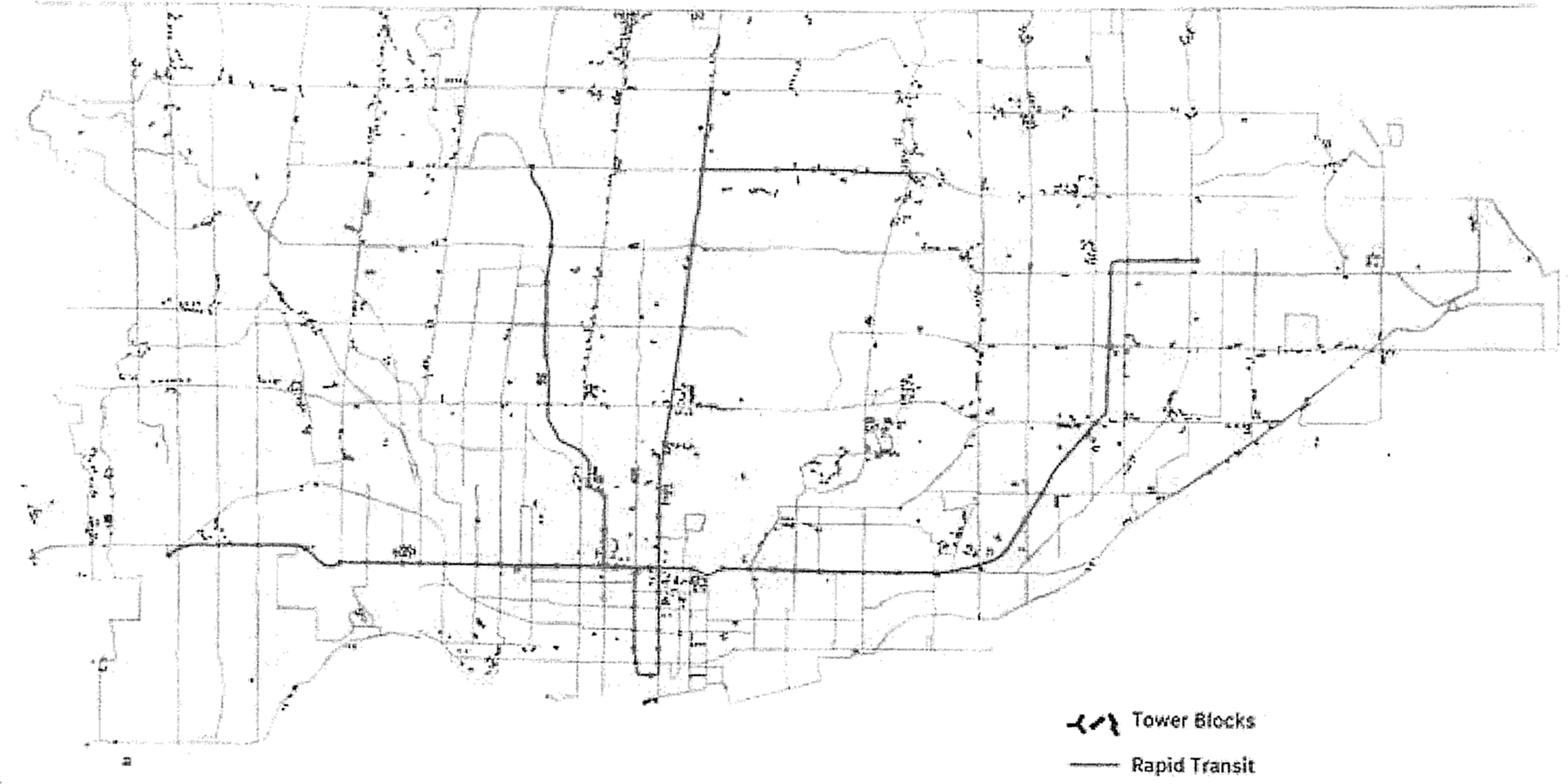
A map of 1189 apartment buildings located across Toronto. Map prepared by E.R.A. Architects Inc.
But in addition to these proposed structural changes the Tower Renewal Project, this article argues, fundamentally addresses larger environmental justice concerns such as spatial inequalities and zoning bylaws, public transportation, health disparities, and fostering public participation. By examining Project documents, newspaper articles, and the environmental justice literature published both in Canada and the United States, the author highlights the environmental justice concerns of the Project even though the term is not explicitly used in Project documents. This absence of the term reflects the challenges to naming, framing, and applying the concept of environmental justice in Canada. 6 The term environmental justice does not have the legal and institutional support that it carries in the United States.
Environmental justice in Canada
Canadian scholars have discussed the challenges of applying American conceptualizations of environmental justice in Canada.6,7 Differences in history, politics, and geography between the two countries have shaped the adoption and application of environmental justice frameworks. 6 For instance, since the 1982 Warren County, North Carolina protests against the illegal dumping of polychlorinated biphenyl (PCB) contaminated soil in predominantly African American communities, environmental justice concerns have gained wider acceptance in the United States than in Canada. 6 Milestones include the Environmental Protection Agency's (EPA's) legal requirement that racism and social justice issues be part of their assessment and evaluation of projects. 6 This is not the case in Canada, where environmental justice actions are shorter lived and less resourced. 6 The language of environmental justice is also lacking in the guiding principles 8 of and the citizen's guide 9 to the Canadian Environmental Protection Act (1999). Environment Canada, a federal agency similar to the EPA, also fails to mention environmental justice issues on their website. 10
Agyeman, Cole, and Haluza-Delay 11 assert, however, that there “have been environmental justice movements in Canada for centuries (if not millennia).” The colonization of aboriginal lands, resources and culture was the first environmental justice struggle. And this struggle continues, but it has largely been overlooked by academic environmentalist thought. 11
For Gosine and Teelucksingh, there are three challenges to naming and framing environmental justice in Canada.
6
These challenges can be summarized as follows:
1. There is a prevailing notion that racism does not exist in Canada; 2. Multiculturalism as a discourse and official government policy hinders anti-oppression activism and analyses; 3. The racialization of space in Canadian cities is organized differently compared to the United States.
Canada is often characterized as “an egalitarian, multicultural, modern state” a distinction attributed to its adoption of the Canadian Multiculturalism Act (1988) which protects certain “civil and cultural liberties to recognized citizens.” 6 This characterization erases the role of racism in the development of Canada as a nation-state through the colonization of aboriginal land and through policies of assimilation. 6 Instances of racism in Canada abound. In 1923, the Canadian government introduced an anti-Chinese immigration law. Meanwhile, immigration from Europe and America was favored and encouraged. 6 During the latter half of the 1960s, the historic African Canadian community in Halifax, Nova Scotia, known as Africville, was razed by the local government in the name of industrial development, urban renewal, and racial integration. 12 In 2005, over 800 residents were evacuated from the reserve in Kashechewan after the local water supply was tainted. 6 The crisis was long in the making, but studies alerting to the poor water quality were ignored, highlighting larger issues of government neglect of environmental issues on native reserves. 6
Racism in Canada is effectively muted by the federal government's official policy of multiculturalism.6,13 Unlike America's assimilationist approach, multiculturalism in Canada “assumes that minority groups (including racial groups) maintain aspects of their own culture while also interacting with the dominant groups' culture.” 6 Multiculturalism as a discourse and policy promotes and celebrates racialized diversity and color-blindness without questioning relations of power. 6 Due to labor shortages, Canada ended its race-based immigration policy in the 1960s and 1970s to accept non-white immigrants. 13 By adopting multiculturalism as a policy, Canada sought to distinguish itself from the United States and Europe as a cosmopolitan, forward-looking nation responsive to—or interested in managing—the wave of anti-colonial movements emerging abroad. 13 However, these changes effectively meant that “outsiders (colonizers, settlers, migrants) [were transformed] into exalted insiders (Canadian citizens)” while simultaneously transforming “insiders (Aboriginal peoples) into aliens in their own territories.” 13
The different organization of race and space in Canadian cities presents a third challenge to naming and framing environmental justice in Canada. 6 American-style racially segregated areas do not exist in Canada, largely due to the different waves of immigration and the different economic backgrounds of newcomers.6,14 Wealthier immigrants in Canada voluntarily choose to live in white neighborhoods or areas with concentrations of people from their ethnic background. American style ghettos have traditionally been defined as residential districts with a concentration of a particular racial or ethnic group where “the majority of its members are forced to live there due to discrimination. 14 Ethnic enclaves, unlike ghettos, are formed voluntarily; their members can leave or live there as they wish. 14 Instead of American style ghettos, Walks and Bourne 14 found that a combination of racially mixed neighborhoods with high-rise apartments accounted for “neighbourhood patterning of low income.” Other studies have confirmed the relationship between mixed ethnic communities, low income, and the concentration of high-rise apartments particularly in Toronto.15,16 Hulchanski 16 writes that in Toronto poverty is concentrated in the third city or the inner suburbs where there are more single-parent families (33%) than the downtown core (26%) and more foreign born residents and renters. These recent studies of Toronto demonstrate the different dynamics of race, class, and space in Canada.
Addressing these three challenges to naming and framing environmental justice in Canada, this article seeks to engage conversations about the conceptualization of environmental justice by examining the Tower Renewal Project in Toronto. Although the Project does not explicitly use the term environmental justice—a practice that reflects the complicated nature of naming, framing, and applying the concept in Canada—it proposes to address several environmental justice concerns, as discussed further below.
Discussion
The environmental justice objectives of the Tower Renewal Project
The Project addresses four key environmental justice concerns. First, it addresses the spatial dimensions of inequality and poverty in Toronto.6,8 Second, it emphasizes the need to increase public transportation infrastructure 17 to address the spatial and economic marginalization of tower neighborhoods. Third, the public health problems created by outdated zoning regulations18,19 is a central concern of the Project. Lastly, public participation is woven into the Project's processes as demonstrated by activities at pilot sites and through other initiatives. 20 This section analyzes how the Project addresses environmental justice concerns.
Urban planning history in Toronto: Deconstructing inequalities
The Tower Renewal Project addresses the dynamics and intersections of space and racial and economic inequalities in Toronto. Although Canadian cities are “not as obvious as American-style segregation and racialization; Canadian-style racialization of low-income communities is hidden under layers of ideology and discourse” such as multiculturalist discourse, as discussed earlier. 6 The racialization of space in Canadian cities, for example, becomes visible in how infrastructure resources are allocated across the city, in media representations of low income areas, and through the extent to which residents participate in land-use decision making. 6 The Project acknowledges that services such as childcare and medical offices are not within walking or biking distance in high-rise neighborhoods. 1 The Project also acknowledges that investment and funding is diverted to affluent and privileged areas such as the city center and outer suburbs. 1 Incomes in tower areas are 40% below the Toronto average.4,21 Hume 22 praises the equalizing thrust of the Project: it provides an opportunity to integrate these much neglected neighborhoods to the downtown core and “extend to tower residents the sorts of things downtowners take for granted” such as better public transit options and services.
The Project proposes zoning changes to address the spatial isolation and lack of services in high-rise areas. Outdated zoning laws, unchanged since the 1960s, mandated that 80% of developed land in these areas be left for parks and green spaces.22,23 Most tower areas consist of more than 90% open space which are largely lawns and parking lots separated by chain link fences. 4 Tower neighborhoods are singularly zoned for residences, 24 making it illegal for entrepreneurial newcomers to open a store or a fruit stand in or near a high-rise building. 25 Infill ideas for rezoned areas include childcare and senior centers, language training centers, new mixed housing, retail, social services, job training centers, and more. 3 Re-zoning and infill proposals are also being used as an incentive for private building owners to retrofit and improve their properties; owners can sell or rent land around the base of a building for infill projects. 26 Project founder, Graeme Stewart, states that efforts to change zoning bylaws in tower areas will be a difficult and costly political battle, but it will solve many of the service disparities in these neighborhoods. 27
Fighting for transportation justice
Bullard and Johnson 17 shed light on the link between transportation and environmental, civil rights and social justice issues. They do this by citing key historic struggles. They draw on the separate but equal clause in Louisiana upheld by the United States Supreme Court in Plessy v. Ferguson (1896) which legalized segregation. Rosa Parks, the Montgomery Bus Boycott, and the illegal dumping of PCB on roadways in North Carolina which galvanized the environmental justice movement also illustrate the intersections of transit issues with environmental, civil rights, and social justice concerns. 17 As well, Bullard and Johnson point out that, historically, gasoline tax monies have been used to fund highways and not public transportation. 17 Highways have been built through communities of color, isolating these areas exposing residents to hazardous wastes, spills, and explosions from the transportation of dangerous materials. 17
The Tower Renewal Project is concerned with transit equity issues. Although high-rise neighborhoods were built to form complete communities, public transit service is limited. Sorensen 28 writes that promises of major investments in public transit were repeatedly delayed or cancelled over the last forty years, resulting in a sub-standard transit system in the inner suburbs of Toronto. The inner suburbs were also built for the car, making pedestrians feel unsafe walking in these neighborhoods. 28 Given the lower than average incomes in high-rise areas, car ownership rates are lower. 29 Apartment residents mainly walk, cycle, or take public transit. 29 The limited transit options in and the car-centric configuration of these neighborhoods have isolaTed, marginalized, and limited employment and other opportunities for the already disadvantaged populations living in high-rise areas. Vehicular accidents involving cyclists and pedestrians are greater in these neighborhoods. 29 Project founder, Graeme Stewart, states that tower areas already have the density to support additional, more extensive public transit networks. 27
The Project lends its support to a separate local initiative called Transit City. 1 Transit City proposes to extend public transit networks to Toronto's inner suburbs where tower neighborhoods are located. Plans involve building four new light rail transit lines along arterial roads over an eight-year period. 30 Sgro and Brillinger 31 write that light rail transit, compared to subways, is more cost effective and connects people to the street.
In addition to supporting Transit City, the Tower Renewal Project proposes further improvements to transportation infrastructure in high-rise neighborhoods. The Project recommends more direct pedestrian pathways to bus stops and improvements to bus waiting areas that will make them safer and comfortable. 29 Parking lots can include car sharing stations providing a cheaper and greener alternative to private car ownership. 29 The Project also proposes building more bicycle paths and providing safe bicycle storage spaces in high-rise buildings. 29 Transit justice is central to the Project's plans.
Addressing health disparities
Several studies have discussed the connections between zoning, race, class and health disparities. Rossen and Pollack 18 write that wealthier communities not only have the political clout to prevent the siting of noxious facilities in their neighborhoods, they can also oppose the siting of unhealthy food establishments as successful campaigns against fast food in privileged neighborhoods such as the Upper East Side in New York City have demonstrated. Hilmers, Hilmers, and Dave 19 found that low income neighborhoods and areas with minority populations were more likely to have abundant access to unhealthy food resulting in food desert conditions. Food deserts are “areas with limited access to healthful food sources and high levels of racial segregation and income inequality.” 19 Greater exposure to unhealthy foods may account for the higher prevalence of obesity in these communities, creating a public health concern. 19 While health inequalities are greater in the U.S., disparities do exist in Canada. 32 Veenstra 33 found that respondents with Aboriginal ancestry reported being at higher risk of diabetes. Similarly, racialized groups reported having fair or poor health, diabetes, and hypertension. 33 Veenstra 33 concludes that “the wear and tear of experiences of racism and discrimination in regular encounters with societal institutions and in everyday life” may account for these health disparities, a finding that “demands further investigation in the Canadian context.”
In an effort to improve the health of residents in apartment neighborhoods, the Tower Renewal Project proposes changes to existing zoning bylaws. Project founder Graeme Stewart collaborated with the Toronto Public Health Department to write a report on the poor health outcomes in apartment neighborhoods. 29 Stewart highlights the limited access to fresh food in these areas and higher incidences of diabetes. 27 Food desert conditions exist in tower neighborhoods due to zoning restrictions that limit mixed land uses making services and food retailers inaccessible to pedestrians. 29 This lack of healthy food options can lead to poor physical and mental health including chronic conditions such as heart disease, depression, high blood pressure, and allergies. 29
The Tower Renewal Project proposes a number of services and design changes to address health inequalities. Fresh food market stalls and kiosks are recommended, as well as community gardens and community kitchen spaces. 29 Multipurpose rooms in apartment buildings can be used to hold public health programs, adult education programs, workshops for parents, and newcomer settlement services. 29 The first floor of apartment buildings could house clinics, an early education centre, or after school tutoring and recreational programs. 29 Green spaces surrounding buildings can be redesigned to host a sports field, children's playgrounds, and recreational spaces for the elderly. 29 The Project's plans for creating health-affirming services and structural changes mirrors solutions to health inequalities proposed by other researchers.19,34
Public participation
Several American studies have examined the indispensable role of public participation in achieving environmental justice. Metzger and Lendvay 35 shed light on the effectiveness of community-based monitoring initiatives which involve citizens and other stakeholders in monitoring environmental quality such as air and water pollution. Kuhn 20 reminds us that self determination and public participation are essential to achieving environmental justice. Kuhn 20 writes that the California Environmental Quality Act requires that the public be involved in decision-making processes. Public participation as a legal requirement is also mandated by the Philadelphia city government. 36 Maguire and Lind 37 write that public participation in environmental and urban planning processes result in better rules and better enforcement of rules. Public participation may also address issues of fairness and justice in environmental decision making. 37
Residents of apartment neighborhoods have been and will continue to be part of the Tower Renewal Project planning and implementation process. Residents were first part of the safety audits used to assess and describe safety concerns in apartment neighborhoods. 2 Capacity building training sessions and safety walkabouts were conducted with 125 participants including 90 youths. 2 The Project is also seeking involvement from key community organizations such as the Rexdale women's center and Action for Neighbourhood Change, which are both located in the north-west Toronto tower neighborhood known as Rexdale. 2 Rexdale is one of four pilot sites of the Project. 2 The Project plans to apply programs and activities successfully implemented at the pilot sites to other apartment neighborhoods. 2 Public housing buildings will initiate their own engagement program called “Recipe for community” to “facilitate resident-inspired projects that strengthen community belonging and pride, and build community skills and capacity.” 1 Forming residents' groups in each apartment building will be the next step in cultivating public participation. 29 Residents have also been involved with a multimedia National Film Board of Canada project entitled One Millionth Tower which documents and describes life in Toronto's high-rise buildings and imagines how these outmoded structures can be humanized. 38 However, the Project does not include strategies to involve residents in political processes at city hall and in the urban planning department. This might be a concern later in the Project.
Conclusion
The Tower Renewal Project addresses environmental justice concerns such as spatial inequalities and zoning bylaws, public transportation, health disparities and fostering public participation. Although the term environmental justice is not explicitly used in Project documents, this absence may reflect the lack of legal and institutional weight behind the term in Canada and larger obstacles to naming, framing and applying the concept there. The Project is still in its beginning stages but recent achievements such as an infusion of funds for two pilot sites 23 and a festival to celebrate high-rise neighborhood talent 39 demonstrate that this is the beginning of a towering and powerful environmental justice initiative in Toronto.
Footnotes
Acknowledgments
The author would like to thank the Professional Staff Congress at the City University of New York for granting a research award to fund this project, and Beenash Jafri for introducing the author to Sunera Thobani's work.
Author Disclosure Statement
The author has no conflicts of interest or financial ties to disclose.