




Abstract
Abstract
Civic environmentalism is gaining new momentum in the Global South in response to the state's structural failure to provide its citizens with urban environmental services and social justice. Dhaka, one of the world's biggest megacities, suffers from a large poverty stricken population, which leads to a gap in environmental services for poor and rich. In recent years, Dhaka has experienced a growing momentum with the environmental justice movement particularly led by poor marginalized people demanding their environmental rights and justice. A confrontational situation arises when the state and the citizens stand against each other. This article illustrates the process of unequal environmental burden placed on the poor marginalized citizens and their subsequent mobilization demanding urban environmental justice in megacity Dhaka.
Introduction
Bangladesh is familiar with neoliberal policy reform due to extensive exposure to democratic transitions, particularly since 1990 after the fall of a decade long military regime. Since its birth as a sovereign country in 1971, Bangladesh has experienced different forms of governance, ranging from military authoritative to one-party dominated democratic.3 With all these structural transitions, poor citizens were still marginalized and disadvantaged, with rare chances of having a voice in decision-making processes. Even though democracy should create opportunities for its citizens, in Bangladesh it has virtually failed to ensure for all people a fair opportunity to develop a thriving voice. This unequal distribution of opportunities for the marginalized causes unequal political representation, as well as fewer opportunities for the creation of advantageous political situations. In this context, democracy has very limited space in Bangladesh to shape peoples' desires or livelihood demands, and that is a true characteristic of megacity governance.
Currently 28% of Dhaka city dwellers live beneath the poverty line with about 47.5% of those poor people living in slums.4 Many have almost no or a nominal level of political representation in the national or regional decision-making process due to their marginalized situation in society. However, that does not necessarily indicate that the poor are apathetic about political issues or engagement. Rather findings demonstrate that poor citizens are motivated to engage in urban politics, so that they can have direct access to decision-making processes.5 In addition to this, in many parts of the world the structural failure of democracy has increased demand for social, economic, and political rights by the unrepresented marginalized people. Apart from their poverty and/or social exclusion, this cluster of citizens utilizes different forms of social mobilization and demonstration to match the demands of environmental justice.
Based on an ethnographic study, this article addresses the unequal urban environmental conditions among the poor marginalized citizens in Dhaka; more precisely it focuses on issues related to marginalized peoples' access to urban open space as means for recreation and shelter during any urban crises. This article also highlights how marginalized people organize themselves against the state to ensure their environmental rights and justice. The unequal environmental burden in Dhaka has mobilized a large portion of the marginalized population. This particular case study illustrates the process of civic environmentalism among the marginalized poor, and the effects this mobilization had on the government's environmental decisions. This study's findings demonstrates how marginalized poor in different parts of the Global South can engage themselves in forms of civic environmentalism to create sociopolitical benefits and opportunities for all.
Unequal Environmental Burden in Dhaka
Most megacities in the Global South have materialized ahead of any systematic-regularized modernization, and therefore, urbanization has not been accompanied by an appropriate level of economic development and opportunity.6 The structural constraints of urbanization usually frame the patterns and features of location-based poverty and inequality. Dhaka followed a similar trajectory of development by failing to create substantial livelihood opportunities for its underclass, poor, and marginalized populations.
This unequal pattern of development gradually influences the disproportionate environmental burdens of the marginalized people, who have little or no voice in the national political decision-making process. People experience this unequal environmental burden through their differential exposures to poor housing and/or living conditions along with a lack of access to safe drinking water, adequate waste disposal systems, etc. This has been further supported by scholarly research: “Historically environmental burdens have always been concentrated in the quarters where the poor and/or ethnic minorities were housed.”7 Similar research also highlights that environmental racism or injustice is not just about correlation between hazards and populations, it is about the power of the grassroots supporters to challenge and reverse them. Class dynamics, political power, and intra-racial divisions play decisive roles in shaping the context of local patterns of environmental injustice. In the megacities of the Global South, unequal environmental burdens directly correlate with stratified social classes and unequal political relationships. Impoverished citizens and/or minorities are the major victims of unequal environmental burdens, and in most cases they have fewer economic opportunities as well as less political voice or participation in the decision-making process. In Dhaka, the lower income, marginalized citizens are involved in different forms of informal business activities and usually live in unhealthy conditions. Poor environmental quality is a predominant feature in these types of neighborhoods.8 Poverty, unplanned neighborhoods, and disproportionate environmental burdens are closely intertwined and are the major causes for unequal environmental burdens for poor.9
Marginalized Citizen Mobilization
Although marginalized citizens often have poor living conditions, scholars in the field of urban politics have found that many underprivileged classes have found effective methods for combating environmental injustice, particularly in the Global South.10 Specifically in Bangladesh, the state or in power political parties have failed to ensure the promise of democracy among its population. This population, particularly the poor majority, are continually ostracized from the decision-making process. The state's failure to ensure justice and rights and/or inclusive development played a critical role in increasing the local social capital which helps to address local socio-environmental challenges. In most cases, the poor marginalized people attempt to mobilize the locally available resources. In recent years, the media also helped citizens to receive broader coverage, which often creates further stimulus and/or postitive spillover impacts in the society. This process ultimately helps the poor marginalized citizens to promote their political values as well as enhance the socially unrepresented class' voice. In the past decade, Bangladesh's underrepresented citizens have been greatly mobilized by a series of poor governmental decisions. In most cases, poor governmental decisions contribute to increasing communal tensions and frustrations. Local people often respond to these issues proactively by demonstrating their opinions and concerns about the issues, so that the government is made aware of citizens' responses. This is now becoming a common phenomenon in most of the megacities of Global South.
In recent years, Dhaka has experienced a number of community level informal environmental justice movements, which demonstrated the popular demands of the unrepresented citizens. The demands of the population are very much locational and time-specific. Protests often focus on a single neighborhood issue or cascading, domino-like problems. These protests are often reactive, short-sighted, and short-lived. Due to these issues, protests by underrepresented populations often draw harsh criticism for their scope and implications for larger society, particularly in the Global South. While location-based environmental justice movements inspires criticism, these movements can create broader implications for the redistribution of social and environmental opportunities, goals, and goods.
Environment and environmental conditions are closely tied to the lives and livelihoods of millions of poor citizens in Dhaka. Even though in many cases, governmental agencies and individual communities surmise that food and shelter are the basic livelihood commodities, they neglect to take account of poor environmental quality and unequal environmental burdens as a major factor in a positive living environment. Environmental quality has a large impact on human health, income, and other associated aspects of daily underclass life. In recent years, many poor neighborhoods in Bangladesh are much more aware about their environmental choices, and therefore, in Dhaka localized environmental justice movements are much more frequent than before.
Old Dhaka: The Case Study
The urban hierarchy in Bangladesh is strongly dominated by metropolitan Dhaka, which is not only the country's primary industrialized city, but also its administrative, commercial, and cultural capital. Its population exceeds 15.39 million people;11 Dhaka is projected to be the world's eighth largest city in 2025 with a population of nearly 22.9 million.12 It is also projected to be one of the world's largest cities in 2050 with a population of approximately 48 million.13
Dhaka has recently been divided into two legislative parts: Dhaka North and Dhaka South (see Figure 1).14 The argument was that the megacity is now in unmanageable shape due to a large population and area.
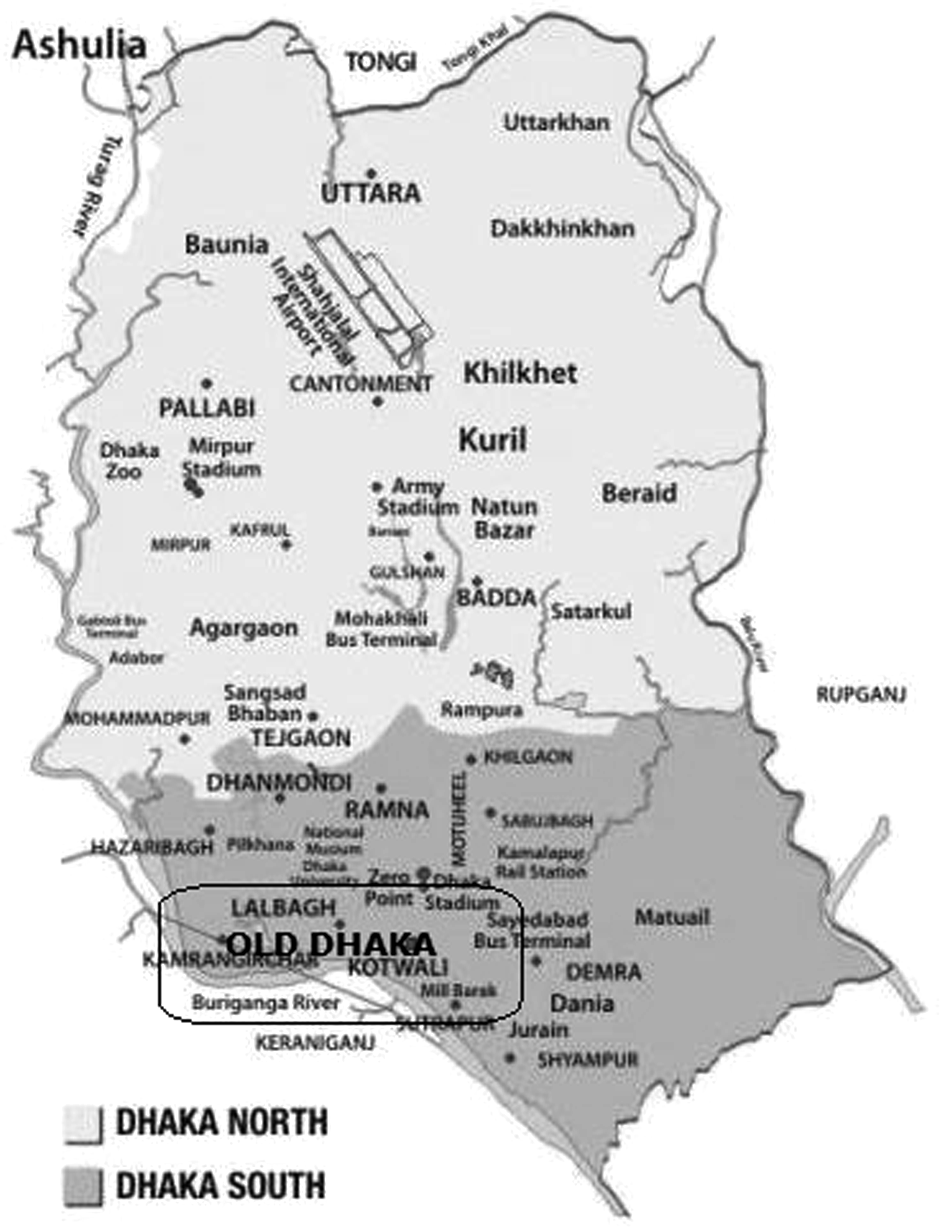
Map: Old Dhaka.
Therefore, to increase urban services, it was decided to divide the city. Without party consensus, the Awami League, the present ruling party, signed into law the separation of Dhaka in 2011.15 The way it has been divided also illustrates the undemocratic practice of the ruling political power; citizens have been used to these types of undemocratic practices and decisions, ever since the fall of General Ershad's authoritarian government in 1990.
Culturally, there is a major division between Old Dhaka and New Dhaka. Legislatively Old Dhaka falls within Dhaka South. Historical evidence says that Dhaka originated with a few urbanized settlements, dating back to the seventh century CE. Initially it was a small local trading center on the banks of the Buriganga River.16 Old Dhaka retained its history and traditional way of business and living, rather than fully progressing into modernity. Over time Old Dhaka lost its dominance in the arts, culture, and economy. Now Old Dhaka is perceived to be the decaying and poor section of the city. Nevertheless, there are still some areas with locational or family dominance over the economy and cultural activities; these areas are reminiscent of its glorious past.
Traditionally and currently, a major portion of the poor working class of Dhaka resides in Old Dhaka due to lower living expenses. Apart from their active involvement in New Dhaka, Old Dhaka's poor residents also actively engage with formal and informal level occupations near their residences. These occupations often include a few citizens engaged in formal occupations, but the majority of citizens engage in informal occupations. Historically, Old Dhaka is the birthplace of today's Dhaka; however, due to its deteriorating environment and poor living conditions many of the local elites have moved their places of residence to New Dhaka. This mass exodus from Old Dhaka began particularly after the liberation of Bangladesh in 1971 when Dhaka became the capital of a sovereign country for the first time in its history.17 To many people, even though Old Dhaka retains its ancestral glories, it has become synonymous with the poor, unprivileged, and socioeconomically marginalized people, who have, in most cases, not even minimal political representation.
However, if Dhaka is one of the densest megacities in the world, then Old Dhaka may have the densest population in contemporary human history.18 Even though there are controversies about the exact number, it is widely accepted that the population density in Old Dhaka has already exceeded the tipping point for human risk and vulnerability.19 Prognosis states the population density in Old Dhaka is 150,000 people/square kilometer.20
Context
This case study focuses on a neighborhood named Kayethtuli in Old Dhaka. Even though the size of Kayethtuli is small, the population size is enormous. However, no research has accurately reported the population of Kayethtuli. Generally people are poor, and they have diverse and precarious occupations and living conditions. It is very common that in Dhaka the poor citizens live congested lives with minimal or no basic human services, such as purified drinking water, medical services, and waste management facilities.21
These deficiencies have adverse impacts on local sustainability. In Kayethtuli, there is only one public open space, locally known as Kayethtuli Water Pump Playground (KWPP). Apart from the essential water pump, the open space provides a play area for children. Within this community, there is no other playground or open public area. There are also big trees which positively contribute to the air quality in Kayethtuli; in an area where the air quality is very poor, any positive contribution is extremely valuable. In addition, this open space provides a secure location in cases of emergency. In recent years, urban disasters, such as fires, water logging, or urban floods during the rainy season, have increased in frequency. Furthermore, as Dhaka falls into an earthquake-prone zone, there is a higher perceived risk for earthquakes. Citizens in this community know that in an emergency situation, this open space is meant to be a shelter and meeting place. Therefore, KWPP not only has recreational value, but is viewed as an evacuation zone during any natural or man-made crises. KWPP is itself owned by the government, but the community has been using and maintaining it over the last several years. In that way, the community developed some informal types of communal ownership of KWPP.
Increased tension
In 2011, the Government of Bangladesh (GOB) planned to build high-rise housing for mid-income public officials in the Water Supply and Sewerage Authority (WASA). However, if this plan came to fruition, local problems amongst poor marginalized citizens would multiply. It is true that Dhaka already suffers from an acute lack of low-cost housing; however, the proposed WASA officials‘ housing would not by any means diminish the urban housing problem. Rather this would create further stress on urban life, particularly due to the proposed location being used as a communal space by local citizens.
The availability of clean water is one of the major livelihood challenges of Old Dhaka residents. A few years ago WASA built a water pump on the corner of this open space. This water pump was warmly welcomed because citizens perceived it to be for the community, even though they were not consulted before its construction. More recently, WASA proposed construction of the aforementioned high-rise buildings for its employees. Similarly, WASA did not consult local citizens as to their opinion nor did they consider the socio-environmental issues that this construction may cause. For instance, a main issue was whether the pump would perform at full capacity and would force citizens to accept sub-standard services, in not only Kayethtuli but also neighboring communities. As plans were discovered by local Kayethtuli community members, they organized against further construction in this open space. Citizens perceived this open space and water service to be part of their minimum standard of human security and livelihood. Officially WASA initiated this high-rise building project on April 26, 2010, but they were forced to shut down the project for the time being due to local protests. After brief periods of oppression and local political manipulation, the government again started this project on April 18, 2011. This action produced similar results. Finally, the project was postponed indefinitely due to local demonstrations, mostly organized by the impoverished, marginalized people.
Street politics to organized demonstration
On May 14th, 2011 the Kayethtuli Maat o Panir Pump Rokkha Committee (Kayethtuli Field and Water Pump Protection Committee) organized a large scale demonstration initiated by local people and supported by local social and political activists. Even though a fraction of local citizens, almost 300 people, actively participated in the demonstration, it was widely supported by the residents of Kayethtuli. National environmental activist group Poribesh Bachao Andolon (POBA, translated: Save the Environment Movement) was also actively engaged in this three-hour long demonstration. Throughout the protest, citizens were encouraged to demonstrate their voices regarding their demands for environmental justice. They pleaded for the government to recognize their needs and respond accordingly. Throughout the protest, local environmental justice mobilization was aligned with a mainstream environmental activist group.
Local people spontaneously participated in the demonstration, no matter whether they were directly or indirectly affected by the government initiative to build the high-rise building. The media had a substantial presence during the demonstration (see Figure 2). Some local intellectuals and social elites were actively engaged in this process and they shared their concerns with the common people about the perceived loss and environmental risks if local people allowed the government to build residential buildings. This large demonstration illustrated the increasing tension between the local citizenry and the state, while at the same time indicating increased social capital among the marginalized population. All these factors helped them not only to confront environmental injustice but also helped to develop resiliency against any other man-made or natural disasters.
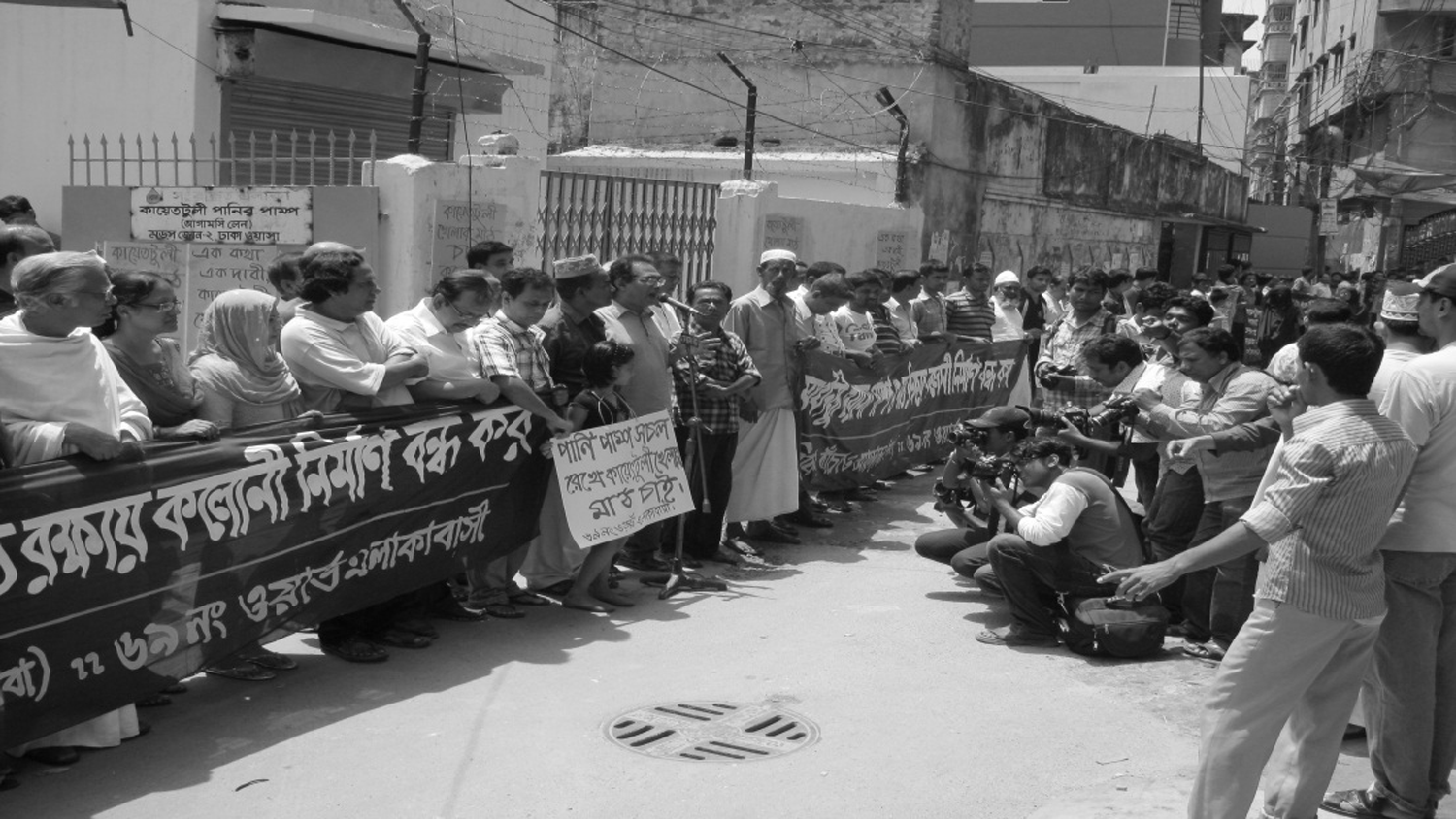
Photo: Demonstration by the Kayethtuli Mat o Panir Pump Rokkha Committee.
After the demonstration, there were informal planning conversations between local activists, representatives of POBA, and concerned social elites. Together, they framed future activism strategies, particularly how activists should identify local environmental problems and how to proceed and negotiate with the government. They also agreed that there should be continuing social pressure through different types of mobilizations and demonstrations.
Initially Kayethtuli Maat o Panir Pump Rokkha Committee formed a committee with 11 executive members and more than 100 general members. Afterwards, they decided that they would plant trees in Kayethtuli Water Pump Playground and would organize different types of social activities and festivals. The local people thought that these types of activities would give the playground even more social and environmental value.
Concluding Remarks
The politics of the Kayethtuli citizenry have gone through a gradual transformation from non-organized street politics to more organized civic engagement on the issue of environmental justice. In the Kayethtuli movement, local marginalized people were the key agents of local protests and demonstrations by demanding their environmental rights from the government. These social agents were largely from the disparate clusters of the urban unemployed, underemployed, or other marginalized groups. This process demonstrated new forms of civic innovations, where marginalized people organized themselves, opted for common goals, demanded their rights, and opposed environmental injustice collectively.
The discussion of the politics of underrepresentation and the production of common interests and goals show us some of the core issues related to the state's capacity to discharge its democratic responsibilities to its citizens along with citizens' responses in restricted situations. Now it is not uncommon to experience in many parts of the Global South burgeoning citizens' initiatives in pursuits of producing common interests through the redistribution of goods, opportunities, power, etc. The Kayethtuli demonstrations illustrate how other groups can have similar outcomes in future situations in Dhaka, where power and opportunity are elitist and the majority of people are deprived of democratic dividends.
Traditionally in the Global South within the realm of post-colonial urban development initiatives, planners and policymakers often neglect the voice of marginalized and/or under- and unrepresented citizens. However, contemporary evidence like the Kayethtuli initiative demonstrates that civic (social) innovation is becoming an integral part of urban reality. This neoliberal force in the form of a citizen movement plays a deterministic role for increasing social innovation and community resiliency, which are mostly needed when citizens are heavily exposed to different forms of sociopolitical deprivations and/or environmental crises.
Although this article has a regional focus on Dhaka, and tries to explain the process of marginalized peoples' movement for environmental justice, it has broader implications for the study of environmental justice movements in other parts of the Global South. This article investigates a broader sociological question: How does the environmental justice movement occur in the Global South, where often the locality experiences a fragile democratic context?
This research article is, therefore, a critical contribution not only to the existing literature of the environmental justice movement, rather it emphasizes the nature of local practices and helps us to further think about how the environmental justice movement can help societies in the Global South to initiate distributive development opportunities by reassessing the relationship between state institutions, society, and bipartisan political parties.
Footnotes
Acknowledgments
The author is grateful to Ashish Subedi and Animesh Kumar Gain for their thoughtful comments on the earlier version of this article. The author acknowledges the field study supports from Farida Khanam (Jagannath University), Abu Naser Khan (POBA), and the people of Kayethtuli. Last but not least, the author also acknowledges support from Utah State University's Writing Center, more particularly to Mr. Matt Winters for his tireless efforts to tackle the linguistic issues.
Author Disclosure Statement
The author has no conflicts of interest or financial ties to disclose.
1
This article is in no way attempting to take sides in the political arguments or parties of Bangladesh. Instead it is meant to explore the effects of grass-root politics in the disadvantaged Global South.
2
Red de Solidaridad con Mexico. Social and Political Analysis. <
3
Rehman Sobhan. The Political Economy of Malgovernance in Bangladesh. (Centre for Policy Dialogue, 2007), Vol. 3.
4
The World Bank. South Asia Population-Urban Growth: A Challenge and an Opportunity. Washington, D.C.: The World Bank. <
6
Mike Davis. Planet of Slums. (Verso, 2006).
7
David Naquib Pellow. Garbage Wars: The Struggle for Environmental Justice in Chicago. (MIT Press, 2007).
8
Farhat Jahan Chowdhury, A.T.M. Nurul Amin. “Environmental Assessment in Slum Improvement Programs: Some Evidence from a Study on Infrastructure Projects in Two Dhaka Slums.” Environmental Impact Assessment Review 26: 530–552 (2006). David Naquib Pellow. Garbage Wars: The Struggle for Environmental Justice in Chicago. (MIT Press, 2007).
9
United Nations Human Settlements Program. The Challenges of Slums: Global Report on Human Settlements. (Earthscan Publications Ltd., 2003).
10
Krista Harper and S. Ravi Rajan. “International Environmental Justice: Building the Natural Assets of the World's Poor.” Political Economy Research Institute (University of Massachusetts Amherst) Working Paper Series 87 (2004).
11
United Nations Department of Economic and Social Affairs. World Urbanization Prospects, the 2011 Revision. New York: United Nations. <
12
United Nations Department of Economic and Social Affairs. World Urbanization Prospects, the 2011 Revision Highlights. New York: United Nations. <
13
United Nations Department of Economic and Social Affairs. World Urbanization Prospects: The 2007 Revision. New York: United Nations. <
14
Ziauddin Choudhury. “The Great Partition of Dhaka City.” The Daily Star (Dec. 6, 2011). <
15
Wikipedia. “Dhaka City Corporation.” <
16
Wikipedia. “History of Dhaka.” <
17
Rita Afsar. “Internal Migration and the Development Nexus: The Case of Bangladesh.” Paper presented at the Regional Conference on Migration, Development and Pro-Poor Policy Choices in Asia, 2003. <
18
Wendell Cox. “World Urban Areas Population and Density: A 2012 Update.” New Geography (05/03/2012). <
19
Mozaharul Alam and Md. Golam Rabbani. “Vulnerabilities and Responses to Climate Change for Dhaka.” Environment & Urbanization 19 (1): 81–97.
20
Hilary Standing. Dhaka, The Environmental Danger Zone. <
21
Mozaharul Alam and Md. Golam Rabbani. “Vulnerabilities and Responses to Climate Change for Dhaka.” Environment & Urbanization 19 (1): 81–97.
5
Shahadat Hossain. “The Socio-spatial Differentials of Political Behavior of the Urban Poor in Bangladesh.” Bangladesh e-Journal of Sociology 2 (July 2005): 74–89. <