




Abstract
Abstract
Artisanal gold mining (ASM) is environmentally damaging and often has deleterious health effects for miners and surrounding communities. The absence of effective legal frameworks and secure rights for miners and communities in Ghana exacerbates this problem. From May 2009 to July 2012, we conducted interviews and focus group discussions with artisanal miners, government officials, policymakers, traditional leaders, and large-scale miners in order to examine the conflicts over access and land-use. The results show that a number of factors pose challenges to the willingness of artisanal to mine legally: the legal framework is incoherent; the human, financial, and material resources to enforce the laws (including decentralized structures) are almost non-existent; and, the political will to execute the laws (including control and sanctions on infractions) is limited. Although artisanal mining is reserved for indigenes, the Chinese, Indians, and Serbs have entered and consolidated their niches in the ASM sector. The metamorphosis of the Chinese and other foreigners from large-scale mining investors into artisanal miners is attributable to collusion with self-seeking citizens to circumvent the Minerals and Mining Act. Interestingly, there is ambivalence, which is expressed in citizen's complaints of environmental pollution against the Chinese. Also, three gaps in the legal framework account for the proliferation of foreigners in artisanal gold mining in Ghana: definition of who a mining investor is; lack of provision for mining rights for communities; and ambiguity of some provisions in the framework. The principal reason for policy failure in the ASM sector is that the current intervention mechanisms are predominantly of a technical order and do not take into account the complex socio-political realities in gold mining areas.
Introduction
Small-scale mining, however, poses significant environmental challenges and often has serious health and safety consequences for workers and surrounding communities. This is generally due to poor practices in mining and processing target minerals. For instance, the improper use and handling of mercury can lead to potential health hazards for artisanal miners as well as inhabitants of the communities who may be exposed to the metal through the food chain (Lacerda and Salomons, 1998). Methyl mercury bio-accumulates in the food chain and is ingested by residents of downstream communities as they eat contaminated fish (Donkor et al., 2006). The most direct exposure pathway however, is the inhalation of mercury vapors created during the burning process. Exposure to mercury can cause kidney problems, arthritis, memory loss, miscarriages, psychotic reactions, respiratory failure, neurological damage, and even death (Tschakert and Singha, 2007). Despite the environmental and health hazards associated with ASM, policy has failed to regulate this activity in Ghana. Subsequently, artisanal mining operations continue to spread as the demand for gold increases and other livelihoods such as farming are no longer economically viable, which is partly due to loss of fertile farmlands to mining companies.
Galamsey is a Twi word for a local artisanal gold miner in Ghana, West Africa; such workers are known as orpailleurs in neighboring francophone nations. Galamseys are people who mine gold independent of mining companies, digging small workings (pits, tunnels, and sluices) by hand. In Ghana, as in many other countries, unregulated ASM is an illegal activity. Yet, ASM has been economically profitable in Ghana for over a millennium (Armah et al., 2010; Aryee et al., 2003; Hilson, 2001). The lack of an adequate regulatory and policy framework can prevent formalization of this sector (Hilson, 2006). This, in turn, makes improvements in the livelihoods of miners and their dependent communities difficult to achieve. Additionally, absence of formalization makes improvements in environmental performance problematic. The absence of adequate legal frameworks and secure rights for miners and communities exacerbates environmental problems and livelihoods of miners. Local governance structures and institutions are typically underdeveloped. Artisanal and small-scale miners are often marginalized and there can be very serious disputes with communities, government agencies, and large-scale mining interests.
The Minerals and Mining Act, 2006 (Act 703), which was enacted to replace the Minerals and Mining Law, 1986 (PNDCL 153) prohibits non-Ghanaians from engaging in ASM. Notwithstanding this prohibition, several foreigners particularly the Chinese have lately been found to be active in the artisanal gold mining sector in Ghana. It is supposed that the high world market price of gold is a driver of the influx of individuals (both legal and illegal) into the ASM sector. The emergence of the Chinese and other foreigners in the ASM sector and the proliferation of their activities suggests gaps in the minerals and mining legal framework. Also, the increasing frequency of surface water use and pollution by these foreigners has exacerbated the frequency and magnitude of artisanal gold mining conflicts. Such conflicts have generated attention internationally.
In Ghana, previous research has focused on conflicts in the ASM sector among transnational corporations, indigenous people, government, and regulatory agencies. In this context, the illegal miners were exclusively Ghanaian (e.g., Armah et al., 2011; Banchirigah, 2009; Taabazuing et al. 2012). The infiltration of foreign artisanal miners mostly from China, India, and Serbia in the sector has made the gold mining conflict dynamics more complex. This new dynamic is hitherto unexamined in the burgeoning literature on ASM conflicts. Therefore, there are gaps in our understanding of how the foreigners actually emerged, and how they consolidated their niche in the sector with time. Consequently, this study will examine the mechanism by which foreign artisanal miners entered and reinforced their position in the ASM sector. Particular attention will be paid to gaps in the dysfunctional minerals and mining legal framework that was exploited by the Chinese and other foreigners in collusion with Ghanaian citizens.
Materials and Methods
Study Communities
This research focuses on 50 communities (Table 1) within the five districts of interest (Figure 1) within the Western, Eastern, and Ashanti regions of Ghana. ASM is widespread in these communities. The Amansie West District is located within latitude 6.05o W, 6.35o N, 1.40o S, and 2.05o E. It spans an area of 1,364 km2 and it is one of the largest districts in Ashanti forming 5.4% of the total land area of the Ashanti Region. Bibiani-Anhwiaso-Bekwai District is located between latitude 6° N, 3° N and longitude 2° W, 3° W. The total land area of the district is 873 km2. The Birim North District stretches over 1,250 km2; that is approximately 6.5% of the total surface of the Eastern Region. The Tarkwa Nsuaem Municipality and Prestea Huni Valley District are located between latitude 50 26' 00"N and 50 40' 00"N and longitudes 10 45' 00"W and 20 10' 00"W. The two districts jointly cover a total land area of 2,354 km2.
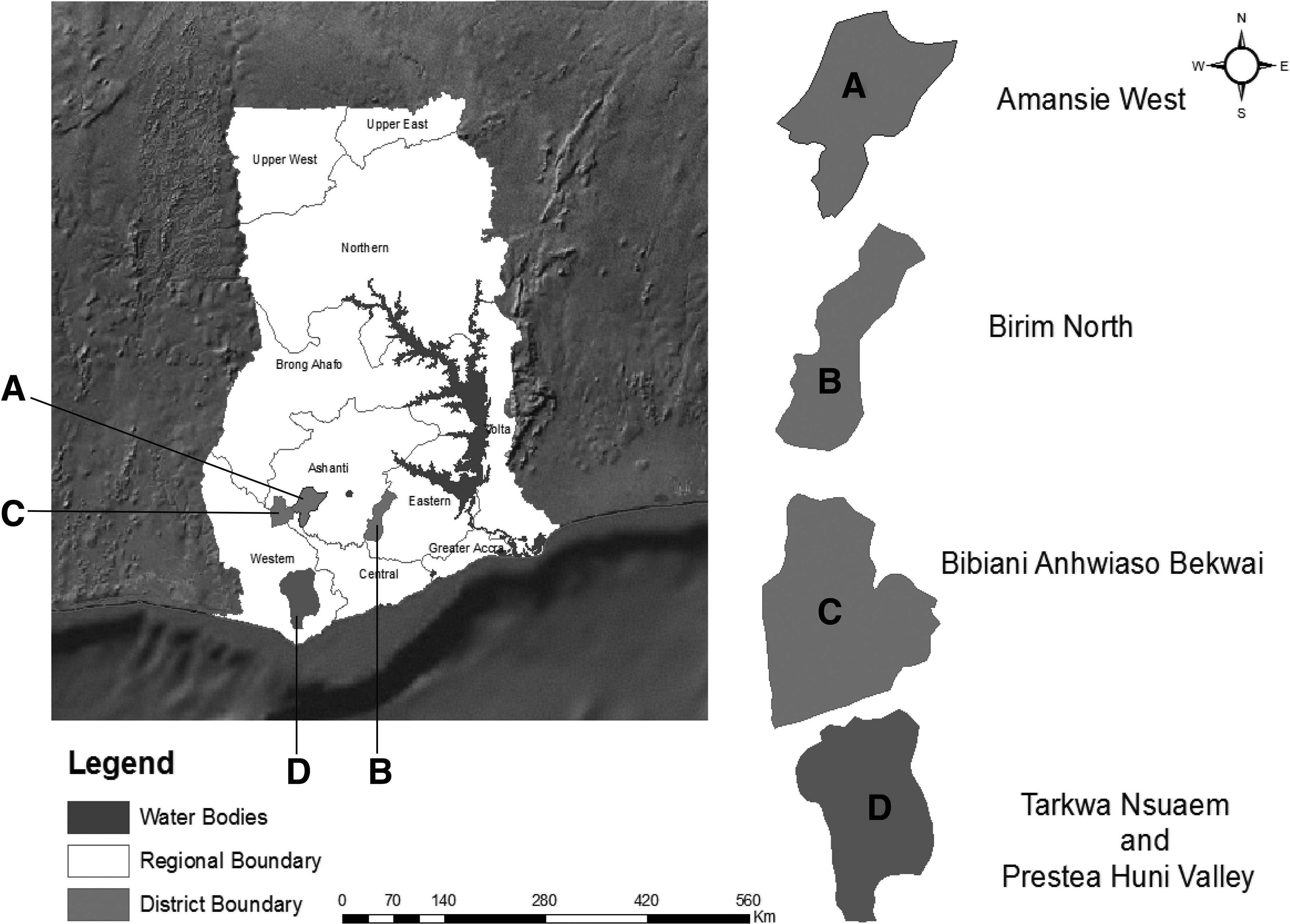
Map of the study areas.
Data collection
Primary data were collected from May 2009 to July 2012 and complemented with secondary information from the national level. A total of 100 interviews and 78 focus group discussions were conducted in the study. The communities were selected based on the pervasiveness of ASM (galamsey) activities. The traditional/cultural hierarchy was identified and a formal request for a community forum comprising the elders, traditional rulers, youth, and women leaders, as well as other opinion leaders, was initiated through family heads (Abusuapanyin). In-depth interviews of farmers, community members, foreigners, youth associations, traditional leaders, assembly members, area council representatives, unit committee members, NGOs, galamsey, and large-scale mining officials were carried out.
The researchers in this study initially made in-person contact with potential respondents and distributed letters that explained the purpose of the study. Some potential respondents (particularly the foreign artisanal miners) were reluctant to participate in face-to-face interviews. When it appeared that this reluctance could endanger the purpose for the study, telephone interviews were offered as an alternative, resulting in increased participation. Respondents were asked to sign a consent form and to indicate whether they wanted to arrange for a face-to-face or telephone interview. Participants were then contacted by phone and a time was arranged to conduct the interviews. Preliminary questions were based on an interview guide that focused on asking participants about their motivations for engaging in artisanal mining, their experiences with artisanal mining in terms of the nature and effects, reasons for influx, and proliferation of foreigners in the artisanal mining sector. The structure of the questions allowed the researchers opportunity with follow-up questions and probes. The interview guide also included questions about the interview method, such as why a participant chose to be interviewed either face-to-face or by telephone. Face-to-face interviews were audio recorded using a small, unobtrusive recorder placed between the interviewer and the participant. Telephone interviews were, however, not recorded as the foreign artisanal miners were uncomfortable with their voices on tape. All of the interviews except phone interviews were transcribed.
Data analysis
Data analysis consisted of identifying themes from various participants at each of the five research districts, and then comparing findings across these locations. A second coder provided a check for reliability in recognizing and coding themes. The across-location analysis demonstrated some commonality in central themes. For example, at each location, indigenous artisanal miners were concerned about the inability of government to expel foreign artisanal miners from the sector. The participants were also asked three questions about the interview method that they had chosen: (1) were they satisfied with the research method? (2) did they feel comfortable with their choice? and (3) did they feel they were able to express themselves freely? To each of these questions, all of the participants responded “yes.” Also, all of the participants indicated they appreciated being given the opportunity of choosing either a face-to-face or telephone interview. Focus group discussions (FGDs) involved traditional rulers, assembly members, members of the Mine and Community Consultative Committee, Unit Committee, and ordinary community members who wished to participate in the deliberations. The aim of the FGDs was the gathering of views of community members on ASM and mercury pollution. The FGDs were analyzed by coding the major themes that emerged. Table 2 shows the number of individuals involved in both in-depth interviews (IDIs) and FGDs. IDIs included both face-to-face and telephone interviews.
Results
Motivation for community members to engage in ASM
Table 3 summarizes the findings of the FDGs and interviews. Galamseys and farmers claim that large mining companies (TNCs) have taken over their fertile lands for mining and are refusing to employ them under the pretext of lack of expertise. This finding is consistent with the observations of Hilson and Banchirigah (2009). The results of this study confirm that local people are under-represented in the formal mining workforce and hold predominately semi-skilled positions. The highest level of education of most of the respondents is primary school. Therefore, they do not have the qualifications required by mining companies for employment. In any case, of the 5% of the respondents who hold either a mining–related diploma or first degree from university, only 2% are employed by the mining companies. Many large-scale gold mines employ highly trained workers. TNCs do little to support local communities or foster a secondary economy (Banchirigah, 2009). In the smaller towns and rural areas where the mines are located, companies make limited use of local labour due to residents' low education levels and lack of skills.
One community member said that: “TNCs employ members from communities outside their catchment area whereas our children are unemployed. They claim our children lack the skills requisite for employment. In fact there are many of us who are qualified yet they have refused to employ us.” (FGD, M, Hunter, December 2010). Another indicated that: “based on feedback from TNCs we sent our children for skills training in order to meet their requirements. Since our skilled children returned none has ever been employed by the TNCs.” (FGD, M, Farmer, December 2010). However, some TNC officials claimed that:
there is only a limited pool of local people who are “work-ready,” that is who have the necessary job experience and skills to move directly into the workforce. In the company, we have reserved a quota for local people but this is never met. In fact, in several catchment communities there are signs that the majority of work-ready people have already been recruited and some TNC operations are having difficulty in meeting their Indigenous employment targets. (Interviews, F, TNC, April 2011)
Emergence of the Chinese, their metamorphosis from investors to illegal artisanal miners and ambivalence
Although it is illegal for expatriates to engage in ASM, our results indicate that many Chinese, Indians and Serbs were engaged in it. In this context, an official of the minerals commission indicated thus:
This sudden interest in Ghana by Chinese and other foreign small-scale miners is explicable. The main reason is the rise in the price of gold on the world market. From $200 an ounce about 10 years ago, gold is now trading at more than $1,500 an ounce. Therefore, the Chinese and other foreigners are assured of good returns on their investments. (Interview, M, Minerals Commission, September 2012)
The minerals commission does not issue small-scale licenses to expatriates. To circumvent this, expatriates pay Ghanaian citizens to register on their behalf and front for their illegal mining activities. For instance, an official of the minerals commission said that:
There are 799 small-scale registered and licensed mining operations owned by only Ghanaians in the country. However, some Ghanaians go through the legal process for acquiring mining licences after which they either sell the licence to the Chinese, transfer the licence or enter into partnership with them. Thus, officially all the small scale mining companies are owned by Ghanaians. Yet, in practice, it is the Chinese and other foreigners who operate them. (Interview, M, Minerals Commission, September 2012)
This was corroborated by another official of the commission:
Many of these Ghanaians sublet their licenses to Chinese and other foreign miners. Behind every illegal Chinese and other foreign operators, we are looking at an opinion leader, a chief, a farmer, a land owner or somebody who then sublets it to the Chinese and other foreigners for these illegal activities. (Interview, F, Minerals Commission, September 2012)
Therefore citizens are complicit in this illegal act. Interestingly, some citizens involved in ASM indicated that the mining law should be enforced to eliminate the Chinese and other foreigners and other expatriates from the subsector suggesting ambivalence. One indigenous galamsey operator indicated that: “the Chinese and other foreigners have easy access to excavators, washing pumps, and other machinery since they are relatively affluent. The EPA [Environmental Protection Agency] has to flush them out. I am prepared to show them where they are hiding and mining.” Another indigenous galamsey operator said: “how can we blame the Chinese and other foreigners and other nationals when our kith and kin aid them in their nefarious activities?” Yet another intimated that:
I have no money to independently operate ASM. I sought employment but to no avail. It is the Chinese and other foreigners who employed me and other fellow community members. Therefore, I think the Chinese and other foreigners are contributing to the reduction of unemployment.
Others were less charitable:
We have allowed foreigners to come, take our limited gold resources and destroy our environment. They will return to their country and leave us impoverished with a degraded environment too. (Interview, M, Policymaker, February 2012)
I blame government for the influx of Chinese and other foreign illegal miners into the country. Various institutions such as the Police, Ghana Immigration Service, and the Minerals Commission are not enforcing the State's laws thereby giving foreigners the leeway to flout them with impunity. The law says, the land may belong to a chief, the farm may belong to a cocoa farmer but ore underneath the land, the President holds that in trust for the people. So if somebody is using excavators in broad day light and steals something that belongs to Central Government, the relevant authorities should in plain language arrest the person. (Interview, M, Traditional ruler, January 2012)
Another traditional ruler had this to say:
We have disrespected our laws so much that people from China can walk into our country illegally and engage in illegal activities, destroy our rivers, drop mercury into the rivers that we drink and still have the audacity to hold a gun to fight Ghanaians. (Interview, M, Traditional ruler, February 2012).
However, interviews with officials of some enforcement agencies show that they have made attempts to address the situation. For instance, interviews with officials of the Ghana Immigration Service (GIS) indicate that there are 607 Chinese with work and resident permits in the country (as of January 2012). Of this, 75 are in the mining industry, 197 in the oil, gas, and energy industry, while the rest are in other sectors. Conceding that the number of Chinese in Ghana could be more, immigration officials interviewed said that was so because some of the Chinese came into the country as investors, while others used the Aflao (Togo) Border as their entry point. According to immigration officials, the majority of the Chinese, in their attempt to avoid going through laid down procedures for resident and work permits, flew from China to Togo and used approved or unapproved routes to arrive in the country. From the beginning of 2012, 81 Chinese who were involved in illegal mining activities in the country have been arrested by immigration officials, 40 have so far been repatriated to China.
Furthermore, one interviewee said that: “Enforcing the law on illegal gold mining is a problem in Ghana. At times we apprehend these Chinese. We send them to the law courts and the same law is used to set them free. Yet, we are accused of inaction…” (Interview, M, Minerals Commission, September 2012).
Also, we found that some Chinese jointly applied with other investors to engage in large-scale mining. The joint application only documents their financial capacity to undertake the capital intensive large-scale mining. However, after receiving the licenses they abrogate the joint partnership and venture into small-scale mining due to lack of funds.
Interestingly, some chiefs, local government officials, and members of parliament were perceived to be involved in galamsey. Our results show that some of these stakeholders even had sole ownership or had formed partnerships with other individuals in ASM companies (including the Chinese) by providing excavators and other machinery to support ASM activities whereas others had contributed financial resources to sustain this operation. Thus, it is interesting to note the ambivalence regarding the involvement of the Chinese and other foreigners in ASM activities. Self-seeking citizens colluded with the Chinese and other foreigners to circumvent the Minerals and Mining Act. Yet, the same citizens are accusing the Chinese and other foreigners and demanding legal action against them.
Turf war between indigenous artisanal miners, foreign artisanal miners, and TNCs
During the interviews, TNCs contend that the widespread pollution of surface water bodies is due to unregulated and indiscriminate ASM activities in all mining communities (Armah et al., 2011). TNCs further claim that ASM have taken over their concessions without permission and are specifically polluting surface water bodies with mercury. For instance, one official of the Ghana Chamber of mines said that:
a group of illegal miners were polluting a river in Obuasi and when out 2 of workers attempted to stop them, they were assaulted. Such barbaric attacks had the tendency of discouraging investors and it would impact negatively on the nation's economy. National Security must take steps to stop this practice and water pollution by the illegal miners (galamsey) before things get out of hands. (Interview, F, TNC, September, 2010)
Similarly, another official of a TNC indicated that:
The involvement of the Chinese and other foreigners in illegal ASM can only exacerbate the existing conflict between galamseys and us. It has the potential to further worsen increase the frequency and magnitude of surface water pollution that these illegal miners have visited upon the nation. The time for the EPA to act is now in order to control such environmental infractions. (Interview, F, TNC, January 2011)
Artisanal miners counter claims that TNCs are also polluting water bodies but on a larger scale since the latter have larger concessions on which they operate. The results suggest that both TNCs and ASM sometimes pollute the water environment with cyanide and mercury respectively. It is significant to note that 800 (82%) interviewees in the various mining communities claimed they could not drink from their original water sources due to perceived pollution. For instance, residents of Twiagya trade food stuffs for sachets of water as the five surface water bodies which originally used to provide them with drinking water have been polluted by mining activities.
A galamsey operator posed this rhetorical question: “… they say our activities are polluting rivers in our communities but government is always silent on what the TNCs and the Chinese and other foreigners are doing to our rivers. Have they forgotten that before colonisation our forebears were mining gold?” (FGD, M, ASM, April 2010).
In relation to the above, one interviewee had this to say:
I have been farming in Wassa Akropong over 20 years. Several Chinese and other foreign nationals (about 100) who use highly sophisticated machines have encroached on my land and are also polluting River Ankobra. When I confronted them, they unleashed their wild dogs on me. I fled for my life. (Interview, M, farmer, August 2009)
Furthermore, according to the participants, the alternative source of drinking water provided for them turns blue when peeled plantain or cassava is put in it. A community resident indicated that: “we have been drinking from the river since childhood but the colour of the water changed from brown when the TNCs diverted the source of the river. Now the water is very clear with no particles. Therefore, we suspect that they have polluted it” (Interview, M, Opinion Leader, August 2010).
Added to this is the devastating effect of illegal mining on the land. In this context, a participant in the FGDs said that:
Farmlands are destroyed in addition to pollution of water bodies as a result of illegal mining. Sometimes they dig the place and when they find no mineral they just move to another place just like that. But with the regulated mining companies this does not happen. (FGD, M, Farmer, December 2010)
Surface water pollution and weak enforcement by regulatory agencies
At the core of surface water pollution by artisanal miners is the issue of weak enforcement of mining regulations. In particular, the legal framework (mining code, legislation) in Ghana is incoherent. Also, the human, financial, and material resources to enforce the laws (including decentralized structures) are almost non-existent. For example, the EPA is visible only at the regional level with virtually no offices at the community level except in a few mining districts. Thus, their response to environmental infractions is rather weak. Also, the political will to execute the laws (including control and sanctions on infractions) is limited. This is demonstrated by the lack of government action on a number of environmental breaches by TNCs and artisanal miners. According to Obiri et al. (2010), there have been no less than 14 cyanide spills into water bodies by TNCs between 1990 and 2004. Yet, the culprits have not been sanctioned by the regulatory agencies. During the FGDs, residents of some mining communities shared similar concerns. For example, most of the residents claimed that in 2001 and 2004 when Goldfields Ghana Limited and Bogoso Gold Limited respectively spilled large volumes of cyanide solutions into rivers Asuman at Abekoase and Aprepre in Dumasi, EPA officials collected blood samples from some of the residents who drank cyanide contaminated water. However, to date they have unsuccessfully pressed EPA several times for a copy of the report. Also, Donkor et al. (2006) indicated that mercury pollution is a common feature of ASM activities.
Regarding surface water pollution by ASM activities, this is what one farmer had to say:
It is true; the Chinese and other foreigners are into “Galamsey” mining in the country. Not only that; they have mined into River Ankobra, a prominent river that serves as the only source of drinking water for the farming communities of Adansi, Dikoto and Konkorso all in the Wassa Amenfi East District of the Western Region. Under the mining regulations, the closest a mining activity can come to a river is 200 feet away. But the Chinese and other foreign “Galamsey” operators have mined much closer to River Ankobra. Yet government has failed to sanction them. If it were local people the security agencies would have accosted them. (FGD, M, farmer, July 2009)
Discussion
The findings suggest possible confrontation between locals who are not directly benefiting from the involvement of foreigners in artisanal mining versus others who are profiting from local-foreigner alliance. We found that environmental degradation associated with artisanal mining is, in part, exacerbated by the political marginalization of the ASM sector. This finding is consistent with the findings of Hilson (2006) and Tschakert (2009). This is coupled with the lack of appropriate incentives to mine in a more environmentally sensitive manner. ASM's marginalization within the mining industry primarily stems from four issues. First, is the persistent belief by government that large scale mining (LSM) should be prioritized, whenever possible, over ASM versus in tandem with ASM. Also, as currently practiced, in most contexts ASM does not contribute as much direct tax revenue to the state as large-scale mining; its indirect contributions are often not calculated or undervalued. This finding supports the observation of Hilson and Banchirigah (2009). Next, ASM as an informal or illegal activity is understood as foregone conclusion: making reform or formalization economically unattractive and/or politically challenging. Again, local markets for high-value/low volume commodities especially gold often lack transparency and formal trading chains. This provides the ideal setup for extraordinary profits in grey or black markets, such as smuggling by unscrupulous middlemen, some of who have direct ties to those with the economic and political means to perpetuate the marginal and informal condition of ASM so crucial for their businesses (Kwai and Hilson, 2010).
These factors create a situation of minimal political will to address the sector. It follows that few successful education initiatives have addressed artisanal miners' ignorance of how to reduce or mitigate their impacts on the environment, or at a more basic level, educate them in the ways in which what they do is environmentally damaging. This is coupled with a widespread lack of incentives for miners to introduce improved techniques or rehabilitate mining sites. Interestingly, unlike in large-scale mining where the financial profits and investments are larger than the costs of requisite conservation programmes, in ASM the profits are orders of magnitude smaller, sometimes altogether elusive and usually dispersed amongst a large group of people.
That poverty, social inequality, and environmental injustice are all at the root and a consequence of the informal and illegal forms of small-scale gold mining cannot be overlooked. This is consistent with the findings of Banchirigah (2009) and Taabazuing et al. (2012). Local populations are pinched between their aspirations to economic development and the damage to their natural environment, social structure, and culture. We argue that conflicts among different stakeholders (TNCs, the foreigners, indigenous artisanal miners, and chiefs) over access to gold-rich soils and rivers in Ghana form an important obstacle to the effective formulation and implementation of public policies for the regulation of small-scale mining activities. Gaining a deeper understanding of such conflicts and their possible solutions is a precondition for developing policies that will enhance the environmental, economic and social sustainability of the gold mining industry (see also Taabazuing et al., 2012). Understanding the actors' perceptions of opportunities of gold mining, the conflicts it generates and the environmental impacts, is fundamental.
At least three gaps in the legal framework account for the proliferation of the Chinese and other foreigners in artisanal gold mining in Ghana: definition of who a mining investor is; lack of provision for mining rights for communities; and ambiguity of some provisions in the framework. First, since large scale gold mining is a capitalised venture; the government of Ghana was interested in individuals or groups that could provide an initial minimum capital of 200,000 USD. Local people did not have access to this amount of money; neither could they access credit from the banks due to the high risks involved in gold mining. This financial requirement fundamentally and inadvertently precluded local people from being investors in large-scale mining and created a loophole for exploitation by some foreigners. The foreigners were able to generate the initial capital requested by government for documentary purposes only without any intention of venturing into large-scale mining. On receiving the license, the Chinese and other foreigners simply resorted to small-scale mining. Second, the acquisition of mining rights is restricted to individuals, companies and partnerships of not more than six persons. Thus, many local people cannot form a partnership with the intention of engaging in mining. Communal people operate in varying group dimensions. The grouping can have a traditional set up (family relations in a locality), administrative in nature (village or community structure), or a combination. The acceptance to such groupings in rural areas can be more appropriate for such people to participate in the mining sector. Next, the legal framework calls for a balanced solution for environmental, social, and economic problems. However, it is not clear on the mechanisms or specific steps mining companies must take to achieve such a balance. In fact, some provisions in the framework are contradictory, ambiguous, and difficult to interpret. Other provisions are voluntary, vague and do not impose penalties for non-compliance. For instance, the legal framework mentions responsible mining. However, the nature and practice of responsible mining remains undefined and is subject to multiple interpretations.
The basic principles and actual applications of responsible mining are still vague to some stakeholders (particularly artisanal miners) because of the lack of information, misinformation or actual negative experiences of past mining practices. In forest reserves, mining licenses were given out at the same time the forestry authority was taking steps to upgrade some of the forest reserves into national parks. Also, the Mining Code is not harmonized with the Forestry and Land Codes, leading to conflicts over entitlements. There are further unclear and contradicting mandates between the Ministry of Land and Natural Resources and the Ministry of Environment Science and Technology at the national levels. Some of the inconsistencies in the legal framework identified in this study have also been documented by Armah et al. (2011).
Conclusion
It is interesting to note the ambivalence on the part of artisanal miners regarding the involvement of the Chinese and other foreigners in ASM activities. Given that self-seeking citizens colluded with the Chinese and other foreigners to circumvent the minerals and mining act in order to gain entry into the sector, it is remarkable that the same citizens are accusing the Chinese and other foreigners and demanding legal action against them. It appears that to a larger extent, the Chinese and to a lesser extent, other foreigners such as the Indians and Serbians have consolidated their niches in the ASM sector. Several policy attempts to regulate ASM in Ghana have failed. The principal reason for this failure is that the current intervention mechanisms are predominantly of a technical order and do not take into account the complex socio-political realities in gold mining regions. Key areas of concern include the casualty rate from mining pit collapse, the social and economic effects of the attempt to shut down artisanal mining, and mercury contamination from gold mining. Other areas of concern include increasing frequency and magnitude of conflicts among TNCs, indigenous artisanal miners and other foreigners, government, chiefs, and farmers. The root of the conflicts surrounding small-scale gold mining in Ghana can be found in legal and political conditions. In particular, current public policies (including the Minerals and Mining Act) are not suitable to deal with the complex situation of a sector in which many poor people find a living, but that remains rather uncontrollable as an informal industry taking place in remote parts of Ghana.