




Abstract
Abstract
Statistics have demonstrated that although we have progressed toward reducing environmental health disparities in the United States, there is still much work to be done. Health disparities result from multiple factors including poverty, environmental threats, inadequate access to health care, and individual and behavioral factors. In an effort to address environmental justice and environmental health disparities in the state of Maryland and Washington, DC, community members, researchers, public health practitioners, policymakers, students, and advocates along with the Community Engagement, Environmental Justice, and Health (CEEJH) team gathered for the First Annual Symposium on Environmental Justice and Environmental Health Disparities in Maryland and DC in December 2012. The goal of the symposium was to establish and sustain a community engaged research enterprise on critical environmental health disparities and environmental justice issues, to raise the visibility of racial and ethnic environmental health disparities and feasible solutions with Marylanders, DC residents, and regional stakeholders, and facilitate action for change. The sessions included topics on the regional watersheds, built environment, toxic chemicals, traffic and air pollution, law and policy, best practices, and community-based participatory research. As a result of the successful meeting, an environmental justice coalition in the Maryland and Washington, DC region was established.
Introduction
L
Unfortunately due to a wide-range of political, socioeconomic, and discriminatory forces, combined with patterns of industrialization, disinvestment, and development, many people of color live in neighborhoods with some of the highest incidences of urban poverty and deprivation. 15 It is no secret that disadvantaged populations are differentially burdened by environmental hazards and stressors including waste facilities and other noxious land uses, lead, and poor air quality. 16 Furthermore these communities often have limited access to health promoting infrastructure, which has been linked to increase exposure to toxic substances in their residential environments. 17
The Center for Disease Control (CDC) defines “health disparities” as preventable differences in the burden of disease, injury, violence, or opportunities to achieve optimal health that are experienced by socially disadvantaged populations and resulting from multiple factors including poverty, environmental threats, inadequate access to health care, individual and behavioral factors, and educational inequalities. 18 And although Maryland has the third highest median household income and the second highest number of primary care physicians per capita in the country, it also ranks 43rd in infant mortality, 28th in obesity prevalence and 31st in diabetes prevalence, 35th in cardiovascular deaths, 32nd in cancer deaths, and 33rd for geographic health disparities, 19 When taking into account physical environment factors including levels of particulate matter and ozone, access to recreational facilities, healthy foods and the amount of fast food restaurants, Maryland ranked 18 of 24 counties in 2010 and 23 out of 24 in 2011 and 2012. 19
In an effort to address environmental justice and environmental health disparities in the state of Maryland and Washington, DC, the Community Engagement, Environmental Justice, and Health (CEEJH) team held the First Annual Symposium on Environmental Justice and Environmental Health Disparities in Maryland and DC in December 2012. The symposium served as a forum for the exchange of ideas among community members, researchers, public health practitioners, policymakers, students, and advocates on environmental justice and health issues in state of Maryland and Washington, DC. In addition, the meeting focused on intergenerational leadership development on environmental justice and health issues with a series of activities for youth from the region.
Methods
Symposium planning
The symposium was held at the Adele H. Stamp Student Union Building at the University of Maryland—College Park on December 1, 2012. Dr. Sacoby Wilson, assistant professor and director of CEEJH, staff, and students worked diligently to coordinate the symposium. The logistics were organized by a planning committee that met bi-weekly in preparation for the symposium from September to November 2012. A CEEJH website was also launched to help facilitate registration and provided participants the opportunity to choose which sessions they wanted to attend in advance. To assist in reaching our goal, folders were distributed to attendees at registration that contained the conference agenda, a short description of each session, and a short bio of each presenter.
As part of their participation, attendees completed an evaluation form. Using the Likert Scale, survey participants highlighted five main themes of the symposium: 1) speakers' knowledge about the subject matter, 2) communication of information, 3) organization of the session, 4) usefulness of information, and 5) the novelty of information. R version 3.0 was used to summarize the data, and Excel was utilized to analyze the data.
Results
The purpose of the one-day conference was to establish and sustain a community-engaged research enterprise on critical environmental health disparities and environmental justice issues, and facilitate action for change. The symposium consisted of several concurrent mornings and afternoon sessions that discussed raising the visibility of racial and ethnic environmental health disparities and feasible solutions with Marylanders, DC residents, and regional stakeholders.
A total of 351 individuals attended the symposium. Three hundred participants registered to attend the symposium via the online registration system, an additional fifty-one participants registered on site. Seventy-nine speakers presented at the symposium. A large portion of speakers were women, who represented 57%. Figure 1 displays the racial distribution of speakers: 48% were of Caucasian decent, followed by African Americans with 42% and Asian and Hispanic at 5%, respectively.
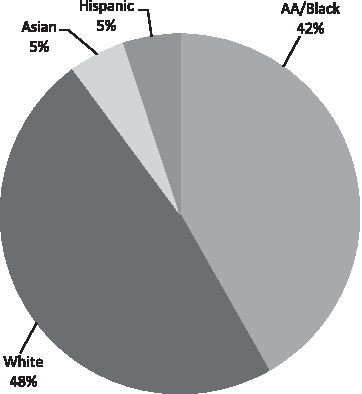
Racial/ethnic composition of symposium moderators and speakers.
Session overview
Each session consisted of a moderator and five panelists. The concurrent sessions ran for one hour and thirty minutes in length, and this time allowed for the panel of five speakers to share their expertise on a particular topic, as well as take questions and comments from the audience. The morning session offered eight concurrent sessions. The first concurrent session, “Environmental Justice and Water Issues in the Chesapeake Bay,” focused on the little work that has been performed to understand how bay contamination may be differentially impacting underserved and vulnerable populations in the region. In concurrent session 2, “Environmental Justice and the Anacostia Watershed,” the panel applied an environmental justice lens to the degradation and restoration of the Anacostia River and looked for parallels in Maryland's other prominent urban waters.
During concurrent session 3, “Built Environment, Social Environment, and Disparities,” panelists discussed issues in Maryland and Washington, DC including the distribution of incinerators in the region and efforts to site more incinerators in overburdened communities, the relationship between housing quality and health, and the proximity of schools to pollution sources. At the same time, concurrent session 4, “Toxic Chemicals, Vulnerable Populations and Risk,” explored the disproportionate impact of pesticides, toxics in consumer products, and chemical contamination of food and water on low income people, people of color, and marginalized groups including children and the elderly.
In addition, in concurrent session 5 entitled “Traffic, Air Pollution, and Environmental Health Disparities,” presenters discussed their efforts to address these environmental justice issues in the region. In another equally important session, concurrent session 6 entitled “Environmental Justice and Children's Environmental Health: Current and Emerging Issues,” presenters described some of the environmental justice challenges facing children in Maryland and Washington, DC, emerging issues in the region, and their efforts to eliminate environmental health disparities that impact children in the region. In concurrent session 7, “Food Justice and Health Disparities,” panelists covered inequities in the food system and industrial animal production with a focus on Maryland and Washington, DC. Lastly, in concurrent session 8, “Connecting the Science of Disproportionate Impact to Environmental Justice Law and Policy,” panelists discussed recent efforts at the federal level and in the region to address policy and regulatory gaps including discussion of the EPA EJ 2014 plan and work of the Interagency Workgroup on Environmental Justice.
The afternoon breakout sessions were filled with solution-focused discussions from experts in environmental justice, public health planning, policy, and other disciplines. During the first afternoon concurrent session, “Use of Community Engagement, Community-Based Participatory Research and Community-University Partnerships to Address Environmental Injustice and Environmental Health Disparities,” Dr. Sacoby Wilson moderated the panel discussion in which the panelists highlighted effective ways to address local environmental justice and health issues including air pollution in metropolitan areas, housing stock, basic amenities, pollution intensive industries, and locally unwanted land uses. This lively discussion provided success stories, challenges, lessons learned, best practices, and next steps for replication of effective, authentic, and transformative partnerships in the region.
In concurrent session 2, “The Use of Health Impact Assessments (HIA) to Address Negative Land Use Impacts and Improve Community Sustainability and Quality of Life,” panelists discussed the use of HIAs in addressing legacy pollution on the Anacostia watershed, transforming the 11th St Bridge in to a community asset and catalyst for public health prevention, and highlighted other HIA success stories in the region. Next in concurrent session 3 entitled “The Affordable Care Act and the Maryland Health Improvement and Health Disparities Reduction Act: How Can Implementation Lead to Environmental Justice and Health Equity?” speakers engaged in open discussion on how these laws can be implemented to achieve health equity, discuss challenges, and engaged the audience in a discussion in how they can work with health policy experts to make sure that these laws benefit vulnerable and underserved populations in the region.
Furthermore, in concurrent session 4, “Best Practices in Planning and Sustainable Communities,” the conversation centered on the years of deindustrialization, disinvestment, suburbanization, gentrification, and poor planning in some communities in Maryland and Washington, DC. Panelists discussed how expulsive and exclusionary zoning, planning, and development have led to these communities having poor infrastructure, high concentration of psychosocial stressors, built environment insults, poor quality of life, and health disparities. Panelists discussed some of the best practices in planning and sustainability that have been used in the region and nationally to make communities greener, healthier, more sustainable, and more just.
Simultaneously in concurrent session 5 entitled “Community Capacity-Building and Empowerment to Address Environmental Justice and Environmental Health Disparities,” speakers spoke on how their partnerships have been effective in building community capacity and how these partnerships have empowered citizens to become more civically engaged. In addition, panelists described challenges of doing grassroots work in environmental justice and health disparities, lessons learned, best practices, and how other groups in the region can replicate their success and develop community driven solutions. Furthermore, in concurrent session 6, “The development of a Community-Based Environmental Justice Network,” speakers discussed the work that has been done with regional environmental justice networks and coalitions in other parts of the country, the positive impact these networks have had in addressing environmental injustice and related economic and health disparities. In addition, they described the lessons learned from participating in these networks and coalitions, challenges in building a regional network in the Washington, DC area, and best practices that could be instrumental for the success of a regional network.
Finally, in concurrent session 7 entitled “Green Jobs, Social Entrepreneurship, Sustainable Development, and Community Revitalization,” speakers described green jobs programs that attendees can use to receive green jobs training and state and local level revitalization programs including funding for sustainable development initiatives. In addition, the panelists discussed some of the challenges they have faced, lessons learned in overcoming these challenges, best practices, and next steps for the region. The symposium concluded with reports from the solution sessions and youth group sessions and closed with next steps.
Symposium evaluation
One hundred and twenty-five participants took part in the symposium evaluation. As previously mentioned, survey participants used the Likert Scale to provide a range of responses on the five main strengths of the symposium: 1) speakers' knowledge about the subject matter, 2) communication of information, 3) organization of the session, 4) usefulness of information, and 5) the novelty of information. Among those surveyed in the morning session, 74% (Figure 2) agreed that “the information was well communicated” by the presenters, and 11% disagreed, while 15% were neutral about the presenters. When asked if “the information I gained is/will be useful to me,” 70% were in agreement that the information conveyed in the session was in fact beneficial.
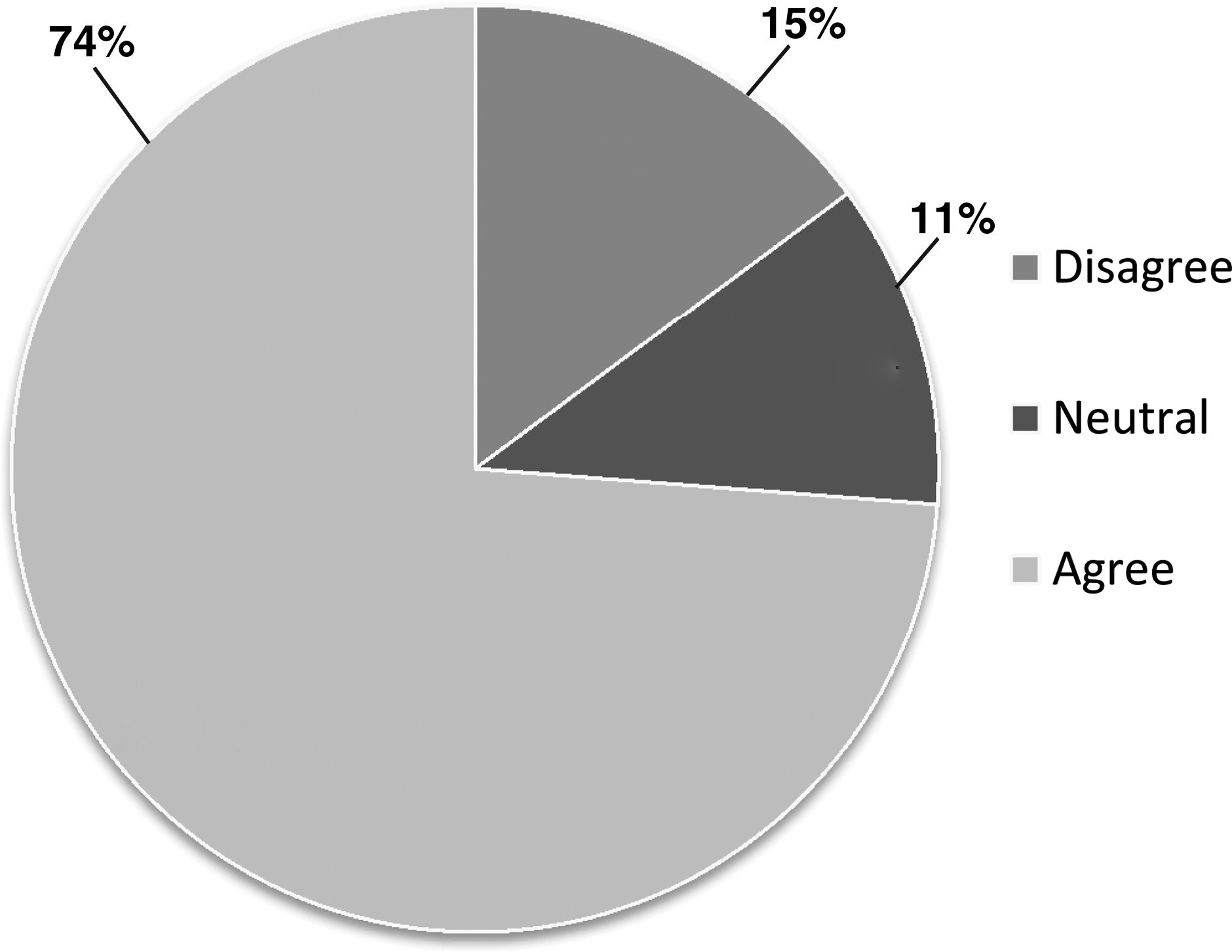
Survey question: Was the information was well communicated by the speaker?
In addition when asked if “I will be able to use the information to address environmental justice issues in my work or community,” 75% (Figure 3) strongly agreed the information discussed in these sessions were beneficial and useful for their community work, while 3% disagreed. In session A2 (Use of Community Engagement, CBPR and Community-University Partnerships), more than half (77%) agreed that the discussion provided an opportunity to develop strategies for solutions for EJ issues, and 71% also strongly agreed that session A2 (Use of Community Engagement, CBPR and Community-University Partnerships) provided an opportunity for collaboration with others.

Survey question: I will be able to use the information to address environmental justice issues in my work or community?
Overall, when asked if an afternoon session “was well organized,” more than 63% strongly agreed the afternoon sessions were structured well. We also found when looking at both the morning and afternoon sessions that a little over 50% of surveyors agreed that they had sufficient time to ask questions. In addition, 88% of surveyors in session E1 (Traffic, Air Pollution and Environmental Health Disparities) agreed that the information was well communicated during the session. When asked the same question during the afternoon session, only 40% of surveyors strongly agreed the information was well communicated.
In addition, during the lunchtime session, Vernice Travis-Miller, a leading environmental justice leader and co-founder of West Harlem Environmental Action (WEACT), delivered the keynote address. Many participants expressed their satisfaction with the lunch time presentation because of the speaker's energy, passion, quality of the information she shared, and call to action on environmental injustice and health disparities in the Washington, DC region. When asked “what did you like the most about the symposium today?” more than 60% of surveyors mentioned their satisfaction with the keynote speaker and also mentioned the great deal of information that was shared by the speaker.
Discussion
The symposium presented a unique opportunity for individuals from many different disciplines to interact with each another. Attendees had an opportunity to better understand environmental health issues that are impacting underserved and economically disadvantaged groups in the region as well as discuss possible solutions. This provided valuable opportunities for communication to further the goal of improving the quality of life in Maryland, and the Washington, DC region. The one-day event also enabled attendees to share their knowledge of various environmental health and justice topics, form new partnerships, and discuss best practices and lessons learned.
The symposium offered a variety of concurrent sessions, however due to the large number of panelists, attendees found it difficult to absorb information from all of the presentations, and participate in the question and answer portion of the respective session in the allotted time. Participants also disliked only having the opportunity to attend one concurrent session in the morning and one concurrent session in the afternoon. Several respondents commented, “I wished I could have gone to more sessions. Next time spread out over 2 days, if possible, so there are less concurrent sessions but more sessions.” This limitation hindered the opportunity for participants enhance their knowledge about more than one environmental health and justice topic. Had we provided an opportunity for attendees to attend multiple sessions, this would have given the speakers more time to present and the attendees more time to ask questions.
As part of the evaluation, respondents highlighted numerous ways in which the symposium was effective as well as suggestions for the next major symposium. One of the common themes mentioned throughout the symposium was the diversity of speakers, as well as attendees. One attendee wrote, “The diversity represented at the symposium is one of the few symposiums that I have attended where speakers/panelists were representative of the diverse populations in our country. Normally, at many conferences/workshops regardless of topic the speaker/panelists are often white males.” Another respondent wrote that they enjoyed the “broad range of specialties present. So many perspectives represented, which really made for excellent discussion.”
There were suggestions made that could have enhanced the experience of the symposium. When asked what did you like the least about the symposium? Many respondents stated that the lack of formal time to network was an issue. The lack of networking opportunity was a limitation of the meeting. The inclusion of a networking hour into the agenda would have facilitated more interaction of among the participants. It's important that attendees are able to foster relations while meeting in a positive and progressive setting like the symposium. Some of the other suggested improvements were the inclusion of contact information of speakers within the agenda, the bios and final agenda draft being made available in advance of the symposium, better building signage, and name tags for attendees. There is a plan in place to incorporate all the suggested improvements into future symposiums and conferences.
Furthermore, one of the major outcomes of this meeting was seeding the establishment of a community-driven environmental justice network in the Maryland and Washington, DC region. The wealth of discussion from attendees resulted in a decision to create an online forum and blog for continued dialogue and peer-learning about EJ best practices. A listserv was also developed to disseminate EJ-related information and news. Since the symposium in December of 2012, we have established online forum space through the CEEJH website to continue the conversation outside of the symposium. The listserv has over 200 members. The listserv encourages discussion between attendees of the symposium. It allows for fast dissemination of information on regional environmental justice and health issues to all members and it also allows members to distribute information as well. In addition, the established network will also allow us to advertise future events, including our fall environmental justice and health disparities symposium that will be held in December 2014.
Conclusion
The First Annual Symposium on Environmental Justice and Environmental Health Disparities in Maryland and Washington, DC was a huge success. Community members, researchers, public health practitioners, policymakers, students, and advocates from across the region where able to attend an informative scientific and action focused conference where they had the opportunity to learn, discuss and exchange ideas. The CEEJH team is planning a 2014 fall conference at the University of Maryland, Stamp Student Union. The planning committee intends to learn from the challenges of the 2012 symposium to improve the experience of its attendees, and be able to track short-term and long-term impact of the 2014 conference.
Footnotes
Acknowledgments
We would like to acknowledge the assistance of the Maryland Institute for Applied Environmental Health and the University of Maryland-College Park, STAMP Student Union for helping to organize the forum. We truly appreciate your contribution. We also send special thanks to CEEJH staff members who helped with the organization of the event. We also thank the United States Environmental Protection Agency (USEPA), State of Maryland, Office of Minority Health, Anacostia Watershed Society, Clarice Smith Performing Arts Center, and Dance Exchange for your contribution to the symposium.
Author Disclosure Statement
The authors received funding from Maryland Environmental Health Network (MEHN), Environmental Integrity Project (EIP), Children's Environmental Health Network (CEHN), Center for a Livable Future (CLF), and the Hoff Funding Board.