




Abstract
Abstract
Low-income, communities of color have historically been exposed to disproportionate amount of toxins from air, water, and land. While the environmental justice (EJ) movement has fought to eliminate environmental concerns, less attention has been given to the health impacts of phthalates and bisphenol-A (BPA) found in common products used in the home, workplace, and schools. Our review of 23 research articles shows that a potential connection between BPA and phthalates exposure in consumer products to adverse health outcomes needs to be further explored. Revisions of the Toxic Substances Control Act are necessary and it is imperative that future policy efforts recognize and use a cumulative risk assessment approach to understand and address the negative health impacts brought on by both chemicals.
Introduction
L
Exposure to BPA and phthalates are a concern because they disrupt the hormonal system 9 and are found in several consumer goods including: building materials, household furnishings, cosmetics, school supplies, and children's toys.6,10 Other health impacts include diabetes, shorter gestation, asthma, and neurodevelopment impairment. These chemicals can be ingested, inhaled, and absorbed through the skin. While several studies by non-governmental organizations and the research community document the health impacts of phthalates and BPA, these chemicals have not undergone a risk assessment by the Environmental Protection Agency (EPA). Another challenge is that various sectors (academic, industry, government, and nongovernmental organizations [NGOs]) list different health and safety concerns for these two chemicals and these discrepancies could create obstacles in identifying adequate policy solutions.
Hence, the purpose of this review is to provide an overview of scientific research connecting the adverse health outcomes associated with BPA and phthalates exposure on low-income and communities of color. We also provide research and policy recommendations that could better address the concerns of EJ communities.
Discussion
A total of 268,194 articles were obtained. Figure 1 describes the selection process. After an initial search and after employing our criteria, 23 articles related to the research questions were synthesized for this review. We summarized the findings into two categories: environment and consumer purchases.
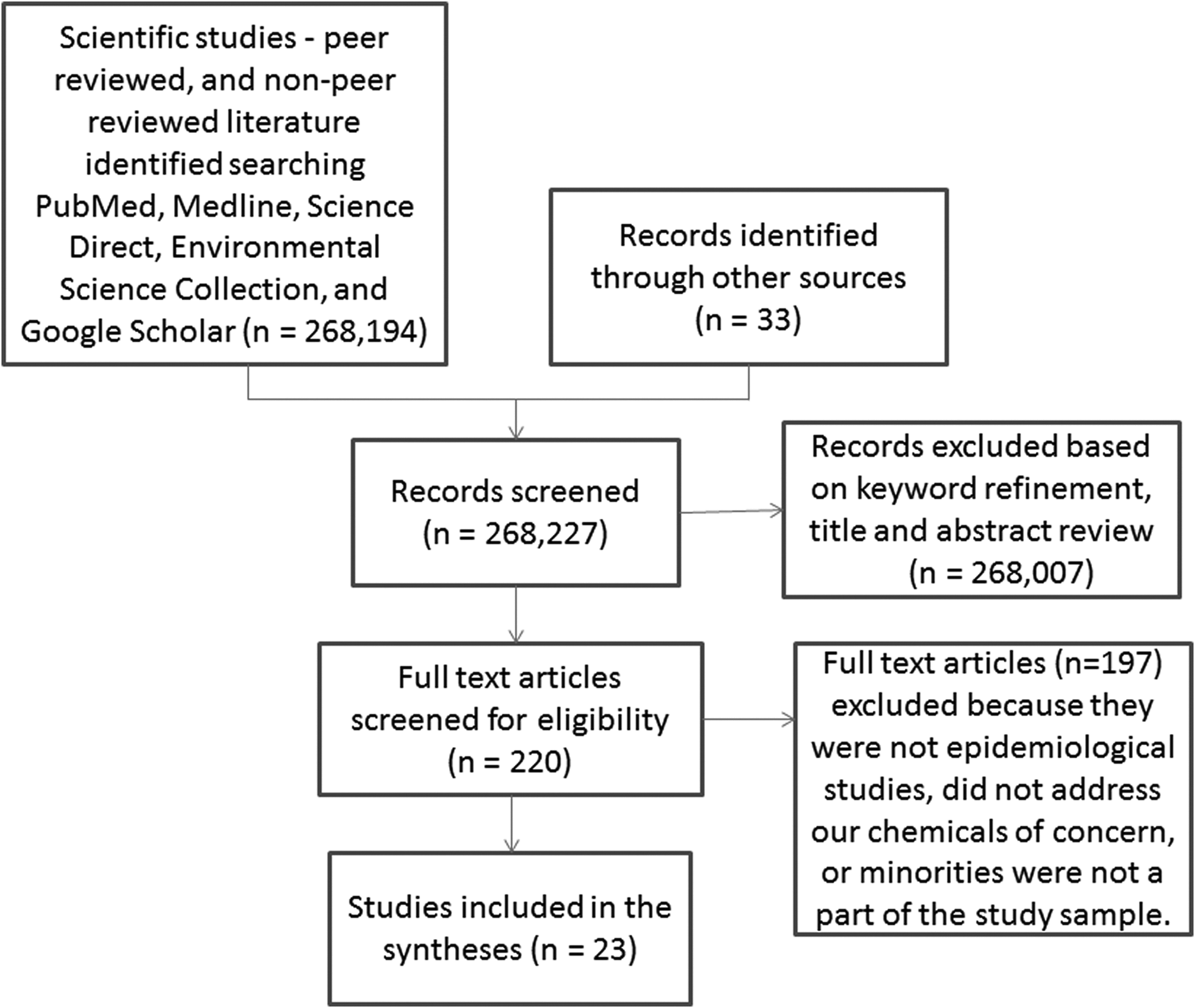
Literature review method.
Environment: home, work, school
In the home, at work, or in school, research shows that low-income and communities of color are at greater risks of BPA and phthalates exposures due to economic and social constraints.11,12,13,14,15,16,17 In fact families with lower income and lower educational levels had a higher burden of BPA.16,17 A seven-year study found a higher proportion of African American children developing eczema due to phthalate exposure through house dust.18,19 Furthermore, poor African American women had up to 78% higher levels of benzyl butyl phthalates (BBP), a phthalate in vinyl flooring that was associated with a double rate of diabetes, compared to women living above poverty level.
Workplace exposure pathways in certain occupations have long been a source of BPA and phthalates exposure. In the United States, 40% of nail salon workers are Asian Pacific Islanders and have been directly exposed to BPA and phthalates found in nails and hair products at the workplace.4 Other work-related exposure pathways include jobs in retail that involve handling credit card receipts containing BPA that can be absorbed through the skin.17,20,23
Even though little information was found on chemicals in children's toys and school supplies, violations in children's products have been reported.6 While there has been some action to remove these products from the market, the harm is irreversible and many other toxins in children's products remain unregulated.6
Consumer purchases
People of color and low-income families have been identified as groups at risk of consuming toxins in food.14,15,16,17 Unal's report on racial disparities and fetal-cord BPA concentrations found that African American mothers had higher serum concentrations, 10-fold higher than Caucasian women. 21 Prenatal exposures to phthalates show that during pregnancy, inhalation of contaminated food products and dermal absorption are major exposure routes for phthalates. For example, a New York City study showed that African American or Dominican pregnant women in an urban area had higher exposure compared to a background sample for the United States. 22 Location, race and ethnicity, and socioeconomic status (SES) are also important factors when it comes to food quality and purchasing. A study of U.S. women from lower SES found that income was inversely associated with urinary BPA concentration because lower SES women may consume more canned foods than do women with higher SES. In contrast, Kobrosly found that lowest SES was associated with the lowest di-2-ethylhexyl phthalate (DEHP) exposure, which is thought to involve food contamination due to processing and packaging. 23 While it was surprising to find the above contradictory results for the correlation between SES and BPA and phthalates exposures in canned foods, it is worth noting that the short-term (one year or less) studies reported insignificant correlations while long-term studies (two to seven years) found more significant correlations.
In terms of personal care products (i.e., perfumes, makeup, skin cream, etc.), Just et al. found in their study that African Americans of reproductive age in New York City used more perfumes, a significant source of diethyl phthalate (DEP), than Dominican women. 24 Another study found that the exposure to three phthalate metabolites differed by race and ethnicity. Mono-ethyl phthalate (MEP) and mono-(2-ethylhexyl) phthalate (MEHP), were especially highest in blacks, and racial and ethnic differences in MEP levels were attributable to greater cologne use in blacks and Hispanics. 25
Closing the gap
After reviewing the eligible articles, phthalates and BPA exposures in communities of color seem to contribute to health disparities with outcomes including stunted fetal growth, shorter gestation, low birth weight, suboptimal neurodevelopment, diabetes, and asthma.26,27,28
Local and federal policy initiatives
Opportunities at the local and federal government levels could work to create healthier environments by limiting the disproportionate exposures of phthalates and BPA. At the federal level for example, some members of Congress have made the effort to improve the Toxic Substances Control Act (TSCA), which has not been updated since 1976. However, all efforts continue to be challenged in the divided Congress. Without a clear path forward on legislative reform, the EPA unveiled a strategy in 2012 to use its authority through the TSCA and the current chemical management program to conduct additional chemical assessment of 83 chemicals. The EPA is developing an approach to screen the thousands of other chemicals that warrant further attention. 29
Research and policy recommendations
This review reveals the need for directed research that considers the cumulative impacts and linkages between EJ and hidden sources of toxic exposure in consumer products. Out of the 23 articles selected for the literature review, eight had specific policy recommendations and/or explicitly addressed the need to conduct cumulative impact assessments to better understand the health effects of BPA and phthalates. Brody et al.10,11 emphasized looking at cumulative impacts from the physical and social environment, indoor exposures from local polluters in EJ research, and creating research partnerships with groups and organizations that are investigating other diseases related to BPA and phthalates. In terms of sustainable change, a shift in federal policies to prevent the introduction of these chemicals into consumer markets is needed. Miodovnik et al.28 recommended that regulatory policies should account for cumulative exposure and require manufacturers to explicitly list BPA and phthalates on consumer goods labels and school supplies. EJ communities do not experience chemical exposures in silos; identifying the specific sources and exposure pathways remains a challenge and properly accounting for the sum of the individual exposures is vital.14,17,30,31,32,33,34,35,36 According to Sexton and Ryan, 37 and Miodovnik et al.28 effective policies can only work to prevent health disparities if the scientific research is more focused on disadvantaged populations and on the communities that are at the highest cumulative risk. In particular, Quirós-Alcalá et al.15 emphasized that research should use more random samples because studies in low-income homes have been limited.
Finally, the relatively small amount of cumulative exposure studies in low-income and communities of color retrieved in this review and the discrepancies in long-term versus short-term studies call for an increase in long-term cumulative risk assessment research for EJ communities, which would clarify and help address cumulative environmental health impacts in EJ communities.
A challenge that arose in this review was the small number of studies obtained addressing health outcomes of BPA and phthalates in consumer products in relation with low income and/or people of color. Out of 268,194 research results generated, only 23 research articles were relevant to the literature review criterion. The lack of studies that highlighted cumulative exposures (i.e., chemical and nonchemical stressors) calls for the importance of cumulative risk assessment research to protect EJ communities.
Conclusions
Communities of color and low-income families are over-exposed to BPA and phthalates via hidden pathways of exposure in consumer products, whether in the home, at work, or in school. Comprehensive chemical policies at the federal level are needed to change the landscape of chemicals in the goods market that will ultimately minimize these exposures on the most vulnerable populations. These policies should focus on disadvantaged populations and the research supporting them should be based on a cumulative risk assessment approach. The health of our communities—especially communities of color and low-income—is still at stake.
Footnotes
Author Disclosure Statement
The authors have no conflicts of interest or financial ties to disclose.