




Abstract
Abstract
Energy production and distribution have created archetypal cases of environmental injustice—mountaintop removal for coal mining in Appalachia, nuclear waste siting on Navajo reservations in the West, oil refineries in southern Louisiana. Renewable energy technologies designed to aid the transition to a lower-carbon economy have often perpetuated the injustices inherent in current energy systems. Clearly, all energy systems create environmental burdens. But to what extent can community-scale, renewable energy systems minimize environmental burdens and maximize benefits to local communities? How can green technologies and the sociopolitical relationships associated with those particular technologies be arranged so that renewable energy systems produce environmental and social benefits, while distributing burdens more equitably? This case study of community-scale woody biomass initiatives in Vermont examines how particular biomass technologies and associated power relations have structured environmental burdens and social benefits throughout the state. This study reveals the importance of decentralizing energy systems—not only in terms of energy technologies, but also of technological decision-making processes. We argue that distributing power in this way may be the most effective way to ensure a more just arrangement of benefits and burdens associated with green energy technologies.
Introduction
M
Yet when used for purposes other than producing electrical power, biomass energy has led to different scenarios. In over 40 communities in Vermont, using wood to heat public institutions has contributed to economic development and has helped to distribute the burdens and benefits associated with energy production more evenly across the state. How does one fuel source lead to such different outcomes? Gwen Ottinger has shown how technological choices lead to environmental injustice by “structuring the distribution of hazards and access to knowledge in particular, usually unequal, ways.” 6 Technological choices also structure the distribution of benefits, though those, too, are often in unequal ways. Like other renewable energies, whether or not a particular biomass-based technology fosters inequality or produces social benefits depends not only on fuel source, the scale of technology, and the methods of extraction, production, and distribution, it also depends on decision-making processes and how deeply those affected by technological decisions are involved.
This article explores the development of community-scale biomass heating systems in 48 communities in Vermont, USA as a case study to examine how technological decisions structured risks and benefits throughout the state. Community-scale biomass development in Vermont provides a way to view energy production not as a burden placed upon disadvantaged communities by powerful outsiders, but as a means by which rural, low-, and middle-income communities have sought to promote sustainable economic development and to protect the integrity of working landscapes. This study aims to add nuance to the ways EJ scholars think about the influence that technological decisions have on the distribution of environmental burdens and benefits associated with renewable energy systems.
Discussion
Since the 1980s, Vermont has led the nation in developing community-scale biomass systems to heat the state's schools. Today, forests provide heat for 20% of Vermont's students. The impetus for converting heating systems in Vermont's schools to wood began in the 1970s, when fossil fuel prices skyrocketed. Most towns heated their schools with fuel oil or electricity. As energy prices increased, the Vermont Superintendents' Association worked with the Department of Forests, Parks and Recreation to develop heating systems that ran on a local, abundant fuel source: wood.
Although biomass advocates were initially driven more by economic concerns rather than environmental ones, more recently they have argued that burning trees to produce thermal energy can help forested communities reduce their carbon footprint. For example, in the 2009–2010 heating season, using wood instead of fuel oil saved Vermont schools over 1.4 million gallons of oil and avoided putting 15,650 tons of carbon dioxide into the atmosphere. 7 The idea that biomass is a carbon-neutral fuel source is based on the notion that unlike coal and oil, trees grow back; any carbon released during the combustion of wood will be sequestered by regrowth. When properly managed, forests protect watersheds, serve as wildlife habitat, and provide for recreational, aesthetic, and energy needs.
The technology used in heating systems in Vermont schools differs from large utility-scale biomass power plants that use wood to produce electricity. The schools' systems are much smaller and use wood fuel more efficiently. For example, each heating system in Vermont's schools uses an average of 541 tons of woody material per year with a total usage of about 23,271 annual tons. 8 This is a small percentage of the total amount of wood that Vermonters burn for energy purposes. Of the 1.6 million tons of wood used for energy in the state, almost half (about 800,000 tons) was used for residential firewood. About two-fifths of the total went to two power plants—one in Burlington and one in Ryegate. 9 These large electricity-generating plants are only about 25% efficient, which means that only about 25% of the fuel is turned into electricity and the rest escapes as heat. Using wood to heat buildings is about 75% efficient, and combined heat-and-power (CHP) systems can have efficiencies up to 80%. 10
In terms of efficiency, smaller scale biomass technologies for thermal applications are clearly a better use of forest resources, but it is also important to consider how these different technologies affect human health. In some ways, the impacts of biomass energy are less harmful than burning fossil fuels, but in other ways, they may be more harmful. According to a study by the American Lung Association, on a ton-by-ton basis, burning woody biomass for heat produces fewer nitrogen oxides (NOx) than burning oil or natural gas and fewer sulfur oxides (SOx) than coal, natural gas, or oil, but wood heat produces more particulate matter (PM), volatile organic compounds (VOCs), and carbon monoxide (CO) than fossil fuels. 11 The amount of pollution produced depends on combustion design and the technology used to control emissions. 12 With this in mind, community-scale biomass proponents have advocated for more efficient boilers and emissions-reductions technologies like electrostatic precipitators, fabric filters, and cyclones to reduce pollutants to state and locally acceptable levels. 13 These types of technologies have helped to mitigate some of the health problems associated with wood energy.
Despite the promise of pollution control technologies, however, all energy systems create risks and rewards. Distributive justice ensures that the benefits and burdens of energy systems be fairly distributed across a population. Any differences between groups should be arranged so that the least well-off benefit. 14 To examine how biomass energy has distributed burdens and benefits in Vermont, we looked at where different systems were installed and the demographic characteristics of the surrounding areas. We gathered the median household income data for every town in Vermont from the 2012 U.S. Census and mapped this data using ArcGIS. Then we overlaid the locations of 48 schools that use wood heating systems in the state to examine the relationship between income and the location of biomass systems. Although 95% of Vermonters are white, we also considered the influence of race by looking at the relationship between the location of wood-heated schools and areas of higher racial diversity within the state.
As shown in Figure 1, we found no relationship between median household income and the location of wood-heated schools in Vermont. Schools in both higher- and lower-income towns have embraced wood heating facilities. Of the 48 schools heated by wood, 46% are in communities where the median household income level is below the national average of $53,046, and 54% are located in towns above the national average. Figure 2 shows that most of Vermont's wood-heated schools are located in towns where the median household income is near the national average. Eight-five percent of the wood-heated schools are located in towns that have a lower percentage of individuals living in poverty than the national average; 15% are in towns that have a higher percentage of individuals living in poverty. There are wood-heated schools in urban areas with larger minority populations, such as Burlington High School, where 31% of the students are black, Hispanic, Asian, or multi-racial; but there are also wood-heated schools in rural places with lower levels of racial diversity like Leland and Gray High School in Townshend, where 98% of the students are white. 15 The lack of patterns between the location of community-scale biomass heating systems in Vermont and race or income suggests that the benefits and burdens associated with this type of energy system were distributed in more or less equal ways.
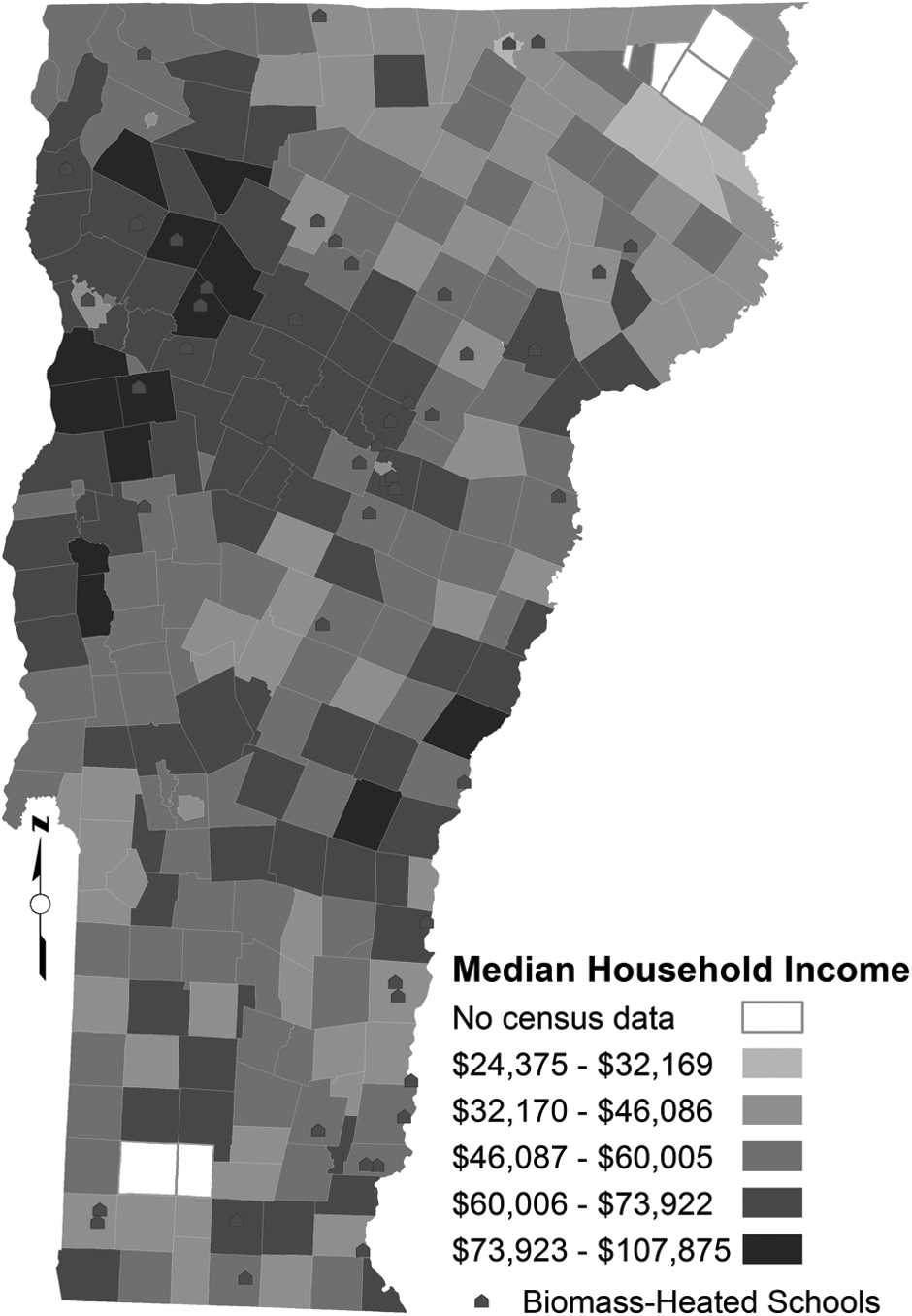
Biomass-heated schools and median household income by town. The map shows no relationship between the location of wood-heated schools and median household income in Vermont. There are several schools in the relatively wealthy suburbs of Burlington and several others in the rural, lower-income towns throughout the state.
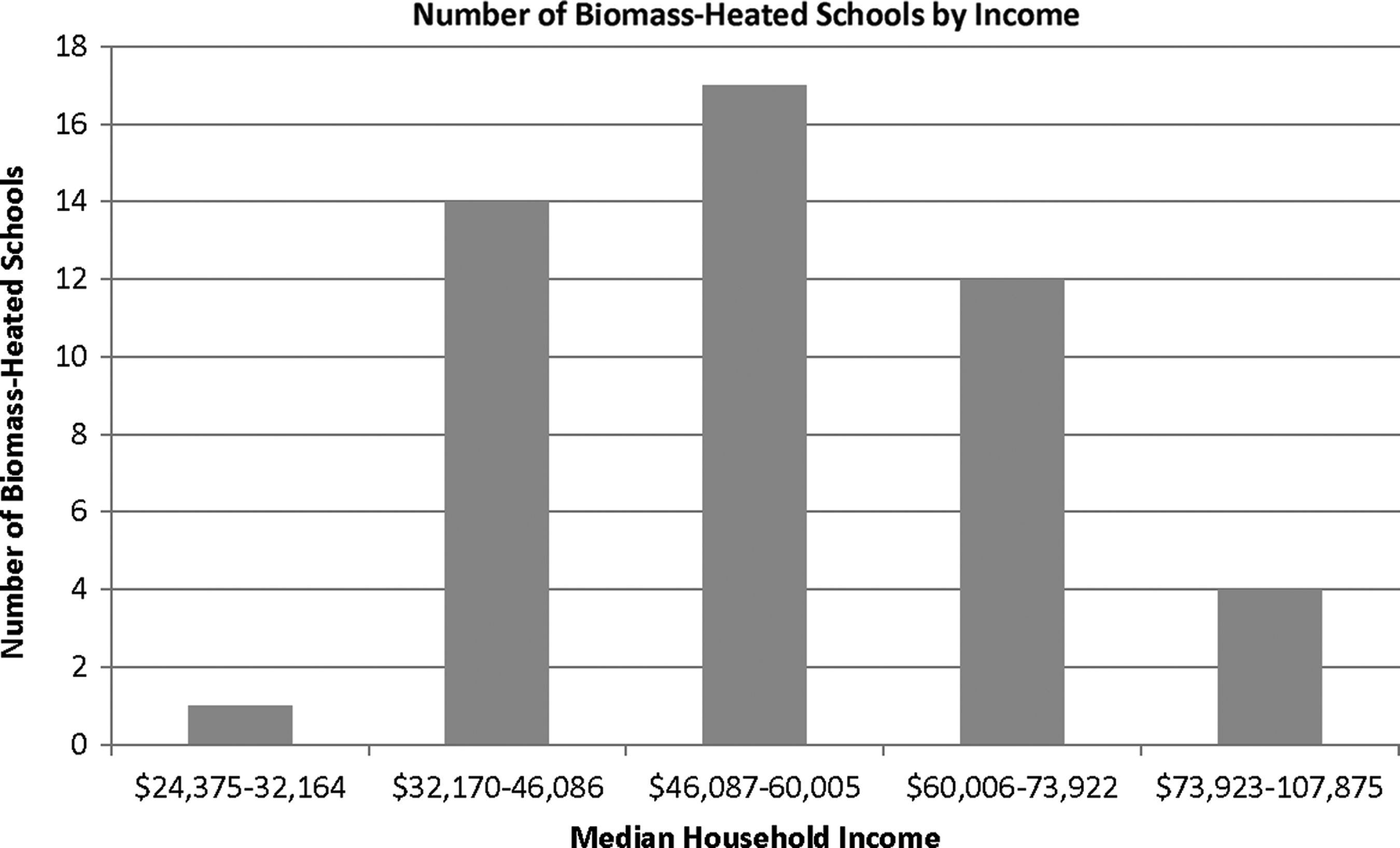
The graph shows that most of the wood-heated schools in Vermont are in towns that have a median household income of $46,087–$60,005. This is near the national median household income of $53,046.
In addition to this spatial analysis, we examined the financial benefits of wood energy. By converting their heating systems to biomass, Vermont towns saved over $1.7 million; larger schools and those that previously heated with electricity saved the most. 16 Community-scale biomass initiatives have also affected the state's forest industry. In 2011, wood energy produced $60 million and 300 jobs in Vermont, including jobs with manufacturers like Chiptec, a Vermont-based producer of biomass technologies. 17 These economic benefits have made small but important contributions to an industry that has been struggling since the 1990s. As Americans have purchased more and more wood products from faraway places with looser environmental and social regulations—a trend which has perpetuated global environmental injustices—Vermont's forest products sector has declined. 18 Wood energy in Vermont has helped rural, resource-dependent communities to diversify their local economies and protect working landscapes from development. As energy justice advocates have shown, providing these kinds of benefits will be critical in the transition to a lower-carbon economy.
Ensuring that benefits and burdens associated with wood energy are distributed fairly requires more than a look at where technologies exist on a map and economic analyses; it also requires an examination of decision-making processes. Energy development has typically relied on top-down processes, but researchers in the UK have found that biomass developers are increasingly aware of the need to involve local people early on in decisions that will affect them. 19 This is consistent with the findings of EJ scholars who have demonstrated that when people who will be affected by decisions about energy technologies are involved in the planning process, more equitable outcomes are likely to result. 20
In terms of biomass heating systems in Vermont's schools, each project was presented to local citizens by the town's school board and passed through a bond vote. Typically, the school board had an energy committee that conducted a feasibility study about the use of wood to heat its buildings. In the early 1980s, the state had funds available to help schools develop wood-heated systems if they could prove that such systems would be cost effective. The schools typically hired energy auditors to see if biomass technologies would be appropriate for their location and institution, and if the financial payback would be worth the investment. Once the feasibility study was completed, school boards often held public meetings and informational sessions about the proposed heating systems. Then, because the new systems involved public funds, decisions about whether or not to move forward with a wood heat system went up for a bond vote, where voters would decide whether or not to support the new technology on town meeting day. 21
Vermont has a history of civic engagement in public affairs that is reinforced by strong local government structures. Historian Sara Gregg has explained how Vermont's emphasis on local governance and traditional institutions like the town meeting, where citizens vote on community issues, have allowed voters to shape local policy. 22 Like in other places, however, participation in community forums like town meeting day is often dominated by individuals and subsets of the population who may not represent the interests and desires of the entire town. Nevertheless, Vermont has local political structures in place that made opposition to heating schools with wood possible.
Although Vermonters have organized to protest the construction of industrial-scale biomass plants, for the most part, the development of community-scale biomass heating systems in schools has been uncontested. We found only two cases of resistance to wood-heating systems for Vermont's schools. In Norwich, one local resident successfully opposed the construction of a biomass heating system at his child's school because he was concerned about air quality issues. Similar complaints were made about a heating system proposed for a school in St. Johnsbury. The demographics of these two places were quite different: one is an affluent community directly across the Connecticut River from Dartmouth College; the other is a rural, low-income area. In both cases, residents were able to stop the construction of the heating systems because of the structure of local decision-making processes. Although decisions about energy in Vermont may be a bit unusual because of the state's grassroots political structures and relatively homogenous, predominantly rural population, this study suggests the importance of decentralizing technological decisions to fit the appropriate political and bioregional context.
Conclusion
Like all energy systems, biomass can produce both burdens and benefits. Ensuring that burdens and benefits are distributed equitably requires careful attention to fuel source, the type of technology used (for direct heating versus electricity production), the scale of those technologies (community versus industrial), and the processes by which decisions are made. Producing electrical power from plants on an industrial scale does not make sense in terms of efficiency or in terms of environmental justice. But the fact that industrial-scale biomass technologies have structured environmental risks in unequal ways does not mean that all ways of using biomass for energy will produce similar outcomes. The transition to a more just, lower-carbon economy will require us to think about energy systems and technological decisions in more adaptive and nuanced ways. Vermont's wood-heated schools provide a compelling case for the necessity of decentralization—not only in terms of energy technologies, but also of technological decisions. Distributing power in this way may be the surest way to ensure that green technologies arrange benefits and burdens in more equitable ways.
Footnotes
Acknowledgments
The authors thank Paul Frederick, Tim Maker, and Adam Sherman for sharing their knowledge and data on Vermont's wood-heated schools.
Author Disclosure Statement
The authors work at and live in buildings heated by Vermont's forests, but other than that, they have no conflicts of interest or financial ties to disclose.