




Abstract
Abstract
This paper examines the permitting process for a coal strip mine in Southeastern Ohio using a distributive and procedural environmental justice framework. A permit application to mine Joy Hollow, a site in rural Athens County, was submitted to the Ohio Division of Mineral Resources Management in 2011. The permit applicant promised the mine would bring jobs and environmental restoration to the Appalachian region already damaged by previous rounds of coal mining. Landowners in favor of the mine leased their property to the mining company, while others living near the proposed mine site opposed it. The opposing groups engaged in the familiar “economy versus environment” debate; however, both groups used ecological narratives to justify their positions. We used semi-structured interviews, participant observation, and document analysis to determine that proponents and opponents of the mine both faced distributive injustice in the form of environmental damage to their hollow from earlier mining activities. However, opponents worried about additional environmental health problems associated with renewed mining faced significant procedural injustice in getting regulators to hear their concerns. Ultimately, the citizen group overcame structural constraints in the permitting process and obtained some justice by putting much pressure on the regulatory authority to fully review, and delay granting, the permit. The applicant subsequently put its permit application on hold and its plan to mine Joy Hollow was tabled. This case study is indicative of the damaging, intra-racial antagonisms created by—and contributing to—enduring forms of injustice in Appalachia wrought by the boom and bust coal economy.
Introduction
C
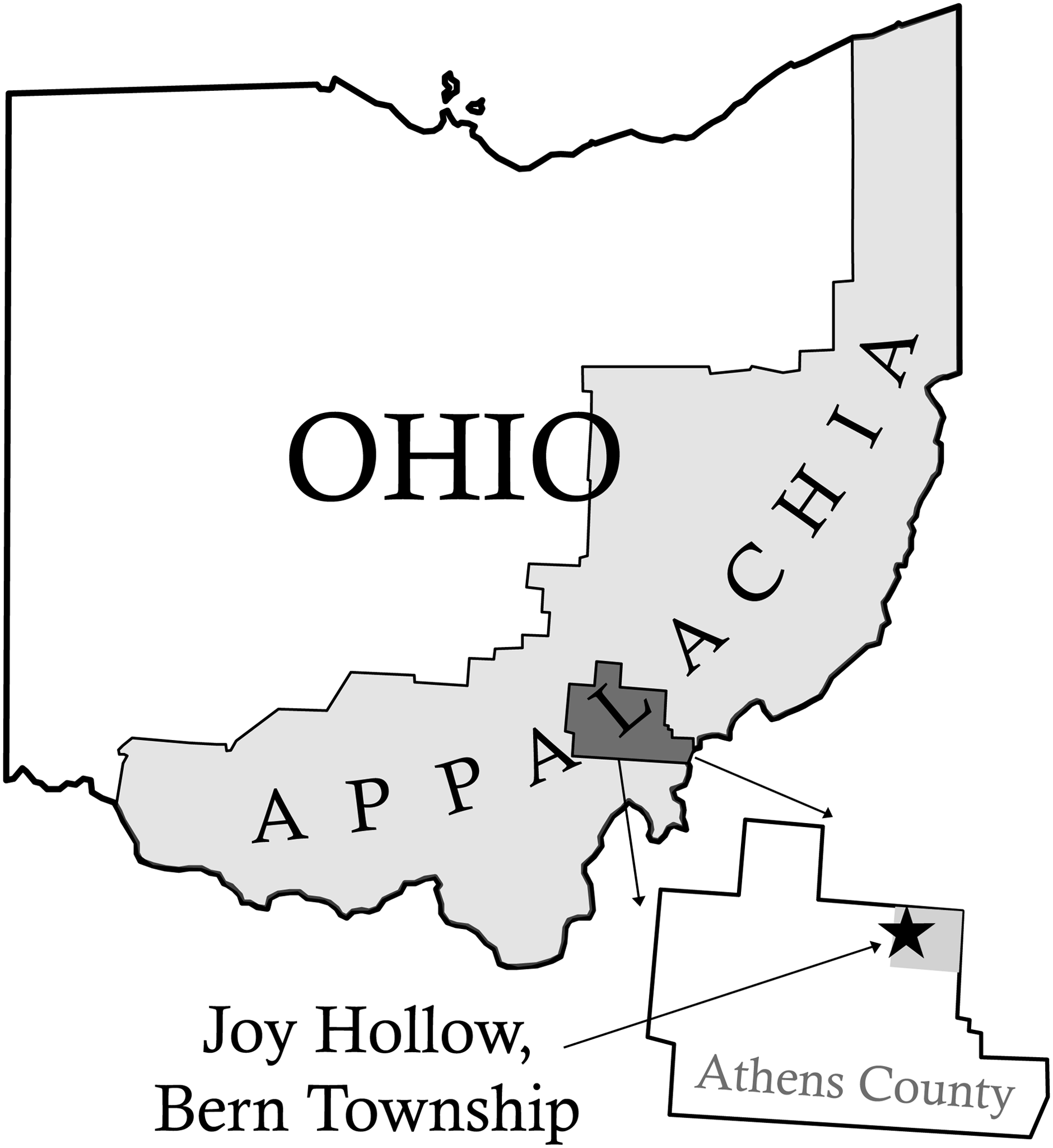
Map showing location of proposed strip mine in Joy Hollow, Bern Township. Map by Harold Perkins.
Bern Township is home to nearly 600 residents, approximately 95% of whom are white. Like many Appalachian communities, Bern Township suffers economically; nearly a quarter of its residents report incomes below the poverty level. 6 Oxford asserted the project would create jobs for local citizens. Despite the company's environmental and economic promises, a local community group, Save Our Rural Environment (SORE), took strides to oppose the permit. SORE was galvanized by the strip mine's potential for environmental harm and community disruption. 7 SORE maintained the mine permit application reflected the will of only three households in Bern Township—those that leased their property for coal mining. The location of the potential mine site also caused concern for people living in the more populated town of Athens fifteen miles away. SORE thus had people from Athens join ranks with members living in Bern Township and elsewhere in Southeast Ohio. At the time of this study, SORE included about 110 people who were primarily white and the group featured a relatively even gender mix. Despite strong resistance from DMRM, these anti-mine activists asserted their right to dissent through public comment periods and forums specified in Ohio's regulatory statutes and the Surface Mining Control and Reclamation Act (SMCRA). 8
We employed qualitative methods in this case study of coal permitting in Bern Township. Our purpose was to examine environmental justice implications of the permitting process in rural Southeast Ohio. To achieve this objective, we utilized semi-structured interviews with members of SORE and landowners who leased their property to Oxford. 9 We also conducted participant observations at public meetings concerning the permit hosted by DMRM. 10 Additionally, document analysis was performed on government publications, press coverage, and SORE communications through e-mail and social media. 11
History of the environmental justice movement and its relation to Appalachia
Struggles for environmental justice have roots in both the civil rights and toxics movements in the United States. 12 Environmental justice activists recognized that a concern for human welfare was largely left out of efforts by mainstream environmental organizations to preserve nature. Thus activism by people of color in Warren County, North Carolina and also by white working class populations in places like Love Canal and Three Mile Island asserted that environments worthy of protection also include the places where people live, work, and go to school. 13 The earliest environmental justice scholarship demonstrated that communities of color disproportionately host toxic landfills. 14 Minority-based environmental justice movements used these studies to generate and justify direct action campaigns against dumping hazardous wastes in the rural South and also in urban neighborhoods in places like Detroit, Houston, and Los Angeles. 15 Environmental justice movements have since expanded their focus on environmental racism to include the siting of garbage incinerators, lead paint in inner-city housing, impacts of extractive activities, and a lack of environmental amenities, among others. However, environmental justice scholars and activists recognize that class standing is an additional and important factor related to who disproportionately suffers from environmental burdens. 16 This is an important consideration because environmental justice struggles occur in largely white Appalachian communities, too.
Minorities comprise nearly seven percent of North Central Appalachia's total population, 17 but environmental racism seems outwardly problematic as an explanation for why people in predominantly white places like Bern Township, Ohio also are subjected to the subregion's environmental degradations. 18 A definition of environmental injustice that includes class position is helpful here. Many Appalachian whites are situated in a low socio-economic position in American society. 19 Their marginalization means they lack the political and economic clout to keep noxious land uses (that contribute to prosperity outside the region) out of their communities. The disproportionate environmental burden poor Appalachians bear while living in landscapes of production is documented. 20 Coal-mining communities suffer health impacts from impaired air and water quality compared to non-coal-mining locations. 21 The rate of birth defects and lung cancer is significantly elevated and the “number of excess annual deaths in mining areas ranged from 1,736 to 2,889.” 22 Poor Appalachians often accept these harms in exchange for the promise of jobs. However, coal-mining employment is decreasing as mechanization replaces manual labor. 23 A reduction of mining jobs thus leaves behind impoverished and sick communities in Appalachia. 24
The region has a history of social and environmental activism against this trend, however. 25 Much of it today involves struggles by women who live in communities impacted by mountaintop removal and other extractive industries. 26 They fight for justice against mining companies that flood their homes, poison their children, and provide little long-term economic security for their families in the process. They do so despite aggressive resistance by coal companies and members of their communities scared of losing their mining jobs. Many of the environmental justice actions in rural areas subject to coal mining are illustrative of the antagonisms that threaten the social cohesion of communities—even when they are racially homogenous.
In the remainder of this article we add to these findings by demonstrating that white, intra-racial heterogeneity—based on varied socioeconomic standing—differentially affects how community members pursue justice in the context of surface coal mining in Joy Hollow. On the one hand leasing landowners are representative of pro-mining residents in Southeast Ohio who often possess land but lack steady income through stable employment. These people are willing, often by necessity, to put their lands to work to better their economic prospects. On the other hand, SORE membership has individuals employed at Ohio University in Athens (and related support services) who are not dependent on making money from leasing their land to industry. SORE members generally occupy a higher place on the socioeconomic ladder given their economic security is tied to the many professional positions they hold in the community. These folks extol a more traditional view of environmentalism with a concomitant interest in human health. Both sides in this controversy believe they suffer a distributional form of environmental injustice from the damage caused by previous rounds of coal mining in their hollow. Yet procedural inequities in land-use decision making, particularly in the permitting process, produced differing paths to environmental justice for people living in the same community. This case study is therefore also indicative of the complex antagonisms produced by extractive land use in the context of economic insecurity in communities throughout Appalachia Ohio.
Discussion
On one side of the Joy Hollow controversy, three leasing landowners touted benefits mining operations would bring in terms of economic development; on the other side, nearby residents backed by SORE expressed fears for their health, their quality of life, and the environment. There was mistrust and a lack of communication between the leasing landowners and SORE. Mining opponents found the leasing landowners' motives to be self-serving, while the leasing landowners felt SORE “vilified” them. Unsurprisingly, the jobs versus environment debate was an important tension between the parties. Leasing landowners had family history/connections with coal mining and believed their actions would create much needed jobs in the community, while SORE rejected this logic as inaccurate, and in any case, unworthy of environmental health risks. But a quote from one of the three leasing landowners indicated antagonism between the parties is more complicated than jobs versus environment, and even possessed elements of common concern. He said, “… we don't want our neighbors disturbed, but we would like to have fixed what's damaged.”
Distributional injustice in Joy Hollow
Leasing landowners and SORE members alike lamented the deteriorated environment created by previous coal mining in Joy Hollow. Both sides therefore suffer distributed injustices associated with previous mining activity that left the hollow damaged. The leasing landowners appreciated Oxford's offer to reclaim their degraded property. One leasing landowner said at a public meeting: “More than 50 percent of my property, roughly 260 acres, is virtually unusable due to highwalls that remain from previous mining …” Another leasing landowner said during an interview that his land: “Is not recovering. It's eating itself up. There's sulfur drainage coming down out of the hillside now, continually. That will be sealed when it is reclaimed. So, it's going to be fixed rather than allowed to stay damaged as the way it is.” He went on to explain that he only decided to lease his land for mining after years of unsuccessfully attempting to get it reclaimed by government officials: “My family has paid full property taxes on probably almost fifty acres of unusable land since we bought it. And the state doesn't care.” A few interviewees from SORE agreed the landowners were “earnestly” attempting to reclaim their land, but questioned why they did not seek other sources for assistance.
SORE interviewees also recognized the land was compromised in the past. One said, “Because I had been to college here, I think most of us had seen the problem strip mines could bring. Because at that point in time [1970s]…there were still strip pits and lots of gob piles and it was just terrible.” Other interviewees opposing the mine permit witnessed detrimental consequences of coal extraction, too. A fundamental difference between SORE members and leasing landowners on this point, however, is that the latter group hopes to see the environment restore itself rather than through reclamation after more coal mining. One non-leasing landowner expressed her desire to let nature take care of the reclamation process: “I never did want it disrupted by any more coal mining. I just love nature so much the way it is, and to see it grow and change.”
SORE members expressed concern in meetings, e-mails, and in our interviews about additional distributional injustices with renewed coal mining. They expressed concern about a decline in property values. One said: “Just the concept that there's a permit in process makes my farm worthless. Most people would not want to buy a piece of land that might have a coal mine across the road.” Another said the mine would be difficult to live near: “It creates significant possibility of air pollution, water pollution, noise, light pollution—the whole bit.” Yet another said, “If this strip mine is permitted…the affected landowners will live in environmental hell. Your travels by the scenic State Route 550 will most likely be behind a coal truck spewing diesel smoke and coal chips flying everywhere.” Others expressed concern about their health by asking, “What would Oxford Mining do if our roofs are covered by coal dust and other windborne contaminants and we cannot collect clean drinking water? Will I be able to dry my clothes on clotheslines? Will my vegetable garden be polluted by dust?”
In these discussions it became apparent that members of SORE and the leasing landowners both relied on ecological narratives to bolster their opposing positions. One of the leasing landowners argued in an interview that reclamation will benefit the environment—particularly if his currently forested property is reverted to pasture after it is mined:
A tree loses its leaves around half a year; it doesn't breathe oxygen, okay? The effect of that green absorbing the carbon dioxide isn't there. A pasture full of green grass stays green all winter, as long as it's not covered by snow. It's slow, not at the same pace, but it slowly continues to thrive and provide oxygen. We as farmers have known that for a long time. Tree coverage is not the only thing that provides oxygen.
The landowner used this ecological narrative to counter SORE's environmental argument. SORE members, in their response, deployed alternative ecological principles. They used phrases like “indicator species,” “biological health,” and other scientific expressions in meetings and during interviews. A couple living in the valley discussed how they “had done their own reclamation on the old strip mines” by widespread tree planting that generated new topsoil on their property. During the public hearing, a non-leasing landowner said:
The Great Blue Heron by virtue of its size and the concentration of its nests in a rookery is perhaps merely the most obvious of Joy Hollow's wildlife assets which are dependent upon good water. As large birds, which have the capacity to feed upon a wide variety of both fish and wetland amphibians, they occupy a high position in the food chain, that they can be regarded as an indicator species in regard to water quality.
SORE challenged the leasing landowners' notion that Oxford's industrial reclamation was therefore necessary in Joy Hollow. The group backed up its assertions with scientific evidence. They asked biologists from Ohio University to measure the water quality of Sharp's Fork, which is the watershed containing the proposed area to be mined/reclaimed. Data sampling showed Sharp's Fork, despite previous mining disturbance, was in “very good biological health.” 27 A SORE leader stated the findings at the public hearing: “Based on the fish data collected at the upstream site the IBI (Index of Biotic Integrity) score indicates that Sharp's Fork meets Exceptional Warmwater Habitat criteria as defined by the Ohio Administrative Code Chapter 3745 −1.”
Procedural injustice in Joy Hollow
Procedural justice is equitable access to power—particularly when it comes to environmental decision making—regardless of groups' varied social, political, or economic status. 28 Access to environmental decision making in Southeast Ohio is anything but equitable, as SORE found out in its efforts against the Oxford mine. This was despite SMCRA legislation that should provide citizens the opportunity to share in decision making through opportunities for public comment on the permitting process. Oxford and the leasing landowners possessed decision-making power that SORE, at least initially, did not have. Oxford had a cadre of individuals who work closely with state regulatory agencies like the DMRM. Thus the leasing landowners had no apparent need to organize themselves politically because the state bureaucratic structure for leasing, mining, and reclaiming land is already in place. One leasing landowner during his interview said he trusted the permitting process to produce a fair outcome for everyone in Joy Hollow: “There's a review board in place. They are professional people hired by the state. They are going to evaluate it. The facts are there. The studies have been done. Let [the state] decide.”
SORE required a vocal group of dedicated individuals to counter the power of the mining company professionals who were skilled at navigating a bureaucratic structure designed to issue permits. The burden of proof fell on the opposition group to make a case that established their concerns about environmental health as legitimate. Their task was large, given that Joy Hollow Permit #10458 is a 350-page document with technical jargon. The time and effort put in by SORE's members to examine the permit application and coordinate a response was voluntary and uncompensated. Their degree of dedication is significant considering the majority of the members had full-time jobs and families. Additionally, the public permit hearing was held at 3pm on a Wednesday—a time when many activists worked their regular jobs.
SORE found accessing information about the permit application from DMRM difficult and believed the agency was uncooperative. The attorney representing SORE wrote the group: “If and when we get this information it should help to answer a lot of points we haven't been able to get information on or answers to” (his emphasis). DMRM, however, had a legal obligation to communicate with the group. According to SMCRA, a public meeting is mandated to be the main forum where public concerns about permits can be expressed, while also providing a venue where regulatory agencies convey pertinent information to attendees. The way in which DMRM attempted to structure this obligatory meeting, however, was seen by SORE as a perversion of SMCRA's original intent. DMRM initially arranged for the meeting to be set up so that citizens' comments would be read to the officials in a private room separate from where the public was situated. SORE expressed outrage at the holding of a public meeting in private. A SORE member chastised the DMRM in an e-mail: “By privatizing the comments, you destroy the public discourse.” These DMRM tactics illustrate how power inequalities are exercised. If a group cannot access pertinent information held by decision makers, their ability to formulate an appropriate response to the situation is hampered. 29
After much pressure the DMRM did eventually agree to allow the comments to be read in public. However, the agency tightly controlled the dialogue. Each speaker was given exactly three minutes to present his or her opinion and if citizens wanted a formal response from DMRM, they had to phrase their concern as a question. The format precluded citizens from expressing their concerns fully. Despite this, SORE's persistence at the meeting exposed so many issues in the permit application that one member described it as “… shamefully inadequate. Shamefully incomplete.” DMRM was legally required to provide answers to these formally submitted questions within a sixty-day period, though this did not happen until much later.
SORE members believed the slow response from DMRM concerning their questions was actually a positive sign. SORE's strategy to question inadequacies in the permit was directly connected to the fact that DMRM never formally denies a coal mine permit. The group knew that citizens can instead put pressure on the DMRM to request additional information from permit applicants to the point where the application is withdrawn voluntarily. Thus SORE forced the DMRM to complete an extensive, time-consuming review of the permit through its numerous public comments in the hope the delay would frustrate Oxford and encourage the company to withdraw its application. Their strategy appears to have worked as SORE members were informed by the DMRM on March 9, 2012, that the agency had “ceased reviewing the permit,” citing that “Oxford [had] approximately 18 pending permit applications in Ohio. Joy Hollow [was] not a priority.”
Conclusion
It is not possible to know exactly why Oxford chose to suspend their effort in Joy Hollow, as company representatives refused interviews. As one SORE member said, Oxford has a “long list” of permits on its books. A leasing landowner also said,
They have other permits that are more important to them right now than Joy Hollow. The reason is because the…[other permits]…are adjacent to other mining areas. It has nothing to do with anything other than it's more important to them to deal with other mines that they have. And that's a business decision on their part.
The leasing landowner thus refused to acknowledge that SORE's actions had any influence on the decision to abandon the permit. On the other hand, SORE members considered their actions vital to the outcome as expressed by a member celebrating their success via group e-mail: “We are confident…that our unrelenting attention to the regulatory process of the permit review let…[DMRM]…know that SORE is playing the public role of watch dog. The law states there must be public involvement, therefore we took that seriously.”
Regardless of Oxford's ultimate motivation, SORE insisted on enhancing public involvement in the permit process, thus achieving hard-won procedural justice within a regulatory framework hostile to participatory politics. Oxford's fast-paced approach was bogged down to such an extent that one can reasonably speculate the company found it too difficult to proceed. The way in which the events unfolded reveal a strategy that appears successful for the anti-mining activists despite the fact that denial of the permit application was not ultimately achieved. Nevertheless, SORE achieved a principle component of environmental justice—equitable participation in environmental decision making. For the leasing landowners, however, the outcome was anything but just; their land and economy remain in a state of disrepair. The mine permitting process and its outcome ultimately left community relations between leasing and non-leasing landowners damaged in Bern Township. This is unfortunate because the community around Joy Hollow is much better served working together toward environmentally just solutions to the region's economic woes.
Footnotes
Author Disclosure Statement
The authors have no conflicts of interest or financial ties to disclose.