




Abstract
Abstract
There is has been strong interest in the state of diversity in the environmental field for some time now. Recent studies have shown that gender diversity is progressing at a faster pace than racial diversity. This article reports on data collected from 324 mainstream environmental organizations in 2014. It examines gender and racial diversity in six different types of environmental organizations—general conservation organizations, freshwater organizations, environmental education centers, environmental consulting organizations, environmental policy institutes/think tanks, and professional conservation and trade associations. The study found that though females exceed males on the staff of environmental organizations, women are underrepresented in the top leadership echelons of the institutions. The study also found that minorities are underrepresented in all ranks of the staff and leadership of environmental organizations. The successes women have had in being hired into the environmental workforce and being promoted to leadership positions are not being replicated for minorities. In addition, the study examined a seventh type of organization. It examined 13 environmental justice organizations and found high levels of gender and racial diversity in them. The study identified factors such as cultural insensitivity, reluctance to hire minorities, failure to promote minorities to leadership positions, ineffective recruitment strategies, and poor mentoring as conditions retarding racial diversity efforts.
Introduction
S
These lingering concerns led scholars to begin studying the demographic characteristics of the movement more systematically in the 1960s. They found it to be a predominantly white middle- and upper-class movement (Harry, Gale, and Hendee 1969; Devall 1970; Buttel and Flinn 1978; Cotgrove and Duff 1980). Rachel Carson helped to galvanize interest in the environment and broaden participation in the movement when she exposed the dangers associated with indiscriminate use of pesticides in her 1962 book, Silent Spring. Despite the growing influence and participation of females, the environmental movement was still male dominated. The modern environmental movement emerged in the 1960s around the time several gender-based, class-based, and multiracial mass movements were very active. So, while the women's movement had strong female leadership and the civil rights and labor movements had multiracial followers and cross-class coalitions, the environmental movement remained white, middle class, and male dominated. This led to renewed questions about the demographic characteristics of the movement (Taylor 2008).
Since the late 1980s, scholars have examined the role of females in environmental affairs (Merchant 2010, 1984; Taylor 2009, forthcoming; Forbes and Jermier 2002; Evarts and Popper 2001; Edge 1999; Kaufman 1996; Dunlap 1995; LaBastille 1980) and developing branches of the environmental movement such as ecofeminism (Mann 2011; MacGregor 2006; Warren 1997; Taylor 1997; Mies and Shiva 1993; Seager 1993; Gaard 1993; Diamond and Orenstein 1990; Merchant 1989). There has been a strong focus on racial and class diversity in the environmental movement during this time period, too. Studies found that there were few minorities on the staff and in the membership of environmental organizations. The studies also found that racial stereotyping was common, and that there was general misunderstanding about the extent to which minorities knew about environmental issues and acted on their concern for the environment. Researchers also found that environmental organizations were either unfamiliar with or insensitive to the environmental problems prevalent in low income and minority communities (Mohai 1985; United Church of Christ 1987; Taylor 1989, 1992; New York Times 1990; Shabecoff 1990; Bullard 1993, 1990; Bryant and Mohai 1992; Environmental Careers Organization 1992).
I will highlight two significant events spearheaded by people of color that generated much interest in diversity in environmental organizations. In 1987, the United Church of Christ published a widely circulated report which discussed the lack of diversity in the environmental movement and questioned whether environmentalists had the best interest of minority communities at heart (United Church of Christ 1987). Three years later, on the eve of the twentieth anniversary of Earth Day, environmental justice activists sent a letter to the ten largest environmental organizations (the Green Group) pointing to the lack of minorities on the staff of these organizations and accusing them of racist hiring practices. The letter, published in the New York Times, ignited public interest in the topic that has not subsided since. Environmental leaders responded to the letter and critics by rebutting the allegations of racism and by stereotyping minorities as being disinterested in the environment. However, some organizations responded by initiating or strengthening diversity programming. The presence of hundreds of environmental justice organizations has kept the issue of diversity in mainstream environmental organizations in the spotlight (Shabecoff 1990; New York Times 1990; Taylor 2014).
Ergo, this article focuses primarily on the state of diversity in mainstream environmental organizations. It examines three questions: First, what is the current status of gender and racial diversity in environmental organizations? Second, there been progress on the issue? Third, how has concern for diversity been translated into action on diversity in environmental organizations? Similar questions could be asked about class diversity: how has class diversity in the environmental movement changed over time? Has the environmental movement been effective in incorporating low income communities, organizations, and residents into environmental activities? Though these are important questions, it is beyond the scope of a paper of this length to examine them. Furthermore, a recent report examined class diversity (see Taylor 2014). I will also examine class diversity in future articles.
Gender and racial diversity trends in environmental nongovernmental organizations
Gender
Studies examining the gender characteristics of the staff and leadership of environmental organizations show that the percentage of females in each category has increased substantially in the last three decades. The baseline was still low in 1988 when the Conservation Fund collected data on the demographic characteristics of presidents, chief executive officers, executive directors, etc., of environmental organizations. The study found that of the 265 leaders studied, 21% were female (Snow 1992) (see Figure 1).
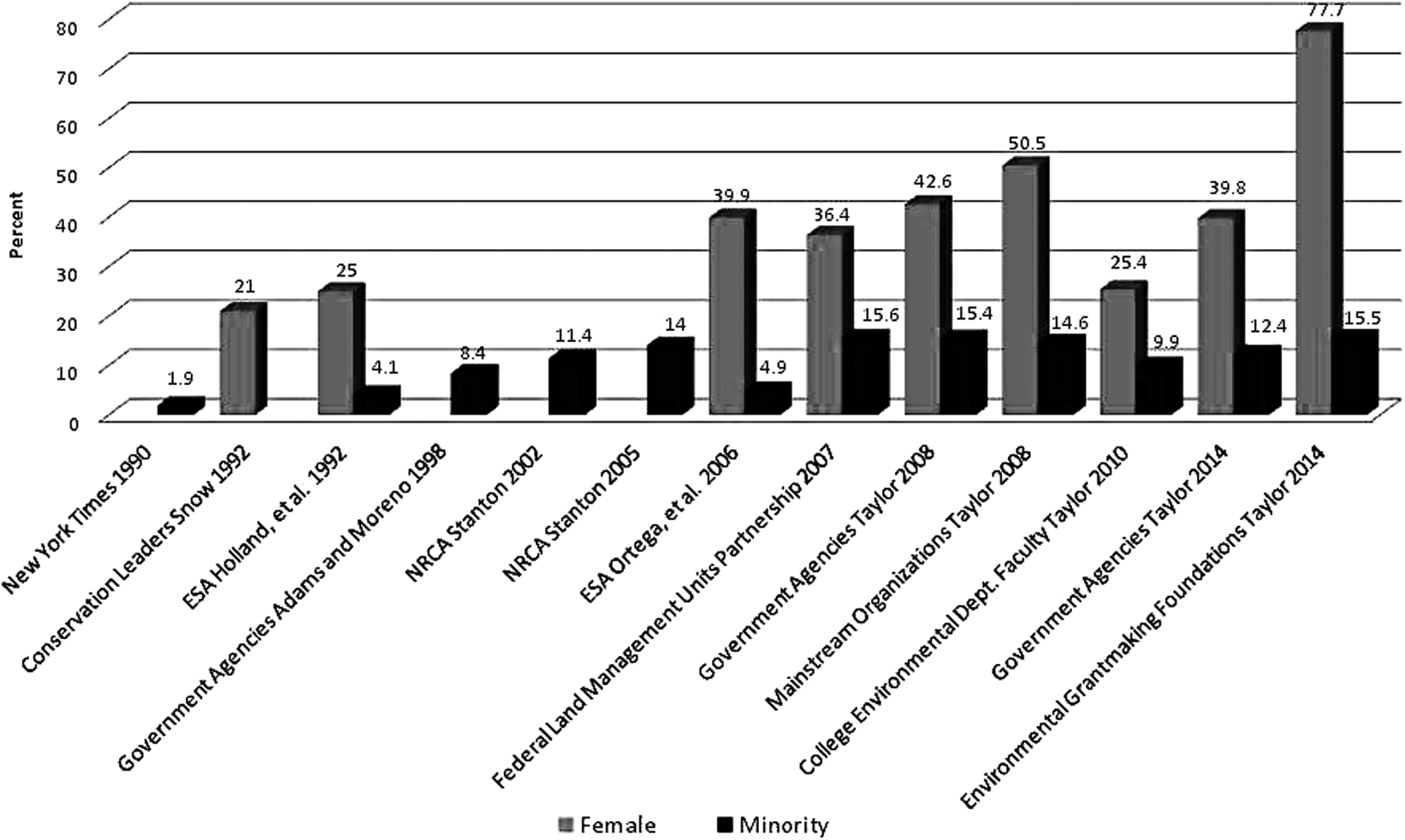
Percentage of female and minority staff in institutional diversity studies—1990–2014.
Professional associations wanting to promote diversity conducted their own studies too. Consequently, in 1992 the Ecological Society of America (ESA) examined its membership and found that 25% of the American respondents were female (Holland et al. 1992). This led the ESA to create the Women and Minorities in Ecology Committee in 1993 that had a stated goal of achieving “a population of ecologists that reflects the gender and cultural diversity of the general population of the United States” (Ortega et al. 2006: 3). The ESA reviewed its progress on diversity in 2005 and found that 39.9% of the members were female. The review indicated that females were making significant strides in the organization: 41% of the members of ESA committees and 57% of ESA committee chairs were female (Ortega et al. 2006; Perkins 2006).
College and university environmental departments were also studied. An analysis of 35,539 faculty in college environmental departments found that 25.4% were female (Taylor 2010). Other diversity studies examined gender diversity of government environmental agencies and environmental nonprofits. Analysis of data presented by the Partnership for Public Service (2007) found that 36.4% of the 103,936 staff of federal land management agencies (such as the Park Service, Forest Service, Bureau of Land Management, and the Fish and Wildlife Service) were females. Taylor (2008) also found that females comprised a significant portion of the staff in environmental agencies and organizations. That is, 42.6% of the staff in 38 government environmental agencies and 50.5% of the staff in 166 mainstream environmental organizations studied were female. Taylor (2014) studied 74 government environmental agencies and found that females comprised 39.8% of the 15,483 staff and 33% of the board members. The report also examined the gender composition of the staff and boards of 45 environmental grant making foundations. The results showed females comprised 77.7% of the staff and 43.9% of the board members of environmental grant makers.
Race
There is consensus that the percentage of females on the staff or in leadership positions in environmental organizations has increased substantially in the last three decades, but can the same be said for minorities? How has the status of minorities changed in these organizations over the same period? Studies generally find that the percentages of minorities on the staff and boards of environmental organizations have increased since the 1990s but have remained low (see Figure 1). In 1990, an informal poll of four of the largest environmental organizations found that minorities constituted 1.9% of the 745 staff in the institutions (New York Times 1990). Two years later, the Environmental Careers Organization (ECO) released a study of 63 mainstream environmental organizations. The study found that 32% of the organizations in the sample had no minorities on their staff; 22% of the organizations also had no minority board members (Environmental Careers Organization 1992).
In 1992, only 4.1% of the membership of the ESA were minorities (Holland et al. 1992). Adams and Moreno (1998) analyzed the racial composition of the staff of environmental agencies and found that minorities constituted 8.4% of the staff in state conservation agencies in 1993 in 16 southeastern states and the U.S. Virgin Islands. A 2002 report that examined diversity in 61 organizations in the Conservation Council of America (CCA) found that 11.5% of the 6,347 staff and 9.6% of the 1,324 board members of these organizations were minorities (Stanton 2002). Stanton (2005) conducted a follow-up study of 21 CCA organizations and found that 14% of the 4,037 staff and 14% of the 570 board members of these organizations were minorities.
When the ESA did a follow-up study of its membership, it found that the percentage of minorities had increased slightly in more than a decade. That is, only 4.9% of the American members of the organization were minorities in 2005. The study also found that minorities comprised only 9% of the membership of ESA committees and 5% of the chairs of ESA committees (Ortega et al. 2006; Perkins 2006). Another professional association, the North American Association for Environmental Education, conducted a diversity study of state-affiliated environmental education associations and found that only 17 minorities were on the boards of the 21 responding state associations. The percentage of minorities in the membership of state associations ranged from zero to about 20% (Clavijo and Chandler 2003a, 2003b). A study of racial diversity in college and university environmental departments found that 9.9% of the faculty were ethnic minorities (Taylor 2010).
Data from the Partnership for Public Service (2007) showed that 15.6% of the staff of federal land management agencies were minorities (see also Taylor 2011a). Taylor (2008) found that minorities constituted 15.4% of the staff in the government agencies studied. The study also found that minorities comprised 14.6% of the 7,200 staff in the mainstream environmental organizations studied. Taylor (2014) reports that minorities accounted for 12.4% of the 11,790 staff and 6.9% of the board members of the government environmental agencies studied. Minorities also comprised 15.5% of the staff and 13.3% of the board members of the environmental grant making foundations examined.
The national context
Gender
The increased interest in studying diversity in environmental organizations coincide with efforts by the National Science Foundation (NSF) to increase diversity in science, technology, engineering, and math (STEM) disciplines and track outcomes. It is appropriate to compare the percentage of females and minorities working in environmental organizations to the percentage of such workers in the STEM workforce as environmental workers are often drawn from the sciences. A recent NSF report found that females account for half of the college-educated workforce in 2010 but only 28% of the individuals employed in science and engineering (S&E) occupations. Females tended to be more concentrated in the “soft” sciences; they accounted for 58% of those employed in the social sciences and 48% of those in the life sciences. In contrast only 13% of those in engineering and 25% of those in computer and mathematical sciences were females (National Science Foundation 2014).
Yet, despite the focus on enhancing diversity, researchers report that 43% of the 105 grants and 30% of the grant dollars awarded in 2011 in NSF's Population and Community Ecology Program were awarded to female principal investigators (Martin 2012). This has significant implications for the training and advancement of female scientists.
These data are borne out in statistics from the Department of Labor (DOL). In 2014 the department reported that 51.6% of the people 16 years and older who were in management, professional, and related occupations were females. However, females account for only 26.3% of the chief executives. When it came to life, physical, and social science jobs, females constituted 45.6% of that workforce (U.S. Department of Labor 2014).
Race
Minorities did not fare as well in either management positions or science jobs. The NSF study found that about 70% of the S&E workforce is white. Asians, blacks, Hispanics, and Native Americans comprise 29% of the S&E workforce. However, Asians are the ethnic minority group most likely to be employed in S&E fields. Asians comprise 5% of the U.S. population age 21 and older, but they hold 19% of the S&E jobs. In contrast, blacks, Hispanics, and Native Americans are underrepresented in S&E occupations. These three groups make up 26% of the U.S. population who are 21 years of age or older yet they occupy only 10% of the jobs in the S&E sector (National Science Foundation 2014). According to DOL, minorities are underrepresented in top leadership positions nationwide. They comprise 25% of workers in management, professional, and related occupations. Moreover, they occupy only 12.4% of the chief executive positions and they occupy 26.2% of the life, physical, and social science jobs (U.S. Department of Labor 2014).
Minorities are also underrepresented when funding is considered. Research shows that black principal investigators were less likely to receive funding from the National Institutes of Health than their white peers (Moss-Racusin et al. 2013). Moreover, only 12.3% of 316 proposals funded in the NSF's Division of Environmental Biology between 2000 and 2010 included activities aimed at broadening participation of underrepresented minorities (Watts, George, and Levey 2015). These two factors have a limiting effect on the access that minority students and professionals have to training and advancement in the sciences.
Lack of access to funding extends to community-based organizations. Minority environmental organizations comprise a small percentage of the institutions receiving funding. A study of 45 foundations that have environment as some or most of their funding portfolio found that together they funded 1,618 organizations in 2012. Of those funded, 11.1% (180) were minority (leadership, members, or clients) organizations. Further analysis revealed that only 5.7% (93) of the organizations funded were ethnic minority environmental organizations (Taylor 2014).
Diversity in the environmental field: Labor supply and a demographic imperative
The diversity of the environmental workforce is of utmost importance. That workforce is growing rapidly, and all indicators are that the demand for environmental workers will increase in the coming years. In 1970, there were about 700,000 environmental jobs but by 2005 there were approximately 5.3 million such jobs (Bezdek, Wendling, and DiPerna 2007; Center for American Progress 2007). Bezdek (2007) estimates that about 40 million environmental jobs could be created by 2030. More recently, the United States Department of Labor's Occupational Outlook Handbook 2010–11 predicted a 28% increase in the number of environmental scientists and specialist positions between 2008 and 2018. This growth rate exceeds the average predicted for all occupations (U.S. Department of Labor 2012).
Notwithstanding, the environmental field faces a labor problem that will force it to hire groups currently underrepresented in its workforce. The environmental workforce is aging and that has significant implications for movement growth, leadership transition, and overall effectiveness. For instance, more than 40% of the workforce of federal environmental agencies is over 50 years old (Copeland 2011; Balcarczyk 2012). Hence, as the demand for environmental workers grows, environmental organizations and agencies will face increasing pressure to utilize the full spectrum of talent available to them to fill job openings. There is already a debate over whether there will be a shortage of American workers who can meet the demand (see for example Copulsky 2013; Salzman, Kuehn, and Lowell 2013). Regardless of the availability of environmental workers, one thing is clear—environmental organizations and agencies cannot continue to bypass minority workers. Ethnic minorities currently constitute a substantial part of the population and those percentages are projected to rise. Hence ethnic minorities will play an even more important role in the American labor force in the future. The 2010 census shows that Hispanics make up 16.3% of the population, blacks 12.6%, Asians 4.8%, Native Americans and Pacific Islanders 1.1%, and mixed-race people 2.9% (U.S. Census Bureau 2010). To ignore this segment of the population means that employers are ignoring roughly 38% of the population.
What does the future portend? According to the U.S. Census, the American population is aging and will be considerably more racially diverse by 2060 (see Table 1). The population will be around 420.3 million by then. The Census Bureau predicts that over the next half century, the U.S. will become a “plurality nation.” Though whites will remain the largest single group, no one group will be a dominant majority (U.S. Census Bureau 2012). If the census projections hold true, by the year 2060 ethnic minorities and people of multiracial backgrounds will comprise roughly 57% of the population. This is an important demographic shift that will impact hiring decisions in the environmental field.
U.S. Census Bureau 2012.
The Study of Environmental Organizations
This article reports on the findings of a diversity study of 324 mainstream environmental nongovernmental organizations. The sample was divided into six groups for detailed analysis. The study analyzes 147 general conservation organizations and five specialized types of environmental organizations—52 freshwater organizations, 49 environmental education organizations, 27 environmental consulting organizations, 25 environmental think tanks or policy institutes, and 24 professional or trade associations. The article also contains a brief analysis of 13 environmental justice organizations (see Table 2).
Organizations listed in this column appear solely for the purpose of providing examples of the types of institutions that may be in this category.
The data used in this study was collected through an online survey designed in Qualtrics and administered through MailChimp. Potential respondents were sent an e-mail containing a brief description of the study and a request to participate in it through MailChimp. The e-mail also contained a hyperlink that respondents could click on to start the survey. Those not wishing to get further correspondence about the survey could unsubscribe. Through MailChimp, the researcher could track the distribution of surveys and send automatic reminders every five days to those who had neither unsubscribed nor opened the survey. Reminders ceased after a respondent opened the survey link. Once a respondent opened a survey and logged off, they could not access the survey again. After five reminders, if a potential study participant did not open the survey, no additional reminders were sent.
The survey—which took between 30 minutes and 45 minutes to complete—was administered from November 2013 to April 2014. The names of organizations and contact information of environmental organizations were gathered from websites, environmental directories (such as the Conservation Directory, National Directory of River and Watershed Conservation Groups, and Wildlife Conservation Environmental Directory), the Leadership Directory, and from databases I developed as part of earlier studies. Multiple sources were used to find e-mail addresses in order to overcome the problem of “churning.” Churning occurs when e-mail addresses change because of a change in Internet service providers, institutional reorganization, or workers changing organizations, etc. (Bradley 1999). Key personnel (for example, an executive director, associate director, or human resources director) in each institution were asked to complete the survey on behalf of the organization. The responses were analyzed in SPSS 22.
To assess the current state of diversity in the organizations, the study examined the percentages of females and racial/ethnic minorities on the staff and boards of environmental organizations. This included an examination of the demographic characteristics of the: (a) interns an organization hosted in the last three years, (b) staff hired in the last three years, (c) total staff in the organization, (d) senior staff in the organization, (e) organizations that had an executive director, and (f) organizations that had a president. The study also analyzed two other dimensions of leadership—the demographic characteristics of the boards as well as the chairs of the boards of the organizations.
The current state of gender diversity in mainstream environmental organizations
There are greater percentages of females in leadership positions in environmental organizations today than in the 1980s when early studies were conducted. There is no question that females have made great strides in obtaining jobs in environmental organizations, however, they are still underrepresented in top leadership positions. Table 3 shows that as the seniority, power, and visibility of the staffing level increases, the percentage of females holding such positions decreases. The study found that females are more numerous in non-senior staff and non-upper-echelon leadership positions than males. The reverse is generally true when senior positions and top leadership positions are considered. There is a larger percentage of females being hosted as interns than males in the six types of mainstream organizations studied. On average, 63.5% of the interns are females but the percentage reached as high as 77.4% in the environmental consulting field. Roughly two-thirds of the interns hosted in environmental education centers were also female. General conservation organizations hosted the lowest level of female interns; 61% of the interns hosted by these organizations were females. Females also dominate the new staff hires; they accounted for 58.2% of such staff. Just over 71% of the staff hired in the three years leading up to the survey in freshwater organizations were females. In no other type of mainstream environmental organization did the percentage exceed 60%.
Females account for 56.3% of the 4,760 staff reported on in the organizations studied. Almost 62% of the staff of the environmental professional and trade associations and 60.1% of those in freshwater organizations were females. Though environmental consulting organizations hosted the highest percentage of female interns, they had the lowest percentage of female staff (52.6%) overall.
Respondents were asked to say how many males and females occupied senior staff positions in their organizations. Almost half (49.7%) of the 755 senior staff identified in the study were female. However, the female composition of this staffing level was more divergent than any other category of staffing examined. The percentage of female senior staff in environmental education centers (66%) was much higher than that found in other mainstream environmental organizations. At the other end of the spectrum, the percentage of females (34.1%) on the senior staff of environmental consulting organizations was much lower than that found in other mainstream environmental organizations.
Respondents were asked to say if their organization had an executive director, president, or chair of the board and to say whether the position was occupied by a male, female, or both. Table 3 reports on the number of organizations indicating they had such positions and the percentage of organizations in which a female occupied each position. These positions are important in diversity analyses as the president and executive director represent two of the most senior, powerful, and visible staff positions in the organizations while the chair of the board represents the most visible and powerful non-staff position in the organizations. Board membership is also an important non-staff position.
Of the two most visible staff positions studied—executive director and president—a much higher percentage of mainstream environmental organizations report having a female executive director than president. On average, 44.6% of the organizations had a female executive director; in comparison, 28.3% had a female president. Environmental education centers were much more likely than other mainstream environmental organizations to have a female executive director and president. That is, 59.5% of the environmental education centers had a female executive director and half had a female president. In contrast, only 35.3% of the environmental consulting organizations had a female executive director. Less than a third of the general conservation organizations, freshwater, environmental consulting, and environmental policy/think tanks had a female president.
Females constituted 35.8% of the 2,959 board members identified in the study. Of the 173 organizations that had a chair of the board position, females occupied the position of chair in 30.6% of those organizations. In four out of ten of the environmental education centers females chaired the boards, however, only 21.7% of the chairs of the boards of freshwater organizations were females.
This study uncovers a trend that has not been identified in any previous institutional diversity studies of mainstream environmental organizations. That is, females fare best in occupying senior staff positions as well as the most visible and powerful positions in environmental education centers. Not only do they occupy two-thirds of the senior staff positions, they are executive directors in roughly 60% of the environmental education centers, constitute half of the presidents, and comprise about 40% of the board members and chairs of the boards (Table 3).
The current state of racial diversity in mainstream environmental organizations
Since the 1990s, the percentage of racial and ethnic minorities on the staff of mainstream environmental organizations has grown slowly. This article reports that minorities continue to be underrepresented on the staff and boards of mainstream environmental organizations. It also shows that as the seniority, power, and visibility of the position increases, the percentage of minorities holding such positions decreases.
The study found that low percentages of minorities are found at all levels of the staff and board in the mainstream environmental organizations studied. Table 4 shows that minorities comprised 20.9% of the 1,304 interns for whom race was known and who were hosted by the organizations in the last three years. Professional environmental and trade associations were far more likely to host minority interns than other types of mainstream environmental organization studied. While 47.6% of the interns hosted by professional and trade associations were minorities, a mere 6.5% of those hosted by environmental consulting organizations were minorities.
Only 14% of the 1,031 staff for whom race was known and who were hired by mainstream environmental organizations in the last three years were minorities. Once again, the professional environmental and trade associations far outpaced other types of mainstream environmental organizations in the hiring of ethnic minorities. Minorities constituted 36.9% of the staff hired in the last three years in professional environmental and trade associations. In contrast, minorities made up 6.5% to 14.5% of the new hires in all the other types of mainstream environmental organizations studied.
The racial background was identified for 4,552 staff; 11.8% of them were ethnic minorities. The professional environmental and trade association had the highest percentage of minority staff at 18.2%. However, less than 10% of the staff of freshwater organizations and environmental education centers were comprised of ethnic minorities.
Ethnic minorities accounted for 7.1% of the 636 senior staff for whom race was known. General conservation organizations had the highest percentage of minorities in senior staff positions in their organizations—10.1% of the senior staff of these organizations were ethnic minorities. However, less than 5% of the senior staff of freshwater organizations, environmental education centers, environmental consulting organizations, and environmental policy institutes and think tanks were comprised of ethnic minorities. Freshwater organizations had the lowest percentage of minorities on their senior staff; only 1.9% of the senior staff of these organizations were ethnic minorities.
The two staff positions in mainstream environmental organizations where one is least likely to find minorities occupying them are executive director and president. The study found that 5.7% of the executive directors were minorities as were 3.4% of the presidents. Less than 5% of general conservation organizations, freshwater organizations, and environmental education centers had an ethnic minority executive director. None of these three types of mainstream environmental organizations had an ethnic minority president. However, 18.2% of the environmental policy institutes and think tanks had an ethnic minority president.
The racial characteristics of two non-staff positions—board membership and chair of the board—were also examined. Ethnic minorities constituted 6.1% of the board members and 5.2% of the chairs of the boards. Environmental consulting organizations were least likely to have either minority board members or chairs of the boards. While 0.9% of the board members were minority none of the presidents of these organizations were minority. The environmental policy institutes and think tanks had the highest percentage of minority board members (17.4%).
A comparison of gender and racial outcomes in mainstream environmental organizations
It is important to compare the status of females and minorities in mainstream environmental organizations as most diversity efforts in these organizations are directed at these two target groups. Furthermore, diversity efforts in many STEM programs target these two groups also. My study reveals three important findings that have significant implications for current and future diversity efforts. These findings are evident in Figure 2. The figure shows that as the seniority, visibility, and power of the staff positions increase, the percentage of females or minorities occupying such positions decrease. However, Figure 2 and data presented above shows that females are much more incorporated into all levels and in all the types of mainstream environmental organizations studied than minorities. Figure 2 also shows a large gap between females and minorities on all the dimensions of diversity studied.
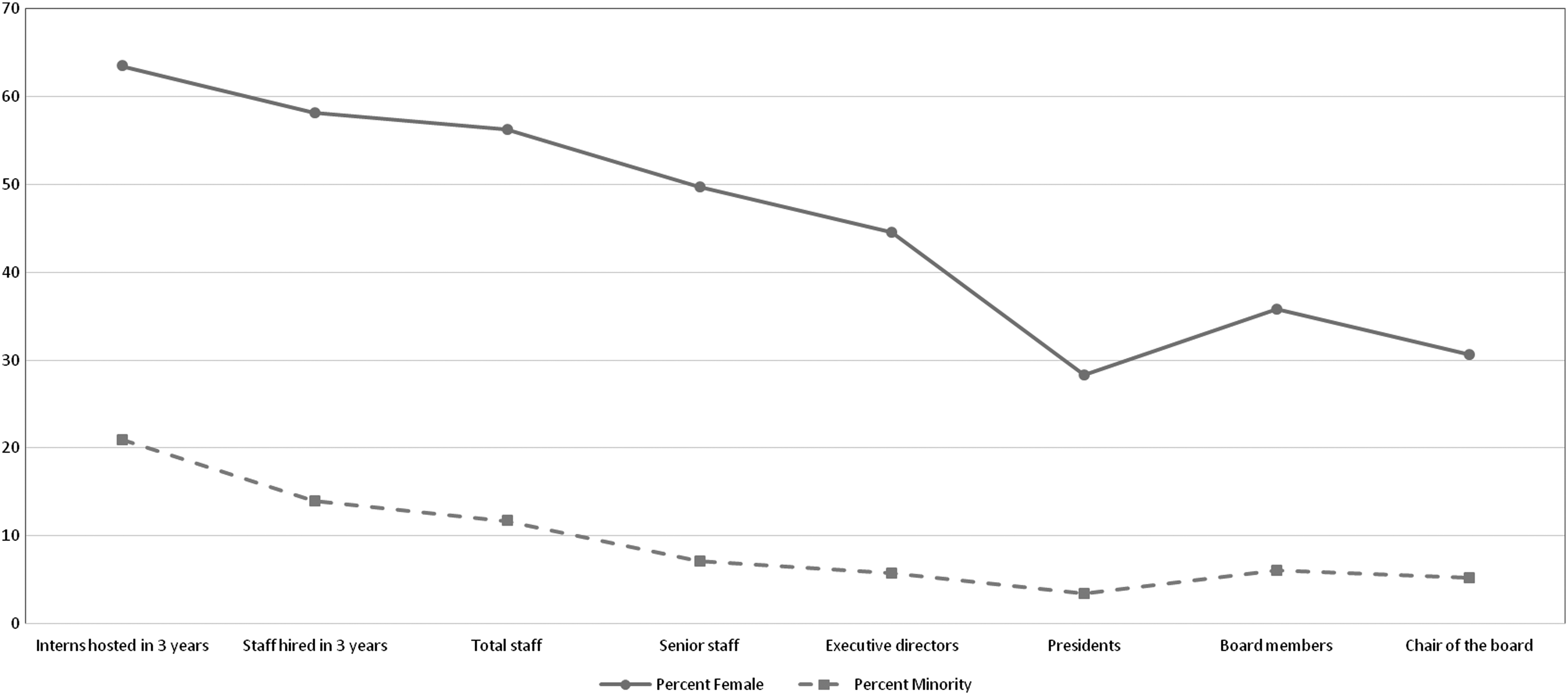
Percentage of females and minorities on the staff and boards of all mainstream environmental organizations.
Though it would have been more illuminating to study the interaction effects of race and gender more directly, the available data did not allow for such comparisons. This is the case because, at the time the study was conducted, many environmental organization did not collect detailed demographic information. Consequently, most were unable to report on how many males or females they had in each racial/ethnic category.
Environmental justice organizations—going against the grain
Thirteen environmental justice organizations were studied. Because of the small sample size, caution is necessary in interpreting the results. The small sample of environmental justice organizations also limits the extent to which comparisons can be made. Table 5 shows the gender and racial characteristics of environmental justice organizations. The table shows that from this limited sample it appears that the environmental justice organizations have been more successful at incorporating females into all levels of the staff and leadership than mainstream environmental organizations. Hence, females comprise more than two-thirds of the senior staff and executive directors; females also make up half of the presidents and 62.5% of the chairs of the boards in the environmental justice organizations studied.
Ethnic minorities are also incorporated more fully into all staff and leadership positions in environmental justice organizations than in mainstream environmental organizations. Minorities occupy two-thirds of the senior staff positions, a third of the executive directorships, and all of the presidential posts in environmental justice organizations. They also comprise two-thirds of the board members. This feature of environmental justice organizations—incorporating significant numbers of females and minorities into the staff and leadership of the organizations—has been a hallmark of these organizations. Studies have shown this to be an enduring characteristic since their advent in the 1980s (Environmental Careers Organization 1992; Taylor 1999, 2007a, 2008).
The large gap that is evident between females and minorities vis-à-vis their level of representation in various staff and board positions in mainstream environmental organizations is not evident in the environmental justice organizations. Hence, the analysis of these environmental justice organizations suggest that ethnic minority females are able to benefit from gains females have made in being hired into and being promoted to leadership positions.
Discussion
This study of mainstream environmental organizations supports the findings of the 2006 ESA study that found that females were being incorporated into the association to a much greater extent than minorities (Ortega et al. 2006; Perkins 2006). Comparisons with STEM diversity studies are also appropriate. The findings of the study shows that more than half of the staff of mainstream environmental organizations and environmental justice organizations are female. This rate exceeds NSF estimates that 28% of those working in S&E occupations and the 48% working in life science occupations are female (National Science Foundation 2014). It also exceeds the rate that the DOL reports—45.6% of the workers in life, physical, and social science occupations in 2014 are females. DOL also reports that 26.3% of the chief executives are females (U.S. Department of Labor 2014). This study shows that the percentage of females in executive positions in both the mainstream environmental organizations and environmental justice organizations exceed DOL's estimate.
Minorities comprised 29% of the STEM workforce in 2010 (National Science Foundation 2014). The DOL reports that minorities comprise a fourth of the workers in management, professional, and related occupations. They constitute a little more than a quarter of the life, physical, and social science workforce and occupy one-eighth of the chief executive positions (U.S. Department of Labor 2014). However, this study found that minorities constitute one-eighth of the staff of mainstream environmental organizations and less than 7% of the executive directors and presidents of these organizations. Hence, minorities were more underrepresented on the staff of mainstream environmental organizations than they were in the STEM and general workforces. It should be noted that while ethnic minorities are underrepresented in mainstream environmental organizations, they cannot be considered underrepresented in environmental justice organizations.
Why so few minorities in mainstream environmental organizations?
Is the “and minorities” part of the phrase “females and minorities” the forgotten half of the duet? Given the number of diversity efforts launched in recent decades that target minorities, minorities are clearly not forgotten. However, incorporating minorities into mainstream environmental organizations has proven to be very challenging and a slow process of inclusion. The question arises, after decades of diversity efforts aimed at females and minorities, why has so little progress been made on racial diversity in mainstream environmental organizations? There are several factors that account for this (see, for example, Taylor 2014). The remainder of the essay discusses four major factors and offer suggestions and strategies for increasing racial diversity in environmental organizations.
Reluctance to hire—vestiges of doubt and skepticism
The study found that 56.4% of the mainstream environmental organizations had not hired any ethnic minority workers in the past five years. Since the 1990s, environmental leaders have asserted that their organizations have not hired minorities because minorities do not have the appropriate educational background to work in mainstream environmental organizations, lack the skills to do so, demand wages that are too high for these organizations to pay, have no interest in working for mainstream environmental organizations, and won't stay with an organization if they are hired (Shabecoff 1990; Environmental Careers Organization 1992; Taylor 2008, 2011b).
While such doubts are not expressed openly about white females today, this study found that there is still skepticism about the training, skills, and commitment of minority workers that reduces their chances of obtaining jobs in mainstream environmental organizations. That is, employers are not likely to hire a person thought to lack training or the appropriate skills, who is disinterested, and who is not committed to the institution seeking to hire them. Interviews conducted with professionals who have worked or currently work in mainstream environmental organizations reveal that minorities are sometimes stereotyped and discriminated against in the hiring process. The stereotyping and discrimination may continue while on the job (Taylor 2014).
When asked to identify what factors hindered the hiring of minorities in their organizations, 39.9% of the study respondents from mainstream environmental organizations said that minorities lacked the educational qualifications to work in their institutions. Moreover, 23% of the respondents thought that minorities did not have the skills their organizations look for in their employees. A third of the respondents indicated that minorities did not want to work for organizations like theirs, and 31.5% of the respondents indicated that minorities desire higher wages than their organizations can afford to pay. Moreover, 15.2% of the study participants believed that minorities would not stay long with their organizations if they were hired.
These data suggest that there is significant work that still has to be done to rid mainstream environmental staff and the institutions of the skepticism, doubts, and stereotypes associated with hiring minority workers. These misgivings persist despite studies showing that minority students express similar levels of interest in working in mainstream environmental organizations as white students and that minority students have salary expectations that are consistent with what is being paid by these organizations (Taylor 2007a, 2007b). Studies also show that minority professionals are willing to work in mainstream environmental organizations and stay longer with the organization hiring them than white professionals (Taylor 2011b).
Research also shows that minorities were aware of environmental issues, interested in them, and perceive environmental risks at rates equal to or exceeding that of whites. Studies tracking changes in attitudes over time also found that minorities support higher levels of spending on the environment than whites and that minority legislators are more likely to vote for environmental bills than other legislators (Ard and Mohai 2011; Taylor 2014).
Reluctance to promote from within
One of the oft used diversity strategies that organizations employ is to groom and promote talented employees already working in the organization to top leadership positions. The study found that mainstream environmental organizations were significantly more willing to do this in the case of females than in the case of minorities. Hence, 72.1% of the respondents report that their organization promoted females already working in the organization to top leadership positions. However, only 31% of the study participants reported that their organization promoted minorities already working in the organization to top leadership positions. This gap in the promotion of females and minorities could help to account for some of the difference in the rates at which the two groups are represented in senior staff and top leadership positions.
The reluctance to hire and promote minorities extends all the way through the pipeline. It is even evident in early career stages such as hiring interns to paid staff positions. Only 30% of the organizations that had diversity programs hired interns from those programs onto the staff of mainstream environmental organizations. The lack of hiring of minority staff should not be interpreted as lack of interest in mainstream environmental organizations on the part of minorities. Data reported by ECO shows that from 1990 to 2007, that organization recruited and placed more than 2,000 minority students desirous of careers in mainstream environmental organizations in internship programs in such institutions (ECO 2007). ECO ceased operations in 2007 and since then there has been no tracking of how many minority students have been hired and have pursued careers in the environmental field. Nonetheless, ECO's success in identifying and connecting minority students with mainstream environmental organizations demonstrates that there is strong interest amongst minorities and that a robust pipeline of potential environmental workers can be built.
Finding the talent
Mainstream environmental organizations currently hire more females than males into their institutions. But, their success with finding and hiring females has not been translated to equal success in finding and hiring minorities. This is the case because mainstream environmental organizations are not identifying where minority talent exists and are not going to those places or connecting effectively with such talent. This is borne out in the data collected for this study. Some organizations make no effort at all to recruit minorities; 50.3% of the study participants said this was the case with their organizations. Lack of knowledge also plays a role in lack of or ineffective minority recruitment. Almost half of the study participants (47.4%) indicated that their organization did not know how to recruit minorities. This raises the question, how are organizations recruiting new workers? Most mainstream environmental organizations used traditional recruitment methods that search for new workers through word-of-mouth (85.3%) or from within existing environmental networks (75.7%). Though many institutions rely on these two types of recruitment strategies, organization theorists note that such recruitment strategies tend to replicate the existing workforce and result in homosocial reproduction (DiMaggio and Powell 1991; Granovetter 1995; Braddock and McPartland 1987; Model 1993). These strategies also result in intentional and unintended biases (of excluding those not in the networks) that are replicated with each recruitment cycle (Ross 2008; Moss-Racusin et al. 2014).
This can be overcome but mainstream environmental organizations are still hesitant to go to college and university environmental programs and to minority institutions and spaces to recruit minority workers. As a result, only 44.1% of the study respondents said their organization recruited new staff from minority-serving colleges and universities. Even fewer recruited from minority environmental professional associations and meetings—26.7% reported they recruited from these venues. This reveals another area where mainstream environmental organizations have to make greater effort to take the steps necessary to increase the racial diversity of their organizations. This means going to the talent. Such talent is not hard to find. Not only are lists of minority-serving institutions (MSIs) as well as historically black colleges and universities (HBCUs), tribal colleges, and Hispanic Association of Colleges and Universities (HACUs) readily available on the Internet and from the Department of Education, there are several well-established minority professional environmental associations to interact with. Professional associations such as the American Indian Science and Engineering Society (AISES); Minorities in Agriculture, Conservation and Related Sciences (MANRRS); Society for Advancement of Chicanos and Native Americans in Science (SACNAS); and the National Hispanic Environmental Council (NHEC) have thousands of young, talented minorities interested in the environmental field participating in their organizational activities. Yet, most of these students and young professionals are overlooked by mainstream environmental organizations.
The onus for increasing diversity should not be placed solely on mainstream environmental organizations. Educational institutions and the government must shoulder some of the responsibility. In particular, colleges and universities with STEM programs should take every opportunity to foster diversity and train a larger pool of minority students. Studies have shown that the percentage of minority students in some environmental disciplines is low (Taylor 2007a, 2007b, 2008; Valdez 1995). Furthermore, data presented above shows that the percentage of minority faculty in environmental disciplines is also low (Taylor 2010). This is exacerbated by structural problems in the federal government's grant-making processes (a critical pipeline for identifying and training students) that overwhelmingly fund projects that pay no attention to broadening the participation of underrepresented minorities (Watts, George, and Levy 2015), fund primarily male faculty (Martin 2012), and fund minority investigators at a lower rate than white investigators (Moss-Racusin et al. 2014). These factors limit the access that minority students have to training and research opportunities.
Mentoring
Though mentoring is widely accepted as an effective way of incorporating and retaining workforce talent, many mainstream environmental organizations do not have mentoring activities aimed at minorities. Hence, 44% of the study participants said their organization did not have mentors in their organizations who could help ethnic minorities. Only 31.8% of the respondents said their organizations had developed a mentoring program. And 42.9% reported that there was a lack of role models in their organization for minorities to interact with. So despite the fact that several large mainstream environmental organizations like the Sierra Club, National Wildlife Federation, Environmental Defense Fund, the Nature Conservancy, the Natural Resources Defense Council, ESA, Wildlife Conservation Society, and the Association for the Sciences of Limnology and Oceanography (ASLO) have developed their own diversity programs, there is still a dearth of mainstream environmental organizations that have not initiated such programming. Diversity programs are important as they provide a critical point of contact for early mentoring. Early and effective mentoring is to be encouraged as this will expand opportunities for minorities, and the workforce in general, and facilitate the retention of minority environmental workers.
Pathways to enhancing diversity in the environmental field
This is a critical time for the environmental field to examine diversity and develop comprehensive strategies that will result in greater equity and inclusion in the near future. Not only should gender and racial diversity be examined and tracked more thoroughly, greater attention should be paid to class, cultural, and age diversity. Sexual orientation, disability, and other forms of diversity should also be incorporated into initiatives. Recent articles in Nature discuss the discrimination and challenges that gay, lesbian, bisexual, and transgender scientists face in the research setting (Waldrop 2014). Interviews conducted with environmental professionals also indicate that this is an area of concern in environmental organizations (Taylor 2014). Researchers have also investigated how the plethora of older male scientists may limit research opportunities for female and young scientists (Scudellari 2015). Some identify an urgent need to train young environmentalists and prepare a new generation of leadership to succeed the aging environmental workforce (Balcarczyk 2015; Taylor 2014).
The time is right to undertake increased and sustained diversity activities. However, the patchwork or helter-skelter approach to promoting diversity in the environmental field has not always been effective. Figure 3 represents a model that shows how diversity can be thought about and planned more holistically. Results presented above follow the work opportunities pathway outlined in Figure 3. As the findings indicate, this pathway is reminiscent of a ruptured pipeline wherein minority talent flows into many environmental organizations but are not effectively hired, mentored, promoted, or retained. That is a small number of minorities are offered internship positions in mainstream environmental organizations but few are hired into paid positions in such organizations. Once hired, a miniscule number are promoted to senior staff or top leadership positions.

Logic model showing the pathways through which the environmental field can be diversified.
To make current diversity initiatives more effective and maximize the impact of future programs, environmental organizations should think about diversity in more comprehensive ways. For instance there are diversity programs that expose minority youths to environmental activities but do nothing else. The logic behind such programs is that early exposure to environmental activities will foster interest in the youths and they will become engaged in environmental affairs over time. While this might be true for a small number of such program participants, diversity initiatives that are buttressed by other elements of diversity programming are more effective in diversifying the environmental field.
Those developing the programs should think about closing the gaps existing in the pathways outlined in the figure. They should also think about multiple pathways to enhancing diversity and create bridges between these. The figure shows that effective diversity initiatives should incorporate several dimensions into their programming. Some of the most critical components to incorporate are: recruitment, funding, positive experiences, support structures, retention and promotion, and openness to institutional change.
Recruitment and funding focus on key inputs to the system. Recruitment is necessary to identify and bring into the environmental field people of diverse backgrounds and experiences as well as new workers. It is also important to recruit a broader range of people to participate in educational opportunities, as well as to the boards, membership, and volunteer corps of environmental organizations. Funding is frequently overlooked when diversity initiatives are being planned. Quite often, initiatives are undertaken with little or no funding. This results in failed or short-lived efforts as the funding needed to run programs effectively and over the long haul are not available. Moreover, minority environmental professionals and environmental justice activists report great difficulty in obtaining funding to undertake diversity initiatives (Taylor 2014). Despite the enthusiasm and good intentions of diversity advocates, adequate funding is critical to making significant progress on enhancing diversity in the environmental field.
Career development, leadership development, and networking are critical to success in the environmental field. However, the efficacy of some environmental diversity initiatives are undermined as educational opportunities (for example admission into college environmental programs) are not linked to career development and networking opportunities (for example participating in professional conferences), and these are not linked to internship opportunities or other work opportunities. Environmental professionals recognize that mentorship is critical to retention and success in the environmental field, yet they report that the mentoring of minorities working in environmental organizations often occur in vacuum or not at all (Taylor 2014). This is the case because organizations are not intentional about developing comprehensive diversity initiatives that link educational and work opportunities to mentoring, career development, leadership development, and promotion to leadership positions.
Moreover, environmental organizations pay little attention to their institutional culture to find out what changes can be made to foster inclusive and nurturing environments for all workers. Environmental professionals report that this occurs because traditional organizational structures and practices have to change to accommodate more diverse workers and that there is resistance to such changes (Balcarczyk 2015; Taylor 2014; Waldrop 2014). Organizations in which workers recognize that greater equity, inclusion, and openness benefits all workers (for instance having explicit and fair criteria for reviews and promotions), are making greater progress on diversity efforts.
Community engagement is another critical dimension of diversity that is often overlooked. This is particularly important when interactions with minority and low income communities are considered. Environmental organizations should be willing to adjust their agendas, approaches, and framing of the issues to collaborate in meaningful ways with communities. This also involves the recognition that communities bring resources to partnerships (such as expertise, skills, networks, and interpretations) that should be respected and incorporated into the evolving meaning and practice of environmentalism.
Conclusions
There is great public interest in environmental issues and efforts should be made to include a wide array of people into all aspects of conservation. This is important because at the same time the predominantly white environmental workforce is aging, the country is getting younger and more racially and culturally diverse. The demographic transition offers an opportunity for environmentalists to take advantage of this opening to build greater institutional diversity in all realms of the environmental field—the workforce, policymaking, curriculum, the academe, organizational memberships, volunteering, stakeholder processes, and advocacy.
To make significant advances in diversity, environmental organizations need to develop comprehensive and collaborative initiatives. Such initiatives should identify existing diversity, equity, and inclusion programs and use pathway approaches to see if and how initiatives can complement each other, fill gaps, and facilitate the inclusion of those currently underrepresented in the environmental workforce and activities.
Footnotes
Acknowledgments
This research was funded, in part, by grants from the Joyce Foundation and the Charles Stewart Mott Foundation.
Author Disclosure Statement
The author has no known conflicts of interest or financial ties to disclose.