




Abstract
Abstract
Under the control of a state-appointed emergency manager, City of Flint residents were disconnected from the Detroit Water and Sewage Department (DWSD) and began drawing water from the Flint River for almost 18 months. This switch was met with opposition from residents who claimed that the water from the Flint River was unsafe. After concerns were confirmed by independent researchers and the Flint water crisis became a topic of national debate, City of Flint and state-level officials chose to switch back to the DWSD and vowed to repair the damage caused by regulatory neglect. In this article, I explore additional factors that might have contributed to the water crisis in Flint, namely the conditions of the plumbing within Flint Community Schools and the corrosive nature of the water before the water source switch in 2014. Based on evidence from City of Flint Water Department audits and recent Lead and Copper Rule compliance data from Flint Community Schools inspection reports, I found that the children of Flint were at-risk of consuming lead-contaminated water years before this crisis received public attention. As noted in this article, problems with lead in the drinking water in schools were profoundly motivated by the persistent use of lead plumbing parts within Flint schools. In addition, elevated blood lead levels among the children of Flint have been likely influenced by Flint's ongoing, but silent, concern: its corrosive water and the effect it had on the city's water distribution system.
Introduction
I
It is important to note that children are more likely to develop elevated blood lead levels from other sources within their environment, including lead-based paint dust in their homes, blight in their communities, and lead plumbing materials used in drinking fountains at school. 6 In response, efforts are made in this article to shed light on additional sources of lead contamination in the City of Flint by documenting shifts in the corrosivity of City of Flint water both before and after the source switch as well as comparing the water quality in Flint with that of a neighboring suburban community, Fenton, Michigan. In addition, with lead and copper compliance data related to Flint Community Schools, I explore the extent to which the conditions of plumbing and fixtures within Flint Community Schools might have contributed to elevated blood levels among City of Flint children, well after the passage of the Lead Contamination Control Act of 1988 that banned the use of these plumbing materials in schools. Furthermore, in an attempt to illustrate how sampling procedures influence Lead and Copper Rule compliance testing results within Flint Community Schools, the nature of lead exposure in Flint Community Schools is examined by using lead and copper compliance test results to compare the amount of lead detected in school drinking water fountains in Flint after utilizing different sampling strategies. These data are explored in this manner to quantify the lead problem within Flint Schools and to determine the extent to which the practice of “preflushing,” a short-term remedy to control lead exposure, affects the levels of lead and copper defected in school drinking water.
The Rise and Significance of the Lead and Copper Rule Regulations
Since children absorb more lead than adults, 7 there has been a great deal of effort to reduce children's exposure to lead. Initial attempts to implement lead and copper regulations emerged in 1975 when 50 parts per billion (ppb) was established as the standard for lead in drinking water; however, this standard did not require public water systems to undergo compliance testing. To address lead exposure in schools, the passage of the Lead Contamination Control Act (LCCA) of 1988 barred the purchase of drinking water coolers with lead parts and recalled drinking water coolers with lead-lined water tanks. 8 Accordingly, amendments to the Safe Drinking Water Act in 1986 required the Environmental Protection Agency (EPA) to revise its lead and copper rules (LCR).
Drinking water regulations for lead and copper were first implemented after the United States Environmental Protection Agency established maximum contaminant level goals for these heavy metals in 1991. 9 LCR of 1991 10 were designed to protect the public from water corrosivity (40 CFR 141.80 & 141.8/(b)). The LCR were game changing, because water treatment officials were tasked with monitoring lead levels in public drinking water after it leaves treatment plants and travels through the distribution system and household plumbing. 11 If the tap monitoring results indicate elevated lead and copper in the drinking water, public water systems are required to begin corrosion control and source water treatment, provide education to the public within 60 days after the end of the monitoring period, and/or replace the service lines that are the source of the problem (40 CFR 141.83).
Tap water monitoring protocol requires that public water systems monitor high-risk locations to detect elevated lead and cooper levels in residents and facilities that are vulnerable to elevated lead and copper levels (40 CFR 141.86(a)). Although there is no maximum contaminant level for lead or copper, if lead and copper 90th percentile monitoring results are above the lead action level of 15 pbb or the copper action level of 1.3 mg/L, the EPA requires corrosion control treatment (40 CFR 141.80-141.91). Public water systems are considered to be in compliance with the LCR when more than 90% of their sample has lead level readings between zero and 15 pbb.
Although the Lead and Copper Rule of 1991 was designed to help local municipalities protect the public from consuming hazardous substances, some public water systems throughout the United States have developed a system of rigging the sampling process to avoid the obligation of addressing the problem of lead-contaminated drinking water. Citizens and community groups warn that for years, water authorities in several cities have been employing deceptive methods that bias tests for lead content before official tests of public drinking water. 12 Before the water crisis, in their drinking water lead and copper sampling instructions, the City of Flint Water Plant was in the practice of asking residents to run the water 3–4 minutes before sampling. 13 Requests by water testers to preflush the pipes before testing the water were provided to Michigan residents in cities, including Grand Rapids, Detroit, Muskegon, Jackson, and Holland, between 2007 and 2015. 14 As recently as 2014, the water department in Philadelphia has been asking residents to run their water several minutes before testing, 15 which is a method that is considered by the EPA to be harmful to the testing process. Although the EPA frowns on sampling protocols that bias the lead results, the EPA is not required by the LCR to approve or disapprove the sampling protocols of local municipalities. In response to inappropriate sampling protocols and persistent problems with lead since the early 1990s, residents in cities such as Washington DC have pleaded with the EPA to review these protocols; however, these efforts have been unsuccessful. 16
Findings
As water experts and consumers debate sampling procedures, elevated blood lead levels in cities such as Flint continue to be problematic. As can be seen in Figure 1, although the percentage of children with dangerous 5 m/d blood lead levels 17 during this time decreased substantially from 51% in 1998 to 15% in 2006, lead exposure in Flint continues to affect a substantial number of children in Flint.
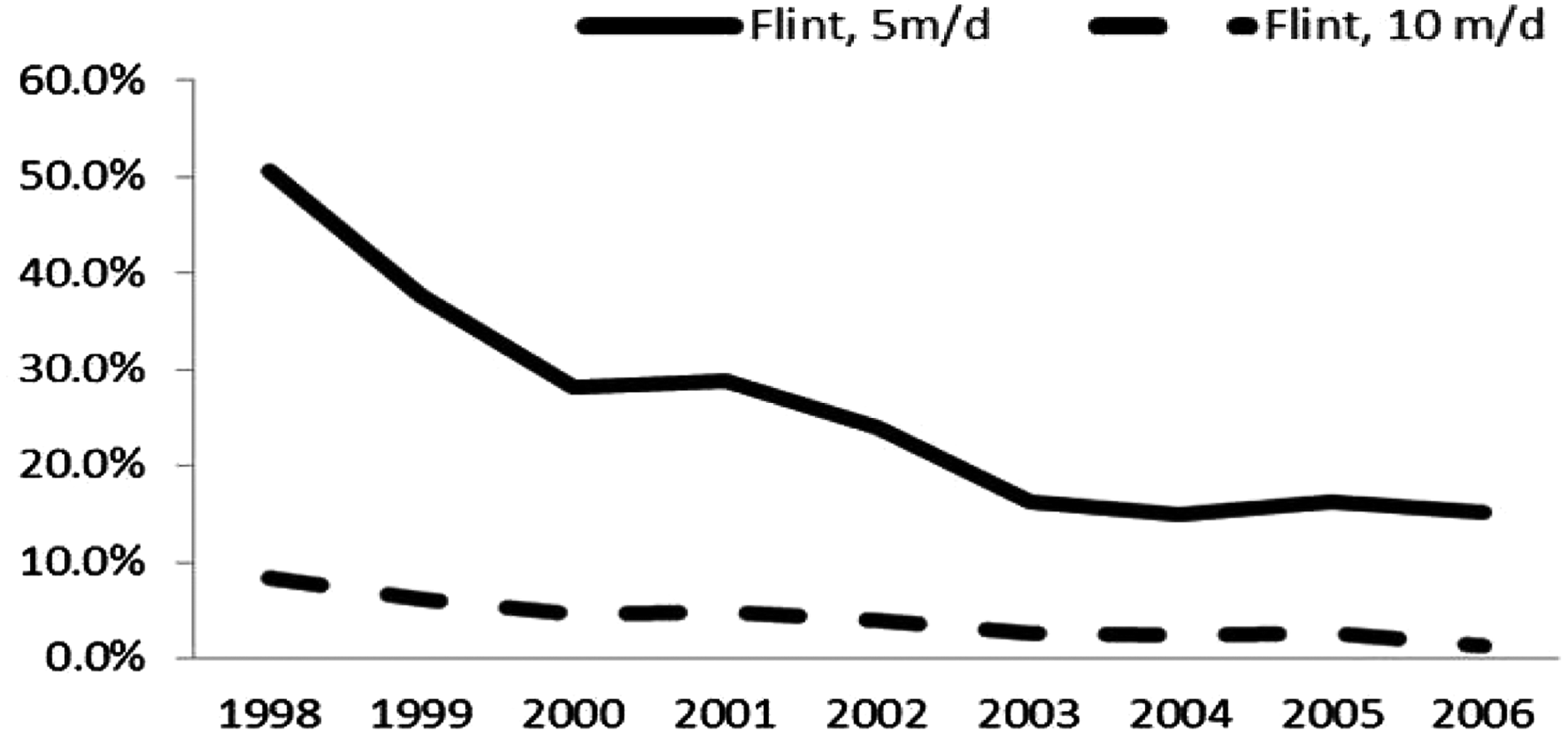
Elevated blood lead levels among City of Flint children, age 6 and under, 1998–2006.
Blood lead level trend data further illustrate that the percentage of the City of Flint children with blood lead levels at 5 m/d continued to decrease between 2007 and 2015. At the same time, Figure 2 shows that the current explanations for the water crisis in Flint may be too narrow. Although the Flint water crisis has prompted people to focus on shifts in the blood lead levels between 2014 and 2015, Figure 2 illustrates that the blood lead levels among children under age 6 within the City of Flint and Genesee county have been steadily increasing since 2013, 1 year before the city's water source switch. The percentage of children within Genesee county with 5 m/d blood lead levels increased from 2% to 4% between 2013 and 2015, whereas the percentage of children under age 6 in Flint increased from 4% to 6% during this time.

Blood lead levels above 5 m/d among Flint and Genesee county children, age 6 and under, 2007–2015.
One factor that might have contributed to the steady increase in elevated blood levels among children in Flint since 2013 is the condition of the distribution system and the aggressiveness of the water. Previous research has established that lead and copper enter drinking water through the leaching of plumbing materials and the lead in water. The difficulty in predicting the leaching of plumbing materials in drinking water and in devising strategies to eliminate these metals from drinking water is also well established in the literature. The corrosion potential or aggressiveness of drinking water plays a key role in water distribution systems, especially in considering how heavy metals impact consumer health. Highly corroded water has been documented to be a significant contributor to the leaching of metals from plumbing materials in drinking water, as measured by the Langelier 18 and the aggressive indices (AI). Although efforts continue to be made to improve attempts to control and eliminate lead in drinking water, researchers agree that corrosive water, as measured by the aggressive index, tends to include significantly high amounts of lead and copper than noncorrosive water.
The AI is an industry-accepted corrosion measure that takes into account the pH, calcium hardness, and total alkalinity of a water sample. The AI is calculated with the following formula: AI = pH + log [(total alkalinity) × (calcium hardness)]. The corrosion potential of water is defined as highly aggressive when the AI is greater than 10, moderately aggressive when the AI is between 10.0 and 11.9, and nonaggressive when the AI is 12 or greater. It has been established in the literature that moderately aggressive water contributes to the softening of pipes and shortens the lifespan of the water distribution system.
The Michigan Department of Environmental Quality (DEQ) water survey documents illustrate Flint's need to make transmission/distribution improvements since 2009. In an April 2013 water system distribution survey, DEQ identified deficiencies in Flint's distribution system, especially on the city's westside, where there was a high concentration of elevated lead in the drinking water discovered. 19 In the 2013 water survey of the City of Flint's Water distribution system, DEQ notes that main breaks occur in many areas of the city; however, the most frequent breaks occurred in areas within the distribution identified as needing improvement. As the DEQ notes, “our main concern with Flint's water system continues to be the condition of the piping. Although the city has replaced approximately 12 miles of watermain over the past ten years, much of the remaining piping is over 60 years old and in need of replacement. Also, this rate of watermain replacement (1.2 miles per year-average) results in a total replacement rate of over 400 years. The typical water distribution replacement rate needs to be 100 years or less.”
Chemical analyses of the City of Flint water demonstrate that water main problems might have been motivated by the aggressive nature of the water, which would have shortened the lifespan of the piping. The data in Table 1, which documents chemical analyses of the City of Flint water between 2009 and 2015, illustrate that the City of Flint water was classified as moderately corrosive both before and after the source switch in 2014. In fact, the water in Flint was more aggressive in 2009 (11.14), as measured by the AI, than it was in 2015 (11.32).
Sources: Test Run of Operation Report, Flint Water Plant & Facilities, October 2012, 4–5.
City of Flint, “Plant Operation report.” September 2009.
City of Fenton, “Water System Sanitary Survey.” May 2015, 9.
City of Fenton, “Water System Sanitary Survey.” Appendix. April 24, 2012, 3.
“City of Flint Water Treatment Plant Monthly Operation Report.” Page 5
DWSD 2014 Water Quality Report.
Available from
Although the water in Flint has been moderately corrosive for some time, chemical analyses of water in suburban Genesee cities, such as Fenton, show a different pattern. As can be seen in Table 2, which documents key chemical properties of the City of Fenton water in April 2012 and September 2015, the water in Fenton has been persistently nonaggressive, as measured by the AI. The AI in 2012 and 2015 were 12.65 and 12.72, respectively.
Source: City of Fenton, “Water System Sanitary Survey.” May 2015, 9.
City of Fenton, “Water System Sanitary Survey.” Appendix. April 24, 2012, 3.
In addition to the moderately corrosive nature of the water in Flint, it is likely that lead contamination among children in Flint also derived from the conditions of environments that children frequent, such as schools. Data from recent LCR compliance testing within Flint Community School facilities illustrate a need to expand our attention to other sources of lead contamination in the community. Table 3 documents the percentage of taps within Flint Community School facilities with lead levels over 15 pbb by school between late 2015 and January 2016. Lead and Cooper testing illustrates that many of the taps, including drinking water faucets, classroom sinks, and kitchen faucets, within Flint Community contained lead-contaminated drinking water. Although 2% of the taps within Michigan School for the Deaf & Learning Resource Center contained water above the actionable level for lead, a significant percentage of the taps within the other Flint Community School facilities contained lead-contaminated drinking water. For instance, the percentages of taps contaminated in the elementary schools, Brownell, Doyle/Ryder, and Pierce Elementary Schools, were 53%, 40%, and 74%, respectively. Taps within the city's high schools were also high.
Sources: Brownell Stem Academy: Outlet Sampling and Plumbing Assessment Recommendations.
Doyle/Ryder Elementary School: Outlet Sampling and Plumbing Assessment Recommendations.
Durant Tuuri Moot Elementary: Fixture Sampling & Plumbing Assessment Results.
Eagles Nest Academy. Fixture Sampling & Plumbing Assessment Results.
Eisenhower Elementary School: Outlet Sampling and Plumbing Assessment Recommendations.
Flint Schools Central Kitchen: Fixture Sampling & Plumbing Assessment Results.
Freeman Elementary School: Outlet Sampling and Plumbing Assessment Recommendations.
Holmes STEM: Outlet Sampling and Plumbing Assessment Recommendations.
Manley School: Fixture Sampling & Plumbing Assessment Results.
Mchigan School for the Deaf & Learning Resource Center: Fixture Sampling & Plumbing Assessment Results.
Neithercut Elementary School: Fixture Sampling & Plumbing Assessment Results.
Northwestern High School: Fixture Sampling & Plumbing Assessment Results.
Pierce Elementary School: Outlet Sampling and Plumbing Assessment Recommendations.
Potter Elementary School: Outlet Sampling and Plumbing Assessment Recommendations.
Southwestern Classical Academy: Fixture Sampling & Plumbing Assessment Results.
Table 3 also displays the percentage of taps with actionable lead levels within each Flint Community School facility by the sampling method, which includes the first draw that does not involve preflushing as well as the third and fourth draws that include preflushing for 30 seconds and 2 minutes. By comparing these methods, it is clear from the data in Table 3 that detected lead levels are extremely sensitive to sampling procedures. With the exception of Flint Northwestern High School, the detectable amount of lead in the drinking water declined significantly within the remaining Flint Community Schools facilities after a 30 second preflushing and was not detectable after a 2 minute preflushing. Although flushing is a temporary method to reduce the amount of lead consumed, it is unlikely that students will flush the foundation before using it. Therefore, each facility's report included many references to replacing the plumbing within impacted faucets with lead-free materials. Since more than half of the taps that did not have lead-contaminated water contained similar plumbing materials as the taps in which actionable lead levels were detected, inspection teams also urged Flint Community Schools to replace the plumbing within nearly all of the taps in its facilities.
Discussion and Conclusion
Implications of Flint's moderately corrosive water before and after the source switch
The findings in this article support the conclusion that Flint's struggle to control the corrosive nature of its water has been a longstanding issue. Although the decision not to engage in corrosion control in Flint after April 2014 complicated matters, it is important to note that the aggressive nature of the water over time might have increased the risk of lead contamination from drinking water, when citizens were of the assumption that the water was safe to consume. Given that there was only a slight change in the corrosivity of the water both before and after the switch, it appears as though the city's deteriorated water pipes and water mains are as much to blame for the elevated blood lead levels observed among children as the switch to the Flint River. The switch to the Flint River certainly ignited a rallying cry that inspired social action around drinking water equity issues; however, the corrosive nature of the Flint water has been a silent threat to public safety and must remain a significant focus on the rebuilding efforts in Flint.
Implications of school plumbing conditions and preflushing
The conditions within schools and the practice of preflushing also have the capacity to increase children's exposure to lead contamination. Although efforts have been made to be more sensitive to lead-contaminated water in schools over the years, in the case of Flint, Michigan, less efforts have been made to remove the hazards, namely lead-based plumbing materials, that contribute to this problem within schools. Furthermore, from test results within Flint Community Schools, we learned that public water systems are enlisting their water customers’ help in momentarily reducing lead levels in drinking water by asking water customers to preflush before collecting water test samples. This action could have devastating consequences, especially within communities and schools such as those in Flint who have been delayed in acknowledging and removing known hazards.
The findings from this article suggest that efforts to address the lead contamination problem in Flint should not cease until a more thorough attempt to root out of the sources of lead contamination in this community emerges. The poisoning of Flint's children did not happen overnight. Nor did the mistreatment of this community begin when public officials in Michigan chose to play Russian Roulette with the lives of Flint water customers by changing the water source in April 2014 and failing to implement the necessary measures to protect water customers from toxins in the drinking water. The aggressiveness of the water and the conditions of the plumbing within Flint Community School buildings suggest that the children of Flint have been at risk for lead contamination for years. As such, the water problem in Flint will not be solved without substantial local, state, and federal collaboration. It is also clear that systemic change in Flint and similarly situated cities requires substantial shifts in how public water systems are managed.