




Abstract
Abstract
Energy supply is a necessary condition for economic and human development, and hence its expansion especially for those who still do not have secure access to it is an important development goal. However, severe environmental injustices exist along the energy supply chain worldwide, and these injustices have not been tackled yet in a satisfying manner. The general increase of energy supply is frequently used as an argument to justify such injustices. The hegemonic discourse of sustainability, largely focused on intergenerational and often overlooking intragenerational justice, has not incorporated this issue so far, nor has energy become a major concern of the environmental justice (EJ) community yet. This article aims at contributing to closing this gap by suggesting a qualitative method based on EJ protocols to systematically evaluate EJ in energy projects. It builds on the concept of energy justice and develops a framework to apply EJ to energy projects in practice. Furthermore, the relationship between EJ and sustainability is being discussed and relevant points for further research are proposed.
Introduction: Energy, Development, and Environmental Justice
T
However, if the access to energy is evidently a necessary condition for development, it can also not be neglected that energy production is a major source of environmental degradation and injustice. Torres and Marques (2001) argued that the use of average values as indicators for development obscures existing inequalities, 2 and hence an increase in the average HDI of a country—supported or induced by enhanced energy supply—does not reflect the inequalities in the share of benefits and burdens along the energy supply chain. Affected populations, indigenous peoples, traditional communities, local small-scale farmers, social movements, environmental organizations, and also in some cases worker trade unions have opposed and struggled against energy projects of various scales and sources in many different countries. 3 Sevá Filho (2013) summarized the large socioenvironmental impacts and their unequal distribution of energy production in Brazil: large scale sugar cane monoculture for ethanol production drives farmers of their lands and exploits workers under precarious conditions; coal mining has polluted soil, subsoil, and water resources; oil and gas extraction and processing have caused water and atmospheric pollution, high water use, and hazardous accidents; and hydropower plants have dislocated hundreds of thousands of people and led to irreversible interruptions in the ecology of the rivers and impacts on populations depending on related ecosystem services. 4 He argues: “The spoliation which suffer these Brazilians, not only the local groups, but the whole working and contributing population, is the continuation of colonialism which defined us centuries ago, and it is the same spoliation cycle which punishes our neighbors in South and Central America.”
Hence, energy supply especially for the world's poor must be enhanced, but its environmental justice (EJ) performance must also improve. During the past three decades, EJ has become a research focus in different fields, including the siting of toxic landfills and other “locally unwanted land uses”, 5 water governance 6 and policy, 7 mining,8,9,10 and climate change. 11 The concept of “energy justice” emerged in recent years 12 ; however, it has not been widely adopted as an EJ issue yet. 13 According to Fuller and McCauley (2016), the concept of energy justice includes access to affordable energy, fuel poverty, and politics of energy infrastructures. 14 The present work is a contribution to the latter. Whereas several methods to assess EJ in an urban context have been developed, 15 no methods to assess EJ in energy infrastructures exist. The purpose of this article is to contribute to closing this gap and propose a methodology how EJ can be systematically approached in energy projects. It builds on a case study on the hydropower project São Luiz do Tapajós in the Brazilian Amazon. The case study provided a systematic analysis of the proposed project's EJ performance based on document analysis and semistructured qualitative interviews with stakeholder representatives. A detailed outline of the study's methodology and findings can be found in Hess et al. (2016). 16
This article extends the developed methodology and suggests its application on energy projects in general through Environmental Justice Protocols (EJPs), thereby offering an approach on how the concept of energy justice can be applied in practice.
EJ and its Application to Energy Projects
An environmental just distribution of benefits and burdens is achieved when no group of people, including ethnical, racial, and social groups, bears a disproportionate burden of negative environmental consequences from economic activity or because of the execution as well as the absence of public policies. 17
Historically, this distributional dimension has been at the center of EJ. Schlosberg (2007) calls attention, however, that struggles against environmental injustices include other aspects that cannot be fully captured by the distributional approach and suggests considering distribution, recognition, procedure, and community capabilities. 18 Recognition refers to the right of social, ethnical, racial, gender, and other groups (and also individuals) to be recognized by the state, authorities, companies, or the society in general. It also includes the recognition of traditional cultures and local forms of knowledge. Procedural justice refers to the way how projects are implemented, including decision-making and participation processes. Yet, community capabilities is the most complex dimension of EJ suggested by Schlosberg. The capabilities approach (CA) was developed by Sen and Nussbaum as a critic on the one-sided understanding of development as income growth.19,20 Its central elements are functionings and capabilities, and “the central measure of justice is not just how much we have, but whether we have what is necessary to enable a more fully functioning life, as we choose to live it.” 21
Schlosberg suggests the CA as an additional dimension of EJ, although arguing that it includes aspects of distribution, recognition, and procedure, but also goes beyond: “So rather than examine recognition, distribution, and process as three different conceptions of justice, Sen and Nussbaum understand all of these as necessary components of a more broad set of factors necessary for our lives to function.” 22
Marjoribanks (2010) observes that Sen's understanding of justice is comparative, that is, his concern is focused on “real-world choices to improve human lives.” 23 Applying the CA in this understanding on energy projects, it can be argued that their aim is the enhancement of the overall capabilities, avoiding the reduction of capabilities of any category of people involved along the supply chain. Community capabilities are, hence, the framework of EJ in this interpretation, including the interrelated dimensions distribution, recognition, procedure, and other aspects. This relationship is illustrated in Figure 1. Table 1 summarizes the content of each dimension and provides examples of environmental injustices in energy production.24,25,26,27,28
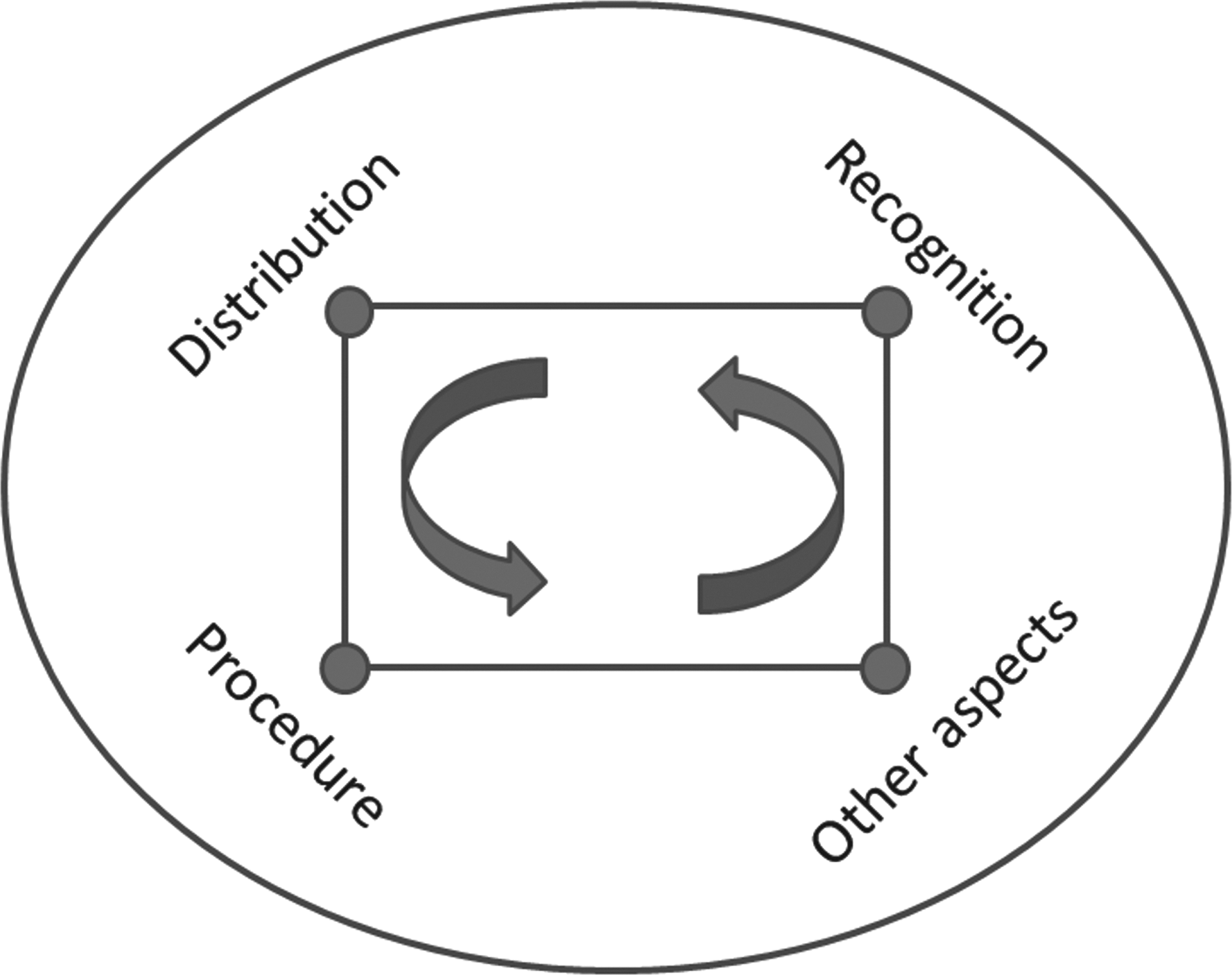
Interrelated elements of environmental justice within the framework of community capabilities (created by Hess et al. 2016).
Toward EJ in Energy Production
Having established this framework of EJ in energy projects, relevant aspects for each justice dimension were developed, resulting in a model of an EJP, which is given in Table 2.
IEIA, Integrated Environmental Impacts Assessment.
To evaluate the EJ performance of an energy project, its performance in each dimension—or, in part, aspects of each dimension—can be evaluated by considering the relevant aspects. If a given project shows a poor performance in one or more dimensions, and no improvements can be implemented, the project fails to meet EJ.
The presented model was developed from a case study on a large hydropower project, 29 and its suitability regarding other energy projects has to be examined in further research. Also, the relevant aspects are evidently site, country, and region specific and have to be adapted to particular circumstances. Furthermore, it is worth looking at some criticism of the suitability of the CA applied to environmental problems. Binder and Witt (2012) criticize that the CA lacks any dynamic connotation and that hence no consideration is given to a possible change of functionings and capabilities over time. 30 This criticism is relevant in the scope of energy projects, considering that energy supply is a powerful trigger of such change. The functionings, capabilities, and also needs of communities evolve with energy supply and economic development. Binder and Witt also add the difficulties in establishing objective criteria for evaluating community capabilities: “Since the capability approach does not explain how valuations of functionings come about and change, what is taking place in its empirical applications is usually a more or less arbitrary ad hoc specification of the underlying value judgements.” 31
Therefore, the inclusion of the dynamic behavior of capabilities in the interaction with energy supply and the establishment of qualitative and/or quantitative criteria for the evaluation of the performance within the suggested EJ dimensions are two crucial challenges for further development of the suggested method. The objective of this research is to establish EJPs as suitable instruments to systematically assess EJ in energy projects.
EJ and Sustainability
In recent years, several articles discussing the suitability of the CA in the realm of sustainability were published. Thus it seems necessary to discuss the relationship between EJ and sustainability, too. Sustainability has become a polemic topic in recent years, and since the Brundtland report, many definitions and discussions on it were produced by several authors.32,33,34,35,36,37,38,39 In the scope of this article, we cannot resume this entire debate, but it is useful to remind some of its central aspects.
The modern world economy is marked by an unrestrained chase for the production of goods and commodities, leading to elevated energy consumption. In this context, a central idea of sustainability is the concern for the material reproduction of human life, which in the—currently hegemonic—capitalist production regime is presupposed as continuously expanding. It is, however, well known that natural processes are exhaustible—hence the necessity to seek alternative materials. Under the assumption of maintaining the hegemonic production system, sustainability can be understood in this way. Moreover, the transformation of natural materials into, for the society, useable goods demands energy. Therefore, energy reproduction also becomes central, leading to the necessity of seeking renewable energy sources.
However, environmental injustices have also been reported in energy projects classified as alternative,40,41 which confirms the necessity to develop an EJ focus in this area. Given that energy projects expand rapidly and threaten traditional peoples and communities, the preparation of these populations to confront such challenges becomes extremely relevant.
The relationship between sustainability and the CA is far from obvious. On the contrary, Crabtree (2013) argues that capabilities can be enhanced at the expense of the environment. This is certainly underlined by the fact that the countries with very high HDI have largely been responsible for environmental degradation. 42 In the same way, an environmental just solution, as defined in EJ and its Application to Energy Projects section, could in principle be achieved by increasing the pressure on the environment. Martínez Alier makes this point when arguing that resolving an environmental conflict (mostly caused by environmental injustice) does not imply resolving the underlying environmental problem. 43 However, the EJ principles from the First National People of Color Environmental Leadership Summit include sustainability explicitly in principle 3 and implicitly in principles 1 and 12, which shows that the topic has been of concern to the EJ community, and Schlosberg and Collins (2014) argue that sustainability was part of the EJ movement's idea from the beginning. 44
We argue that the adoption of EJ in energy planning would be a strong trigger for sustainable solutions, because (1) solutions that meet the necessities of one or several groups at expense of others would be no option anymore (neither on a national nor on an international scale); (2) EJ would pose a big pressure on energy planners to privilege solutions with overall low socioenvironmental impacts, as these are most likely to meet the principles of EJ in a satisfying manner, and include local and regional necessities in the planning; and (3) EJ would put a pressure on energy projects to include all externalities, turning renewable and alternative sources with low externality costs more competitive.
Conclusions
The interrelationship between energy supply and development is evident and has been proved by research. Therefore, the provision of safe energy supply for those who still do not have secure access to it—for domestic, economic, and public activity—is an important development goal. In recent decades, sustainability has become a central concern in energy planning. However, this is not the case for EJ. Severe environmental injustices exist throughout the energy supply chain across the world, and the official sustainability discourse does not tackle this problem in a satisfying manner—if at all. This article argues that this gap must be filled, because there is no justification why intergenerational justice (the focus of the hegemonic sustainability debate) should be more important than intragenerational justice.
To approach this task, a methodology to systematically assess the EJ performance of energy projects is suggested, building on the CA as its framework. In doing so, this article represents a starting point rather than a result. As argued in Toward EJ in Energy Production section, the suggested EJP is a model that must be tested, improved, and enhanced in further research. Some of the relevant research points in this respect—such as the application of the protocol to different energy projects, the inclusion of the dynamic behavior of capabilities, and the development of robust assessment criteria—were already outlined. The debate on this topic has just begun.
Footnotes
Acknowledgments
We would like to thank the anonymous reviewers for their extremely valuable comments to this article.
Author Disclosure Statement
No competing financial interests exist.