




Abstract
Abstract
Environmental health awareness programs play an important role in educating people to understand the environmental health conditions of one's working and/or living environment. Even though different environmental health awareness approaches have been conducted among communities for the past decades, the environmental health conditions in developing countries are still worrying. The objective of this study was to assess and understand the environmental health awareness among local and foreign blue-collar workers in Kuala Lumpur, Malaysia. The study recruited 60 foreign immigrants and 60 local blue-collar workers through simple random sampling around Kuala Lumpur. A face-to-face interview was conducted by using a validated questionnaire. Results showed that there were significant differences of environmental health awareness levels among local and foreign blue-collar workers (p < 0.05), except occupational safety and health. The blue-collar workers who live in areas where there are high concentrations of poverty are likely to encounter multiple stressors, including noxious odors, emissions from local industries, illegal dumping, occupational hazards, financial stress, and concerns about crime and safety. This study highlighted the necessity of customizing environmental health awareness by considering differences in background, which may help to enhance the environmental health's perception, practices, and knowledge among the blue-collar populations in this country.
Introduction
E
Today, there is an increasing trend of heavy in-migration because of the promising job opportunities in Kuala Lumpur, which is known as one of the most densely populated metropolitan cities in the world. Between the year 1991 and 2000, the population of this city increased from about 3.2 to 5 million. Heavy concentrations of people from the rural villages, however, have led to many socioeconomic and health problems, which has exacerbated the strain on existing social amenities and infrastructures. 2 In addition, the phenomena of ex-migration to Kuala Lumpur have exacerbated the situation such that the ratio of foreign immigrants to local community is 1:11. 3 In the year 2000 alone, Kuala Lumpur received 42,000 foreign laborers to fill the needs of construction, plantation, manufacturing, and services industry.
In most developing countries such as Kuala Lumpur, environmental health awareness is one of the crucial components that need to be achieved to ensure a sustainable environment in the region. However, past studies suggested that the individual's awareness level and concern for environmental hazards are lacking in this decade. 4 In view of this, it was recommended that citizenship behaviors shall consider the self-responsibility to increase the environmental health awareness among its community. 5 This issue has been highlighted in the Tenth Malaysia Plan report, which aims to fill the wide gap between community health-related knowledge and behaviors. The unsolved environmental health, safety, hygiene, and sanitation problem has minimized the community's coping capacity and reduced the sense of ownership of their health conditions.
For decades, the overall responsibilities for public health have been within the community health section under the Ministry of Health and with public health practitioners. Even though policy makers and scientists have made great efforts in promoting environmental health, threats still exist. As shown in Figure 1, to combat this problem, we need a resilient community that can respond as an environmentally sensitive community. 6 One's knowledge, perception, and attitude are fundamental in determining how one behaves toward environmental health hazards. Past studies also suggested that one of the best ways of preserving the environment is through education to create awareness in the society.7,8 At the same time, the most effective measure to improve communities' coping strategies, adaptation measures, and their sense of belonging is to improve their awareness level to continuously secure them a safe and healthy environment. 9
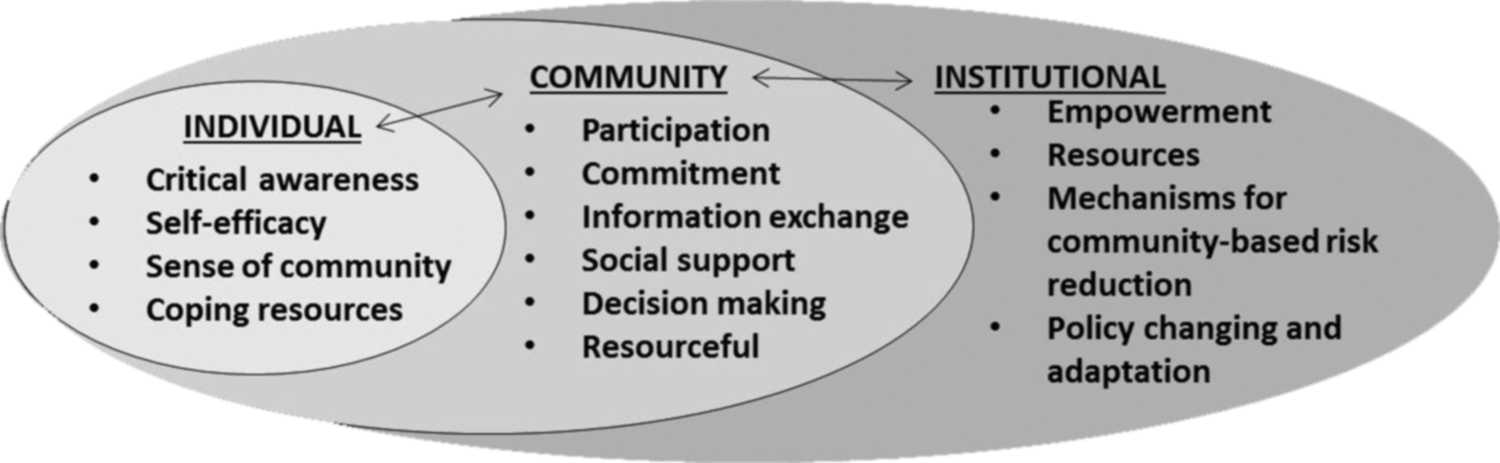
Framework of Resilient Communities through Sustainable development. Adapted from Paton and Johnston. 9
Cultivating environmental health awareness by initiating from the individual levels will help to enhance sustainable development among the community as a whole. 10 With the ultimate aim of shifting current public health practices from disease diagnosis to increasing the health awareness of prevention and coping capabilities, the purpose of this pilot study is to assess and understand the trend of environmental health awareness among local and foreign blue-collar workers in Kuala Lumpur, Malaysia.
Methodology
This is a cross-sectional pilot study conducted from February to April 2016 at Kuala Lumpur Metropolitan city, which is currently a home to about 7.2 million people or more than a fifth of Malaysia's total population. This conurbation city is the heartland of Malaysia's main construction, services, and manufacturing industry. Malaysia is known as the home to numerous migrants from other states within Malaysia as well as foreign laborers largely from the neighboring Southeast Asia countries. Local blue-collar workers can be defined as those who work as laborers on a small scale of workforce to support the manpower needs. Foreign blue-collar workers are those who migrated from their own country to another country for job seeking purposes to supplement the workforce of the country for a limited term or to provide skills on a contractual basis that the country seeks.
A total of 60 local and 60 foreign blue collars participated in this study. The recruitment was conducted during the local workshop for employees' training and development that was held at the national capital and most populous global city of Malaysia (Kuala Lumpur). Workers who participate at the stated workshop were recruited randomly after consent of participation was asked and has at least 1 year of working experience at Kuala Lumpur and had lived in the city for at least 1 year. The demographic characteristics of the study population were examined to determine the background, such as age, how long he/she has been living in Kuala Lumpur, level of education, and number of residents living in the house.
A face-to-face interview was performed by using the questionnaire adapted from a validated Comprehensive Environmental Health Checklist. 11 Table 1 provides the checklist used in this study. There were 10 elements checked according to the environmental health awareness form, such as (1) odor and air pollution; (2) water quality; (3) sanitation; (4) occupational safety; (5) household hazards and safety; (6) natural hazards; (7) neighborhood safety hazards; (8) industrial hazards; (9) river and irrigation canals; (10) roads and highways, railroads and walkways. A Likert scale of “1” (Not at all aware), “2” (Slightly aware), “3” (Moderately aware), “4” (Very aware), and “5” (Extremely aware) was measured based on the individual's perception to particular environmental health conditions. To quantify the awareness level into scores, the total marks of each of this survey items were summed up according to different subject groups.
Source: Adapted and modified from Comprehensive Environmental Health Checklist. 11
Validity and reliability of instrument
A group of research assistants were trained particularly to conduct survey questionnaire among the study population. This is to minimize the occurrence of interobserver variability during a face-to-face interview. Respondents were interviewed by these trained research assistants to ensure the validity of the questionnaire alongside with content and its criterion validity. As such, the contents of the question items were asked to ensure that they match the actual situation that is being studied, and the ability to predict a hypothesized outcome. Following the pretesting assessment, questionnaire items (variables) are selected to test for their test–retest reliability after a 1-week interval and internal consistency by using intraclass correlation coefficient and Cohen's kappa coefficient. Each item revealed the reliability of 0.70 and above.
Statistical analysis
The data were analyzed using SPSS® for Windows® version 22. Univariate analysis was performed to summarize the descriptive demographic information of the study population. The Mann–Whitney U test was carried out to compare the difference of the level of environmental health awareness between local and foreign blue collars. A p < 0.05 was considered statistically significant.
Result
The subjects in this study were blue-collar workers who were mainly involved in manual work or labor. As tabulated in Table 2, the result showed that most of the local workers (77%) and foreign workers (58%) were in the age range from 20 to 29 years. Majority of them have stayed in Kuala Lumpur for more than 10 years. Besides, most of the blue collars reported to earn MYR 1000–3000 per month. The average education level of local and foreign workers is senior high school level. Both the local and foreign workers reported to have at least four to seven residents living in sharing concept houses. Most of the local and foreign workers claimed that it is unlikely to develop health-related symptoms due to the living environment; conversely, the health-related symptoms are more likely to develop when they are based in their working environment. Anyhow, less than 50 percent of local and foreign workers claimed that they have had the chances to attend environmental health-related training and/or seminar.
Next is to examine and compare the level of environmental health awareness among local and foreign blue-collar workers. As shown in Table 3, the comparison was analyzed using the Mann–Whitney U test. The result shows that local blue-collar workers showed a significant increased awareness level toward environmental health (p < 0.05) except that there is no significant difference in their awareness toward occupational safety (p = 0.327) among the study population. Overall, the environmental health awareness levels of both local and foreign workers show remarkable difference.
p-value is significant at 0.05 levels.
Discussion
The purpose of examining environmental health conditions among local and foreign blue-collar workers is due to the fact that they are the frontline community who are at high risk of environmental health and safety hazards from their living and work environment. Therefore, the current pilot study was performed on an exploratory basis to assess the awareness level among the study population. Results showed that there were significant differences of environmental health awareness level among local and foreign blue collars (p < 0.05), except occupational safety and health. The blue collar workers who live in areas where there are high concentrations of poverty are more likely to encounter multiple stressors, including noxious odors, emissions from local industries, illegal dumping, occupational hazards, financial stress, and concerns about crime and safety.
Local and foreign blue-collar workers
The determinants of environmental awareness among people in every country are varied; the evidence showed that the environmental awareness and ecological behaviors can be influenced by different factors. 12 In this study, both the local and foreign blue-collars workers in Kuala Lumpur were surveyed. Based on their sociodemographic background, both groups hold the educational background up to high school level. Even though both groups hold the same educational level, most of the foreign blue collars register as unskilled laborers (grocery clerks, hotel maids, and general cleaners and sweepers); conversely, local blue collars choose to work as skilled laborers (electricians, technicians, financial technicians, and administrative assistants). Distinct from developed countries, the demand for labor forces plays an important role as an economy development factor in the developing countries with transforming economy. On the basis of such adaptation, most developing countries in Southeast Asia face the challenges of promoting the growth of skilled laborers, at the same time, demanding unskilled laborers to maintain the country's production output. This labor division impacts have aggravated our social contradictions in many aspects. Environmental health protection is one of the core elements to be discussed in this context.
Past studies highlighted that one's knowledge of environmental health risks is the key factor in determining an individual's self-coping capacity, which he or she perceives toward environmental health hazards. 4 Nevertheless, the community's awareness toward environmental health examined in this study showed that most of the foreign blue collars indicated a significant reduced awareness level of environmental health compared to local blue collars. This alarming trend could be a direct result from the lack of understanding toward environmental health risks, and as Cureton (2011) 13 pointed out, knowledge is directly related to specific behaviors.
According to the Labor Force Survey Report, 3 foreign workers are more devoted to their job than local blue-collar workers; they are more favored by the local employer even with the lower wages. Since the main purpose of foreign workers is to gain sufficient income, which is difficult for them to seek in their home country, they can bear the unfavorable terms and conditions of employment. 14
Studies found that minority communities recorded face disproportionate exposure to environmental hazards. 15 This is consistent with the results found in this study as most of the foreign blue-collar workers are likely to live and work in an unsafe and unhygienic environment. People who live in poverty with constraints such as financial conditions have limited options of picking and choosing where they want to live. During a face-to-face interview, a study found that foreign workers tend to live with an undesirable environment's health condition, such as heavily polluting industries, hazardous waste sites, contaminated water and soil, in older or shared housing with deteriorating lead-based paint, adjacent to major roadways where hazardous chemicals are transported in areas with limited access to healthy food, and more.
Environmental health disparities
For decades, environmental health disparities and injustice are a public health issue and a human rights crisis. 13 In Kuala Lumpur, due to limited land supply, many residential areas are situated in close proximity to industrial premises and heavily trafficked areas, with an increase of proliferation of slums and squatters mostly by the foreign workers. The environmental health problem in this city is mostly attributed by atmospheric pollution, water pollution, climate change, ozone depletion, and solid waste management, as well as toxic, chemical, and hazardous waste management. 16
Sanitation, household hazards, and safety
The result of this pilot study highlighted that most of the foreign workers live in a shared house without a safe source of water and food. Their household has poor disposal of waste at communal collection containers. Instead, the household wastes are discovered on the drain's surface, and open spaces in the vicinity of their living environment. The inadequate solid waste practices and facilities can result in indiscriminate and unsanitary environments. 17 This explained the reason of why foreign workers have relatively low sanitation awareness compared to the local workers. As suggested by a past study, 18 most of the megacities in the developing countries have not considered an adaptable or an affordable system to provide services to informal settlements in metropolitan areas. In addition, due to financial constraints or commitment of supporting their own family in their home country, most of these foreign laborers prefer to live in dormitories built in partnership, which may be in old factories or other converted industrial spaces, or in walkup apartments, shop-houses, or construction sites. These living environments are often cramped and overcrowded—and are “slum-like” in the middle of this megacity.
Road (highways, railroads and walkways) safety
Recent economic growth in Malaysia has resulted in a significant increase in the volume of road traffic in most cities in the country. The current study found out that most of the local and foreign blue-collar workers reported that they live near to roadways with moderate to heavy traffic volume at Kuala Lumpur town. To be able to travel quickly within a city, the current study showed that the local workers have opted for motorcycles or private car as their means of transportation, compared to the foreign workers who remained to take buses and trains as the primary mode of mass transit in the city. In other words, local workers remained as the main road users who are directly exposed to the road hazards compared to foreign workers, making them to have the passive awareness of road safety rules and regulations. In fact, a past study also suggested that the ever increasing growth of vehicular traffic due to population explosion has resulted in severe traffic problems on roads. 19 This includes road accidents, pavement conditions, lack of crosswalk and sidewalk, and so on.
Air quality and odors
The outdoor air quality of residential premises is directly influenced by nearby industrial activities and traffic conditions. 20 Vehicular emission is one of the factors that contribute to the outdoor air pollution. 21 In this study, most of the respondents claimed that they are living in the vicinity of the high-rise buildings surrounding the narrow traffic roads with heavy traffic conditions. The air pollutants emitted by vehicular exhausts are not easily dispersed inside the highly populated areas and are readily accumulated to levels that can pose adverse health effects to people living or working there. 22
Indoor air quality is another major global public health threat requiring greatly increased efforts around 50% of people in developing countries. 23 This is by considering the fact that there is a close interrelationship between unfavorable living environment, for example, polluting fuels, cigarette smoke, and socioeconomic development. 23 Studies showed that less frequency of household cleaning and inadequate ventilation occurring in their crowded living environments may increase the indoor air quality conditions and odors. 21 The findings of past studies are consistent with the result of this study, which showed that most of the local workers who live with less than three residents are more aware of the indoor air quality, sewage odors, smoke, and other problems than foreign workers with their shared home concepts who have more than three residents staying in the considerably crowded living environment.
Water quality
Malaysia has abundant water resources and adequate rainfall and yet the nation has water shortage and water quality problems. Various measures have been taken by the government to address water issues, but despite these measures, the quantity and quality of drinking water are still one of the main concerns of Malaysian consumers today. 24 The current study showed that local workers are more aware than foreign workers of the water quality pertaining to health issues. This may be due to the fact that domestic sewage discharge from a poor living environment among foreign workers' residential housing has led to more problems in water quality due to its typically large volume and high amounts of organic discharge and other contaminants, such as oil, metals, and pesticides. In addition, a diverse range of organic compounds carried to water sources as the consequence of human activities can be persistent in the environment and be transported long distance, affecting the regions in which they were never produced. 25
Occupational safety and health
Workplace environmental hazards or occupational hazards are global major cause of disabilities and mortality among the working population. The current study showed that there is no significant difference of occupational safety and health-related awareness between two study populations. This may be due to the fact that there is a high prevalence of occupational injuries among workers in the construction, manufacturing, and agricultural sectors. 26 In addition, even though some industries have evolved high-technology approaches to minimize workers' exposure to work-related safety and health issues, empirical evidence still shows that workers in the developing countries still seem to be at high developing occupational hazards. 27
Neighborhood safety
Past studies showed that neighborhoods with higher concentrations of poverty may experience increased exposure to stresses that are detrimental to health, for example, violet crime, financial insecurity, and unfair treatment such as discrimination, even as they experience reduced access to resources that may promote health behaviors. 28 The current study showed that local workers are more aware of the increase of neighborhood safety compared to foreign workers. During the interview, the local workers claim that the declination of neighborhood safety, such as violence, crime, vandalism is due to the influx of foreign workers to the metropolitan areas from the past years.
Natural hazards
The rapid urbanization process in many developing countries has exacerbated the process of environmental degradation and contributed to disasters such as flood. Kuala Lumpur is facing the same problem due to urbanization with a build-up of impermeable surface areas for residential, commercial, and industrial purposes. Nevertheless, Malaysians are still unaware of the existing warning system that the government currently applies nationwide. 29 The result in this study is consistent with a past study which proposed that the poor, marginalized, and vulnerable urban communities are often involved in impended risk communication when responding to natural disaster hazards. 30 Therefore, the vulnerability of the foreign workers having poor response to the hazards due to their limited opportunity for knowledge and resources is high.
Conclusion and Recommendation
The development of environmental health awareness is a key element in the formation of fundamental solutions for environmental problems that are blocking sustainability. It is concluded that blue-collar residents who live in areas in which there are high concentrations of poverty are likely to encounter multiple stressors, including noxious odors, emissions from local industries, illegal dumping, occupational hazards, financial stress, and concerns about crime and safety.
Therefore, public awareness through educational programs is very important and an essential step toward sustainable developments.31,32 The health promotion campaigns are urged to be able to attend to the disparities in the ability to act on available knowledge in such a way that the health of the population could be improved with greater access to resources.
Footnotes
Author Disclosure Statement
No competing financial interests exist.