




Abstract
Abstract
There is widespread acknowledgment of the crisis nature and injustices around water quality and access in Flint since mid-2014. This crisis led to different forms of grassroots activism demanding political accountability, transparency, and redress. However, residents' experiences and their needs and demands in response to the crisis have been largely ignored. This article explores the mechanisms of suppression at work in obscuring these needs and demands. Specifically, it sheds light on the role of the public sector, the media, and the academic institutions in reproducing these mechanisms of suppression. The article situates the struggles over political accountability within the neoliberalization of public administration and government through emergency management. Capital accumulation can continue and intensifies, whereas emergency management further contributes to suppressing public dissent in the times of crisis via the erosion of political accountability. By illuminating institutionalized mechanisms of suppression of residents' needs and demands, we argue that the Flint water crisis should also be seen as a crisis of government, journalism, and academia.
Introduction
In Michigan's urban majority black cities,
privatization and free-market governance left more than
200,000 people living in poverty poisoned or without water.
We are thirsty for justice. […]
Lead pipes and decaying infrastructure,
Our foundation is literally crumbling,
We have no structure
physically or emotionally.
The result of the racist application of emergency management,
We are so thirsty. 1
T
There are numerous accounts of the history and timeline of what is widely known as the Flint water crisis. 2 In brief, the story begins in early 2014 with a struggling city under “emergency” financial management by a state-appointed bureaucrat. In accordance with its ostensibly cost-saving directive, the emergency manager decided not to renew a contract with the Detroit Water and Sewerage Department, and rather to switch to the corrosive Flint River as an entirely new supply was constructed for the city. Without implementing proper corrosion control, the switch quickly led to the leaching of lead from the city's aging water pipes into the water supply. 3 Health complications also emerged shortly thereafter among the residents, in the form of hair loss, skin rashes, and other ailments, alongside complaints about the appearance and smell of the water. Although the effects of lead poisoning typically take years to be revealed, water testing at various points after the switch exposed the presence of dangerous bacteria, including Escherichia coli, in the water distribution system; whereas disinfection responses resulted in harmful byproducts, including total trihalomethanes. 4 The relationships between people's experiences and perceptions with water, well-being, and illness, and the ways in which the switch in water source may have caused or contributed to these experiences and perceptions are complex and as yet, not well understood scientifically. Nevertheless, as of late 2016 and despite a switch back to the Detroit water authority in October 2015, scientists and authorities still encourage residents to continue using filters/bottled water for the foreseeable future, 5 and complaints about illness and poor water quality persist.
Flint has a majority African American population (55% compared with the state's 79% white population), and 62% of children living in poverty, a figure nearly three times higher than the rest of the state and the nation. 6 It is socioeconomic conditions such as these that make evident that the water crisis in Flint is a matter of environmental injustice. 7 Within academia, some scholars have explored various dimensions of the tragedy. For instance, several scholars provide important legal and regulatory analyses. 8 Others offer critical health analyses. 9 Some point out in various ways how the crisis did not emerge from thin air, but rather is a reiteration of longstanding racialized patterns of social exclusion, political fragmentation, and disenfranchisement. 10 Others still suggest principles for meaningful “healing” of Flint, which they characterize as a “corrosive community” reeling from toxic exposure on residents and moreover, the collapse of trust in public authority. 11
In this article, we wish to complement these contributions by examining the ways in which Flint residents' experiences and lived realities throughout this crisis have been suppressed. We wish to detail how Flint residents' attempts at gaining the attention of public authorities to the unfolding crisis, and struggles to obtain assistance in arresting and mitigating the effects of it have faced multiple forms of suppression by different institutions. We argue that the neoliberal logics in which many of the implicated institutions are embedded contribute to mechanisms of suppressions of people's voices and activism. As we will show, these mechanisms obscure people's needs and disarm their political demands. We will discuss how these forms of suppression not only resonate with underlying currents of racism and misogyny but also reflect unintended effects of “benign” efforts that, however, are mediated by a neoliberal logic in which the suffering of Flint residents is commodified and the official responses are depoliticized.
We draw from three public panel discussions and multiple one-on-one interviews throughout the autumn of 2016 with Flint residents who at the time were engaged in various civil society groups, including Flint Rising, Flint Democracy Defense League, Water You Fighting For?, Genesee County Hispanic/Latino Collaborative, Flint Development Group, and Woodside Church. We also interviewed academics and media representatives involved with Flint. Finally, our account draws on the burgeoning media coverage of what has become widely known as the Flint water crisis. All quoted text given next without a reference is taken from first-hand accounts.
Discussion
Public authorities at the helm of culpability
Since the start of the crisis in April 2014 and continuing today, public authorities have in multiple ways suppressed residents' experiences and demands for action and accountability. Residents described how “paternalism and misogyny” were evident in official responses over time. One described how women who protested and raised their voice were referred to as “hysterical.” Another respondent recounted how in a public debate in early 2015, a Flint city councilor asked whether she “was on her period.” Our respondent added, “This is a very sexist city. They called me a crazy housewife. Over sensitive.” Another Flint resident described how when presenting bottles of water in a public hearing to state-appointed “emergency manager” Jerry Ambrose in early 2015, “he called me a liar and he called me stupid. I went up to him with bottles from my tap […] he's like, I don't believe that's your water.” 12 When she independently pursued water testing and was informed of the bewilderingly high lead levels it contained, the Michigan Department of Environmental Quality publicly responded by issuing the patronizing statement, “Anyone who is concerned with the water quality in Flint can relax.” 13 Residents' concerns over deteriorating health were also met with the “blaming the victim” response by some officials who responded that “people don't wash hands.” This particularly emerged in relation to a county-level epidemic of the Shigella bacteria in 2016, which causes severe diarrhea and fever and is believed to spread in conditions of poor hygiene. Most incidences have been reported in Flint. In response, the Genessee county Health Department started a “wash your hands campaign.” 14 However, the public authorities' (and media's) fixation on people's personal habits, even when behaviors are legitimated by people's fear of the water, 15 has frustrated and shamed Flint residents.
By mid-2015, residents had self-organized for home water testing. Under the scientific supervision of Virginia Tech, several hundred people implemented testing kits in their own homes, undertaking strategies to prevent tampering to ensure that their test methods were beyond scientific reproach. This was critical, as the research team leader Professor Marc Edwards later described, “I thought no one would claim that people would put lead in the water samples. […] but people from the state said that to me.” 16 When the results proved high lead contamination, the Michigan Department of Environmental Quality sought to discredit the results, claiming that they did not match tests that the Department had conducted around the same time. An investigation conducted by a journalist from the American Civil Liberties Union subsequently revealed that the state-led testing sample purposefully avoided high-risk homes by unlawfully sampling from areas with new infrastructure without lead plumbing. 17 This behavior seemed to mark a shift from what some call “willful ignorance” during the first 8 months of the crisis alongside paternalism and misogyny, to outright deception.
Importantly, these events all took place while Flint was under emergency management. Emergency management is legally vested in the Michigan Public Act 436 (2012), which gives the state the power to relinquish the authority of financially struggling cities to state-appointed “emergency managers.” This governance shift suspends the powers of elected city councils and mayors and undermines established mechanisms of democratic representation. Flint has been under emergency management several times, including when it began drawing water from the Flint River as a cost-saving measure in 2014—a decision that (coupled with a lack of corrosion control) triggered the corrosion of Flint's lead pipes. The emergency management law is highly contested; it was rejected by voters but championed by Republican State Governor Rick Snyder and reinstated by Republican lawmakers shortly thereafter. 18
Residents see emergency management as an “imposition of autocracy” and a “crisis of democracy.” Scholars similarly refer to it as a “democracy deficit,” 19 pointing out that the disenfranchisement by emergency management is particularly problematic in that such takeovers inherently target already weakly franchised populations. 20 Such vulnerable or marginalized groups are already experiencing socioeconomic disadvantages and face difficulties in claiming rights, let alone in a context of the suspension of local democratic processes. 21
By late 2016, residents' demands for action have reached maturity. Many have long called for the retraction of the emergency management law; many also call for the resignation and/or criminal investigation of the state governor, Snyder. Flint Rising, an organization formed in early 2016 with the expressed purpose of responding to the crisis on behalf of the residents, has put three specific demands to the public authorities: “[1] We should not have to pay for poisoned water […] We demand a refund of water paid for since April 2014. […] [2] They need to fix what they broke. We need immediate replacement of all public and private infrastructure damaged since the crisis- with local hire [jobs]. And, [3] families deserve to be healthy. We need long term medical and educational services.” However, a representative (and Flint resident) also pointed out, “It's an abusive relationship. You're going to your abuser to ask for help.” As of late 2016, none of the demands just cited have yet been met.
Problematic role of the media
Although the public authorities certainly held the reins in the suppression of local needs and demands, the media also played a role. Initially, it did so in absentia. Residents referred to a “media blackout” in much of the first year of the crisis. From the spring of 2014 when residents began to complain about brown, stinking water and changes in their health, until early 2015, there was an almost total lack of coverage by mainstream U.S. media outlets. 22 A journalist commented on Flint: “One is reminded of what happens when there's a blackout […] Under cover of darkness, terrible deeds are often done. Well, news media have left the poor under cover of darkness. Our light shines on politics, the middle class, technological gimmickry and celebrity gossip, yes. […] Our inattention frees politicians to ignore them as well.” 23
Initially, “we had to beg for media coverage,” a resident described. So, she started her own blog. She explained, “I had to do my own journalism. Rachel Maddow from [corporate news giant] MSNBC finally came and said that ‘without [my] social media coverage’ she would have no idea!.”
A journalist from Michigan Radio with a long presence in Flint explained why he and other media representatives took so long to probe into what eventually became an obvious crisis. “One of the reasons I was willing to accept someone saying, that the water quality is ‘ok’, is because it's ‘Oh, another thing is broken in Flint.’ It's a city with a series of things going wrong. Water was just one of the things […]. In 2014, I'd do a story on water, then ten other things. […] No matter how many e-coli outbreaks, no matter how many complained about rashes from taking a shower. We were just not paying attention. Because in a city where a lot of things break, it's [hard to see]. […]. Finally, someone saying ‘don't worry, the water's safe’ didn't work for me anymore.” He explained that “parachute media” are bound to headlines that sell: “[they] run in to do a quick two hours. … They don't know the city: they look for ruin porn. In Flint they look for lead water porn. They look for the absolute worst, […] talk to a [resident], talk to a state person, and that would be their story: ‘Look at this horrible looking city, look at this terrible situation, look at this concerned mother, and then look at this expert who says, it's fine’.”
When the national media started to pay attention in 2015, the same journalist pointed out a perpetuation of “parachute” reporting: “When the big lead news came out, […] the national media invaded the city. They were here for two days, three days, a week. The governor said, ‘We are going to do something about this’. And then they're gone.”
Some residents pointed out that media also made things worse, by reframing their words in ways that distorted their stories. One resident described: “I would give long explanations [in media interviews], and they would chop it up, and make it look like I was saying something positive.” This same resident explained how the media “tried to make [residents] look crazy,” for instance, “by only interviewing people that were crying… although this is a perfectly reasonable reaction!” She explained her preference for European media coverage: “they don't chop us up like the US media.” Further, “It took us doing our own science [e.g., analyzing water quality] and to lift our own person into the mayor position of Flint to have the media take us seriously instead of framing us as crazy people.”
At times, the attention became almost overwhelming. Some interviewees mentioned friends who received phone calls at all hours from interested journalists, even in the middle of the night. However, a resident also reminded of the absence of some voices in the media: “I haven't seen any [undocumented/illegal residents] being interviewed.” This is despite “about 4000–5000 undocumented people in Flint [who] are also afraid and being poisoned.”
Media attention is clearly a double-edged sword—but it taught some residents how to “play the game.” A resident explained that to counter national media's efforts to ridicule and/or ignore Flint residents, she had to “get tough” and be in control of the media coverage, for example, demanding live streaming of interviews. Nonetheless, in the days leading up to the United States presidential election over the autumn of 2016, she pointed out that, “when Trump farts,” the Flint story disappeared from view. People perceived that the election coverage by the media not only silenced an important struggle but also allowed those responsible to continue to avoid investigation.
As of late 2016, meaningful coverage and exposure of the ongoing crisis may be greater than ever. At the same time, some of the same media outlets covering the crisis and demanding information have contributed, intentionally or not, to reproducing apolitical narratives that are disconnected from lived realities and political struggles for accountability and justice. For instance, Governor Snyder managed for much of the crisis to stay in control of its public framing. When pressed, Snyder came to posit that the crisis was the result of a set of poor technical judgements, lack of technical expertise, and a culture of bureaucratic government that needs improvement.
An exchange with MSNBC anchors from early 2016 demonstrates exactly this strategy of depoliticization. 24 After being introduced by the anchors as someone who is “pretty transparent,” Snyder acknowledged “major failures” and blamed his staff for “being much too technical, not having the culture of asking the common-sense questions.” Snyder framed the crisis as “a terrible tragedy” and was willing to “accept responsibility” because “these people [state bureaucrats] worked for me.” To Snyder, the crisis is “a huge bureaucratic problem,” it is “part of the problem with culture in government,” and the actual responsibility for “terrible decisions” is with the state bureaucrats whom Snyder refers to as “the quote-unquote experts.” In response, MSNBC anchors affirmed the governor for “shouldering a lot” and for being a “really good man.” Nonetheless, the anchors did ask Snyder whether Flint was “a case of environmental racism?” Snyder refused this categorically and brought the discussion back to “a handful of quote-unquote experts” who “made terrible decisions.”
This exchange reveals Snyder's keenness on a technical framing of the crisis and willingness to claim symbolic rather than substantive, political responsibility as per people's demands. In response to Snyder's statements, a reporter at news giant Washington Post described him as, “clear-headed, as willingly shouldering responsibility for the problem yet confident he can fix it […] Quite frankly, Snyder didn't seem as if he were a politician trying to hide something, but rather a politician trying to fix something people in his administration messed up.” 25
Although such an account does point the finger at the “administration,” the narrative of “people messing up” suggests, in line with Snyder's framing of the crisis, that the “administration” is to blame for a set of technical decisions that led to unintended consequences (“failures”). Many Flint residents and critical observers reject this narrative that they see as undermining efforts to demand political accountability. To the contrary, many suspect that political corruption and private interest contributed to the water crisis. As a Flint attorney who has represented residents in a class-action lawsuit exclaimed, “We're not remotely close to the whole truth.” Hence, many people of Flint direct their activism squarely at the nexus of public authority and private interests, as a strategy of repoliticization of a struggle that to them cannot be won if the root of the crisis is not brought to light.
It is not only residents who suspect political corruption and neglect as contributing to the water crisis. The governor's own task force challenged Snyder's framing of the crisis in March 2016 by calling it a “story of government failure, intransigence, unpreparedness, delay, inaction, and environmental injustice” and acknowledged the role of Flint citizens and investigative journalism in bringing the crisis to light. 26 The task force also acknowledged its limitations in investigating an underlying rationale behind the ostensibly cost-saving decision to switch Flint's water source, hinting at potential connections between emergency management and corporate interests.
Complicated role of academia
Although some scientists have been critical allies in the struggle for justice in Flint, academic institutions are also implicated by some residents in the obscuring of issues that are of relevance to them. One resident pointed out that although UM-Flint organized lectures around the crisis, they eventually stopped inviting community organizers, instead reproducing the official narrative that the water is getting better. 27
She later added, “What I said was too controversial, so now they [invite] a bunch of academics and some bureaucrats … They talk about environmental injustice, but there's always someone on the panel that says, ‘No, it doesn't qualify as environmental injustice.’” Another reflected that “UM researchers are researching stuff that nobody asked for. […] They are doing research to further their careers. It's not help.” She described how a cross-campus assembly on the Flint crisis produced a research agenda to study how many residents were considering to move. She recounted, “People were getting phone calls asking whether they'd move! But we want to know what the burdens [of polluted water] are. What does this mean for our education system, for the health system?”
Critical observers explain that academic dependency on funding and Flint's reputation constrain research and activism agendas of Flint's academic institutions vis-à-vis the water crisis. A Kettering University faculty member explained that broadly, “[scientists] are afraid of upsetting the agencies they get their funding from.” He described how a new collaborative project that he is involved with along with researchers from several other academic institutions, the Flint Area Community Health and Environment Partnership (FACHEP), faced overt resistance by the state and the city of Flint—public institutions that are funding the research: “At various times, we've had to battle the state, the county, the feds, and even the city to get this off the ground, get access to information, and maintain our independence. If you want to put it in a nutshell […] it's a ‘don't find bad stuff’ mentality.”
To some academics, the water crisis has technical causes that demand technical solutions; other scientists see the crisis in a broader political and economic frame and history. These perspectives shape current research objectives and approaches. New alliances between the hard science of civil engineering and anthropology emerged when Professor Edwards from Virginia Tech oversaw a citizen-science water testing campaign in Flint; however, these alliances have shown to be fragile over time. 28
Today, Edwards works on a state-commissioned scientific committee (Flint Water Interagency Coordinating Committee) that suggests that the water quality is improving (although debate on how much it is improving persists even within the committee). Some residents have come to turn their backs against Edwards. His reputation in the eyes of some has changed from being a comrade in the struggle against corruption to a state bureaucrat. Thus, science itself has become an object of contestation, its authority claimed in alliances and divisions cutting across the Flint population. 29
“Crisis capitalism” and neoliberal logics at work
Misogyny, patriarchy, racism, and mechanisms of suppression of democratic dissent are expressed in the political economic context of neoliberal capitalism, in which predominantly white, privileged men with connections across public and private sectors constitute the decision-making elite on behalf of corporate interests in a largely black city. As we show later, the dominant neoliberal logic continues to enable capital accumulation while suppressing people's demands, by (1) privileging markets over health concerns, (2) blaming disenfranchised communities for the perceived inability to govern themselves, and (3) promoting depoliticized narratives of progress and prosperity.
To begin with, the residents we spoke with understand the importance of making visible a central contradiction of the crisis, emphasizing how the city of Flint is a clean water desert in one of the world's largest territories of fresh water, the Great Lakes region. Several described their frustration with “crisis capitalism” at work in their city, which allows corporations to profit in a time of a health and a political crisis. As an example, respondents pointed at corporate giant Nestlé, which operates several well fields around the state to draw and bottle Michigan groundwater and whose state spokesperson was married to Governor Snyder's chief of staff at the time of the water supply switch. In accordance with state law, Nestlé pumps water for free, “subject only to a nominal $200 annual paperwork fee.” 30
Amid the Flint water crisis, Nestlé Waters North America requested permission from the Michigan Department of Environmental Quality to increase pumping almost three-fold at a production well northwest of Flint. 31 This came at a time when many Flint residents were still reliant on bottled water for cleaning, cooking, and bathing. 32 Without apparent irony, company representatives defended the need to expand production, because “U.S. market for bottled water in general is driving the bid for more Michigan groundwater.” 33 What sounds like a simple supply-demand calculus is to Flint residents and water activists a perversion of what is at stake in Flint. Although the “market” demand is being met with free water pumped out of public commons and distributed across the country, Flint residents' demand for clean water cannot be fulfilled, because there is no money to pay for infrastructure.
A resident explained his view of “crisis capitalism” as one that brings together public and private sectors into alliances that to many people in Flint are not working with the public interest in mind: “The people that caused the crisis are getting paid, and the money isn't trickling down to the community. […] We are talking about a billion in revenue [to replace the corroded pipes]. People will kill for that. So let's not be mistaken about what's happening here. These people are playing for keeps…” A journalist also pointed out that, “[Governor] Snyder came in promising to run the state as a business and he absolutely succeeded. It's the business model that caused the disaster in Flint.”
In a continuation of historically evolving expropriations of black communities, emergency management appears to be a new strategy of neoliberal restructuring. 34 Here, we follow Harvey's understanding of neoliberalism as a capitalist, political, and ideological project to curb the power of labor and to geographically expand markets for capital accumulation through privatization and dispossession. 35 Emergency management does not simply allow processes of capital accumulation to continue amid crises; it intensifies these processes 36 of accumulation by dispossession, by further dissolving the public and private domain into a technocratic governance regime. 37 In the state of Michigan, technocratic interventions are usually legitimized by economic inequalities that are due to past, racialized expropriations. 38 Historically disenfranchised black communities are perceived as being unable to govern themselves and, thus, are framed as needing technocratic management to solve the crisis and manage critical resources. A journalist put it this way: “White people in the suburbs say, ‘Those people just can't handle their business. They are either corrupt or incompetent.’ In their minds, this justifies the state coming in. […] We have to confront the racism.”
To critical observers, it is no coincidence that African American communities in Michigan are disproportionally hit by the politics of emergency management. 39 In 2013 alone, “about half of Michigan's African-American population lived in a city under emergency management, compared to about 2% of white residents.” 40 A Michigan State faculty member of sociology described the “political doublespeak” behind the application of the emergency management law, which is promoted despite “the reason [that] most of the cities are under emergency management […] because these cities are suffering from cuts to state revenue sharing.” A journalist active in Flint added, “It's more than state cutting revenue sharing—the state is pushing them over the edge, then using the situation they created to come in, take them over, and strip them of their assets.” This occurs against a historical backdrop of revenue base decline in areas such as Flint, manifested by racialized housing policies, road development, and so on, that have long favored whiter and wealthier communities in the state of Michigan. 41
Flint residents also know well that the racialized water management system in the state of Michigan is not the result but the cause of a manufactured crisis. One resident contextualized what occurred in Flint by referring to Flint's history of democratic erosion through neoliberalization of public administration and government: “The Flint water crisis is several stories. The grassroots resistance to fascism and neoliberal agenda. This is what happens when democracy is mishandled. And now, we have a reframing of the narrative of the Flint water crisis. […] To suppress blame of and guilt of the [state-appointed] Emergency authorities.” The We the People of Detroit research collective, active in a city that has also experienced emergency management takeover, produced maps to exemplify how the crisis territorialized the state through emergency management (Fig. 1). A representative pointed out that emergency management is effectively a mechanism that is used to convert public assets into private wealth through contracting out crisis management to corporations.
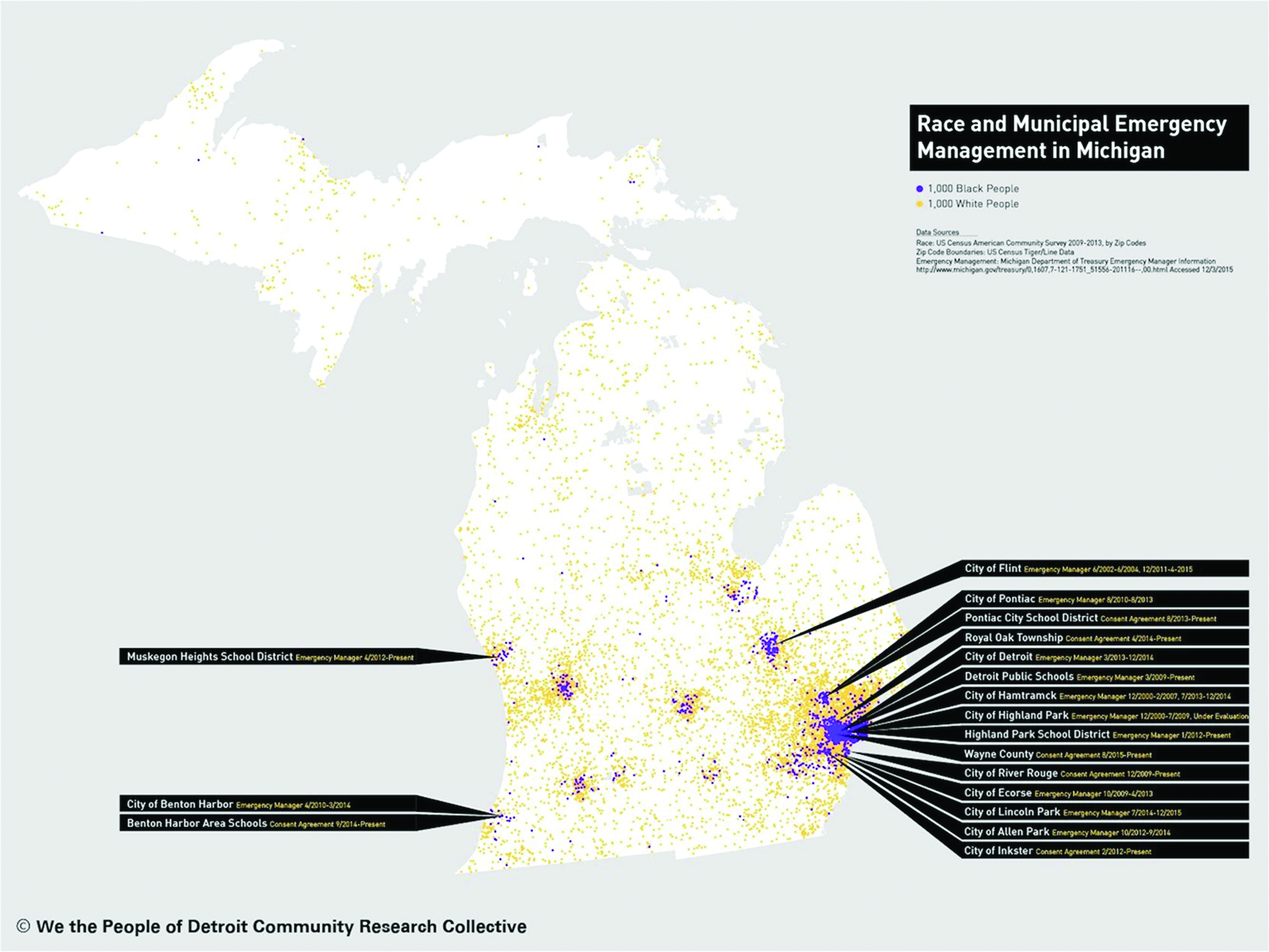
Race and municipal emergency management in Michigan. 49
Thus, in a paradoxical situation where market needs are met and financial deficits are deemed “emergencies” that further private accumulation in the name of emergency management, the lived realities, health concerns, and political demands of residents are not taken seriously. Emergency management, therefore, also constitutes a mechanism of suppression of public dissent in the times of crisis via the erosion of political accountability.
Since mid-2016, the hashtag #FlintFwd has been mobilized as “a movement inspired by the resilience of the people of Flint, MI. People that are passionate about disrupting the current narrative surrounding the city. It's proving that, together, the people of Flint can make it through seemingly insurmountable perils and come out the other side stronger, prouder, better than ever.” 42 The website claims “no political affiliation”; it is affiliated with key economic interests via the Flint & Genesee Chamber of Commerce's “Moving Flint Forward” Initiative funded by “several key community stakeholders.” 43
Above all, #FlintFwd website notes that “our mission is to […] revitalize Flint's downtown.” 44 Some media outlets promote #FlintFwd “showcasing city's strength, people, businesses.” 45 Some residents are critical of what they see as a “state” initiative, which obscures the problems that remain. A Kettering University academic and resident of Flint sees the initiative as “a state-driven effort to rebrand Flint in coordination with local political and economic elites.” A UM-Flint faculty member described how the academic institutions in the city are incentivized to minimize the crisis, noting, “the [UM-Flint] administration was worried about how [the crisis] would affect admissions.” Perhaps it did: A 3% enrollment drop was registered in early 2016, 46 and such a trend also occurred in other institutions such as Kettering. By asking people to “move on,” #FlintFwd represents another strategy of depoliticization in the name of economic progress and prosperity to suppress people's political demands. Residents are invited to escape the crisis by declaring its end. “Forward”-looking rhetoric is mobilized to bypass political accountability.
Conclusion
The Flint water crisis continues to polarize the community, the media coverage, and public perceptions. It is alive with conflicting stories at multiple levels about what went wrong, who is to blame, what constitutes the “crisis,” how bad the crisis even is, and how it should be addressed. This article engages the experiences and demands of residents and the mechanisms of suppression of resident voices in their struggles for justice and democracy itself. Clearly, public authorities, especially at the state level, are interested in ending the problem as an unfortunate cascade of technical failures. Flint's political and economic elites are concerned about Flint's reputation as a city in economic decline. Academic and scientific endeavors take place under structural constraints that encourage technical solutions and inhibit critical queries. The media continues to serve multiple interests, some tangled up in financial incentives, some keen to retain a neutrality that ignores the unequal power relations at play, thereby contributing to further manifestations of these differences.
Of course, the Flint community itself is not homogenous. Internal divisions are visible in the competing narratives over the state of the crisis, and how far reparations and official responses should go. Flint is “characterized by social disruption, a lack of consensus about environmental degradation, and general uncertainty.” 47 Some people remain fearfully focused on health implications, whereas others trust in reports that the water quality has returned to safe levels. Some are primarily concerned with seeking political accountability, arguing that the water crisis needs to be addressed as a crisis of democracy itself, whereas others focus more on technical solutions. Some would like to see connections of patronage and corruption exposed among Flint's and state political and economic elites; whereas others are working toward a strong public-private partnership that they see as a foundation for Flint's economic development toward greater prosperity. However, the personal stories such as those that we depict in this article provide important insights into how crises are negotiated between political demands and technical framings.
What we see unfolding in Flint is the production of, and struggle against, mechanisms of suppression of people's needs and demands. By unpacking these mechanisms and the institutions involved, we show how the crisis is not simply about water but also constitutes a crisis of government, democracy, journalism, and academia. As one active member of the Flint community pointed out, “Privatization and libertarianism don't work for us. […] Flint is a canary in the coalmine: if it can happen in Flint, it can happen in other places too.” Or as another put it, “Michigan is a ground zero for water wars.” In this sense, what happened (and continues) in Flint and elsewhere across the state is a result of an ongoing neoliberal political project of state capture by private interests, 48 or as a UM-Flint faculty member called, “the state of Michigan looting the public sector.”
To many residents, the crisis cannot be resolved if the issues are successfully disarmed from their political weight by official narratives that are, in part, co-produced by the state of Michigan, private interests, and parts of media and academia. The dependency on funding, reputation, and economic development brings these diverse actors together into uneasy alliances that jointly constitute mechanisms of suppression of people's search for justice. In carving out a meaningful path forward, residents are devising new means to make their voices heard and bring about change, taking the lead in organizing scientific testing and creating their own media presence. As a resident demanded, “The community needs to be the driver and the center at every step of the way. They know what's going on. They're building their own tools. Everyone can be a leader.”
Footnotes
Acknowledgments
The authors would like to express their deep gratitude to everyone who took the time to tell them their story and for their work in keeping the political struggle for justice alive in Flint. They are also indebted to Benjamin Pauli, Jason Kosnoski, and Jens Friis Lund for their critical insights along the way.
Author Disclosure Statement
No competing financial interests exist.