




Abstract
Abstract
New Bedford Harbor (NBH) in Massachusetts was listed as a Superfund site in 1983 due to extensive contamination with polychlorinated biphenyls (PCBs) from industrial pollution. Since 1999, the U.S. Environmental Protection Agency (EPA) has posted signage and fencing in areas around NBH to discourage fishing activity, along with distributing consumption advisories locally. This exploratory study combined qualitative and geographic information system methods to assess fishing activity, signage, and awareness of the PCB contamination and consumption advisories among people fishing at NBH. We conducted interviews with fishermen along a portion of NBH (n = 12), and we recorded and geocoded observations and locations of fishing activity (n = 54) and fishing related signage (n = 53). Despite our limited sample size, our findings are similar to those of larger quantitative studies: advisories are not reaching vulnerable fishing populations. While all participants stated that their reasons for fishing were recreational, two-thirds reported that their catch was eaten. People who ate or shared their catch for consumption were less aware of signage, the advisory, and the contamination than nonconsumers. Most signage lacked visuals, the consumption messaging was not consistent, and was limited to English, Spanish, and Portuguese, which may not be sufficient to reach newer immigrants. This pilot study identified successes and shortcomings of the current efforts by EPA to reduce consumption of PCB contaminated seafood in this environmental justice community. Finally, we offer lessons learned and suggestions for future research on a larger scale.
Introduction
T
New Bedford Harbor (NBH), located in southeastern Massachusetts, extends over 18,000 acres and has been one of the nation's largest sites contaminated with polychlorinated biphenyls (PCBs) since the mid twentieth century. PCBs, considered carcinogens, persist in the sediment and accumulate over time in shellfish and bottom-feeding fish in the harbor. 3 , 4 To protect public health in 1979, the Massachusetts Department of Public Health (MA DPH) promulgated state regulations prohibiting taking and/or consuming of certain finfish or shellfish from three distinct Closure Areas of NBH. 5 Due to the extensive contamination, NBH was designated a Superfund site in 1983. 6 Although PCB concentrations vary by species and closure area, seafood samples generally indicate that PCB concentrations decrease in the harbor from north to south. 7
Immediately adjacent to NBH is the City of New Bedford. Based on the 2010 Census, 70% of the population in New Bedford lives in census blocks meeting at least one of the MA environmental justice criteria: households earning 65% or less of the statewide median income and/or 25% or more residents with low English language proficiency, minority status, or who are foreign born. 8 In the city of 95,000 people, community organizations estimate that there are about 10,000 undocumented immigrants (including most recently immigrants from Guatemala over the last decade) and 10,700 immigrants who are naturalized citizens (as part of older, established immigrant groups from Portugal and Cape Verde). 9 According to 2010 Census and 2011–2015 American Community Survey data, 21% of New Bedford is made up of foreign-born immigrants and 17% of its population is Hispanic or Latino.
According to the EPA, the greatest concern regarding PCB exposure from NBH “is the possibility of people eating contaminated locally caught seafood”. 10 Since the early 2000s, EPA Region 1, MA DPH, and Massachusetts Department of Environmental Protection (MassDEP) have implemented various education campaigns, consumption advisory updates (Fig. 1), and engineering controls. 11 , 12 , 13 Despite state and federal efforts, the need for outreach on the consumption of locally caught PCB-contaminated seafood from the harbor has continued to be highlighted by agencies and in the media in 2013 and 2014. 14 , 15 , 16 , 17 This pilot study aimed to identify the motivations, behaviors, knowledge, and perceptions among a small and diverse sample of people who fish in Closure Area 2 of NBH and to determine whether signs and advisories are appropriately placed and meaningful to people who fish.
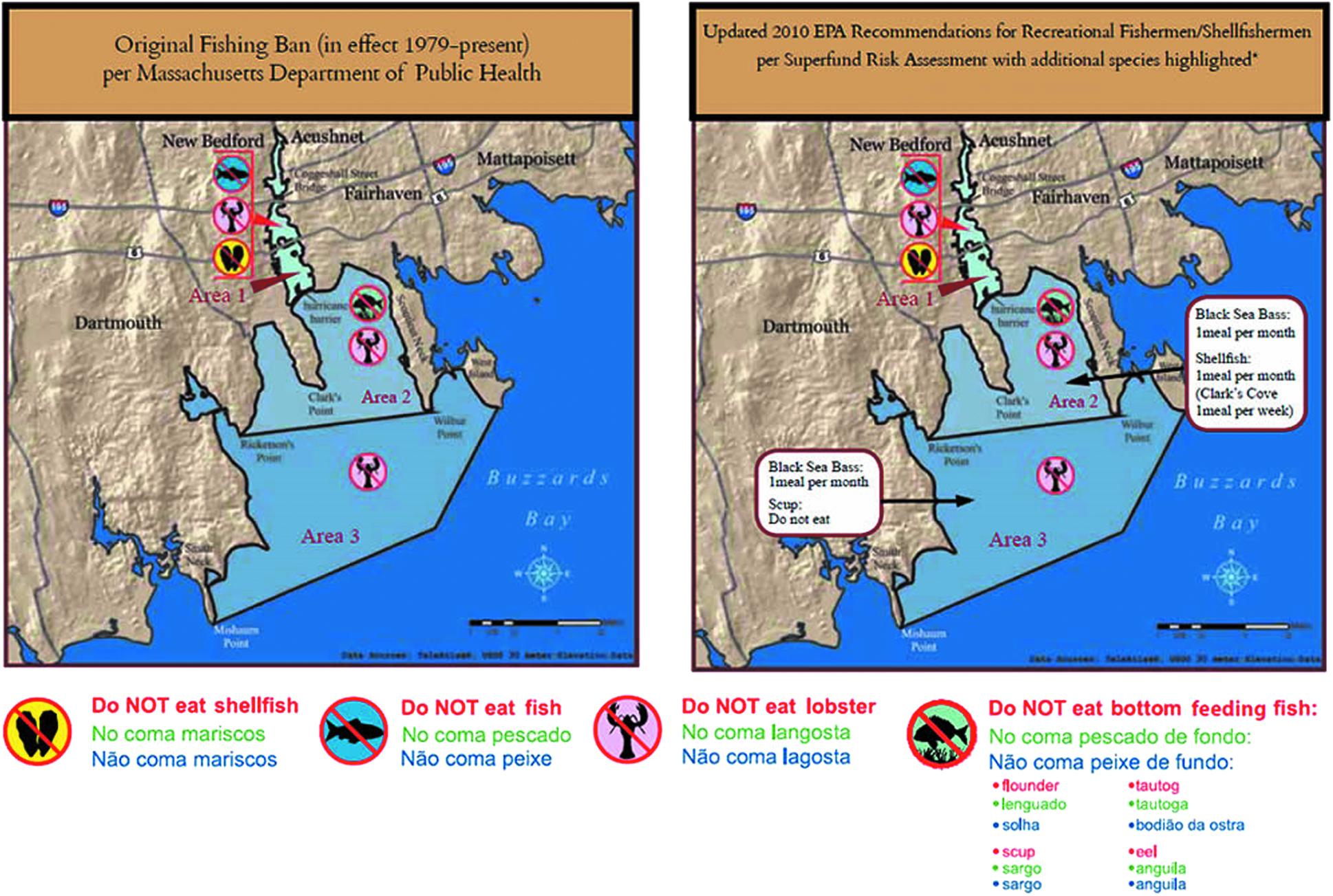
EPA Map describing the three Closure Areas of NBH and the respective fish consumption advisories that existed at the time this study was conducted.12
Materials and Methods
Data collection
The Boston University Medical Campus Institutional Review Board deemed this study exempt from human subject review and granted approval of our protocol in June 2015. Of the three closure areas (Fig. 1), Closure Area 2 was selected for study because the entirety of its waterfront is for public access.
Fishing related signage was photographed along the shoreline of Closure Area 2 in New Bedford in May 2015. Signage and fishing activity geographical coordinates were recorded using GPS software (Map Coordinates v 3.0.10), and qualitative observations of fishing activity were conducted over 6 weekend days in the spring and summer of 2015. Interviews about fishing activity and advisory awareness were requested of men who were observed fishing along Closure Area 2 of NBH on 5 of the 6 weekend days, between half past noon and 6:30 PM. All interviews were conducted in English.
Recruitment was based on convenience sampling. Twenty-seven fishermen were approached to be interviewed. The interview guide consisted of 30 open-ended questions about fishing habits, type and fate of catch, knowledge of NBH contamination, and fishing advisory awareness. Thirteen fishermen agreed to be interviewed and a total of twelve interviews were analyzed (one interview was excluded from analysis due to a language barrier discovered midway through the interview.)
Data analysis
The strength of qualitative inquiry is its analysis of a sample of information-rich cases where the goal is not generalizability, but rather in-depth understanding. 18 Analysis included inductive qualitative coding of the interviews, signage, photographs, and maps. Codes are labels assigned to words, phrases, or images in the raw data to aid in categorizing and highlighting themes within the context of the data. 19 Codes were developed, reviewed, and refined as more of the raw data were analyzed, as well as by comparing and contrasting codes between subgroups of participants, signage, or spatially.
Interviews were coded to identify patterns among participant behaviors, knowledge, and demographics. To understand the motivation for fishing, assess advisory awareness, knowledge, and risk perception, as well as characterize participant values and beliefs, as they pertain to fishing, qualitative interview responses were coded to examine concepts and themes relevant to fishing activity among subgroups, such as race/ethnicity, age, town or city of residence, those who consume their catch, and those who practice catch and release.
Signage, photographs, and maps were coded to identify patterns among signage locations, languages, messaging, and responsible authorities. Photographs of the signage were coded to understand messaging, use of text versus images, and language to assess whether the current outreach efforts are meaningful to the target population. Maps characterizing people fishing, interview participants, and signage were created using ArcMap 10.2 mapping software (ESRI, Redlands, CA).
Results
Participants
Fishing activity and habits
Fifty-four observations of men, women, and children fishing in groups or individually were noted around Closure Area 2 of NBH (Fig. 2a). Five of the twelve participants who completed the interview were immigrants and seven were minorities (Table 1).

Participants are catching finfish, not lobster or shellfish
The fish most commonly caught by participants were scup, tautog, flounder, and black sea bass (Fig. 3). All participants reported that they did at least one of three actions with their catch: ate it, shared it (presumably for consumption), and/or released it (Table 2). In Figure 3, the red symbols indicate the types of fish caught by people who reported eating their catch (consumers.) A limitation of this study was we did not specifically ask: Of the fish you catch, which ones do you eat? Nonetheless, three consumers reported only catching species listed in the advisory. The remaining four consumers caught a mix of fish species, some of which are listed in the advisory and some are not. Risk of PCB exposure through consumption may exist for fish not under advisory because the EPA does not have sufficient data to make recommendations for these fish.
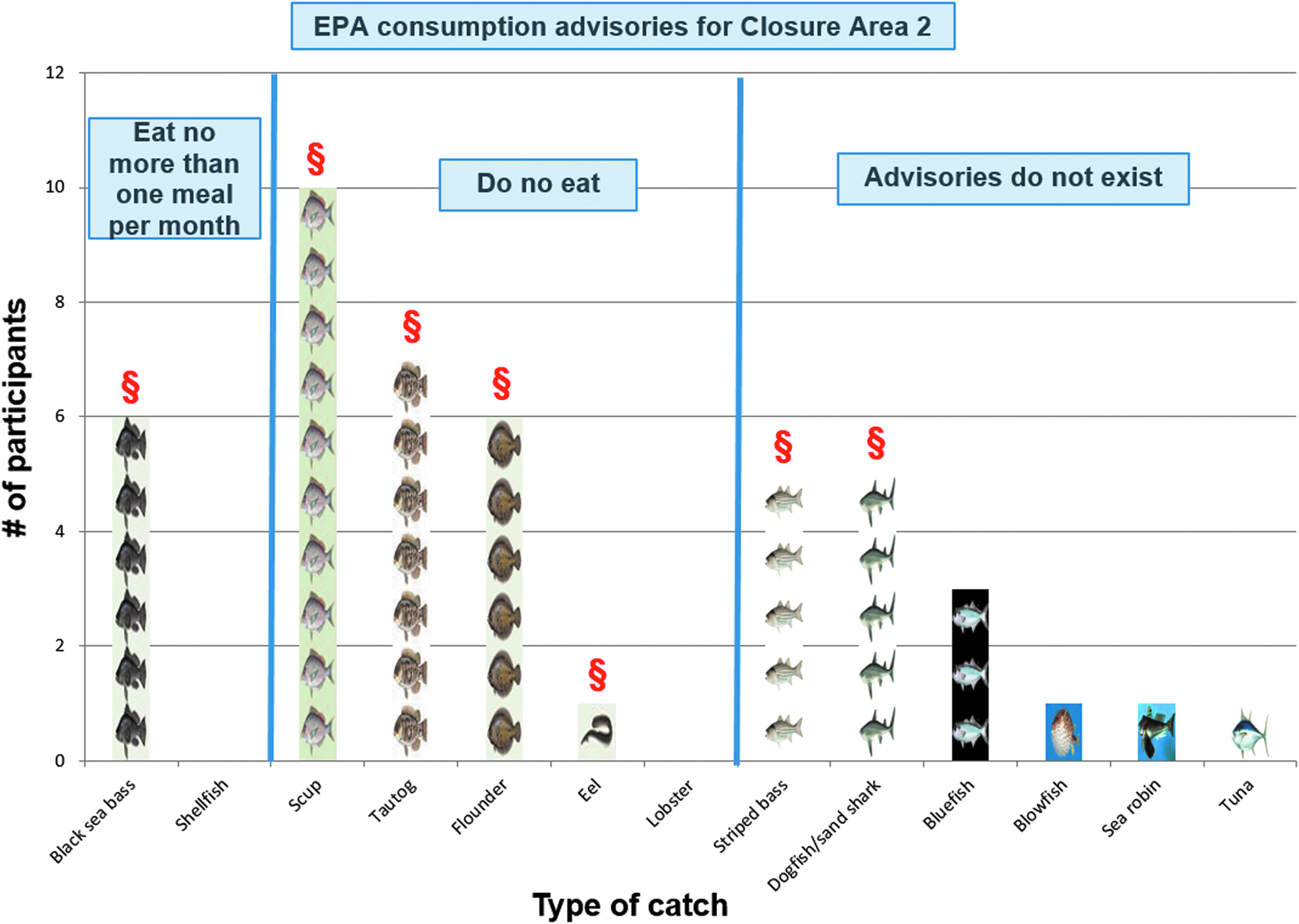
Types of fish/shellfish reportedly caught in NBH Closure Area 2 by interviewed participants, classified by EPA consumption advisory categories EPA consumption advisory for Closure Area 2 only. Other advisories were in place for Closure Areas 1 and 3. Red symbol indicates the types of fish caught by people who reported consuming their catch.
“within catch size limit” refers to the fact that the length of the fish is sufficient under fishing permit restriction.
Consumption is a by-product of fishing
Despite the fact that all participants state that their reasons for fishing are recreational, two-thirds reported that their catch is eaten.
Reasons participants fished included: to spend time with family or significant others, escape from family obligations and the daily grind, hobby/enjoyment, and cultural identity. When asked why he fished, one participant responded, “Portuguese. I love fishing.” Only one participant stated that his motivation to fish was to provide food. He reported that he “never throws back” his catch and that he and his extended family, including three children under age 12, always ate it. An additional four participants did say that they ate their catch only when it was within the catch size limit (Table 2). Another two participants reported eating, sharing with neighbors or friends, or releasing their catch. These seven participants were demographically diverse except in regard to their immigrant status. Four of the five foreign born participants ate their catch compared with three of seven U.S. born participants. Higher educated participants were not less likely to eat their catch; both participants who earned a bachelor's degree or higher ate their catch.
Sharing of catch is occurring among family, friends, neighbors, and strangers
Seven participants reported that they share their catch with a variety of people and potentially multiple groups of people, including adult family members (n = 5), children family members under age 12 (n = 1), friends (n = 2), neighbors (n = 2), and with people in the vicinity of where they are fishing (n = 1). While some participants are not actively sharing their catch, they are often asked to share.
Fishermen reported knowledge of alternative locations to fish
While eight participants reported fishing at eight other more pristine locations in Massachusetts, the four participants who reported they fished only at NBH said they ate or shared their catch and had not seen the fishing related signage.
Signage, advisory, and contamination awareness
Consumers were less aware of signage, the advisory, and the contamination than nonconsumers
Consumers were less likely than nonconsumers to have seen fishing related signage along the shoreline (4 out of 7), possess knowledge about seafood safety at NBH (2 out of 7), perceive NBH to be contaminated with bacteria/biologics describing it as “not that clean, not that purified” and “can see the water is dirty, moldy” (2 out of 7), or possess knowledge about PCB contamination (1 out of 7), whereas nonconsumers were more likely than consumers to have seen fishing related signage (4 out of 5), possess knowledge about seafood safety at NBH (3 out of 5), know NBH to be contaminated with bacteria or sewage (4 out of 5), or possess knowledge about PCB contamination (2 out of 5).
Participants think it is acceptable to eat fish from Closure Area 2 but not Closure Area 1
Closure Area 1 is more contaminated than Closure Area 2 and is separated by the hurricane barrier. All of the three participants who indicated that they fished in Closure Area 1 always released their catch. None of the additional four participants, three of whom consume their catch and said they fished on the hurricane barrier, fished on the side facing Closure Area 1. All seven participants had seen the fishing related signage along the shoreline except one. This participant said referring to fish caught in Closure Area 1, “I don't mind. If it's a big fish, I'd eat it.”
Institutional and engineering controls: signage, advisories, and fencing
Signage with consumption related messaging is severely lacking and has inconsistent messaging
The signs in Closure Area 2 reflect the priorities of at least five different authorities (Table 3). Signs have been erected by these authorities to communicate the fishing ban, the consumption advisories, chemical contamination from PCBs, bacterial contamination from combined sewer overflows, and beach use (Fig. 2b). Although there are many signs along the hurricane barrier and Closure Area 2, only 25% of the 53 signs have consumption related messaging and all were posted by the EPA (Table 4). All the signs with consumption related messaging are limited to the hurricane barrier. The EPA catch and release signs in Closure Area 2 have no language about consumption and are visually identical to the no fishing signs (Fig. 4).

Three types of signs (
EPA, Environmental Protection Agency.
The EPA consumption advisory is not reaching its intended audience
When participants were asked if they knew the consumption advisory for Closure Area 2, not one fisherman replied yes.
Fencing, maintained by the EPA and installed along the side of the hurricane barrier facing Closure Area 1, is effective
During a field visit in May 2015, two men were observed fishing together along the side of the hurricane barrier facing Closure Area 1. Upon a second field visit in July 2015, a fence had been erected at that spot, and from the second field visit onward no people were observed fishing.
Discussion
Fishing is occurring at NBH by people of different genders, ages, and races/ethnicities. Similar to previous larger quantitative studies in urban settings in the United States, consumption of the fish can be characterized as culturally and socially driven rather than for subsistence. 20 , 21 , 22 Previous studies have also shown that advisory awareness is low among anglers at contaminated sites, anglers are unable to correctly state the advisory, and consumption among anglers still occurs even when advisory awareness is high. 23 , 24 , 25 At NBH, we found that consumers are less aware of the signage, advisory, and contamination and no participant could state the advisory for Closure Area 2.
Finally, our finding regarding consumption at NBH is supported by a larger survey carried out at NBH during the same time period. During the summer of 2015, the outreach coordinator program at the EPA approached people fishing along NBH to learn about the behaviors of people who are fishing in the harbor and to disseminate the seafood advisory. EPA outreach coordinators (three local and bilingual residents) asked 73 people who were fishing at NBH if they consumed their catch; 62 people (85%) responded yes. 26 We found a similarly high consumption rate—67% of participants ate or shared their catch.
With regards to signage with consumption messaging at NBH, the lack of effectiveness may be due to culturally/linguistically insufficient and visually identical yet mixed messaging signage. Most signage lack visuals and are limited to English, Spanish, and Portuguese, which may not be sufficient to reach new waves of immigrants from other countries such as Guatemala, where K'iche is the dominant language among many immigrants. 27 The most concerning finding of this research is that despite the existence of the applicable MA DPH regulation and EPA seafood advisory specific to Closure Area 2, appropriate signage conveying the regulation and advisory is severely lacking. Given that the elevated levels of PCBs still exist in seafood in Closure Area 2, it is not publicly evident why consumption messaging is restricted to Closure Area 1 and inconsistent in Area 2. According to the EPA Region 1 office, this discrepancy in messaging outside Closure Area 1 is due to the fact that EPA's seafood consumption advisory is based on a more health protective risk assessment than what the MA DPH based their recommendation upon; DPH's consumption recommendation, which is in agreement with guidance from the U.S. Food and Drug Administration and MA Department of Marine Fisheries, is based on a person consuming seafood from a variety of different sources, whereas the EPA's recommendations assume that a person is only consuming fish from NBH. 28 A valid critique of institutional controls, which is playing out at NBH, is that local governments often lack the experience and resources to enforce them, and they are ineffectively implemented due to lack of funds and authority combined with unclear jurisdiction. 29 Nonetheless, the authorities have made strides to protect public health at NBH despite the fact that over 20% of the EPA signage has been vandalized (Table 3) suggesting the community's lack of regard for the authority's message. Successes include: none of the participants report catching lobster or shellfish, no participant consumers are consuming catch from Closure Area 1, and fencing installed by EPA in summer 2015 along the side of the hurricane barrier facing Closure Area 1 appears to be effective. Recent qualitative studies in the United States have concluded that culturally tailored interventions to reduce fish consumption at contaminated sites are critical. 30 , 31 In addition, the National Environmental Justice Advisory Council (NEJAC) found that environmental justice communities may depend on eating fish they catch to meet nutritional and economic needs, as well as for cultural, traditional, or religious reasons. Particularly for low-income and communities of color, alternative places to fish, the option to catch and release, and access to protein substitutes may not exist. In addition, not fishing and eating their catch may be inconceivable culturally for some populations compared to the general population. 32 The work conducted by the EPA outreach coordinator program with the community brought light to the fact that K'iche is not a written language so the EPA is no longer considering translating signage into K'iche, but is considering other creative approaches to signage that are being informed by the community. 33
A concern that can often exist in environmental justice communities where fishing in contaminated waters occurs is that access to uncontaminated waterways is not an option. 34 We found that two-thirds of the participants had alternative fishing locations and nearly all participants have access to a car. This finding presents the opportunity to further explore the possibility of encouraging fishing elsewhere or the very least consumption of fish from other water bodies. A future study could examine what alternatives anglers would be open and able to engage in. Although access to alternatives was not a concern for most participants, from an environmental justice and public health perspective, the four participants who reported that they fished only at NBH all reported that they ate or shared their catch and had not seen the fishing related signage.
Limitations of this research include a small sample size and convenience sampling. Non-English speakers were not interviewed, and interviews were only conducted on the weekends during the day time and in the summer. Nine out of twenty fishermen approached to participate declined due to the language barrier, and this study may have missed the most vulnerable population from an environmental justice perspective or populations who fish more frequently and/or make a living off their catch.
Moving forward, discrepancies in spatial variation of signage consumption messaging and the EPA advisory for Closure Area 2 should be addressed. Further research and evaluation should expand upon this pilot study to glean why no consumption from Area 1 and no shellfish consumption are occurring. These successes may provide lessons learned that may be applicable to other sites around the country to effectively deter fish consumption from contaminated waters. In addition, as recent research has shown, cultural tailoring is of the utmost importance. The majority of participants who were fishing and consuming their catch at NBH would be characterized as MA EJ populations based on their immigrant and minority status, and consumption as a by-product of fishing suggests that the role of culture needs to be more fully studied and explored in environmental justice communities.
Footnotes
Acknowledgments
Thank you to the study participants fishing along New Bedford Harbor for their time and participation, to Dr. Wendy Heiger-Bernays for reviewing the proposal and interview guide, to Kelsey O'Neil of the EPA for reviewing the article and providing feedback, and to Michael Peer for accompanying me in the field. This research was supported by the National Institute of Environmental Health Sciences' (NIEHS) Superfund Research Program grant 5 P42 ES007381 and the NIEHS training grant T32 ES014562. The contents are solely the responsibility of the grantee and do not necessarily represent the official views of NIEHS.
Author Disclosure Statement
No competing financial interests exist.